

15 Essential Interview Questions to Ask a Fractional CMO in 2026
Over 40% of small and mid-market businesses are expected to use fractional leadership by the end of 2026. While the model is surging in popularity, many Michigan business owners still worry they'll end up paying for a high-level strategy that never actually gets implemented. It's a valid concern. There is a massive difference between a consultant who hands over a slide deck and a fractional executive who takes ownership of your growth. Knowing the specific interview questions to ask a fractional cmo is the only way to tell if a candidate has the technical proficiency and leadership grit to manage your team effectively.
You want a leader who integrates into your company culture and delivers a measurable return on investment. We've developed a structured interview framework designed to help you vet for strategic depth and execution. This guide provides 15 essential questions to ensure your next hire can handle the unique demands of the Michigan business landscape, from Detroit's mobility sector to Ann Arbor's tech hubs. You'll gain a clear roadmap for measuring success and the confidence to secure a leader who drives real revenue growth.
Key Takeaways
- Learn how to distinguish between a passive consultant and an embedded executive who takes full ownership of your marketing results.
- Master the exact interview questions to ask a fractional cmo to vet their strategic depth and ability to drive a measurable return on investment.
- Discover a framework for evaluating how a part-time leader manages full-time teams and balances multiple client priorities.
- Identify why regional Michigan expertise is essential for navigating the local B2B and B2C landscapes from Detroit to Grand Rapids.
- Implement a weighted scorecard and a paid audit strategy to minimize hiring risks and ensure a perfect cultural fit.
Understanding the Fractional CMO Role vs. Traditional Consultants
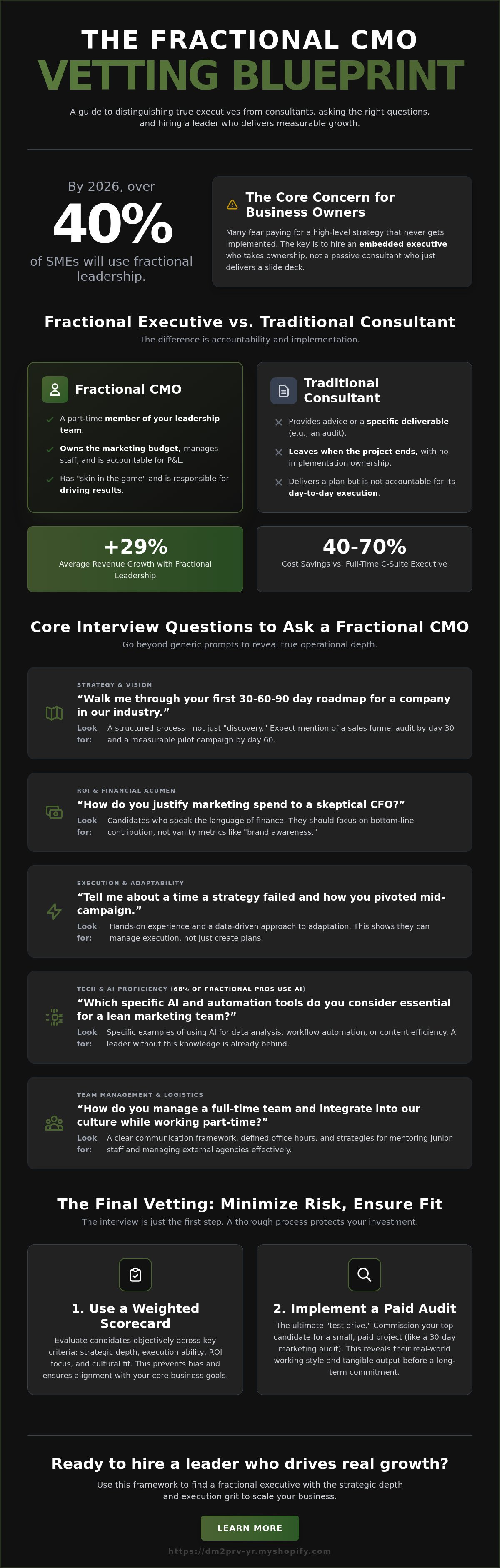
Many business owners confuse a Fractional executive with a traditional marketing consultant. The difference is significant. A consultant usually provides advice or a specific deliverable, like a brand audit or a strategy document. Once the project ends, they leave. A Fractional CMO is different. They are a part-time member of your leadership team who owns the marketing budget, manages your staff, and carries accountability for the profit and loss of the marketing department. They don't just suggest ideas; they lead the people who execute them.
In 2026, this distinction is critical because businesses can't afford to pay for plans that sit on a shelf. A Fractional CMO has "skin in the game." If the strategy fails, they are the ones answering to the CEO. This level of accountability is why companies using fractional marketing leadership report an average revenue growth of 29%, compared to just 19% for those without it. When preparing your interview questions to ask a fractional cmo, you must look for this sense of executive ownership rather than a list of past consulting projects.
There is also a clear divide between a specialized agency and a fractional leader. An agency is a vendor that provides services like SEO or graphic design. A Fractional CMO is your internal advocate who manages those agencies. They ensure every vendor is aligned with your business goals. For many Michigan firms, especially those in the $5 million to $50 million revenue range, this model offers 40% to 70% cost savings compared to hiring a full-time executive with the same level of experience.
When is your business ready for a Fractional CMO?
Mid-market firms in the Detroit-Grand Rapids-Flint corridor often hit a "growth plateau" when they reach a certain size. Your existing team is likely talented but lacks senior-level mentorship to scale further. You don't necessarily need a full-time CMO costing $300,000 or more annually. You do need someone to bridge the gap between tactical execution and high-level business goals. If your marketing feels reactive rather than proactive, it is time to consider a part-time C-suite investment.
The 2026 Marketing Landscape: Why generalists are failing
The marketing world has changed rapidly. "Post-and-pray" social media strategies are dead. In 2026, 68% of fractional professionals are leveraging AI to automate workflows and enhance data analysis. You need a leader who understands how to integrate these tools while navigating a privacy-centric digital world. Your interview questions to ask a fractional cmo should vet their ability to turn raw data into a competitive advantage for your specific industry. Advice is cheap. Results are expensive. Make sure you are hiring for the latter.
Core Interview Questions: Strategy, Execution, and ROI
Hiring an executive leader is a high-stakes decision that requires more than a casual conversation. If you're currently exploring the fractional CMO model, you need a vetting process that moves beyond surface-level prompts. Generic questions lead to generic hires. To ensure your investment yields the 61% improvement in marketing ROI that many companies see within six months, you must use targeted interview questions to ask a fractional cmo that expose their true operational depth.
Start by testing their immediate vision: "Walk me through your first 30-60-90 day roadmap for a company in our industry." A veteran leader won't just talk about "discovery." They will describe a structured process that includes auditing your existing sales funnel by day 30 and launching a measurable pilot campaign by day 60. They should also be able to answer how they justify marketing spend to a skeptical CFO. Look for candidates who speak the language of finance, focusing on how every dollar spent contributes to the bottom line rather than just "brand awareness."
Execution is where many part-time leaders fail. Ask: "Tell me about a strategy you pivoted mid-campaign based on Michigan-specific market data." This tests their ability to stay hands-on. In 2026, 68% of fractional professionals are using AI and automation tools to stay competitive. Ask which specific tools they consider essential for a lean marketing team. If they aren't leveraging AI for data analysis or content efficiency, they are likely wasting your budget. If you want to ensure your candidate has the right technical edge, browse our fractional leadership resources to see what modern standards look like.
Vetting Strategic Depth
A great Fractional CMO connects marketing activities directly to revenue. During the interview, ask about their experience balancing customer acquisition cost (CAC) against lifetime value (LTV). They should be able to simplify complex data into actionable executive summaries that a Board of Directors can understand. If they hide behind jargon, they probably don't have the strategic depth you need.
Assessing Tactical Knowledge
You need a leader who understands current 2026 algorithms and platform shifts. Use the "Single Opportunity" test: ask them what they see as your biggest untapped growth lever after a brief review of your site. Their answer should be specific. Finally, ask how they handle failed campaigns. You are looking for a framework of accountability and learning, not excuses about "market conditions."
Vetting the "Fractional" Logistics: Team Integration and Availability
A brilliant strategy is worthless if the leader isn't around to guide the execution. Because Fractional CMOs manage multiple clients, you must understand how they allocate their time. One of the most vital interview questions to ask a fractional cmo is: "How many other clients do you currently serve, and how do you prioritize urgent needs?" While 91% of organizations report that their fractional CMO exceeds expectations, that success depends on clear boundaries. You don't need a full-time employee, but you do need a partner who won't disappear when a crisis hits your Grand Rapids or Detroit office.
Integration is another hurdle. A fractional leader shouldn't operate in a silo. Ask them how they plan to integrate with your existing sales and product teams. In Michigan's manufacturing and tech sectors, marketing must move in lockstep with inventory and development. If they can't explain how they'll bridge the gap between being an "outsider" and a "team leader," they aren't the right fit. Their communication plan should be specific. Will they use Slack for daily check-ins? Do they schedule weekly syncs? Are they willing to conduct on-site visits to your Michigan headquarters?
Managing junior staff is often a core requirement for this role. Ask: "What is your process for managing and upskilling our junior marketing staff?" You want a leader who builds your internal capabilities so that your team becomes more self-sufficient over time. This mentorship is a key part of the executive accountability mentioned earlier. They aren't just there to give orders; they are there to elevate your people and ensure the work gets done correctly even when they aren't online.
The "Ghosting" Risk: Ensuring Consistent Presence
The biggest fear with part-time executives is the "ghosting" risk. Avoid this by setting firm expectations for response times and "office hours" during the interview. A professional should provide a clear hand-off process for tactical execution so your team never feels stuck while waiting for an answer. They should act as an integrated part of the leadership team, not a distant vendor who only shows up for monthly reviews.
Leadership and Mentorship Style
Leading a team you didn't hire requires high emotional intelligence. Vet for a leadership style that aligns with Michigan business values like transparency and hard work. Ask how they handle underperforming team members or agency partners. You need someone who can make tough calls while maintaining a positive culture. A "culture fit" check is essential. If their style doesn't mesh with your local team's grit and directness, the engagement will likely struggle regardless of their technical expertise.
The Michigan Factor: Why Regional Context Matters for Your CMO
Marketing in Michigan doesn't follow the same rules as marketing in California or New York. The Detroit-Grand Rapids-Flint corridor has a unique economic pulse that requires a nuanced touch. B2B manufacturing in Brighton requires a different strategy than a B2C tech startup in Ann Arbor. When considering interview questions to ask a fractional cmo, you must test their regional awareness. A leader who tries to apply a high-burn Silicon Valley playbook to a lean manufacturing firm in Fenton will likely struggle. You need someone who understands the Midwest sales cycle, where long-term trust and pragmatic ROI often outweigh flash and "disruption."
Your candidate should be able to discuss their local network. Ask: "Do you have local media or vendor connections in Michigan?" A fractional leader who knows the regional landscape can often negotiate better rates with local agencies or secure placements in publications like Crain's Detroit Business. They should also understand the seasonal economic shifts that affect the state. From automotive production cycles to the logistical challenges of Michigan winters, these factors impact how and when you should spend your marketing budget. If they don't see how the local environment affects your bottom line, they aren't truly integrated into your business.
Local Industry Expertise
Vetting for experience in Michigan’s core sectors is non-negotiable. Whether your firm is in Automotive, Manufacturing, Logistics, or Tech, the candidate must understand the specific regulatory and competitive hurdles of the region. Does the candidate understand the local talent market? If you need to hire a marketing manager in Grand Rapids, your CMO should know where to find them. They should also be familiar with regional events like the Detroit Auto Show or Grand Rapids tech summits. These aren't just networking opportunities; they are critical touchpoints for brand positioning in a state that values innovation and grit.
The Value of On-Site vs. Remote
While the fractional model is inherently flexible, physical presence still carries weight in Michigan business culture. Ask if they are willing to travel for quarterly strategy sessions in Brighton or Flint. These face-to-face meetings are where real cultural alignment happens and where the CMO can truly grasp the "brand pride" that Michiganders feel. Your marketing should reflect the state's evolution from its automotive roots to its new status as a hub for mobility and experiential design. If you're ready to find a leader who understands these local dynamics, hire a Michigan-based fractional CMO today to secure your competitive edge.
The Final Vetting: Evaluation Scorecard and Next Steps
After you've asked the right interview questions to ask a fractional cmo, you need a structured way to grade the answers. Subjective impressions often lead to hiring mistakes. To find the right executive for your Michigan business, use a weighted scorecard to objectively measure their potential impact. This ensures you prioritize strategic depth and leadership over polished presentation skills. A balanced evaluation should look like this:
- Strategy (40%): Do they focus on revenue growth and P&L accountability?
- Leadership (30%): Can they mentor your junior staff and manage vendor relationships?
- Technical (20%): Are they proficient in 2026 AI and automation tools?
- Cultural Fit (10%): Do they align with the values of your Detroit or Grand Rapids team?
Don't jump into a long-term contract immediately. Many successful partnerships start with a "Trial Project" or a paid audit. This initial engagement allows you to see their work ethic and technical proficiency firsthand. During this period, review their case studies for specific data points. Look for a track record of driving revenue growth, which averages 29% for companies using this model. When checking references, ask previous clients about their communication style and how they handled campaign pivots. Since 91% of organizations report that their fractional CMO exceeds expectations, a poor reference is a major warning sign.
Red Flags to Watch For
Be wary of candidates who rely heavily on buzzwords like "synergy" or "holistic" without providing tactical explanations. A major red flag is a refusal to commit to specific KPIs or revenue-linked goals. If they present a "one-size-fits-all" strategy that ignores the specific nuances of the Michigan manufacturing or tech sectors, they likely won't deliver the ROI you expect. Transparency is key. A quality fractional leader will be open about their availability and how they manage their other client commitments.
Onboarding Your Fractional CMO
The first 14 days are critical for success. Ensure your new leader has full access to your data, introductions to key stakeholders, and a deep-dive into your current sales funnel. Define exactly what success looks like for the first 90 days. This clarity prevents the "strategy-only" trap and keeps the focus on execution. Ready to scale? Contact our Michigan marketing experts today to find a leader who can transform your growth trajectory.
Securing Your Fractional Leadership for 2026
Finding the right marketing executive shouldn't feel like a gamble. By focusing on accountability, tactical depth, and regional expertise, you can secure a leader who truly integrates into your company culture. You now have a comprehensive framework to distinguish between a passive consultant and a fractional executive who takes full ownership of your growth. Using the right interview questions to ask a fractional cmo ensures you hire a partner who understands the unique economic drivers of the Detroit and Grand Rapids markets.
Success in 2026 requires more than just high-level ideas. It demands a structured approach to execution that bridges the gap between strategy and sales. Our local Michigan support team is ready to help you implement proven 90-day growth frameworks tailored specifically to your industry. If you're ready to stop guessing and start scaling with a leader who has skin in the game, Book a Strategy Consultation for Your Michigan Business today. Your company deserves an executive who is as committed to your long-term success as you are.
Frequently Asked Questions
What is the typical monthly retainer for a Fractional CMO in Michigan?
Retainers for experienced Fractional CMOs in 2026 typically range from $8,000 to $20,000 per month. For early-stage companies, engagements may start as low as $2,000 to $5,000, while firms with over $50 million in revenue can expect rates between $20,000 and $50,000. These fees depend on the complexity of your marketing needs and the level of executive involvement required.
How many hours a week does a Fractional CMO usually work?
A Fractional CMO generally dedicated 5 to 15 hours per week to a single client, depending on the scope of the agreement. They focus on high-level strategic oversight and team leadership rather than daily tactical tasks. Establishing clear expectations about their availability and response times is one of the essential interview questions to ask a fractional cmo during the vetting process.
Can a Fractional CMO help with hiring a full-time marketing team?
Yes, a Fractional CMO often takes the lead in recruiting, interviewing, and onboarding full-time marketing staff. They use their executive experience to identify the specific skills your company needs to reach its next growth milestone. This ensures that every new hire aligns with the long-term strategy and technical requirements of your marketing department.
What is the difference between a Fractional CMO and a Marketing Consultant?
The primary difference lies in accountability and integration. A Fractional CMO is a part-time executive who manages your team, owns the marketing budget, and is responsible for revenue outcomes. In contrast, a consultant typically provides high-level advice or specific project deliverables but does not take an active leadership role within your company's daily operations.
How do I measure the ROI of a Fractional CMO hire?
ROI is measured through metrics like Customer Acquisition Cost (CAC), Lifetime Value (LTV), and overall revenue growth. Data shows that 61% of companies engaging a fractional leader see an improved marketing ROI within six months. Additionally, these firms report an average revenue growth of 29%, significantly higher than the 19% growth seen in companies without dedicated marketing leadership.
Do Fractional CMOs typically bring their own tech stack or use ours?
Most Fractional CMOs will audit and optimize your existing tech stack while recommending specific tools to improve efficiency. Since 68% of fractional professionals use AI in their work, they often introduce advanced automation and data analysis tools to your team. Their goal is to ensure your technology supports your strategy without unnecessary software bloat.
Is a Fractional CMO better than a full-service marketing agency?
A Fractional CMO and a marketing agency are complementary rather than competitive. The CMO acts as your internal strategic head who manages agency partners to ensure their tactics align with your business goals. While an agency executes specific tasks like SEO or content creation, the CMO provides the leadership and accountability necessary to make those tactics successful.
How long do Fractional CMO engagements usually last?
Engagements typically last between 6 and 24 months. Some businesses use a fractional leader as a bridge until they are ready to hire a full-time executive, while others prefer the long-term cost savings of the fractional model. The duration is usually determined by how quickly the company reaches its specific growth targets and strategic milestones.
Disclaimer
Some content published on this website may be developed with the assistance of AI-powered research and writing tools to help streamline research, organization, and content creation. All articles are reviewed, edited, and approved by Marvin Growth Partners to ensure they align with our perspectives, experience, and intended messaging.
While we strive to provide accurate and up-to-date information, blog content is intended for informational and educational purposes only and should not be considered legal, financial, or professional advice. Readers should independently verify information and consult qualified professionals when appropriate.