

2026 Ecommerce Marketing Strategy for Action Sports Brands: The Michigan Growth Framework
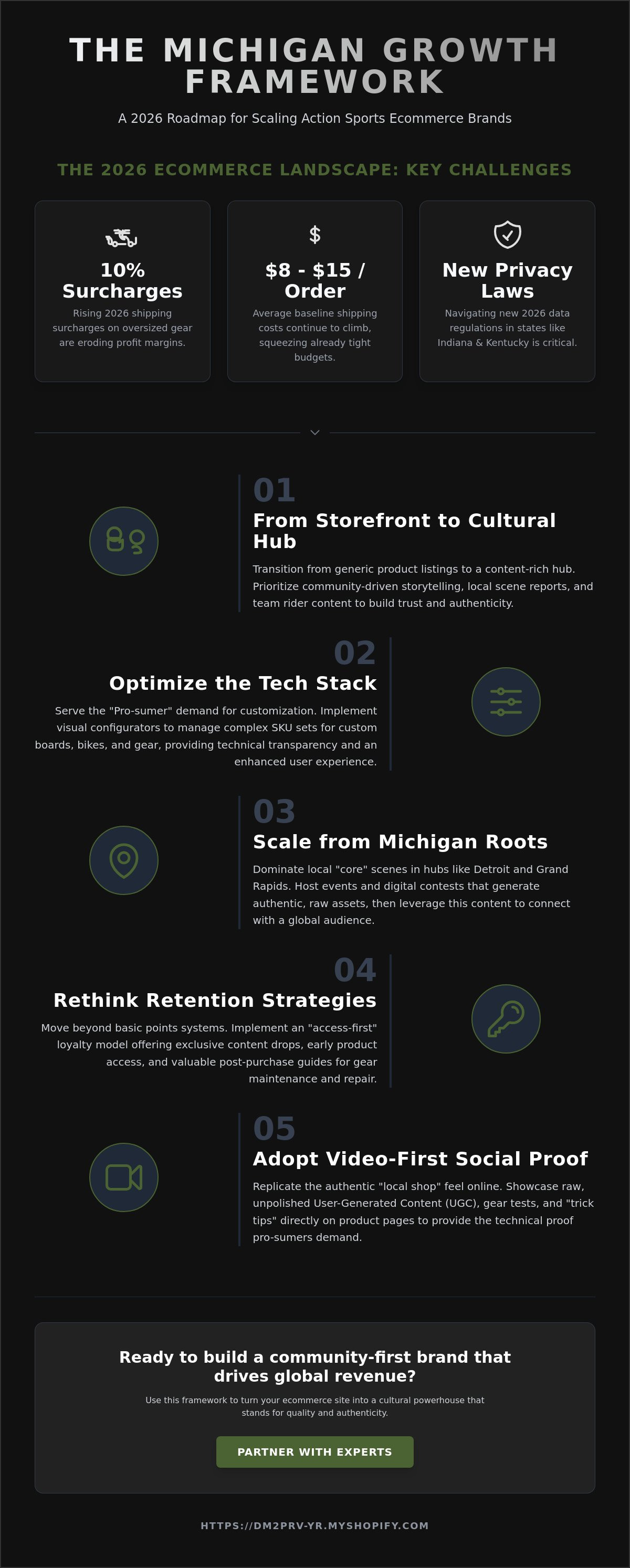
What if the key to beating global retail giants isn't a massive ad budget, but making your website feel as authentic as the sticker-covered backroom of a local skate shop? Scaling a brand requires a precise ecommerce marketing strategy for action sports brands that respects the culture while driving serious revenue. You know your brand's soul lives in the community, yet translating that "shop culture" to a digital storefront often feels impossible. It's even harder when you're facing 2026 shipping surcharges that have climbed up to 10% for oversized gear and average shipping costs between $8 and $15 per order.
This article introduces the Michigan Growth Framework, a specific roadmap to help you transition from a local favorite to a global powerhouse. We'll show you how to master AI-powered personalization, comply with the latest 2026 data privacy laws in states like Indiana and Kentucky, and protect your profits against rising logistics costs. It's time to build a community-first hub that drives loyalty and scales your revenue.
Key Takeaways
- Transition from a transactional storefront to a cultural hub by prioritizing community-driven storytelling over generic product listings.
- Implement a high-performance ecommerce marketing strategy for action sports brands by utilizing visual configurators to manage complex SKU sets for custom gear.
- Scale your brand by dominating the Michigan corridor through local "core" events that generate authentic assets for a global audience.
- Shift retention efforts from basic points-based systems to an "access-first" loyalty model that offers exclusive content and post-purchase maintenance guides.
- Adopt a video-first social proof strategy to replicate the authentic "local shop" feel for your digital customers in 2026.
Defining the 2026 Action Sports Ecommerce Landscape
Action sports ecommerce isn't just about moving inventory. It's a specialized ecosystem of hardware, apparel, and lifestyle products built for high-intensity, community-led activities like skateboarding, surfing, and snowboarding. In 2026, a successful ecommerce marketing strategy for action sports brands moves away from the transactional "buy now" button. Instead, it focuses on curating a culture that resonates with the core demographic. This shift is necessary because consumers are increasingly skeptical of brands that lack a genuine connection to the sports they represent.
Traditional Sports marketing often focuses on mass appeal and broad fitness goals. For action sports, that approach is a death sentence. You aren't selling a treadmill for a New Year's resolution; you're selling the tools for a lifelong pursuit of progression. Your content needs to reflect this by highlighting the grit, the failures, and the eventual triumphs of the sport. Authentic storytelling is the only way to bridge the gap between a digital storefront and the physical world of action sports.
The "Pro-sumer" has become the dominant force in 2026. These are buyers who possess deep technical knowledge and demand professional-grade gear even if they aren't competing on a world stage. Your marketing must speak their language. If you're describing a skateboard deck, don't just call it "durable." Talk about the specific wood-pressing process or the resin used to prevent delamination. Experts can smell a lack of authenticity from a mile away, so technical transparency is your greatest asset.
The Distinction Between Action Sports and General Athletics
Generic fitness marketing fails here because action sports are rooted in counter-culture. While a big-box retailer might sell a "skateboard" next to a yoga mat, the action sports consumer sees them as entirely different worlds. Your digital presence must replicate the feeling of a local shop. It should be a hub for advice, localized weather reports for surf spots, or videos of the local team hitting a new rail in Detroit. You're building a digital home for the community, not just a catalog. This approach builds the trust required to scale an ecommerce marketing strategy for action sports brands effectively.
Key 2026 Market Drivers for Action Sports
The visibility from the 2026 Olympics has pushed niche sports into the mainstream, but the core market remains loyal to authenticity. Michigan hubs like Grand Rapids and Detroit are now global influencers in streetwear and hardware design. There's also a massive shift toward "repairable" gear. Brands that offer replacement parts for trucks or tutorials on repairing gear are winning over consumers who value long-term durability and sustainable manufacturing over fast-fashion alternatives. This focus on longevity is a cornerstone of the Michigan Growth Framework, ensuring your brand stands for quality in a crowded global market.
Building a Community-First Content Engine
Static star ratings and two-sentence text reviews no longer cut it for high-performance gear. In 2026, a robust ecommerce marketing strategy for action sports brands relies on video-first social proof. When a customer considers a new deck or a pair of downhill skates, they want to see the flex, hear the "pop" of the tail, and watch how the equipment handles a real-world impact. This raw, unpolished content builds a level of trust that professional studio photography simply cannot match.
Aspiration is the fuel for this engine. By tapping into the skateboard lifestyle, brands can create content that feels like a shared experience rather than a sales pitch. This means documenting the early morning sessions, the road trips, and the parking lot culture that defines the sport. Your team riders are essential here. They act as the technical north star for your brand, proving that your gear can withstand the highest levels of abuse while inspiring the next generation of riders to push their limits.
UGC Strategies for Technical Gear
Incentivizing high-quality user-generated content (UGC) requires a delicate touch. Avoid corporate-style "submit your review" emails. Instead, launch community challenges that resonate with local scenes. For example, hosting a "Best Trick at the Brighton Rail" digital contest encourages riders in Brighton and Fenton to upload raw clips. These "Trick Tips" and "Gear Tests" serve as a powerful marketing funnel. When you display this authentic footage directly on product pages, you provide the technical proof pro-sumers demand. If you're looking to build this kind of authority, it helps to partner with experts who understand the culture.
The 2026 Influencer Pivot: From Reach to Authority
The era of the "mega-influencer" is fading in the action sports world. In 2026, micro-influencers with deep roots in the Michigan scene out-convert national celebrities. A local rider who is respected at the Grand Rapids skate park carries more weight than a generic athlete with a million followers. Focus on building long-term partnerships with local parks and surf shops. Your ambassador programs should reward community contribution, such as organizing local clean-ups or coaching beginners, rather than just tracking affiliate sales. This builds a foundation for an ecommerce marketing strategy for action sports brands that is sustainable and culturally relevant.
Optimizing the Tech Stack for High-Performance Gear Sales
Selling high-performance gear requires more than a basic storefront. A successful ecommerce marketing strategy for action sports brands in 2026 demands a tech stack that handles extreme technical complexity. Unlike general retail, your site needs to manage intricate relationships between components. If a customer is buying skateboards online, they aren't just picking a deck; they're matching truck widths to deck sizes and choosing durometer ratings for wheels. Your backend must support these dependencies to ensure the user doesn't end up with incompatible parts.
AI-driven personalization is a critical tool for navigating this complexity. Your site should recognize the difference between a park skater and a downhill longboarder within seconds of their arrival. Showing a street skater a 40-inch pintail is a wasted opportunity. By tailoring content, product recommendations, and even landing pages to specific disciplines, you mimic the expertise of a shop manager who knows exactly what gear to pull from the back room. This level of relevance is what separates professional brands from generic retailers.
Fit technology is another essential 2026 pillar. Technical footwear and apparel brands rely on precise sizing to ensure performance and safety. Integrating virtual fit tools helps customers find the right size without the trial and error of shipping returns. This is especially vital for action sports where a loose shoe or a restrictive jacket can lead to an awkward fall or a ruined session. Providing these technical assurances builds the confidence required for a high-value purchase.
Custom Product Builders and Visualizers
Implementing 3D configurators allows riders to see their custom setup before it's built. This visual confirmation significantly reduces return rates because the customer knows exactly how the grip tape looks against the deck. Augmented Reality (AR) takes this a step further, letting customers project the board's actual dimensions onto their floor to gauge the size. To maximize revenue, integrate "Bundle and Save" logic. This automatically calculates discounts when a user completes a setup with decks, trucks, bearings, and wheels, encouraging a higher average order value.
Mobile-First Performance for the On-the-Go Skater
Most action sports purchases happen "spot-side." A skater breaks a kingpin or shreds a shoe and needs a replacement immediately. Your site must be optimized for these high-intent, on-the-go moments. Fast checkout options like Apple Pay and Google Pay are essential to capture the sale before the session ends. Consider using Progressive Web Apps (PWAs). These allow users to access your maintenance guides or hardware tutorials even when they're at a park with poor reception. Keep your mobile navigation lean. A gear-heavy catalog can easily become a maze on a small screen, so prioritize clear, technical filters that help users find specific parts fast.
Scaling from Michigan Roots: Local-to-Global Marketing Tactics
Scaling a brand globally doesn't mean forgetting where you started. In fact, your origin story is your most potent marketing asset. An effective ecommerce marketing strategy for action sports brands begins by dominating the local corridor. By establishing a stronghold in Michigan cities like Flint, Detroit, Fenton, Grand Rapids, and Brighton, you create a blueprint for success that can be exported. Local "core" events serve as a factory for authentic brand assets. Raw footage of a local jam in Detroit carries more weight than a polished studio shoot in California because it feels real to the community.
Once you've secured your home turf, use "Designed in Michigan" as a premium brand pillar. Global customers in 2026 are looking for specialized expertise from unique geographic hubs. From there, scale geographically by targeting similar climate and culture clusters. A brand that thrives in the varied Michigan seasons will naturally resonate with riders in regions like the Pacific Northwest or Northern Europe. This methodical expansion ensures your brand remains grounded while reaching a global audience.
Hyper-Local Michigan SEO for Global Credibility
Search engine optimization isn't just about broad terms. By targeting specific phrases like "skate shop Detroit" or "Grand Rapids streetwear," you build local authority that translates into global trust. When a customer in London or Tokyo sees your brand's deep physical connection to Michigan landmarks, they perceive a level of authenticity that generic online retailers can't match. Use your local environment in photoshoots. Whether it's the industrial backdrop of Detroit or the lakefronts in Fenton, these settings tell a story of durability and grit.
The Omnichannel Advantage in Action Sports
Modern retail requires a seamless blend of physical and digital spaces. Implementing Buy Online, Pick Up In-Store (BOPIS) for your Michigan customers creates a convenient bridge between your website and your storefront. Use your shops in Brighton and Fenton as "experience centers" where riders can test gear before committing. By syncing inventory across warehouses in Flint and Detroit, you can offer real-time local delivery or quick pickups. If you're ready to modernize your operations, you can consult with our ecommerce growth team to streamline your omnichannel setup. This infrastructure ensures that your local fans get the best service while your global platform continues to scale.
Retention Strategies: Turning Gear Buyers into Brand Advocates
Traditional loyalty programs often fail in the action sports world because they feel like a corporate bribe. A skater doesn't want to accumulate points for a generic discount; they want to feel like they're part of the brand's inner circle. In 2026, a successful ecommerce marketing strategy for action sports brands prioritizes access over currency. This means offering your most loyal customers early entry to limited-edition deck drops or invitation-only sessions at local parks. By shifting the focus to exclusive experiences, you build a bond that transcends a simple transaction and respects the culture of the sport.
Consumables offer a significant opportunity for recurring revenue and long-term retention. Items like grip tape, skate wax, and bearings are frequently replaced. Implementing a subscription model for these essentials ensures your brand remains the default choice for every tune-up. This consistency is vital in 2026. It helps brands stabilize revenue while offsetting the rising shipping surcharges and customer acquisition costs mentioned earlier in this framework. When you're the brand that keeps their board rolling smoothly every month, you aren't just a shop; you're a partner in their progression.
Educational Content as a Retention Tool
Education is the ultimate retention tool. When a customer buys new gear, don't just send a receipt. Send them automated guides on how to maintain it. If they bought suede shoes, send a tutorial on cleaning them to extend their life. In Michigan, seasonal shifts are a major factor for gear longevity. Provide specific guides on winterizing a setup to handle salt and moisture. Helping a customer fix their gear instead of just pushing a new sale builds immense loyalty. It shows you care about their experience, not just their wallet.
Membership and Exclusive Community Tiers
Community tiers take this further. High-CLV customers should receive free entry to local Michigan skate events or the chance to vote on future deck graphics. This collaborative approach turns customers into stakeholders. By providing a brand-owned hub where riders can share clips and spots, you create a digital version of the local shop hangout. It's about building a space where the community feels seen. When riders feel like they have a say in the brand's direction, they stop being customers and start being advocates. This level of engagement is the final piece of a modern ecommerce marketing strategy for action sports brands.
Dominating the Global Scene with Michigan Authenticity
Success in 2026 requires a fundamental shift from simply selling hardware to actively curating a community hub. By digitizing the local shop feel and leveraging high-performance tech like 3D configurators, your brand can provide the technical depth that pro-sumers demand. We've explored how a localized Michigan foundation serves as the perfect springboard for global expansion. This approach ensures your brand remains grounded in the culture while using data to navigate complex shipping surcharges and evolving privacy regulations.
Building a sustainable ecommerce marketing strategy for action sports brands is about balancing this cultural authenticity with professional-grade execution. Our team brings deep roots in the Michigan skate scene alongside specialized expertise in Shopify-driven growth and data-backed trend forecasting. We help you turn casual buyers into lifelong advocates through access-based loyalty and educational retention. It's time to take your brand to the next level. Scale your action sports brand with the 2026 Growth Framework. The future of your brand is built on the grit and passion you put in today.
Frequently Asked Questions
What is the most effective marketing channel for action sports in 2026?
Short-form video platforms that prioritize "clip culture" are the most effective channels in 2026. This content mimics the raw energy of a skate video and builds immediate trust with the core audience. Brands that integrate these clips into their product pages see higher engagement. It's the most authentic way to prove your gear works in the streets without a polished corporate filter.
How do I compete with Amazon and big-box retailers in the skate industry?
You compete by offering technical depth and cultural authenticity that mass retailers can't replicate. A big-box store sells a board as a toy; you sell it as a precision tool. Providing expert advice and a community-led ecommerce marketing strategy for action sports brands creates a moat around your business. Focus on your "pro-sumer" audience who values durability over a cheap price point.
Should my action sports brand focus on TikTok or Instagram in 2026?
Focus on TikTok for discovery and Instagram for community retention. TikTok's algorithm is better for reaching new riders through viral trick clips and technical gear tests. Instagram remains the hub for lifestyle storytelling and direct communication with your existing fans. Balancing both ensures you fill the top of your funnel while keeping your core advocates engaged with your brand's daily life.
How can a Michigan-based brand appeal to surfers on the coast?
Highlight the "hard water" grit of Michigan's surf scene to build global credibility. Surfers on the coast respect gear that's designed for the brutal, cold-water conditions of the Great Lakes. This "Made for the Cold" narrative positions your products as more durable and resilient than fair-weather alternatives. Authentic storytelling about Michigan's industrial and natural landscape resonates with riders who value equipment that lasts.
What ecommerce platform is best for custom skateboard configurators?
Shopify Plus is the premier platform for brands requiring complex visual configurators. It offers the most flexibility for integrating 3D models and managing the complex SKU dependencies required for custom setups. While platforms like BigCommerce offer 0% transaction fees, Shopify’s app ecosystem provides better tools for "bundle and save" logic. This makes it easier to implement a high-performance ecommerce marketing strategy for action sports brands.
How do I manage seasonal inventory for snow and skate products?
Manage seasonal shifts by using pre-orders and data-backed inventory forecasting. By launching pre-orders for snow products in late summer, you can gauge demand and secure cash flow before the season hits. Diversifying into year-round soft goods like apparel also helps smooth out the revenue dips between the peak skate and snow months. This balanced approach protects your margins against seasonal fluctuations.
Is email marketing still relevant for the Gen Z action sports audience?
Email marketing is highly effective for Gen Z when it's used for exclusive access and technical education. Don't send generic weekly newsletters. Instead, use email for "early-access" drops or sending maintenance guides for bearings and trucks after a purchase. This high-value approach keeps your brand in their inbox without feeling like spam. It builds a direct line of communication that you own entirely.
How do I build a team rider program that actually drives sales?
Build your team rider program around technical expertise and local community influence rather than just skill. A rider who provides "trick tips" or gear reviews often drives more sales than one who only posts highlight reels. Reward them for community engagement and content creation to ensure the partnership benefits your brand's digital authority. Authentic riders act as the ultimate social proof for your hardware.
Disclaimer
Some content published on this website may be developed with the assistance of AI-powered research and writing tools to help streamline research, organization, and content creation. All articles are reviewed, edited, and approved by Marvin Growth Partners to ensure they align with our perspectives, experience, and intended messaging.
While we strive to provide accurate and up-to-date information, blog content is intended for informational and educational purposes only and should not be considered legal, financial, or professional advice. Readers should independently verify information and consult qualified professionals when appropriate.