

Build a Custom Marketing Strategy for Your Detroit Business
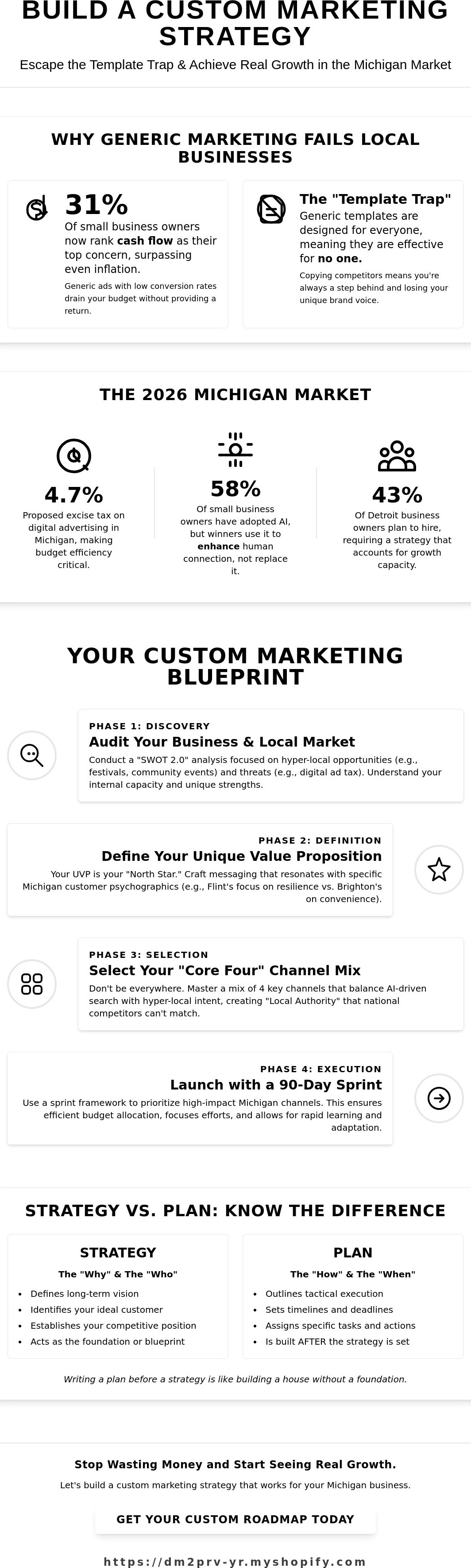
Did you know that 31% of small business owners now rank cash flow as their top concern, even surpassing inflation? It's incredibly frustrating to watch your marketing budget vanish into generic ads that simply don't convert. You're likely tired of feeling like your Detroit shop is invisible next to national big-box competitors or feeling overwhelmed by the pressure to be on every single digital platform. That's why building a marketing strategy custom for your business is no longer optional; it's the only way to ensure your brand survives a shifting landscape that includes a proposed 4.7% excise tax on digital advertising in Michigan.
You deserve a roadmap that actually works for our local landscape. At Marvin Growth Partners, we'll show you how to move beyond cookie-cutter templates and achieve a higher ROI on every dollar spent. By focusing on your specific goals rather than a generic checklist, you can stop wasting money and start seeing real growth. This guide explores how to combine AI-first efficiency with hyper-local community tactics to build a resilient brand that stands out from Flint to Detroit and everywhere in between.
Key Takeaways
- Avoid the "template trap" by treating your marketing as a living blueprint that highlights your unique brand voice rather than copying national competitors.
- Conduct a deep audit of your internal capacity and Detroit-area competitors to identify exactly where your business can dominate the local market.
- Define a unique value proposition that serves as your "North Star," ensuring every piece of custom messaging resonates with your specific customer base.
- Master the art of building a marketing strategy custom for your business by selecting a "Core Four" channel mix that balances AI-driven search with hyper-local intent.
- Launch your strategy using a 90-day sprint framework to prioritize high-impact Michigan channels and ensure efficient budget allocation.
Why Generic Marketing Fails: The Need for a Custom Business Strategy
Many Detroit business owners fall into the "Template Trap." They download a free PDF, swap out the logo, and wonder why their revenue isn't climbing. Generic templates are designed for everyone, which means they're effectively designed for no one. A true marketing strategy isn't a static document you file away. It's a living blueprint that evolves with your business and the Michigan economy. If you're simply copying what a competitor does, you're always one step behind and losing the unique voice that made you start your company in the first place.
By May 2026, we've seen a massive shift toward human-centric marketing. While 58% of small business owners have adopted AI into their operations, the ones winning the most market share are those who use technology to enhance, not replace, personal connections. If you're a business in Fenton or Brighton, your customers aren't looking for an algorithmic response. They want to know you understand their community and their specific needs. Building a marketing strategy custom for your business ensures you don't lose that unique voice while trying to scale in a competitive digital environment.
Strategy vs. Plan: Knowing the Difference
People often use these terms interchangeably, but they serve different masters. Your strategy is the "Why" and the "Who." It defines your long-term vision, your ideal customer, and your competitive position in the local market. The plan is the "How" and the "When," focusing on the tactical execution of those ideas. Writing a plan before you have a strategy is like trying to build a house in Detroit without a foundation; it might look fine for a week, but it won't survive a Michigan winter. Strategy must always come first.
The Cost of "Shouting into the Void"
Generic marketing is expensive. When you run non-targeted ads or post aimlessly on social media, you're essentially shouting into a void. This leads to unsustainably high customer acquisition costs. With 31% of small business owners citing cash flow as their biggest worry in 2026, wasting money on ads that don't convert is a risk you can't afford. Building a marketing strategy custom for your business allows you to create "Local Authority." This acts as a competitive moat, making it much harder for national big-box retailers to steal your customers. When you're relevant to your neighbors, you don't have to outspend the giants; you just have to out-connect them.
The Discovery Phase: Auditing Your Business and Michigan Market
Before you spend a dime on digital ads, you need a clear-eyed look at your current standing. Building a marketing strategy custom for your business starts with a rigorous internal audit. You can't just look at your bank account; you have to look at your team's bandwidth. If you're planning to hire, as 43% of Detroit business owners are in 2026, your strategy needs to account for that growth capacity. Identify your unique strengths, whether it's a proprietary manufacturing process in Grand Rapids or a deep-rooted community reputation in Detroit. These aren't just "nice-to-haves" anymore. They're the foundation of your competitive moat.
A traditional SWOT analysis often feels like a school project, but SWOT 2.0 for a Michigan firm means looking at hyper-local opportunities. Is there a major local festival or sporting event you can pivot around? Since 58% of local business owners have already modified operations for such events, you can't afford to ignore the local calendar. Conversely, a digital threat might be the proposed 4.7% digital advertising tax in Michigan. If you're feeling stuck on how to evaluate these factors, working with a dedicated strategist can clarify your path forward.
Defining Your Ideal Michigan Customer
Stop targeting "everyone in Michigan." A resident in Flint has different daily stressors than someone in Brighton. Psychographics matter more than simple age ranges. For example, a Brighton customer might prioritize high-end service and convenience due to longer commutes, while a Flint customer might value resilience and local reinvestment. Map out where they spend their time. Do they listen to local sports radio during the drive, or are they strictly in focused LinkedIn groups? Your Unique Value Proposition must speak directly to these local nuances to be effective.
Analyzing the Local Competitive Landscape
National brands have huge budgets, but they're slow. Use digital tools to see what Fenton competitors are bidding on in search results. You'll often find "Gaps in Service" where big-box stores fail. Maybe they don't offer same-day local delivery or they lack a physical presence for troubleshooting. Your competitive advantage in Detroit might be as simple as being the only provider that offers on-site support within an hour. Building a marketing strategy custom for your business means doubling down on these specific gaps that national giants are simply too large to fill.
Developing Your Unique Value Proposition (UVP) and Messaging
Your Unique Value Proposition (UVP) acts as the North Star for your entire brand. It's the central promise that guides every ad, email, and social post you create. When you're building a marketing strategy custom for your business, your UVP shouldn't just list what you do; it should explain why a Detroit resident should care about you more than a national competitor. Success in developing a robust marketing strategy requires choosing one of three primary paths for your UVP: product excellence, customer intimacy, or operational ease. You can't be everything to everyone. Trying to be the cheapest, fastest, and highest quality usually results in being none of the above.
A strong UVP must pass the "Grand Rapids Test." If you took your messaging and placed it in front of a local at a coffee shop on Wealthy Street, would they immediately understand how you solve their specific problem? In a world where 58% of small business owners are using AI to generate content, authentic local messaging is your greatest asset. It's not just about being "local"; it's about aligning your brand voice with the grit and resilience that defines the Michigan business community. This alignment builds a level of trust that a generic, AI-generated campaign from a national firm can't replicate.
Crafting a Message That Sticks
Most businesses focus on features, but customers buy benefits. To fix this, apply the "So What?" test to every claim. If you say, "We have twenty years of experience," the customer asks, "So what?" The answer should be, "We've navigated every Michigan economic shift since 2006, so we know exactly how to protect your assets during a downturn." Use local storytelling to bridge this gap. Share behind-the-scenes content or customer testimonials from people in Brighton or Fenton. This provides the social proof and credibility that 2026 consumers crave over polished, corporate perfection.
UVP Comparison: Local vs. National
National brands often struggle to compete with hyper-local value. Even with Detroit digital billboard rates as low as $2 per hour, a generic message will still fall flat if it doesn't offer something unique to the region. Building a marketing strategy custom for your business means leaning into these geographic advantages.
| Generic Value (National) | Custom Local Value (Detroit/Michigan) |
|---|---|
| Free Shipping in 3-5 Days | Same-day Local Pickup in Detroit or Flint |
| Competitive National Pricing | Support Michigan Families (6% Sales Tax Reinvested Locally) |
| 24/7 Chatbot Support | On-site Consultation with a Local Michigan Expert |
For a local retail business, a winning UVP might look like this: Our boutique provides Detroit residents with a hand-curated selection of Michigan-made goods and immediate, in-person styling expertise that national e-commerce algorithms simply cannot replicate.
The 2026 Marketing Roadmap: Channels and Technology
The mistake many owners make is trying to be everywhere at once. By May 2026, 91% of business owners plan to adopt more digital tools, but that doesn't mean you should join every social platform. Instead, pick a "Core Four" channel mix that aligns with your specific capacity. Building a marketing strategy custom for your business involves selecting channels where your local Fenton or Brighton audience actually lives. SEO has shifted toward hyper-local intent and AI-driven search results. It's no longer just about ranking for a term; it's about being the definitive answer for a local problem.
Owned media, like email and SMS lists, has become a critical hedge against rising costs. With a proposed 4.7% excise tax on digital advertising in Michigan, building your own first-party data is a financial necessity. Content marketing in 2026 is less about high-budget production and more about authentic short-form video. Customer testimonials from your neighbors in Flint or Detroit provide the credibility that search engines and humans both prioritize. Building a marketing strategy custom for your business requires this shift from broad reach to deep local connection.
Leveraging AI for Strategy Execution
With 58% of small business owners already incorporating AI, the technology has moved from a novelty to a necessity. You can use AI for sentiment analysis to understand what customers in the Detroit region are saying about your industry in real-time. This allows you to pivot your messaging before a trend fades. Predictive analytics also help you set your 2026 marketing budget by identifying which seasons, like the Michigan summer tourism peak, offer the highest potential ROI. If you want to streamline this process, you can explore our strategy consulting services to see how AI fits your specific model.
The Multi-Channel Integration Strategy
Success in 2026 requires connecting your offline presence to your digital funnel. If you host an event in Detroit, use QR codes to lead attendees toward a digital lead magnet or an SMS sign-up. This creates a seamless transition that captures data you actually own. Retargeting strategies should focus on local conversion while respecting the latest privacy regulations. Instead of generic tracking, use your first-party data to reach out to customers who have already shown interest. Finally, set KPIs that focus on revenue and local market share rather than vanity metrics like "likes" or "shares." Real growth is measured by the strength of your local brand recognition and your bottom line.
Implementation: Executing Your Custom Strategy in Michigan
Execution is where most great ideas go to die. To prevent this, you should view building a marketing strategy custom for your business as a series of 90-day sprints rather than a massive, overwhelming overhaul. During the first thirty days, focus on your foundation: clean up your local SEO listings and set up your CRM to capture first-party data. The second month should focus on launching your "Core Four" channels. By the third month, you'll have enough data to see which local Michigan channels are driving the highest ROI. This phased approach keeps your team focused and prevents the burnout often associated with new marketing initiatives.
Budget allocation must be ruthless, especially with 31% of Detroit business owners citing cash flow as a primary concern in 2026. Instead of spreading your funds thin across every available platform, prioritize high-impact local channels. For instance, digital billboards in Detroit can start as low as $2 per hour, offering a cost-effective way to build brand recognition without a massive long-term contract. Your "marketing stack" should include tools that automate repetitive tasks, such as AI-driven email sequencing, while leaving room for the human-centric touch that Michigan customers expect. Remember, your strategy is a living document. It's never truly "finished" because the market and consumer behaviors are constantly shifting.
Local Community Integration as a Strategy
In 2026, the most successful businesses are those that weave themselves into the local fabric. This goes beyond simple ads. Consider partnering with other businesses in Fenton or Brighton for cross-promotional campaigns that benefit both parties. If you're a retail shop, perhaps you host a pop-up for a local coffee roaster. Sponsoring local events or youth sports teams in Flint can build a level of brand equity that digital ads alone cannot touch. When you measure success, look at "Community Impact" metrics, such as local referral rates and event attendance, alongside your traditional click-through rates.
Measuring Success and Pivoting
Data is only useful if you actually look at it. Set a recurring date for monthly and quarterly reviews to analyze your progress. Monthly reviews are for tactical adjustments, like tweaking ad copy or changing an email subject line. Quarterly reviews are for strategic pivots. If the Michigan Senate passes new consumer protection laws or the proposed digital advertising tax becomes reality, your strategy must adapt to stay compliant and profitable. Don't be afraid to kill a channel that isn't performing. Building a marketing strategy custom for your business means having the discipline to double down on what works and the courage to walk away from what doesn't. Ready to build your own? Contact us for local Michigan business support and let's get started.
Take Control of Your Detroit Brand's Future
The days of relying on cookie-cutter templates are over. To thrive in the 2026 Michigan market, you need a plan that balances technological efficiency with the human-centric touch your neighbors expect. We've explored how a strong Unique Value Proposition and a focused channel mix can protect your cash flow and build real local authority. Building a marketing strategy custom for your business is the most effective way to move from shouting into the void to creating meaningful connections in cities like Grand Rapids and Flint.
Success requires constant optimization and a commitment to your local community. Whether you're navigating new digital taxes or integrating AI into your workflow, having a resilient roadmap is your greatest competitive advantage. We specialize in modern strategic frameworks designed specifically for the unique challenges of the Detroit region. Don't let another quarter pass with stagnant growth or wasted ad spend. It's time to invest in a vision that's as unique as your company.
Build Your Custom Michigan Marketing Strategy Today and start growing your brand with local expertise you can trust.
Frequently Asked Questions
How long does it take to build a custom marketing strategy?
Expect the discovery and planning phase to take between four and eight weeks. This timeframe allows for a deep dive into your internal capacity, competitor mapping, and the development of a unique value proposition. Rushing this process usually results in the "Template Trap" mentioned earlier, leading to generic campaigns that fail to resonate with local Michigan consumers.
Do I need a huge budget to compete in the Detroit or Grand Rapids markets?
No, a massive budget isn't a requirement if you prioritize high-impact local channels. Digital billboards in Detroit can start as low as $2 per hour, offering a flexible way to build brand awareness without a long-term contract. By focusing on hyper-local SEO and community integration, smaller businesses can effectively out-maneuver national big-box competitors with much larger spends.
What is the most important part of a custom marketing strategy in 2026?
Authenticity and local relevance are the most critical factors for success this year. While 58% of small business owners have incorporated AI into their operations, the most successful brands use technology to enhance human connections rather than replace them. Your strategy must address the specific pain points of residents in Flint, Brighton, or Detroit to build lasting trust and authority.
How often should I update my business marketing strategy?
You should perform a tactical review every month and a comprehensive strategic audit every quarter. This frequency allows you to adapt to local economic shifts or regulatory changes, such as the proposed 4.7% digital advertising tax in Michigan. A static strategy becomes obsolete quickly. Regular updates ensure your roadmap remains aligned with your actual business capacity and market conditions.
Can I build a marketing strategy myself or do I need an agency?
You can start the process yourself, but building a marketing strategy custom for your business often benefits from professional local expertise. An agency provides access to advanced predictive analytics and specialized market data that solo-preneurs might lack. Many Detroit business owners find that professional guidance helps them avoid expensive trial-and-error mistakes while accelerating their 90-day launch sprint.
How do I know if my marketing strategy is actually working?
Focus on your Return on Investment (ROI) and local brand recognition rather than vanity metrics like social media likes. Track whether your customer acquisition costs are decreasing and if your revenue is meeting the growth expectations you set during the discovery phase. If your cash flow is stabilizing while your local market share grows, your custom roadmap is performing as intended.
What local Michigan resources are available for small business marketing?
The Michigan Small Business Development Center (SBDC) and the Detroit Regional Chamber offer excellent data and networking opportunities. These organizations provide insights into local consumer behavior and help you stay informed about state-specific legislation. Leveraging these community-focused assets allows you to refine your competitive moat and stay connected with other business owners in Fenton and Grand Rapids.
How does AI affect building a custom strategy for a small business?
AI acts as a force multiplier that allows small teams to execute complex tasks like sentiment analysis and personalized customer journeys. building a marketing strategy custom for your business in 2026 involves using AI to automate repetitive content production while freeing up time for high-level strategy. It helps you identify emerging local trends across Michigan before they become mainstream, giving you a significant head start.
Disclaimer
Some content published on this website may be developed with the assistance of AI-powered research and writing tools to help streamline research, organization, and content creation. All articles are reviewed, edited, and approved by Marvin Growth Partners to ensure they align with our perspectives, experience, and intended messaging.
While we strive to provide accurate and up-to-date information, blog content is intended for informational and educational purposes only and should not be considered legal, financial, or professional advice. Readers should independently verify information and consult qualified professionals when appropriate.