

Calculating Customer Lifetime Value for Shopify: A 2026 Guide for Michigan Brands
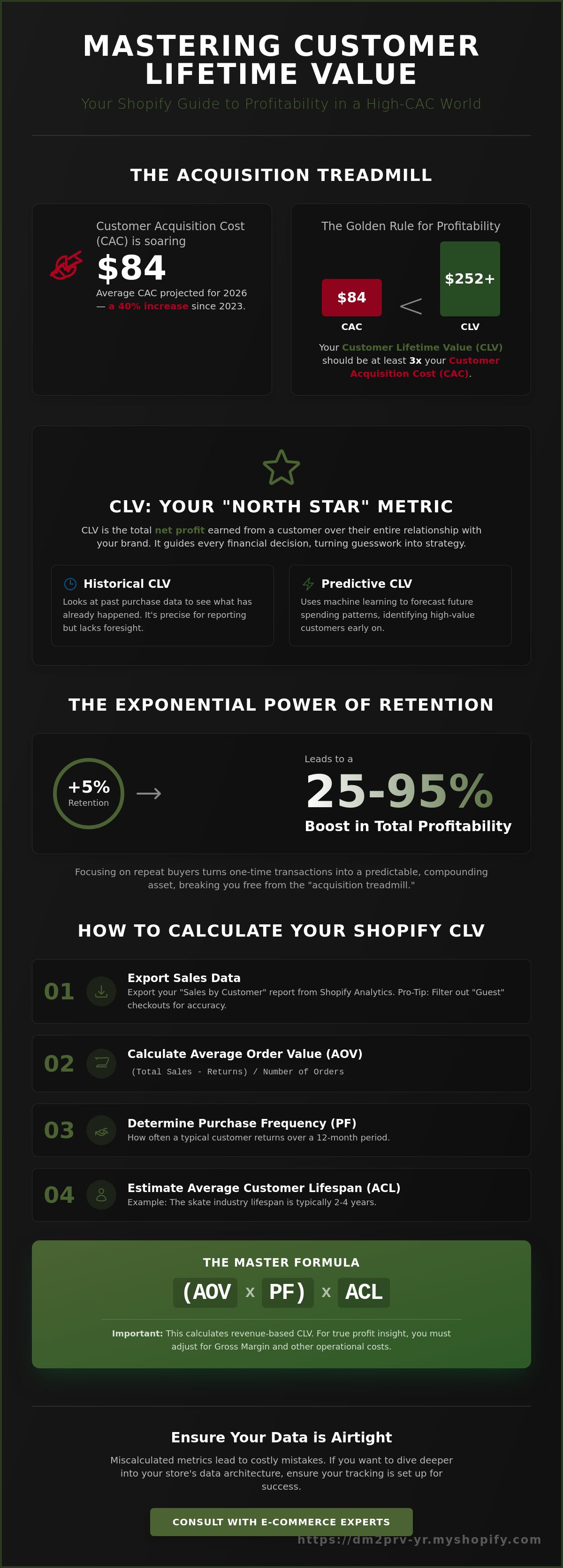
With customer acquisition costs (CAC) soaring to an average of $84 in 2026, a 40% increase since 2023, many Michigan e-commerce owners feel like they're running on a treadmill just to stay in place. It's frustrating to see your marketing budget disappear while you're left wondering if those first-time buyers will ever return to your store. You likely suspect that simply driving traffic isn't enough when you're competing in high-churn niches like Detroit streetwear or Grand Rapids skate gear. You're not alone in feeling that hype isn't a sustainable business model anymore. This guide will show you that calculating customer lifetime value for shopify is the key to breaking this cycle and ensuring your brand stays profitable. You'll master the exact formulas and Shopify tools needed to track, calculate, and grow your CLV. We'll dive into specific Shopify reporting tiers, explain how to navigate Michigan's 6% sales tax nexus, and share strategies to boost repeat purchase rates beyond the current 35% industry ceiling. By the end, you'll know exactly how much you can afford to spend to win every sale.
Key Takeaways
- Learn the step-by-step process for calculating customer lifetime value for shopify using your store's native sales reports and return data.
- Understand how to leverage Shopify's cohort analysis to visualize customer retention patterns and profit growth over time.
- See how your metrics stack up against 2026 industry benchmarks for skate and streetwear brands in the Michigan market.
- Explore localized strategies like Detroit-based pickup options and community events that drive higher repeat purchase rates.
- Master the "North Star" metric that helps you determine exactly how much you can afford to spend on customer acquisition.
Understanding Customer Lifetime Value (CLV) in the Shopify Ecosystem
In the high stakes world of Michigan e-commerce, Customer Lifetime Value (CLV) represents the total net profit a brand earns from a single customer throughout their entire relationship. Unlike simple revenue tracking, CLV accounts for the costs of goods sold, shipping, and marketing. For Shopify store owners in Detroit or Grand Rapids, this metric is the "North Star" that guides every financial decision. If you don't know your CLV, you're essentially flying blind when setting your marketing budgets.
The relationship between your Customer Acquisition Cost (CAC) and your LTV is the most critical ratio in your business. Industry experts generally agree on the 3:1 rule; your customer's lifetime value should be at least three times what it cost to acquire them. With 2026 average acquisition costs reaching $84, a Michigan brand needs a CLV of at least $252 to remain healthy. As privacy regulations and cookie-less browsing continue to degrade third-party tracking, calculating customer lifetime value for shopify using first-party data has become the only way to ensure long-term sustainability.
Historical vs. Predictive CLV: Which Should You Use?
Most beginners start with Historical CLV. This method looks at past purchase data to see exactly what has already occurred. It's accurate for reporting but lacks foresight. Predictive CLV, however, uses machine learning to forecast future spending patterns based on current behavior. Shopify's "Predictive Spend" tier is a game changer for Detroit-based retailers. It allows you to identify which customers are likely to become "whales" before they even make their second purchase, letting you prioritize high-value segments in your email flows.
The Impact of Retention on E-commerce Profitability
The math behind retention is staggering. Research shows that a 5% increase in customer retention can lead to a 25% to 95% boost in total profitability. In competitive Michigan markets like Flint, Fenton, and Brighton, local loyalty stabilizes the LTV curve. When a customer feels a community connection to a brand, they're less likely to "churn" or switch to a national competitor. Calculating customer lifetime value for shopify helps you identify these loyal pockets. Ignoring this leads to the "acquisition treadmill," where you must constantly buy new traffic just to maintain flat revenue. By focusing on repeat buyers, you turn one-time transactions into a predictable, compounding asset.
Manual Formulas: How to Calculate CLV Using Your Shopify Data
While automated tools provide speed, manually calculating customer lifetime value for shopify ensures you understand the underlying mechanics of your business. It allows you to strip away the noise and focus on the actual cash flow entering your Michigan bank account. By mastering these formulas, you can verify the accuracy of your apps and make more confident investment decisions for your brand's future. The process follows a logical path from raw transaction data to a final profit-focused figure.
- Step 1: Export your "Sales by Customer" report from Shopify Analytics to identify individual buying patterns.
- Step 2: Calculate Average Order Value (AOV). You must subtract returns from your total sales before dividing by the number of orders to get a realistic figure.
- Step 3: Determine Purchase Frequency (PF) over a 12-month rolling window to see how often a typical customer returns.
- Step 4: Estimate the Average Customer Lifespan (ACL). In the skate industry, this often spans 2 to 4 years before a customer's style or needs shift.
- Step 5: Apply the Master Formula: (AOV x PF) x ACL. This gives you the gross revenue a customer will generate.
Gathering the Raw Data from Shopify Admin
To start, navigate to Analytics > Reports > Customers in your Shopify admin panel. Set your timeframe to "Total Lifetime" for a historical view, or "Last 12 Months" to understand recent shifts in buyer behavior. Always filter out "Guest" checkouts when possible. Anonymous data can fragment a single customer's journey into multiple entries, which artificially lowers your purchase frequency and skews your final results. If you want to dive deeper into your store's data architecture, consult with e-commerce experts to ensure your tracking is airtight.
Adjusting for Gross Margin and Operational Costs
Revenue-based LTV is a vanity metric that can lead to overspending on ads. To find your true "North Star," you must multiply your revenue LTV by your gross margin percentage. This accounts for the cost of goods, Michigan's 6% sales tax, and transaction fees. Don't forget to account for Michigan-specific shipping costs; shipping a heavy skateboard deck from Grand Rapids to the Upper Peninsula is significantly more expensive than a local Detroit delivery. You must subtract discount codes from the AOV before finalizing your LTV to avoid overestimating your profit. This adjusted figure represents the actual money available to cover your $84 average customer acquisition cost and still leave room for growth.
Leveraging Shopify Analytics and Third-Party LTV Tools
Once you've grasped the manual math, it's time to let software handle the heavy lifting. Automated systems reduce human error. They provide real-time updates that spreadsheets simply can't match. For most Michigan retailers, calculating customer lifetime value for shopify starts within the native analytics dashboard before moving to specialized third-party platforms. Using these tools allows you to shift from reactive reporting to proactive marketing.
Shopify's internal data is often more reliable than Google Analytics 4 (GA4) for financial metrics. Since Shopify tracks the actual transaction, it accounts for returns and cancellations that GA4 might miss. However, GA4 remains superior for understanding the top-of-funnel journey. By 2026, the most successful brands integrate both, using Shopify for the "source of truth" on profit and GA4 for channel attribution. You can then feed this LTV data into your Meta or Google Ad campaigns to build "Value-Based Lookalike" audiences. This ensures your Detroit-targeted ads find users who mirror your highest-spending customers, rather than just anyone who clicks a link.
By the middle of 2026, apps like Lifetimely and Glew have evolved to offer deeper insights into "Profit LTV" rather than just "Revenue LTV." These tools automatically pull in your Shopify Payments fees, which range from 2.4% to 2.9% depending on your plan, along with your marketing spend from various platforms. This level of automation is essential for Michigan brands managing tight margins in competitive niches. It transforms calculating customer lifetime value for shopify from a monthly chore into a real-time dashboard that informs your daily bidding strategies.
Shopify’s Native Cohort Analysis Explained
The "Retention" table in your Shopify dashboard is the most underutilized tool for tracking LTV growth. It groups customers by the month of their first purchase and tracks their subsequent spending over a 12-month window. If your "Month 12" spend is significantly higher than "Month 1," your retention strategies are working. You can also use native segments to identify your "Whales." These are the top 5% of customers who often drive 40% of your total revenue. Understanding this cohort's behavior helps you tailor your Grand Rapids or Ann Arbor local marketing to attract similar high-value buyers.
When to Upgrade to a Dedicated LTV Platform
You'll know your store has outgrown native tools when you start selling across multiple channels like Amazon or physical retail locations. Dedicated platforms consolidate this data into a single view. These 2026-era tools often include Customer Data Platforms (CDPs) that use predictive modeling. They can tell you exactly when a customer is about to churn. This allows you to trigger a "win-back" email or a direct mail offer before they're gone for good. For brands with complex inventories, these platforms also highlight which specific products lead to the highest long-term retention.
Benchmarking CLV for Skate and Streetwear Brands in 2026
Michigan's climate and culture create a unique environment for e-commerce benchmarks. In the skate and streetwear sectors, your product mix heavily dictates your long-term profitability. Understanding these industry-specific nuances is essential when calculating customer lifetime value for shopify, as a "one-size-fits-all" approach often ignores the reality of how Michigan skaters and sneakerheads actually shop. With the global streetwear market reaching nearly $400 billion in 2026, local brands must look beyond surface-level revenue to understand which products actually drive loyalty.
Seasonality plays a massive role in the Great Lakes State. Michigan winters essentially halt outdoor skating for months, causing a predictable dip in hardgoods sales. However, savvy brands use this time to lean into heavyweight hoodies and Detroit-themed streetwear. This seasonal shift actually helps stabilize the LTV curve. While a customer might buy three skateboard decks in the summer, they transition into high-margin apparel during the snowy months. Local branding increases "stickiness"; a customer in Grand Rapids is far more likely to remain loyal to a brand that sponsors local park jams or uses Michigan-specific iconography than a faceless national retailer.
Hardgoods vs. Softgoods: The LTV Divergence
Skate hardgoods like decks, trucks, and wheels are high-frequency items. Dedicated skaters might break a deck every month, leading to frequent transactions but often lower profit margins due to manufacturing and shipping costs. In contrast, streetwear apparel like hoodies and limited-run T-shirts typically boasts a higher Average Order Value (AOV), often hovering around $117. The most successful Michigan stores use hardgoods as an "entry product." They acquire the customer through a necessary equipment purchase and then transition them into high-LTV apparel buyers. If you need help refining your product-led growth strategy, connect with our Shopify strategy team to optimize your funnel.
The 'Drop' Culture Effect on Shopify Metrics
The "drop" model remains the dominant force in 2026 streetwear. These limited-edition releases create massive spikes in your Shopify analytics, but the real value lies in the "Halo Effect." A successful drop doesn't just generate immediate sales; it re-engages dormant customers and increases their lifetime value. Calculating customer lifetime value for shopify during these periods requires looking at how many "drop hunters" become multi-category buyers. The repeat purchase rate for a typical streetwear brand in 2026 usually sits between 20% and 35%, though local Michigan brands often exceed this through community-driven releases. By measuring the lifespan of a customer across multiple drops, you can determine if your "hype" is translating into actual brand equity or just temporary noise.
Strategic Ways to Increase Your Shopify Store's LTV in Michigan
Once you've mastered calculating customer lifetime value for shopify, the focus shifts from observation to optimization. You know what your customers are worth; now you must increase that value to outpace rising acquisition costs. One of the most effective methods is strategic bundling. By pairing low-margin hardgoods, like a skateboard deck, with high-margin streetwear, such as a premium hoodie, you immediately boost your Average Order Value (AOV). This approach turns a necessary equipment purchase into a lifestyle investment, moving the needle on your total profit per user.
Subscription models offer another powerful lever for Michigan brands. Consumables like skate wax, grip tape, or even high-quality basic tees are perfect candidates for recurring orders. By offering a small discount for a monthly delivery, you lock in purchase frequency and eliminate the chance of a customer drifting to a competitor. This predictable revenue stream makes your long-term financial planning much simpler and stabilizes your cash flow during the slower winter months.
Hyper-Local Marketing and Community Building
Building face-to-face loyalty in cities like Fenton, Brighton, or Ann Arbor creates a "hometown hero" advantage that national brands can't replicate. Hosting local skate jams or sponsoring community events allows you to collect first-party data in a high-trust environment. When you use local Michigan influencers who actually hang out at the same parks as your customers, your repeat purchase rates tend to climb. For those who need their gear immediately for a weekend session, highlighting Fast Shipping Skateboard Gear with local delivery options can be the deciding factor that brings a customer back for their second and third purchase.
Optimizing Post-Purchase Email and SMS Flows
Your Shopify data tells you exactly when a customer is likely to need a replacement. If a local skater buys a deck in April, they'll likely need a fresh one by June. Setting up a "Replenishment" flow in Klaviyo or Shopify Email based on these timelines keeps your brand top-of-mind. You should also implement win-back campaigns for anyone who hasn't shopped in 90 days. By segmenting your list to target those with "High LTV" potential, you can afford to offer a more aggressive discount to bring your most profitable customers back into the fold. Calculating customer lifetime value for shopify allows you to justify these higher retention spends because you know the long-term payoff is there.
Local Logistics as a Retention Tool
Shipping speed is a massive competitive advantage in the 2026 landscape. Offering 1-day shipping within the Detroit metro area or Grand Rapids encourages repeat orders because customers know they don't have to wait. You can also use "Free Shipping to Michigan" tiers to encourage larger cart sizes, effectively raising your AOV. Reducing friction for returns in Brighton or Flint builds immense trust. When a customer knows that an exchange is easy and local, they're far more likely to take a risk on a new apparel drop, knowing you'll take care of them if the fit isn't perfect.
Turning Shopify Data into Michigan-Scale Growth
Mastering the art of calculating customer lifetime value for shopify transforms your store from a guessing game into a precision-engineered profit machine. You now have the formulas to move beyond vanity metrics and the strategies to turn one-time buyers into lifelong advocates. By focusing on high-margin apparel drops and leveraging local logistics, you can comfortably outpace the rising costs of acquisition that are defining the 2026 e-commerce landscape. Remember that retention isn't just about emails; it's about building a community that values quality over hype.
Since 2024, we've been dedicated to serving the Michigan skate community with fast local shipping across Detroit, Grand Rapids, and Fenton. Our curated selection of high-LTV streetwear brands is designed to help your store maintain healthy margins and consistent growth. Whether you're refining your cohort analysis or launching your first loyalty program, the data is now on your side. It's time to stop chasing traffic and start building equity.
Scale your Shopify brand with the best skate gear and streetwear today and start maximizing your long-term profitability.
Frequently Asked Questions
What is a good LTV to CAC ratio for a Shopify store?
A healthy LTV to CAC ratio for e-commerce is 3:1. This means your customer's lifetime value should be at least three times the cost of acquiring them. If your ratio is 1:1, you're only breaking even on your marketing spend. Aiming for 3:1 ensures you have enough margin to cover operational costs and Michigan sales tax while remaining profitable over the long term.
How often should I calculate my LTV for my Michigan business?
You should calculate your LTV at least once per quarter to account for seasonal shifts in Michigan's buying patterns. High-volume brands often perform this check monthly to monitor the impact of specific product drops or marketing campaigns. Regular reviews help you spot churn trends before they damage your bottom line. It's the best way to ensure your acquisition spend stays aligned with actual profit.
Can I calculate LTV if I only sell one-time purchase products?
Yes, you can calculate LTV for one-time products, though it will often equal your Average Order Value (AOV) minus acquisition costs. However, many "one-time" brands find that customers return for accessories or gifts. Tracking these edge cases is vital when calculating customer lifetime value for shopify. Even if repeat purchases are rare, understanding that baseline helps you set a strict ceiling for your maximum customer acquisition spend.
Does Shopify calculate LTV automatically in the Basic plan?
Shopify's Basic plan provides limited native LTV reporting compared to the Advanced or Plus tiers. While you can see basic sales data, you won't have access to the full cohort analysis reports that automate the process. Users on the $39 per month Basic plan usually need to export their "Sales by Customer" reports to spreadsheets. This manual approach is necessary to get an accurate view of value.
How do returns and refunds affect my Shopify LTV calculation?
Returns and refunds directly reduce your LTV by lowering the total net profit earned from a customer. If you don't subtract these from your gross sales, you'll end up with a vanity metric that overstates your brand's health. High return rates are common in apparel, so always use net revenue for your math. This ensures your 3:1 LTV to CAC ratio reflects actual cash in the bank.
What is the difference between LTV and LCV (Customer Value)?
Lifetime Value (LTV) typically refers to the total net profit a customer brings, while Customer Value (LCV) often focuses on gross revenue. Some marketers use the terms interchangeably, but it's safer to treat LTV as the more rigorous, profit-adjusted metric. Understanding this distinction prevents you from overspending on acquisition. Always clarify if you're looking at top-line sales or bottom-line profit when you are reviewing your store reports.
How can I find my most profitable customer segment in Shopify?
You can find your most profitable segments by navigating to the "Customers" section in Shopify and filtering by "Total spent." This identifies your "Whales," or the top 5% of buyers who drive the most value. Analyzing these users helps you understand which products or Michigan-based marketing channels attract the best customers. Once identified, you can create lookalike audiences to find more shoppers with similar high-value traits.
Why is my LTV decreasing even though sales are up?
Your LTV might decrease during a sales surge if you're acquiring a high volume of one-time, discount-driven buyers. If these new customers have a lower AOV or never return for a second purchase, they'll pull down your average. This often happens during aggressive clearance events or holiday sales. It's a sign that while your store is moving fast, you aren't building the long-term brand loyalty needed for growth.
Disclaimer
Some content published on this website may be developed with the assistance of AI-powered research and writing tools to help streamline research, organization, and content creation. All articles are reviewed, edited, and approved by Marvin Growth Partners to ensure they align with our perspectives, experience, and intended messaging.
While we strive to provide accurate and up-to-date information, blog content is intended for informational and educational purposes only and should not be considered legal, financial, or professional advice. Readers should independently verify information and consult qualified professionals when appropriate.