

Clarify Your Story for Detroit Business Growth
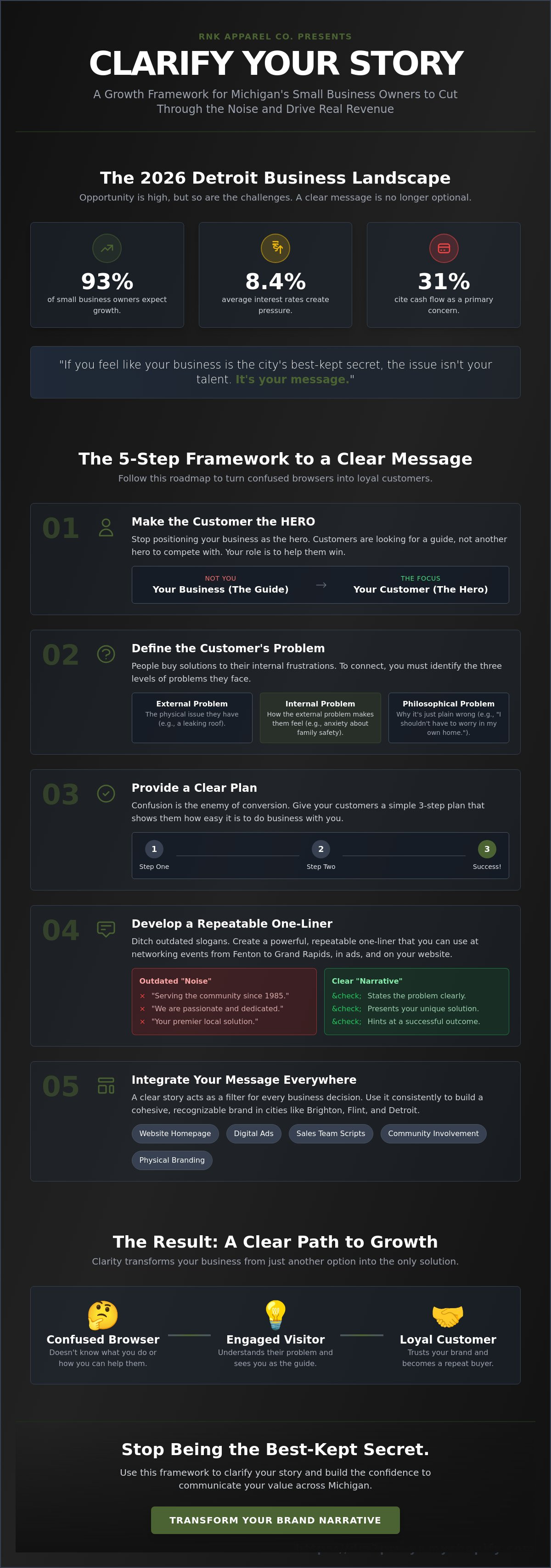
Did you know that 93% of Detroit small business owners expect growth in 2026, even while facing 8.4% interest rates? It's a crowded market where simply being good at what you do is no longer enough to win. If you feel like your business is the city's best-kept secret or you're tired of watching potential customers bounce off your website, the issue isn't your talent. The issue is your message. To cut through the noise and reach a local audience that's increasingly cautious with their spending, you must clarify your story. When you eliminate confusion, you stop being an option and start being the solution.
You likely feel the pressure to make every marketing dollar count, especially since 31% of local owners now cite cash flow as their primary concern. This guide will show you how to transform your brand narrative into a tool that drives real revenue. You'll learn how to create a repeatable one-liner, optimize your website to convert visitors into leads, and build the confidence to communicate your value across Michigan. We're moving past vague slogans to provide a framework that turns confused browsers into loyal customers.
Key Takeaways
- Shift your marketing perspective to make the customer the hero of the narrative, ensuring your message addresses the specific problems they're trying to solve.
- Use a proven 7-part framework to clarify your story, which helps remove the "noise" that often leads to high bounce rates on Michigan business websites.
- Identify why outdated slogans like "serving the community since 1985" don't resonate and learn what local customers actually need to hear to make a purchase.
- Develop a foundational BrandScript and a repeatable "one-liner" that you can use everywhere from digital ads to networking events in Fenton or Grand Rapids.
- Explore ways to integrate your clear message into physical branding and community involvement in cities like Brighton and Flint to build a cohesive, recognizable brand.
What Does It Mean to Clarify Your Story in 2026?
In the current Detroit economy, the stakes for communication have never been higher. While 93% of local small business owners anticipate growth this year, they are doing so against a backdrop of 8.4% interest rates and tightening cash flow. In this environment, every word on your website or in your ads must work for you. To clarify your story means to strip away the "noise" of your internal business operations and focus entirely on the transformation you provide for your customer. It's the process of closing the clarity gap, which is the distance between what you think you are saying and what your audience actually hears.
The human brain is biologically programmed to tune out information that doesn't help it survive or thrive. If a customer has to burn too many calories trying to figure out what you sell, they will simply move on to a competitor who makes it easier. This isn't just a creative exercise; it is a vital part of a modern Content Marketing Strategy. When you have a clear narrative, it acts as a filter for every business decision you make. It dictates what goes on your homepage, what your sales team says on the phone, and even which community events in Wayne County are worth your time.
The Difference Between Noise and Narrative
Most Michigan business websites function like "inside-out" brochures. They lead with their founding date, their office location, or their mission statement. This is noise. A true narrative positions the customer as the hero and your business as the guide. Customers don't want to hear that you're the best; they want to hear that you understand their problem. By shifting your messaging from "look at us" to "we can help you," you align with how the human brain processes information. You stop being a confusing distraction and start being a necessary resource.
Why Local Brands in Detroit and Flint Need Clarity Now
The local service market in cities like Detroit and Flint has become increasingly saturated. With 58% of small businesses now integrating AI into their operations, the volume of content being produced is staggering. Standing out requires more than just being louder. It requires being clearer. A clear story builds immediate community trust because it proves you know your neighbors' specific pain points. In 2026, local loyalty is no longer built on transactions alone. It's built on a shared story where the customer feels seen, heard, and understood by a brand that speaks their language.
The 7-Part Framework: A Roadmap to a Clear Message
Building a brand that resonates in the Detroit market requires more than just a catchy slogan. It requires a structured framework that guides your customer through a logical journey. When you clarify your story, you transition from a business that lists features to a brand that offers a transformation. This journey begins by identifying the "Character" of your story. Contrary to what many local leaders believe, your business is not the hero. Your customer is. If you position yourself as the hero, you're actually competing with your customer for the spotlight. Instead, you must step back and let them take center stage.
Every hero faces a problem. To connect deeply, you must define the three levels of conflict your audience faces: external, internal, and philosophical. For instance, a Detroit resident might have an external problem like a failing HVAC system. Their internal problem is the stress of an unsafe home for their children. Philosophically, they believe they shouldn't have to choose between a warm house and their monthly savings. Once you identify these, you position yourself as the "Guide." A guide provides a clear, 3-step plan to resolve the conflict. This reduces the customer's "mental friction" and makes the path forward obvious. Finally, you must offer a direct call to action. In a market where 31% of owners are worried about cash flow, people won't spend money if they aren't sure how to buy from you.
Defining the Customer’s Internal Problem
People don't just buy products; they buy solutions to internal frustrations. A homeowner in Flint might need a new roof (external), but they are actually buying the peace of mind that their family is protected (internal). If you only talk about shingles and warranties, you miss the emotional hook. The #1 frustration for a Flint small business owner is often the feeling that their hard work is being ignored by a community that doesn't understand the value they provide. Addressing this specific anxiety is how you build a narrative that sticks.
Building Authority Without Bragging
Authority is about competence, not ego. You can demonstrate your ability to help by highlighting local testimonials or mentions in Michigan-based media outlets. This proves you've helped people just like them without making the conversation all about your achievements. By showing empathy for their situation and the competence to fix it, you earn the right to lead. If you're ready to start applying these principles to your own marketing, you can explore our strategic resources designed to help local businesses scale. Remember, the goal of the guide is to lead the hero to a win, not to take the credit for the victory.
Overcoming the "Noise" in the Michigan Market
Many business owners in Grand Rapids and Fenton believe that their biggest challenge is a lack of exposure. They think that if they just spend more on ads or post more on social media, the leads will follow. However, the real obstacle is often the "noise" they are creating themselves. When you fail to clarify your story, you end up shouting into a crowded room without saying anything that sticks. In a market where month-over-month small business sales growth was flat at 0.0% in April 2026, you can't afford to waste a single interaction on a confusing message. You aren't just competing with the shop down the street; you're competing with every notification on your customer's phone.
One of the most common mistakes is leading with "insider baseball" jargon. Whether you're in manufacturing or marketing, using technical terms that only your peers understand alienates your local audience. Another trap is the "Hero Boast." Stating that you've been "serving the community since 1985" might feel like a badge of honor, but it doesn't tell a customer in Brighton how you'll solve their problem today. Your history is only relevant if it proves you have the experience to be their guide. If your message is buried under industry buzzwords or self-congratulatory facts, your potential clients will move on to someone who speaks their language.
The "Grunt Test" for Michigan Websites
To audit your clarity, you need to perform the "Grunt Test." Imagine a caveman looking at your website for five seconds. Could he grunt the answers to three basic questions?
- What do you offer?
- How will it make my life better?
- What do I need to do to buy it?
Local Competition: Why Being "Better" Isn’t Enough
In a saturated Michigan service market, being the "best" is a subjective claim that's hard to prove. However, being the "first to be clear" is a massive competitive advantage. While your competitors are busy listing their 50 different services, you can win by focusing on the one transformation your customer wants most. Your local roots should be framed as a guide credential. Instead of saying "We're local," say "Because we live in Flint, we know exactly how the local climate affects your foundation." This shifts the focus from your identity to your ability to solve their specific, regional problem.
Step-by-Step: Implementing Your Story in Your Business
Implementing a clear message shouldn't require a massive corporate budget. While some national agencies charge tens of thousands for brand workshops, you can clarify your story by focusing on a few key documents. The first is your BrandScript. This is a simple, one-page document that summarizes the story framework for your specific business. It serves as the "north star" for all your marketing efforts. Whether you're designing a billboard for I-96 or writing an email to a client in Grand Rapids, you check every word against your BrandScript first.
Once your script is set, you must train your team to use it. If your staff in Detroit can't explain what you do in two sentences, your customers won't understand it either. Consistency is key across all departments. After implementation, track your results carefully. Look for a decrease in website bounce rates and an increase in lead form submissions. If you're using AI tools (integrated by 58% of small businesses as of Q1 2026), ensure the prompts you use are based on your specific BrandScript to maintain a human, local feel.
Crafting the Perfect Local One-Liner
A one-liner is your elevator pitch. It follows a specific four-part formula: the Character, the Problem, the Plan, and the Success. For example, a Fenton-based home inspector might say: "We help local homebuyers avoid expensive structural surprises with a 24-hour inspection report that guarantees peace of mind." It's short, punchy, and focuses on the win. Here is a sample you can adapt: We help Detroit families lower energy bills with efficient HVAC installs for year-round comfort.
The Lead Generator: Capturing Interest Beyond the Sale
Not everyone is ready to buy immediately. In a market where cash flow is a top concern for 31% of business owners, you need to provide value first to clarify your story as a helpful partner. Create a "Lead Generator," such as a PDF guide titled "5 Ways to Protect Your Michigan Business from Inflation." This positions you as the Guide rather than a pushy salesperson. It builds trust by solving a small problem for free. Follow this up with an automated email sequence that continues the story. If you need help building these assets, check out our implementation tools to get started today.
Living Your Story: Beyond the Script in Detroit and Beyond
A clear message is only as strong as its execution across your entire operation. Once you clarify your story, the next challenge is ensuring that narrative doesn't get lost as you scale. With 59% of Detroit business owners planning to expand and 43% planning to hire in 2026, the risk of "story drift" is real. When new employees join your team, they must be onboarded into the story just as much as they are trained on technical tasks. If your internal culture doesn't mirror the external promise you've made to your customers in Wayne or Oakland County, the resulting friction will eventually erode your brand's credibility.
Maintaining consistency requires a commitment to your BrandScript in every interaction. Whether you're capitalizing on major local events to boost social media growth or managing cash flow during periods of inflation, your story remains the filter for your decisions. In a market where 91% of business owners are adopting digital tools, the human element of a clear story becomes your greatest differentiator. It's the reason a customer chooses a local shop in Flint over a faceless national chain. Your story isn't just something you say; it's the experience you deliver from the first click to the final handshake.
Physical Touchpoints: Merch, Signage, and Shops
Your story should be visible before a customer even walks through your door. In Grand Rapids, your storefront signage should immediately pass the "grunt test" we discussed earlier. If you sell apparel or streetwear, use those items to turn your customers into advocates. A t-shirt shouldn't just have a logo; it should represent the "success" your hero is looking for. When your physical presence in the community matches your digital narrative, you build a cohesive brand that feels stable and trustworthy. This alignment is crucial for the 93% of Detroit businesses expecting growth this year.
Your Local Legacy: Success and Failure
Every great story has high stakes. To clarify your story, you must be honest about what your customer stands to lose if they don't work with you. In the Michigan market, "failure" might mean a homeowner's basement flooding during a spring thaw or a small business owner losing their competitive edge due to poor marketing. Conversely, "success" is the peace of mind and prosperity that comes from a problem solved. By clearly defining these outcomes, you give your audience a reason to care. Don't let your business remain a hidden gem while your competitors take the lead. You can start clarifying your brand story today with our local Michigan team and build a legacy that lasts.
Secure Your Competitive Edge in the Michigan Market
The Detroit economy is recalibrating, and the businesses that thrive will be those that communicate with absolute precision. By shifting your focus from your own history to the customer's transformation, you remove the mental friction that causes high bounce rates. You've seen how a structured 7-part framework and a punchy one-liner can turn a confusing website into a lead-generating machine. Now is the time to clarify your story and ensure your message resonates from the streets of Grand Rapids to the storefronts of Flint.
Success in 2026 requires more than just local roots; it requires a results-driven narrative that proves you understand the specific challenges your neighbors face. Whether you are updating your digital presence or refining your physical branding, staying consistent is your best defense against market noise. If you're ready to stop losing customers to confusion, we're here to help you build a brand that works as hard as you do. Clarify Your Story and Grow Your Business with a practical, local approach. Your business has a powerful role to play in Michigan's growth, and your customers are waiting to hear it.
Frequently Asked Questions
How long does it take to clarify a brand story?
Drafting the core elements of your narrative typically takes between two and four hours of focused work. However, the full implementation across your website, social media, and sales collateral usually spans two to four weeks. This timeframe allows for testing your message with local customers to ensure it resonates before you commit to a full-scale launch.
Do I need to hire a certified guide to use the StoryBrand framework?
No, you don't need to hire a professional to begin using these principles. While a guide provides expert oversight and can speed up the process, many Michigan business owners successfully apply the 7-part framework on their own. By focusing on the customer's problem and your role as their guide, you can create a compelling message without a large initial investment.
What is the most common mistake in clarifying a story?
The most frequent error is positioning the business as the hero of the story instead of the guide. When a brand leads with its own accolades or history, it inadvertently competes with the customer for the spotlight. To clarify your story effectively, you must focus on the customer's journey and how your expertise helps them overcome their specific challenges.
Can I clarify my story if I have multiple different products or services?
Yes, you can manage multiple offerings by creating an "umbrella" narrative for your brand and individual scripts for each service line. The key is to find the common internal frustration that all your customers share. Once you've established that core theme, you can tailor the specific plan and success outcomes for each individual product you sell in the Michigan market.
How does clarifying my story help with local SEO in Michigan?
Clarity significantly improves user engagement metrics, such as time on page and bounce rates, which are vital signals for search engines. When your message is clear, visitors from cities like Detroit or Grand Rapids stay on your site longer because they immediately understand your value. This increased engagement tells Google that your content is high-quality and relevant to local search queries.
What is a BrandScript and why do I need one?
A BrandScript is a foundational document that serves as the "north star" for all your marketing and communication efforts. It maps out the seven essential elements of your story in one place so your messaging remains consistent across all platforms. Without this document, businesses often suffer from "story drift," where their message becomes diluted and confusing as they grow.
How much does it cost to implement a new brand narrative?
The cost varies based on whether you update your materials in-house or hire outside help for design and copywriting. While the strategy itself can be developed for free, you should account for the time required to update your digital and physical assets. Many local businesses choose to roll out changes incrementally to manage their cash flow while still benefiting from a clearer message.
What is the "Grunt Test" for websites?
The Grunt Test is a five-second audit that determines if your website is clear enough for a first-time visitor to understand. It asks if a user can immediately identify what you offer, how it makes their life better, and how they can buy it. If your homepage requires too much "brain fuel" to navigate, potential leads will likely leave and find a clearer competitor.
Disclaimer
Some content published on this website may be developed with the assistance of AI-powered research and writing tools to help streamline research, organization, and content creation. All articles are reviewed, edited, and approved by Marvin Growth Partners to ensure they align with our perspectives, experience, and intended messaging.
While we strive to provide accurate and up-to-date information, blog content is intended for informational and educational purposes only and should not be considered legal, financial, or professional advice. Readers should independently verify information and consult qualified professionals when appropriate.