

D2C Growth Strategies for Apparel: Scaling Your Brand in 2026
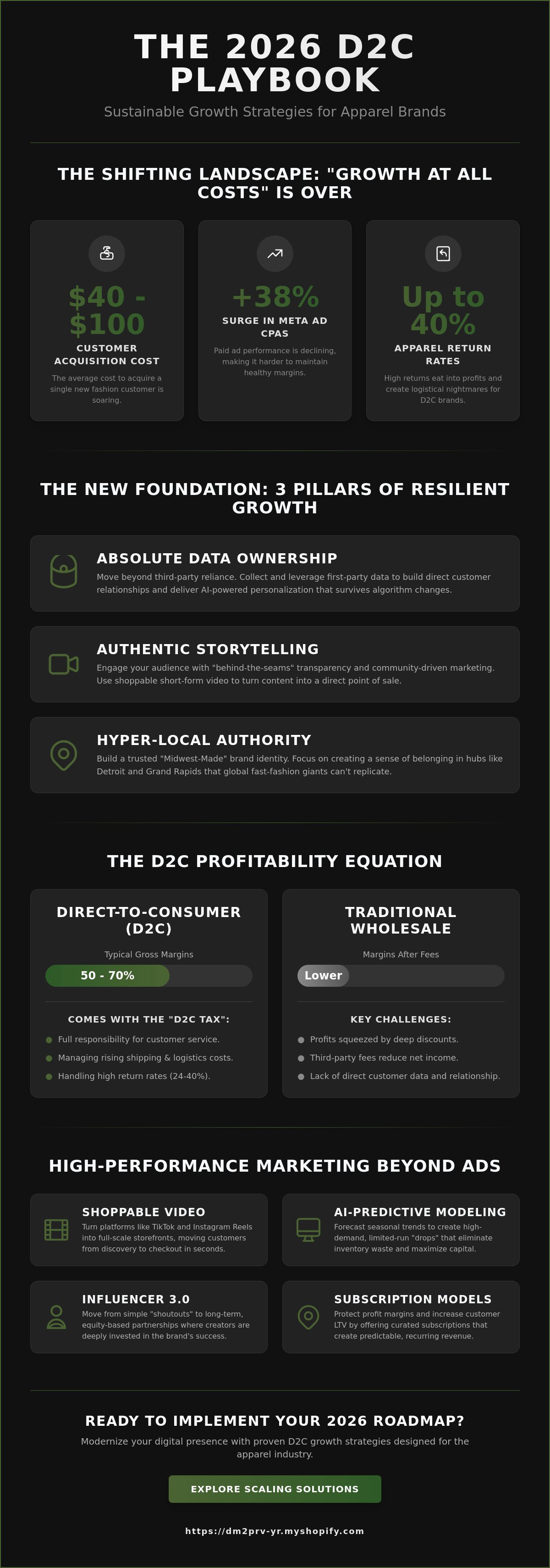
With Customer Acquisition Costs (CAC) for fashion brands now averaging between $40 and $100 per customer, the old "growth at all costs" model is officially dead. You've likely felt the pressure as Meta ad CPAs surged by 38% since last year, making it harder than ever to maintain healthy margins. If you're struggling to compete with global fast-fashion giants while managing return rates as high as 40%, you aren't alone. It's time to shift your focus toward sustainable d2c growth strategies for apparel that prioritize building a resilient, local community over simply buying clicks.
We'll show you how to master the latest direct-to-consumer tactics to scale your brand, reduce acquisition costs, and foster deep loyalty in Michigan and beyond. You'll learn why "Hyper-Local Digitalization" is the key to winning in 2026 by connecting with shoppers in Detroit or Grand Rapids on a personal level. This guide previews a future of predictable revenue and higher customer lifetime value through AI-powered personalization and community-driven marketing that survives any algorithm change.
Key Takeaways
- Shift your focus from expensive, ad-heavy tactics to community-first scaling that builds long-term brand resilience.
- Capitalize on shoppable short-form video and deep influencer partnerships to drive high-performance sales beyond basic social media ads.
- Establish hyper-local authority in Michigan hubs like Detroit and Grand Rapids to create a trusted "Midwest-Made" brand identity.
- Adopt proven d2c growth strategies for apparel by using first-party data and subscription models to protect your profit margins.
- Audit your current technology and master one core channel before expanding to ensure your brand is ready for 2026 scale.
What are D2C Growth Strategies for Apparel in 2026?
Scaling a brand in the current market requires more than just a great product; it demands a total shift in how you reach your audience. Implementing effective d2c growth strategies for apparel means embracing a Direct-to-consumer (D2C) business model that removes the middleman and lets you sell directly to end-users via your own digital channels. In 2026, this isn't just about having a website. It's about owning the entire relationship, from the first time someone sees your brand on social media to the moment they unbox their order.
The 2026 shift is defined by a move away from "ad-heavy" growth toward community-first sustainable scaling. With Meta ad CPAs rising by 38% since last year and average customer acquisition costs (CAC) for apparel sitting between $40 and $100, buying your way to the top is no longer a viable long-term plan. Instead, successful brands are focusing on three core pillars: absolute data ownership, authentic storytelling, and localized fulfillment. These pillars allow you to build a resilient business that doesn't crumble every time a social media platform changes its algorithm.
In Michigan, apparel has become the leading D2C category because local brands are leveraging their unique regional identity. By focusing on city-specific roots in places like Detroit and Grand Rapids, these companies create a sense of belonging that global fast-fashion giants can't replicate. When you combine this local trust with modern d2c growth strategies for apparel, you create a brand that customers don't just buy, they join.
The Evolution of Direct-to-Consumer Fashion
The fashion landscape has transformed from the basic e-commerce sites of the 2010s into the immersive digital experiences we see in 2026. Traditional retail partnerships in Michigan, which were once the primary goal for new designers, are now secondary to owned digital storefronts. This evolution is driven by 2026 consumer privacy laws that make third-party tracking more difficult. To survive, brands must now prioritize gathering first-party data directly from their customers to provide the personalized experiences that shoppers now expect as a minimum standard.
D2C vs. Wholesale: The Profitability Reality
The financial appeal of D2C is clear when you look at the margins. While wholesale often squeezes profits through deep discounts and third-party fees, the D2C apparel standard typically offers gross margins between 50% and 70%. However, these higher margins come with significant responsibilities. You must manage your own customer service, navigate rising shipping costs, and handle return rates that often range from 24% to 40% in the apparel sector. The "D2C tax" is the fundamental shift of capital from offering wholesale discounts to funding the high costs of direct customer acquisition and logistics.
High-Performance Marketing: Moving Beyond Basic Social Ads
Static image ads are no longer the engine of growth they once were. While Meta ads for apparel still maintain an average click-through rate of 1.24%, the rising costs of customer acquisition require a more dynamic approach. To achieve sustainable scaling, modern d2c growth strategies for apparel must prioritize video commerce and shoppable content. In 2026, the brands winning the market are those that treat every piece of content as a direct point of sale, allowing customers to move from discovery to checkout in seconds.
Success now relies on AI-predictive modeling to stay ahead of the curve. By analyzing historical data and current social sentiment, brands can forecast Michigan seasonal trends months before the first snow hits Detroit. This data-driven foresight allows you to implement "drop culture" effectively. Releasing limited-run collections based on these predictions creates a sense of urgency that maintains high demand while virtually eliminating the inventory waste that plagues traditional retail. This lean approach ensures your capital remains in your growth engine rather than sitting on a warehouse shelf.
Moving beyond simple "shoutouts" is also essential. Influencer 3.0 is about long-term equity-based partnerships where creators are deeply invested in the brand's success. These relationships feel more like collaborations than paid advertisements, which is vital for building trust with a modern audience. If you are ready to modernize your digital presence, you can explore customized scaling solutions designed for the apparel industry.
Short-Form Video and Shoppable Content
TikTok and Instagram Reels have evolved into full-scale storefronts. Turning these platforms into checkout points requires a blend of high-energy entertainment and "behind-the-seams" transparency. Showing the craftsmanship in your studio or the daily life of your team builds a layer of trust that static ads cannot replicate. User-generated content (UGC) should serve as your primary ad creative; it feels authentic to the platform and often results in higher engagement because it looks like a recommendation from a friend rather than a corporate pitch.
Niche Influencer Networks in Michigan
Hyper-local marketing is the secret weapon for brands in the Great Lakes State. Detroit-based micro-influencers often outperform national celebrities because their followers share a specific cultural context and regional pride. Building a "Street Team" in cities like Flint and Fenton can drive significant digital engagement through grassroots movements. By collaborating with local Michigan skate and streetwear icons, your brand gains an authentic seal of approval that resonates deeply with the local community, creating a loyal base that survives broader market shifts.
The Michigan Advantage: Building Hyper-Local Community Authority
Regional identity has become a primary differentiator in an oversaturated market. In 2026, "Midwest-Made" serves as a powerful trust signal for consumers who are increasingly skeptical of anonymous global fast-fashion giants. By centering your d2c growth strategies for apparel on Michigan hubs like Detroit, Grand Rapids, and Brighton, you create a brand epicenter that feels tangible and authentic. This isn't just about geography; it's about tapping into a shared cultural pride that drives deep customer loyalty.
Capturing local search intent is a vital part of this strategy. While your competitors fight for broad national keywords, you can dominate high-intent searches like "streetwear near me" or "boutique apparel Detroit." This localized SEO approach allows you to acquire customers at a fraction of the cost of broad digital campaigns. You aren't just selling a shirt; you're offering a piece of the local culture, which makes your brand much harder to ignore in a crowded social media feed.
Leveraging phygital strategies, such as hosting pop-up events in Fenton, serves as a bridge between the physical and digital worlds. These events are excellent opportunities to fuel your online newsletter signups and gather first-party data. When a customer interacts with your brand in person, their likelihood of becoming a repeat digital buyer increases significantly. This local presence builds a "fortress" around your brand that protects you from the volatility of international market trends.
Harnessing the Detroit and Grand Rapids Creative Scenes
Partnering with local Michigan artists for limited-edition apparel drops turns a standard product into a collector's item. These collaborations provide a unique story that resonates with the community and provides fresh content for your social channels. Sponsoring local skate competitions or fashion mixers in Grand Rapids builds genuine credibility with subcultures that value authenticity above all else. You can also use geo-fenced mobile ads to target shoppers while they are attending Michigan fashion events, ensuring your brand stays top-of-mind long after the event ends.
Phygital Marketing: Bridging the Gap
The "Showroom" model is a game changer for scaling brands. A small physical footprint in a high-traffic area like Brighton can triple online sales by giving customers a place to feel the fabric and verify their size before they commit to a purchase. This directly addresses the high return rates, often between 24% and 40%, that plague the apparel industry. Placing QR codes in local Michigan shops that lead to exclusive D2C online collections creates a seamless path from foot traffic to digital conversion. Industry professionals report that hyper-local Michigan events can reduce online CAC by up to 40% by capturing high-intent leads in a low-competition environment.
The Retention Engine: Protecting Margins and LTV
Scaling isn't just about finding new customers; it's about keeping the ones you have. With customer acquisition costs (CAC) for apparel brands now sitting between $40 and $100, relying solely on first-time buyers is a recipe for thin margins. Effective d2c growth strategies for apparel in 2026 focus on building a "fortress" around your first-party data. By owning your customer list and moving away from third-party tracking, you insulate your brand from the volatility of ad platforms. SMS marketing has emerged as the highest-converting channel for Michigan streetwear drops, providing a direct line to your most engaged fans without the noise of a social media feed.
Predictable revenue is the holy grail of D2C. Subscription models, such as a "Sock of the Month" or seasonal basics replenishment, provide the recurring cash flow needed to weather slow periods. To further protect your bottom line, AI-predictive modeling and fit-technology are now essential. Some industry professionals report that integrating virtual try-on tools can reduce return rates by as much as 30%, directly addressing one of the industry's biggest profit drains. If you're ready to improve your customer lifetime value, you can start building your retention strategy today.
Solving the Return Rate Crisis
Return rates for D2C apparel are notoriously high, often ranging from 24% to 40%. You can fight this by implementing "Fit-Quizzes" that help shoppers choose the right size based on real-world data. Using sizing charts that account for regional body types can also improve accuracy. When a return does happen, the psychology of offering store credit over a refund is powerful. It keeps capital within your business and encourages the customer to try a different style rather than walking away entirely.
Loyalty Programs that Actually Work
Modern loyalty programs must move beyond simple points systems. In 2026, your best customers want access. This includes early access to new drops or invitations to exclusive events in Detroit or Grand Rapids. Gamification is another powerful tool; reward your community for sharing photos of your gear on social media. Creating tiered VIP levels, like an "Inner Circle" for your most loyal Michigan fans, fosters the kind of community-driven growth that survives any algorithm change. Implementing these d2c growth strategies for apparel ensures your brand remains profitable even as advertising costs continue to rise.
Implementing Your 2026 Growth Roadmap
Execution is the bridge between a great idea and a profitable brand. To successfully deploy d2c growth strategies for apparel, you must first audit your current tech stack to ensure it can handle the demands of 2026 scaling. Platform costs have shifted; for instance, the Shopify Basic plan now sits at $39 per month, while the Grow plan is $105 per month. You also need to account for rising logistics costs, such as the 7.8% average increase in USPS Ground Advantage rates and the $11.99 minimum charge for FedEx Ground packages. Knowing these numbers upfront prevents your margins from being eroded by "hidden" operational expenses as you grow.
Prioritizing your channels is just as critical as your technology. Many brands fail because they try to master five platforms at once and end up mediocre at all of them. Instead, focus on mastering one primary acquisition channel before expanding. As you scale, shift your key performance indicators (KPIs) from Return on Ad Spend (ROAS) to Marketing Efficiency Ratio (MER). While ROAS only tracks individual platform performance, MER measures your total revenue against your total marketing spend, providing a clearer picture of your brand's overall health and sustainability.
The 90-Day D2C Scale Plan
Success requires a structured approach to growth. During Month 1, focus on data cleanup and building your first-party list to insulate yourself from rising ad costs. Month 2 is dedicated to content engine activation; this is the time to seed influencers in Detroit and Grand Rapids with your latest designs. By Month 3, you should be ready for paid media scaling and retention automation. This phased approach ensures you have the infrastructure to support new customers without sacrificing the personalized experience that built your initial community.
Why Local Expertise Matters for Global Scale
Working with a team that understands the specific nuances of the Michigan market provides a distinct advantage. A partner who knows the Fenton and Brighton landscapes can help you navigate regional trends and logistics more effectively than a generic global agency. We recommend a "Hub and Spoke" growth model: establish a dominant presence in your local Michigan hub first, then use that momentum to expand your reach nationally. If you are ready to scale your brand, you can get a custom D2C strategy audit to identify your biggest growth opportunities for the coming year. This localized expertise ensures your d2c growth strategies for apparel are grounded in real-world data and community roots.
Future-Proof Your Brand in the Michigan Market
Scaling in 2026 isn't just about spending more; it's about spending smarter. You've seen how community-driven roots in Detroit and Grand Rapids can lower acquisition costs while building lasting loyalty. By integrating AI-powered fit technology and local phygital events, you're not just selling clothes; you're building a resilient ecosystem that survives algorithm shifts. This approach turns first-time buyers into lifelong advocates who value your brand's regional identity and commitment to quality.
Mastering these d2c growth strategies for apparel requires a partner who understands both the technical landscape and the unique culture of the Great Lakes State. We specialize in 2026 e-commerce tech stacks and have deep roots in Michigan skate and streetwear culture. Whether you're based in Fenton or Brighton, we provide the local support needed to take your brand national. Scale Your Apparel Brand with Michigan's D2C Experts today. The path to sustainable growth starts with a single, data-driven step. Your brand's next chapter is waiting.
Frequently Asked Questions
What is a good customer acquisition cost (CAC) for apparel in 2026?
A good CAC typically falls between $40 and $100 for the apparel and fashion sector as of early 2026. This range reflects the increased cost of advertising on major platforms like Meta, where the median cost per acquisition rose by 38% from 2025. Brands should aim for a CAC that allows for a healthy return on ad spend, keeping in mind that the median ROAS for fashion on Google Ads is currently 4.07x.
How can Michigan apparel brands compete with fast-fashion giants like Shein?
Local brands compete by prioritizing regional authority and community-driven d2c growth strategies for apparel that global giants can't replicate. While fast-fashion relies on volume and low prices, Michigan brands should focus on "Midwest-Made" quality and hyper-local storytelling in hubs like Detroit. Leveraging micro-influencers and hosting phygital events in Fenton or Brighton builds a level of trust and authentic connection that mass-market algorithms simply can't match.
Is it better to use Shopify or a custom platform for a growing D2C brand?
Shopify is the preferred choice for most growing brands due to its robust ecosystem and predictable pricing tiers. In 2026, the Shopify Grow plan costs $105 monthly, or $79 if billed annually, providing a scalable foundation without the high development costs of a custom platform. For large-scale operations, Shopify Plus starts at $2,300 monthly, offering advanced features that allow brands to focus on sales rather than managing complex server infrastructure.
How do I reduce my apparel return rates without hurting sales?
Reducing return rates, which currently range from 24% to 40% in the D2C sector, requires better sizing accuracy and product visualization. Implementing AI-powered fit quizzes and detailed sizing charts based on real customer data can lower returns by ensuring shoppers get the right fit the first time. Offering store credit instead of cash refunds also helps keep capital within the business while encouraging customers to find a style that works better for them.
Should my apparel brand focus on TikTok or Instagram for growth in 2026?
Most successful brands use both, but the focus should shift based on where your specific subculture lives. TikTok is dominant for viral discovery and shoppable short-form video, while Instagram remains a core channel for aesthetic branding and building long-term community loyalty. Since the average conversion rate for D2C apparel is between 1.45% and 1.9% in 2026, a multi-channel approach ensures you capture shoppers at different stages of the buying journey.
What are the most effective loyalty strategies for streetwear brands?
Effective loyalty strategies move beyond basic points to offer exclusive access and community membership. Streetwear fans value early access to limited-edition drops and invitations to local events in Grand Rapids or Detroit. Gamifying the experience by rewarding customers for sharing user-generated content on social media also builds organic reach. These d2c growth strategies for apparel foster a sense of belonging that keeps customers coming back regardless of platform changes.
How much should I spend on influencer marketing as a local Michigan brand?
Influencer spend should be dictated by your customer acquisition targets and the specific reach of local micro-influencers. Rather than chasing national celebrities, focus on Detroit-based creators who offer higher engagement rates within your target demographic. Many brands find success by dedicating a percentage of their marketing budget to long-term equity-based partnerships. This ensures creators are genuinely invested in the brand's growth rather than just providing a one-time shoutout.
What is the 'Marketing Efficiency Ratio' (MER) and why does it matter more than ROAS?
MER is calculated by dividing total revenue by total marketing spend across all channels. While ROAS looks at individual ad performance, MER provides a holistic view of your brand's efficiency and overall profitability. In a market where Meta's median ROAS is 2.65x and Google Shopping Ads CPC can reach $1.02, MER helps you understand if your combined efforts are actually growing the business sustainably. It accounts for the halo effect of various channels working together.
Disclaimer
Some content published on this website may be developed with the assistance of AI-powered research and writing tools to help streamline research, organization, and content creation. All articles are reviewed, edited, and approved by Marvin Growth Partners to ensure they align with our perspectives, experience, and intended messaging.
While we strive to provide accurate and up-to-date information, blog content is intended for informational and educational purposes only and should not be considered legal, financial, or professional advice. Readers should independently verify information and consult qualified professionals when appropriate.