

Detroit Marketing Audit Checklist: What's Included?
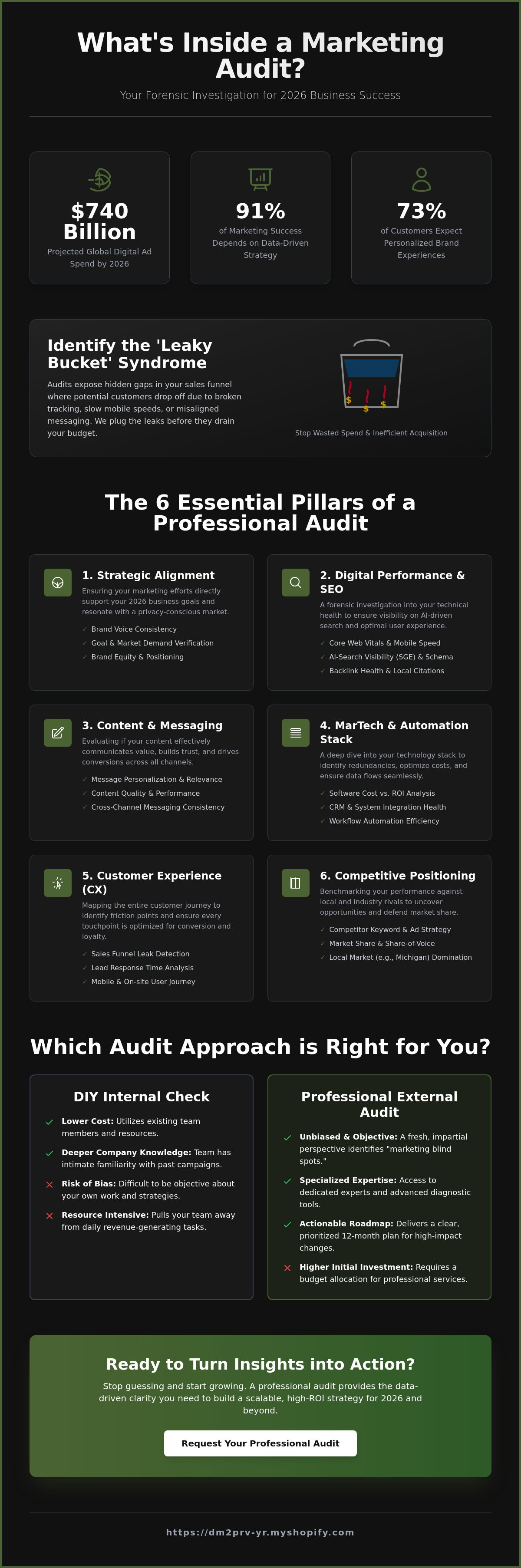
Global digital ad spending is projected to reach $740 billion by 2026, yet 91% of marketing success now depends on strict, data-driven strategies. If you're tired of seeing your budget disappear without a clear ROI while local Michigan rivals seem to dominate the search results, you need to know exactly what's included in a marketing audit. This process is far more than a simple checklist. It's a forensic investigation into your technology, brand equity, and local market positioning designed to stop wasted spend and fix inconsistent messaging.
It's easy to feel overwhelmed by the fragmented digital landscape of 2026, especially with new FCC rules on AI voices and consent revocation making compliance feel like a legal minefield. We understand the frustration of finding "leaky buckets" in your sales funnel. This article provides a clear roadmap for the next 12 months by outlining the exact components of a professional audit. You'll learn how to benchmark your performance against competitors and use your data to build a scalable strategy that actually converts.
Key Takeaways
- Understand why a 360-degree diagnostic is essential for navigating 2026's volatile market and making rapid strategic pivots.
- Explore the six core pillars of a professional review to understand what's included in a marketing audit and how they impact your ROI.
- Compare the benefits of a DIY internal check against a professional external audit to choose the best path for your annual planning.
- Identify the specific tracking, financial, and CRM data you must prepare to uncover hidden "leaky buckets" in your sales funnel.
- Learn how to turn audit findings into an actionable 12-month roadmap that prioritizes immediate high-impact changes.
Why a Marketing Audit is Mandatory for 2026 Business Success
A marketing audit is a 360-degree diagnostic of your brand's health. It's not just a performance review; it's a forensic investigation. In Detroit's competitive business hubs, from the tech startups in Midtown to the established manufacturing firms in Dearborn, the cost of inaction is high. If you're wondering What's Included in a Marketing Audit?, you're already one step ahead of competitors who still rely on "gut feelings" to drive their strategy. Standing still in the Michigan market is the same as moving backward.
The 2026 digital environment is more fragmented than ever. With global digital ad spending projected to reach $740 billion this year, the noise is deafening. A surface-level check might show you're spending money, but it won't show you why your ROI is stagnant. A forensic audit digs into the "why" behind the numbers. It examines how AI-generated voice regulations or the latest FCC opt-out rules are impacting your local outreach. Without this deep dive, you're essentially flying blind in a storm.
The Difference Between Analysis, Assessment, and Audit
It's common to confuse these three terms, but they serve very different purposes in a professional strategy:
- Analysis involves looking at specific data points in a vacuum. It tells you what happened yesterday but lacks broader context.
- Assessment is a subjective evaluation of your team’s skills, internal processes, or current brand messaging.
- Audit is the objective, evidence-based verification of your entire marketing engine, systems, and results.
While an analysis might show a drop in website traffic, an audit will prove that your technical SEO is failing or that your local Michigan rivals are outbidding you on high-intent keywords. Verification is the key to growth.
Identifying the 'Leaky Bucket' Syndrome in Your Funnel
Most underperforming campaigns aren't failing because of bad creative. They're failing because of "leaky buckets." These are hidden gaps in your sales funnel where potential customers drop off due to broken tracking, slow mobile load speeds, or misaligned messaging. Audits expose the "Marketing Blind Spot," those areas where you think you're winning but are actually losing money on inefficient customer acquisition. By knowing What's Included in a Marketing Audit?, you can systematically plug these leaks before they drain your resources. A marketing audit acts as a financial firewall that protects your 2026 budget from being consumed by invisible inefficiencies.
The 6 Essential Pillars: What’s Actually Included in the Audit?
A professional audit isn't just a spreadsheet of social media likes. It's a structural review of your entire business engine. To truly understand What's Included in a Marketing Audit?, you have to look beyond surface metrics and evaluate the six pillars that sustain your growth. This includes verifying that your 2026 goals align with actual market demand in the Great Lakes region and ensuring your brand voice remains consistent from your Instagram ads to your physical storefront in Royal Oak. Right now, 73% of customers expect personalized experiences. If your audit doesn't reveal how to deliver that personalization, it's incomplete.
Strategic alignment ensures you aren't chasing outdated trends. In 2026, this means checking if your messaging resonates with a privacy-conscious audience. Your digital footprint covers SEO, paid media, and social engagement, but the audit must also scrutinize the Customer Experience (CX). It's not enough to get a lead; you need to audit how that lead becomes a loyalist. If your sales team takes too long to respond to a query, your marketing spend is being thrown away. If you're feeling overwhelmed by your current software costs, our marketing strategy experts can help streamline your operations and identify high-impact wins.
Digital Performance & Technical SEO Audit
When you Conduct a Digital Marketing Audit, you must prioritize technical health. This includes checking visibility in AI-driven search engines like Google's SGE or Perplexity. For Michigan businesses, accuracy in local directories is vital for capturing regional intent. We look at:
- Core Web Vitals and mobile responsiveness.
- AI-search visibility and schema markup.
- Backlink health and local citation accuracy in Detroit and Grand Rapids directories.
- Conversion rate optimization (CRO) for high-traffic landing pages.
Marketing Technology (MarTech) & Automation Stack
A deep dive into What's Included in a Marketing Audit? reveals that your software stack is often the biggest source of waste. Many businesses pay for multiple tools that perform the same functions. We identify tool redundancy to reclaim your budget. We also audit your CRM health to ensure your data is clean and actionable. If your automation workflows create friction instead of saving time, they need to be rebuilt or retired.
Competitive Benchmarking & Local Market Positioning
You don't operate in a vacuum. You need to know how you stack up against the top three rivals in your specific Michigan city, whether that's Flint, Ann Arbor, or Lansing. We compare your share of voice and price positioning against local competitors. By analyzing their 2026 ad spend and creative strategies, we find the gaps they've left open for you to exploit.
Internal vs. External Audits: Which Approach is Right for You?
Deciding who performs your diagnostic is just as critical as knowing What's Included in a Marketing Audit? for your specific industry. For many Detroit business owners, the choice comes down to a trade-off between cost and objectivity. An internal audit allows for deep access to your day-to-day operations and historical data. However, it often lacks the 'outside-in' perspective needed to identify why your local Michigan rivals are gaining ground. If your team built the current strategy, they might be too close to the project to see its structural flaws. This is where the 'Marketing Blind Spot' becomes dangerous for your 2026 growth.
Internal audits serve as excellent quarterly pulse checks. They're perfect for businesses with strong internal data analysts who need to optimize a single channel, like refining a Google Ads campaign or checking Instagram engagement. The main limitation is 'confirmation bias.' It's human nature to overlook mistakes in a system you created. An in-house team might see a 5% drop in conversions as a market fluctuation, whereas an external auditor might identify it as a technical failure in your lead-to-customer conversion path. If you choose the DIY route, you must ensure your team has the time to look at data objectively without feeling the need to defend their previous work.
The ROI of a Professional Third-Party Audit
A professional third-party audit provides a forensic 'blueprint' for your next 12 months. Fresh eyes find the errors that have become invisible over time, such as broken tracking pixels or misaligned CRM workflows that fail to honor the latest FCC opt-out rules. When you analyze What's Included in a Marketing Audit? from a professional perspective, you'll see that external partners also provide access to proprietary benchmarking tools and industry-wide data sets. These aren't available to the general public and are essential for accurate competitive analysis in Grand Rapids or Ann Arbor.
Objectivity saves money. With 91% of marketers attributing their success to data-driven strategies in 2026, having a neutral expert verify your data's accuracy is essential. The return on investment comes from identifying 'leaky buckets' before they drain your budget. This ensures every dollar of your marketing spend produces a measurable result. While an agency audit requires an upfront investment, it's often significantly cheaper than the cost of a failed strategy or a multimillion-dollar TCPA settlement caused by poor data handling.
Preparing for Your Audit: A Checklist of Data & Assets
Before you dive into the details of What's Included in a Marketing Audit?, you must ensure your data is accessible and organized. Preparation is the difference between a generic report and a surgical strike on your inefficiencies. Since 91% of marketers attribute their success to data-driven strategies in 2026, the quality of your audit depends entirely on the quality of your inputs. You'll need to compile a comprehensive list of assets, starting with your financial records. This means tracking every dollar of your marketing spend against revenue by channel over the last 12 months. If your budget is close to the industry average of 7.7% of total company revenue, even a small error in tracking can lead to thousands of dollars in wasted spend.
Next, gather your brand assets. This includes your internal style guides, mission statements, and all current campaign creative. Auditors use these to check for messaging consistency across different channels. If your Detroit-based storefront uses a different tone than your social media ads, your brand equity is likely being diluted. Finally, don't forget customer data. Personas, recent survey results, and churn rates provide the context needed to understand why certain segments are underperforming. To start this process with a professional framework, you can book a strategy consultation to ensure you're gathering the right metrics from day one.
Gathering Your Digital Keys
Auditors require administrative access, not just viewer permissions, for tools like Google Analytics 4 (GA4), Search Console, and your CRM. This level of access allows them to see the backend configurations where tracking errors often hide. You should also include 'shadow marketing' data, which refers to any promotional efforts happening outside your main department, such as a sales team's independent LinkedIn outreach. Providing at least three years of historical data is vital for 2026 forecasting because it helps identify long-term patterns and seasonal shifts specific to the Michigan economy.
Defining Your Specific Audit Objectives
You must decide if you're auditing for efficiency or for growth. An efficiency audit focuses on cutting costs and identifying tool redundancy. A growth audit looks for ways to scale what's already working. Setting KPIs for the audit itself ensures you get a measurable result. For businesses in the Great Lakes region, this often includes regional goals like 'Dominate Detroit search' or 'Outperform rivals in the Grand Rapids manufacturing sector.' Clearly defining these goals prevents the audit from becoming a data dump and keeps the focus on actionable outcomes.
From Insights to Action: Executing Your 2026 Marketing Roadmap
An audit without an action plan is just an expensive bookend. Once you've identified the gaps in your strategy, your first priority should be the "quick wins." These are low-effort, high-impact changes, such as fixing broken tracking pixels or updating local Michigan citations that may have drifted. When you understand What's Included in a Marketing Audit?, you realize that the most immediate value comes from plugging the "leaky buckets" identified in earlier stages. These small adjustments can often lead to a noticeable boost in lead quality before you even touch your creative assets.
The second step involves addressing structural flaws. This might mean rebuilding your MarTech stack to eliminate redundant subscriptions or fixing technical SEO issues that prevent your site from appearing in AI-search results. With 83% of sales teams that use AI reporting growth in 2026, ensuring your technology actually supports your goals is mandatory. After fixing the foundation, you can move to budget reallocation. This is where you cut funding for "zombie" channels that offer no ROI and shift those resources toward winners. For instance, if your data shows that email marketing is generating the projected $36 to $40 return for every $1 spent, it's time to double down on that channel.
Finally, you'll set a 12-month strategic calendar. This roadmap should be based on the objective findings of your audit, not on last year's habits. By aligning your campaign schedule with the seasonal trends of the Detroit market and your specific business goals, you create a predictable path for growth. It moves your team from a reactive "firefighting" mode into a proactive, data-driven rhythm.
The Executive Summary: Communicating Findings to Leadership
Presenting audit data to stakeholders requires a focus on the bottom line. Executives don't need to see every technical SEO error; they want to know how the audit impacts ROI, customer acquisition cost (CAC), and lead-to-customer conversion rates. Use your findings to build a business case for the resources you need. If the audit proves that 72% of your budget is going to digital channels but tracking is broken, leadership is far more likely to approve a tech stack upgrade. Focus on the 31% of marketers who prioritize ROI as their top metric to keep the conversation centered on business value.
Building Your Continuous Improvement Loop
A marketing audit isn't a "one-and-done" event. In the volatile market of 2026, it's an annual necessity. Successful brands set up "micro-audits" for every new campaign launch to ensure tracking is active and messaging is compliant with current FCC rules. This continuous loop prevents small errors from ballooning into multimillion-dollar liabilities. Ready to see what’s missing? Book your comprehensive marketing audit with us today.
Secure Your Competitive Edge in the Michigan Market
A thorough diagnostic is the only way to ensure your 2026 strategy remains resilient against market shifts and regulatory changes. By now, you understand that knowing What's Included in a Marketing Audit? is just the first step toward reclaiming your ROI. Success requires moving beyond simple data collection to implement a forensic review of your MarTech stack and local positioning. Whether you choose a quarterly internal pulse check or a deep-dive external review, the goal remains the same: identifying "leaky buckets" before they drain your budget.
Stop guessing which channels are working and start scaling with confidence. We provide expert analysis specifically designed for Michigan growth, focusing on a data-driven ROI approach and a comprehensive evaluation of your marketing technology. Our team helps you turn complex insights into a clear, 12-month roadmap that prioritizes your most profitable opportunities. It's time to stop wasting ad spend and start dominating your local niche.
Get Your Custom 2026 Marketing Audit Roadmap and start building a more profitable future for your business today.
Frequently Asked Questions
How long does a full marketing audit typically take?
A full marketing audit typically takes between two and six weeks to complete. The exact timeline depends on the size of your organization and the complexity of your digital ecosystem. Small businesses with a single focus might see results in 14 days, while larger firms in Detroit with multiple locations and complex CRM integrations often require the full six weeks for a forensic deep dive.
What is the average cost of a professional marketing audit in 2026?
The cost of a professional marketing audit in 2026 depends on the size of your business and the depth of the diagnostic. A comprehensive review of a multi-channel enterprise strategy requires more resources than a focused audit for a local service provider. Most organizations treat the cost as a strategic investment that pays for itself by uncovering inefficient ad spend and identifying high-value growth opportunities.
Can a marketing audit help with my local SEO in Michigan?
Yes, a marketing audit is a powerful tool for improving local SEO in Michigan. It identifies inaccuracies in local directories and maps while highlighting gaps where your rivals in cities like Grand Rapids or Ann Arbor are outperforming you. By auditing your local presence, you ensure your business remains visible to regional customers who are searching for your specific services in real time.
What is the most important part of a marketing audit?
The most critical component of an audit is the objective verification of your data and the resulting actionable roadmap. Collecting metrics is useless if the data is inaccurate or if you don't know how to apply the findings. When you examine What's Included in a Marketing Audit?, the focus should be on turning forensic insights into a 90-day plan that addresses foundational issues like tracking before you scale.
How often should a business conduct a marketing audit?
You should conduct a comprehensive marketing audit at least once every 12 months. This allows you to reset your strategy for the coming year and adjust to market shifts. Many successful Michigan firms also perform quarterly micro-audits on specific channels to catch smaller issues early. Regular reviews ensure your brand remains compliant with evolving regulations like the latest FCC rules on AI voice campaigns.
Will a marketing audit tell me exactly which ads to run?
An audit won't write your ad copy, but it will show you exactly which types of creative and channels are delivering the best ROI. By analyzing historical performance, the audit highlights high-performing messaging and identifies "zombie" campaigns that should be cut. This data provides the foundation for your next creative strategy, ensuring your ad spend is allocated to the tactics that actually convert.
What happens if the audit shows my current strategy is completely wrong?
If an audit reveals that your current strategy is failing, it should be viewed as a valuable opportunity to pivot before wasting more resources. Discovering that your approach is misaligned with 2026 market realities allows you to stop the bleed immediately. The audit provides the objective evidence needed to secure buy-in for a new direction that focuses on proven data rather than outdated assumptions.
Do I need to stop my current marketing while the audit is happening?
There's no need to pause your current marketing activities during the audit process. In fact, auditors prefer to see your campaigns running so they can analyze real-time data and identify leaky buckets as they happen. Understanding What's Included in a Marketing Audit? involves recognizing that the diagnostic is meant to observe your engine in motion, ensuring that the final recommendations are based on your actual performance.
Disclaimer
Some content published on this website may be developed with the assistance of AI-powered research and writing tools to help streamline research, organization, and content creation. All articles are reviewed, edited, and approved by Marvin Growth Partners to ensure they align with our perspectives, experience, and intended messaging.
While we strive to provide accurate and up-to-date information, blog content is intended for informational and educational purposes only and should not be considered legal, financial, or professional advice. Readers should independently verify information and consult qualified professionals when appropriate.