

Ecommerce CRO Services 2026: The Michigan Guide to Maximizing Shopify Revenue
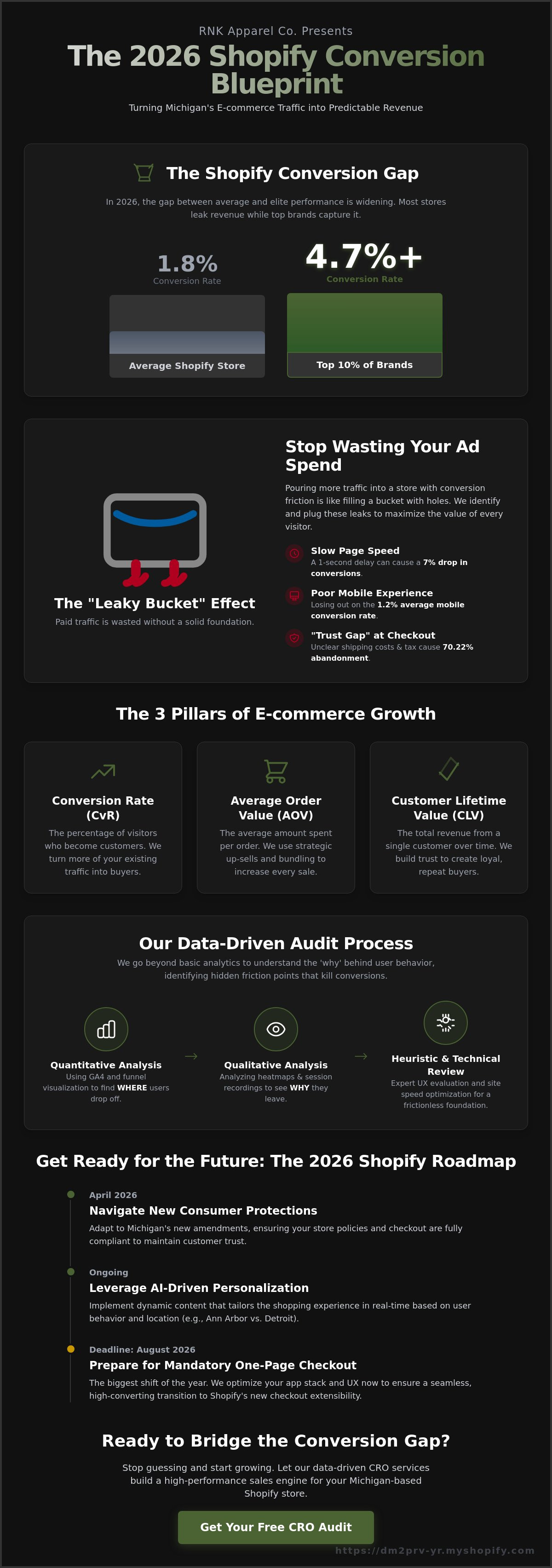
In 2026, the average Shopify store converts at just 1.8 percent, while the top 10 percent of brands are hitting 4.7 percent or higher. You've likely felt that gap while watching your ad spend climb without seeing a matching rise in revenue. It's frustrating to see 70.22 percent of shoppers abandon their carts right at the final shipping step, especially when you're trying to navigate Michigan's flat 6 percent sales tax rules and the new consumer protection amendments passed in April 2026. Many local brands are turning to specialized ecommerce CRO services to fix these leaks before the mandatory Shopify one-page checkout update arrives in August.
You deserve a store that works as hard as you do. This guide shows you how data-driven conversion rate optimization can turn your Michigan-based ecommerce store into a high-performance sales engine. We'll explore how to use AI-driven personalization and mobile-first design to lower your customer acquisition costs while creating a predictable, data-backed growth roadmap. From decoding Google Analytics 4 to increasing your average order value, you're about to learn how to bridge the gap between Michigan's unique consumer expectations and Shopify's technical capabilities.
Key Takeaways
- Discover how professional ecommerce CRO services stop the "leaky bucket" effect by turning existing traffic into consistent revenue through systematic testing.
- Learn to identify hidden friction points by moving beyond basic GA4 data to analyze heatmaps and session recordings of your specific customer base.
- Determine whether your store needs small-scale A/B testing or a full UX redesign based on your current traffic volume and long-term growth goals.
- Master the 2026 Shopify roadmap by optimizing your app stack for site speed and preparing for the mandatory transition to one-page checkout extensibility.
- Gain a competitive edge by leveraging local insights into Midwest consumer trust factors and values that national agencies often overlook.
What are Ecommerce CRO Services and Why Does Your Michigan Business Need Them?
At its core, Conversion rate optimization (CRO) is the systematic process of increasing the percentage of visitors who complete a specific goal on your website. For a Shopify store in Brighton or Detroit, this usually means turning more browsers into buyers. Think of your store as a bucket. Many Michigan business owners spend thousands on Facebook and Google ads to pour "water" into that bucket. If your site has technical friction or a confusing layout, your bucket has holes. This is the "Leaky Bucket" theory. You can keep buying more traffic, but without professional ecommerce CRO services, you're just watching your ROI drain away into the digital pavement.
There's a significant difference between surface-level tweaks and structural optimization. While some agencies focus on minor changes like button colors, modern CRO in 2026 looks at your entire funnel architecture. We analyze how your site’s skeleton supports the user journey. With the 2026 shift toward AI-driven personalization, high-performing stores now use dynamic content that adapts to individual shopper behavior in real time. If a customer from Ann Arbor visits your site, they should see a different experience than someone browsing from out of state, tailored specifically to their needs and local context.
The Core Metrics of Ecommerce Optimization
Success isn't just about one number. We look at three primary pillars to measure the health of your sales engine:
- Conversion Rate (CvR): While the average Shopify store in 2026 sees rates between 1.4% and 1.8%, our goal is to push you toward the top-tier benchmark of 4.7% or higher.
- Average Order Value (AOV): It's significantly cheaper to encourage an existing customer to add one more item to their cart than it's to find a brand-new shopper.
- Customer Lifetime Value (CLV): Effective ecommerce CRO services don't just secure a one-time sale; they build the trust necessary to ensure that customer returns for years.
Why Michigan E-tailers Struggle with Conversion in 2026
Local brands face unique hurdles. In the Detroit and Grand Rapids corridors, shoppers have been conditioned by the "Amazon effect" to expect lightning-fast shipping and instant updates. When an independent Michigan brand can't clearly communicate shipping timelines or tax clarity, a "Trust Gap" forms. Additionally, Michigan's urban populations are increasingly mobile-first. If your Shopify store feels clunky on a smartphone, you're losing the 1.2% average mobile conversion rate that could be powering your growth. Understanding these regional nuances is what separates a generic strategy from a winning Michigan roadmap.
The Data-Driven CRO Audit: Identifying Your Store's Hidden Friction
Raw data tells you what happened, but it doesn't tell you why your visitors are leaving. Moving beyond basic Google Analytics 4 (GA4) reports is the first step in a professional ecommerce CRO services strategy. While GA4 identifies that a shopper abandoned their cart, it won't show you that they couldn't find the "Calculate Shipping" button or that your site's font was unreadable on a mobile device in a Flint coffee shop. A thorough data-driven CRO audit bridges this gap by combining cold numbers with human behavior.
Technical performance is a non-negotiable foundation for any audit. Industry data shows that a mere 1-second delay in page load time can result in a 7% reduction in conversions. For a Michigan business, this means a slow-loading product page for a user in Flint can directly evaporate your profit margins. We pair these technical checks with heuristic evaluations. This involves UX experts manually hunting for "obvious" conversion killers like hidden search bars, broken image links, or confusing navigation menus that frustrate even the most motivated shoppers.
Quantitative Analysis: The 'What' of User Behavior
Quantitative data acts as your map. We use funnel visualization to pinpoint exactly where users drop off. If 80% of your Detroit-area visitors add items to their cart but only 5% reach the final payment screen, you have a checkout friction problem. We also perform segment analysis to see how different groups behave. Identifying these device-specific and regional patterns ensures you aren't hemorrhaging sales due to a poor mobile experience.
Qualitative Insights: The 'Why' Behind the Bounce
This is where we watch real people interact with your Shopify store. Heatmaps allow us to distinguish between "dead clicks" and high-intent engagement. If a session recording shows a user hovering over an unclear shipping policy, we've found a "why." Post-purchase surveys add another layer, asking customers what almost stopped them from buying. Professional ecommerce CRO services use these human stories to turn raw data into a growth roadmap. If you're ready to see where your site is losing money, you can request a preliminary friction report to start your journey.
A/B Testing vs. UX Redesigns: Choosing the Right Optimization Path
Deciding between a total site overhaul and incremental A/B testing is a critical choice for any Michigan brand. Many business owners rush into a "radical redesign" because they're bored with their current look. This is dangerous without baseline data. You risk throwing away elements that actually work while introducing new, untested friction points. Instead, a comprehensive guide to CRO suggests that iterative growth often yields better long-term results. By using professional ecommerce CRO services, you can implement a model where small, data-backed wins compound over 12 months. This approach protects your current revenue while systematically hunting for growth.
Consider a retailer based in Fenton. Instead of scrapping their entire Shopify theme, they used incremental testing on their product pages. They focused on their mobile layout first, as that's where most of their local traffic originated. By refining their "Add to Cart" placement and clarifying their local shipping options, they grew their revenue by 40 percent. They didn't guess. They tested. This method allows you to learn exactly why a change worked, rather than wondering which part of a total redesign caused a sales spike.
When to Prioritize A/B Testing
A/B testing requires a specific traffic threshold to ensure results are valid. If your store doesn't have enough monthly transactions, you won't reach statistical significance. Focus your efforts on high-traffic areas like Product Description Pages (PDPs). Always build a clear hypothesis before starting. For example, "If we move trust badges near the price, then conversions will rise because it reduces buyer anxiety." Don't stop tests early. Patience is key to finding real winners that actually impact your bottom line.
When a UX Overhaul is Necessary
Sometimes, minor tweaks aren't enough to save a failing store. If your Shopify theme dates back to 2018, it likely lacks the mobile-first features required in 2026. A full overhaul is also necessary when you've built a "Franken-stack" of conflicting Shopify apps that tank your site speed. When mobile responsiveness failures are baked into your site's code, a clean redesign provides the high-performance foundation that professional ecommerce CRO services need to succeed. You can't A/B test your way out of a broken foundation.
The Shopify-Specific CRO Roadmap for 2026
Technical agility is the defining factor for Shopify success in 2026. The platform is undergoing a major shift, requiring all merchants to upgrade to the new one-page checkout by August 2026. This isn't just a layout change; it's a move toward checkout extensibility that allows for deeper customization without breaking the core code. For Michigan brands, this roadmap starts with streamlining that checkout process to remove every possible barrier. Professional ecommerce CRO services now focus heavily on this transition, ensuring that your store doesn't just meet the deadline but uses it as a launchpad for higher revenue.
The second phase of the roadmap involves a ruthless optimization of your Shopify app stack. Every additional app adds weight to your Liquid files, often bloating the Largest Contentful Paint (LCP) and slowing down your site. We prioritize performance by auditing these apps and replacing heavy third-party scripts with native Shopify features where possible. Beyond speed, we leverage Shopify Markets to help Michigan businesses expand. Given our proximity to the border, localized settings for Michigan-to-Canada sales can tap into a massive neighboring market with minimal friction. Finally, we implement advanced search and discovery enhancements to ensure users find what they need in two clicks or less.
Checkout Optimization in the Age of Shopify Plus
Modern checkout strategy is about reducing cognitive load. We use a "less is more" approach by minimizing form fields and utilizing address auto-completion. Trust is built through transparency. We integrate local Michigan shipping badges and accelerated payment options like Shop Pay to cater to the 70.22 percent of shoppers who might otherwise abandon their carts. By showing real-time tax calculations, including Michigan's flat 6 percent rate, you eliminate the "surprise cost" objection that kills sales at the final step.
Mobile Performance for the Michigan Commuter
Michigan's tech-savvy workforce often shops during commutes or quick breaks. This requires a strict thumb-zone design where every critical button is reachable on a large smartphone screen. We optimize images using WebP formats to maintain crisp product detail without the heavy file size of traditional JPEGs. For high-volume retailers in Grand Rapids or Detroit, we may even explore "Headless" Shopify architectures to provide near-instant page loads. If you're concerned about your current mobile speed, you can audit your Shopify technical stack to identify hidden bottlenecks.
Why Partnering with a Local Michigan CRO Agency is Your Competitive Edge
Choosing a partner for your ecommerce CRO services shouldn't feel like a transaction with a distant, faceless entity. For Michigan brands, the ability to sit down for a face-to-face strategy session in Detroit or Brighton provides a level of clarity that digital calls often lack. A local agency understands that the Midwest consumer values straightforward communication and tangible trust signals over flashy, empty marketing. We know that a shopper in the Grand Rapids area might have different aesthetic preferences and delivery expectations than someone in New York or Los Angeles. This regional intuition allows us to build high-converting experiences that resonate with your core audience on a cultural level.
Your optimization efforts must work in harmony with your other marketing channels. When your CRO strategy is synchronized with your Michigan-targeted PPC campaigns and local SEO, you create a seamless journey from the first Google search to the final purchase. If your ads are highlighting your local roots, your website needs to reinforce that trust. Having direct access to local Shopify experts who understand the regional business climate means your technical fixes and creative updates are always aligned with the reality of the Michigan market. You aren't just a ticket in a queue; you're a local partner with shared goals.
From Detroit to Grand Rapids: A Network of Success
Local presence dramatically speeds up the timeline from strategy to execution. When an agency knows the competitive landscape in Flint and Fenton, they don't need a long discovery phase to understand who you're up against. They already know the regional players and the local hurdles. The Michigan Advantage in CRO is the unique blend of industrial work ethic and modern tech agility. This combination ensures that your store is not only technically sound but also built with the resilience and practical focus that defines our state's business culture.
Getting Started: The First 90 Days of Your CRO Program
The first 90 days of a professional program are about building momentum. We start with a comprehensive audit to identify and implement "low-hanging fruit" fixes that provide immediate ROI. Once the initial friction points are cleared, we move into a continuous improvement loop. This involves ongoing testing and refinement to ensure your store scales alongside the projected 3.1% to 3.3% personal income growth forecasted for Michigan in 2026. If you're a Michigan business owner ready to stop guessing and start growing, it's time to build a roadmap that turns your local presence into a global sales engine through expert ecommerce CRO services.
Building Your High-Performance Sales Engine for 2026
The transition to Shopify's new one-page checkout mandate by August 2026 marks a pivotal moment for Michigan retailers. Success in this new environment requires more than just following best practices; it demands a deep understanding of how your specific visitors navigate your store. By moving from raw data to actionable insights and prioritizing mobile performance, you can bridge the trust gap that often holds local brands back from competing with national giants. We've explored how iterative testing and technical optimization can turn a "leaky bucket" into a predictable growth machine.
Your store's potential is waiting to be unlocked. With our deep expertise in Shopify Plus and Liquid optimization, we provide the technical precision and local support that businesses in Detroit, Grand Rapids, and Flint need to thrive. Every audit we conduct includes data-driven ROI forecasting to ensure your growth strategy is backed by hard numbers. If you're ready to stop leaving revenue on the table, you can scale your Shopify store with expert ecommerce CRO services in Michigan today. Let's work together to build a high-performance sales engine that powers your business for years to come.
Frequently Asked Questions
How much do ecommerce CRO services typically cost in Michigan?
Investment levels for optimization programs depend on whether your brand requires a one-time project-based audit or a recurring monthly retainer. High-growth stores typically choose a retainer model to support continuous testing and technical refinements as they scale. For seven-figure and eight-figure brands, the cost is determined by the complexity of the Shopify theme and the volume of traffic being analyzed. Smaller businesses often begin with an audit to identify immediate revenue leaks before committing to a long-term strategy.
How long does it take to see results from a CRO program?
Most Shopify stores see initial performance lifts within the first 30 to 90 days as "low-hanging fruit" technical issues are resolved. However, reaching statistical significance for complex A/B tests can take three to six months depending on your monthly traffic volume. It's an iterative process that compounds over time. Consistency is key because the insights gained from early tests inform the high-impact strategies used in later stages of the program.
Do I need a certain amount of traffic for CRO to work?
You generally need a minimum of 500 to 1,000 conversions per month to run A/B tests that yield statistically valid results. If your store hasn't reached that threshold yet, professional ecommerce CRO services focus on qualitative methods like user testing and heuristic evaluations. These techniques allow us to identify and fix friction points for Michigan stores with lower traffic, ensuring the site is fully optimized before you ramp up your ad spend.
What is the difference between SEO and CRO services?
SEO focuses on bringing potential customers to your store, while CRO focuses on turning those visitors into paying buyers. Think of SEO as the invitation to a party and CRO as the experience that makes guests want to stay and engage. Both are essential for growth. SEO builds your top-of-funnel awareness, but without a solid conversion strategy, you'll likely see a poor return on your marketing investment.
Can CRO help reduce my Shopify store's cart abandonment rate?
Yes, optimization strategies specifically target the friction points that lead to the 70.22 percent average cart abandonment rate seen in 2025. By streamlining the checkout flow and providing clear shipping and tax information early, you remove the "surprise costs" that drive shoppers away. We also focus on integrating accelerated payment options like Shop Pay, which significantly reduces the effort required for a customer to complete their purchase on mobile devices.
Is A/B testing better than a complete website redesign?
A/B testing is usually the safer choice for established stores because it allows for data-backed improvements without the risk of a total site failure. A complete redesign is only necessary if your current Shopify theme is technically obsolete or fundamentally broken on mobile. Testing allows you to isolate specific variables to see exactly what drives revenue. This iterative approach protects your existing sales while systematically hunting for growth opportunities.
Why is my Shopify conversion rate lower than the industry average?
A low conversion rate often stems from technical friction, slow load times, or a lack of mobile-first design. In 2026, the average Shopify conversion rate sits between 1.4 percent and 1.8 percent, but mobile users often convert at a lower rate of 1.2 percent. If your store isn't optimized for the "thumb-zone" or if your page speed is sluggish for Michigan commuters, visitors will likely bounce to a competitor who offers a smoother experience.
How do I choose the best ecommerce CRO agency in Detroit or Grand Rapids?
Choose an agency that demonstrates a deep understanding of the Michigan consumer and the Shopify technical ecosystem. The best ecommerce CRO services will offer transparent data reporting and a clear methodology for how they move from an audit to active testing. Look for a partner that prioritizes ROI forecasting and has experience with Shopify Plus features like checkout extensibility. A local agency also provides the benefit of face-to-face strategy sessions to ensure your brand's voice remains consistent.
Disclaimer
Some content published on this website may be developed with the assistance of AI-powered research and writing tools to help streamline research, organization, and content creation. All articles are reviewed, edited, and approved by Marvin Growth Partners to ensure they align with our perspectives, experience, and intended messaging.
While we strive to provide accurate and up-to-date information, blog content is intended for informational and educational purposes only and should not be considered legal, financial, or professional advice. Readers should independently verify information and consult qualified professionals when appropriate.