

Ecommerce Growth Agency for Kids Brands: Scaling in 2026
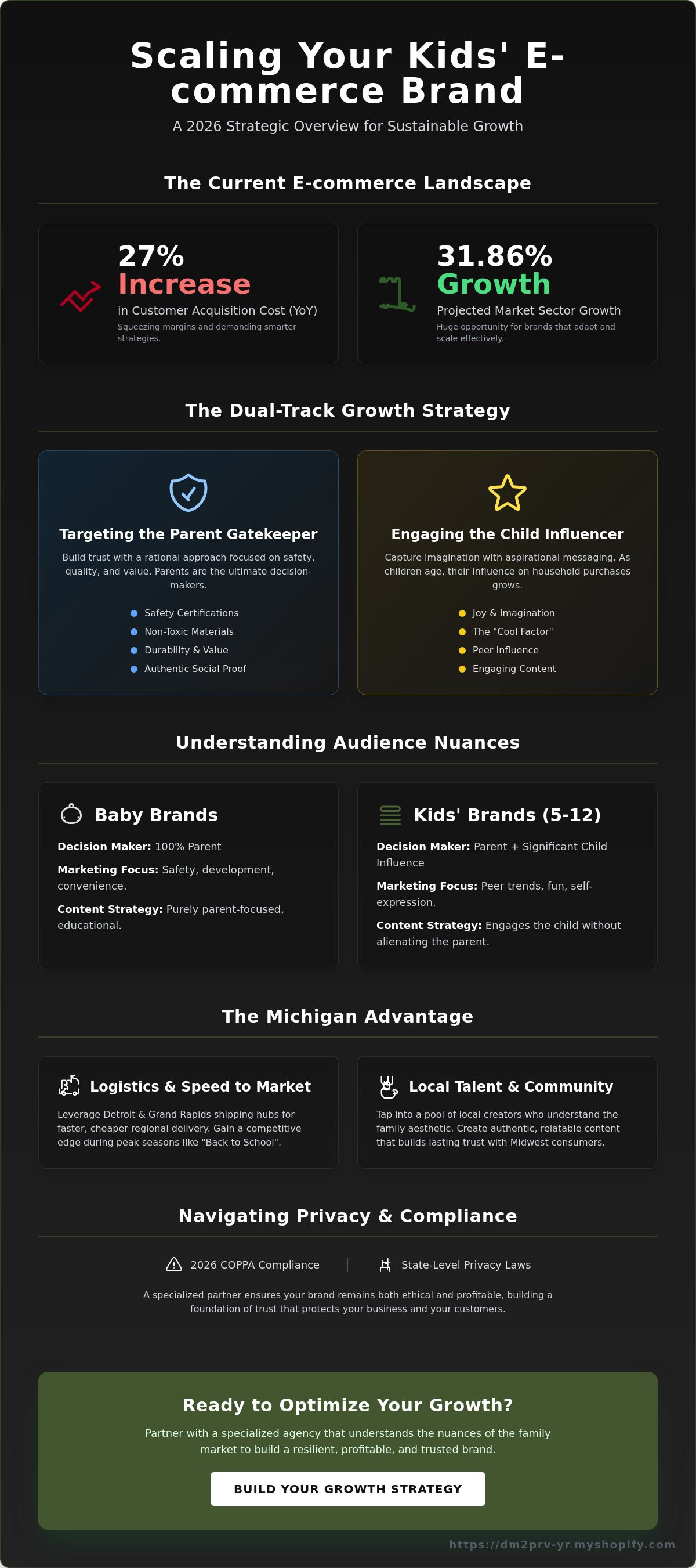
The average customer acquisition cost in the baby and child e-commerce market jumped by 27% in April 2026 compared to the previous year. You've likely felt this squeeze on your margins while trying to keep up with the 31.86% growth projected for the sector this June. Scaling a children's brand isn't just about spending more on ads. It's about navigating a landscape where parental trust is the only currency that matters. Partnering with a specialized ecommerce growth agency for kids brands is no longer a luxury but a necessity to survive these rising costs and increasingly complex privacy regulations.
You understand that your business needs more than just a marketing vendor. You need a partner who respects the delicate balance of the Dual-Track strategy: building trust with parents while maintaining resonance with children. This article explores how to achieve sustainable year-over-year growth by building authentic communities and leveraging local Michigan business expertise. We'll break down the latest 2026 COPPA updates, strategies for smoothing out seasonal revenue troughs, and data-driven methods to improve your customer lifetime value.
Key Takeaways
- Learn how a specialized ecommerce growth agency for kids brands balances the priorities of parents as gatekeepers and children as influencers.
- Explore the logistical benefits of Michigan's ecommerce ecosystem, including how proximity to shipping hubs in Detroit and Grand Rapids accelerates delivery.
- Master performance marketing and SEO tactics designed to capture high-intent searches for safe and ethical children's products.
- Gain a clear understanding of 2026 COPPA compliance and state-level privacy laws to ensure your brand remains both ethical and profitable.
- Identify the key criteria for selecting a growth partner who understands the unique nuances of the family market and the local business landscape.
What is an Ecommerce Growth Agency for Kids Brands?
An ecommerce growth agency for kids brands is a specialized partner that manages the entire customer lifecycle, from initial discovery to long term loyalty. These firms don't just manage ad spend. They oversee the full funnel growth of online stores that cater to families. In 2026, a generic agency often fails because it treats a children's brand like any other consumer product. A specialized agency understands that you aren't just selling a toy or a shirt; you're selling a promise of safety, development, and joy to a household.
Success in this niche requires looking beyond one off sales. With customer acquisition costs rising, a specialized ecommerce growth agency for kids brands focuses on high level metrics like Customer Lifetime Value (LTV) and household penetration. They analyze how a brand can stay relevant as a child grows, ensuring that a customer who buys a swaddle today remains a customer when they need school gear five years later. This deep understanding of family dynamics is what allows specialized agencies to outperform generalist competitors.
The 'Parental Gatekeeper' Strategy
Parents are the primary gatekeepers of the household economy. To reach them, brands must build a foundation of absolute trust. This involves leading with safety certifications, non toxic material guarantees, and authentic social proof from other parents. For families in Detroit and throughout Michigan, there's a strong preference for brands that feel grounded and reliable. Marketing to these parents requires a rational approach that highlights durability and value. However, the brand must also use aspirational messaging that resonates with the child's perspective. It's a dual track effort: satisfy the parent's logic while fueling the child's imagination.
Kids vs. Baby Brands: Key Differences
Many marketing firms mistakenly group baby products and kids' gear into the same bucket. This is a strategic error. While parents make every decision for an infant, children aged 5 to 12 begin to exert significant influence over what enters the home. As kids age, the role of peer influence and "cool factor" grows exponentially. Understanding Youth marketing strategies becomes vital during these years. A specialized ecommerce growth agency for kids brands recognizes this shift in decision making power. They help brands transition their creative assets from purely parent focused content to material that engages the pre teen demographic directly without compromising on safety or ethical standards.
The Michigan Advantage: Why Detroit and Grand Rapids are Hubs for Kids' Brands
Michigan has quietly transformed into a strategic center for children's retail. Cities like Flint, Detroit, and Grand Rapids aren't just industrial hubs anymore; they are now the backbone of a thriving digital commerce network. When you partner with an ecommerce growth agency for kids brands that calls this region home, you tap into a deep understanding of Midwest consumer behavior. This local perspective is invaluable for brands that want to move beyond generic marketing and build lasting relationships with families who value authenticity and reliability.
Beyond the cultural fit, the region offers a wealth of creative talent. Areas like Fenton and Brighton have become pockets for designers and digital storytellers who understand the family aesthetic. These creators know how to balance the "rational" needs of a parent with the "aspirational" desires of a child. By leveraging this local talent pool, brands can create content that feels grounded and relatable, avoiding the polished but sterile feel often produced by coastal agencies.
Local Logistics and Speed to Market
Speed is a competitive necessity in 2026. Leveraging Detroit's massive logistics infrastructure allows brands to achieve faster regional delivery times, which is a primary factor in parental buying decisions. During high pressure periods like the "Back to School" season, Michigan based brands have a clear edge. They can move inventory through regional fulfillment centers more efficiently than competitors located on the coasts. This proximity reduces shipping costs and ensures that essential kids' gear reaches families when they need it most. If you're ready to optimize your local reach, a growth strategy tailored to Michigan can make all the difference.
Building Community in the Great Lakes Region
Trust isn't built in a vacuum. It's built through shared values and community engagement. Local agencies have their fingers on the pulse of events in Grand Rapids and Brighton, allowing for unique brand activations that feel personal rather than corporate. They can connect your brand with Michigan based parenting groups and micro influencers who carry significant weight in local circles. These influencers aren't just faces on a screen; they are neighbors who share the same schools and parks as your customers.
This community focus also extends to digital safety. Parents in the Midwest are often more protective of their family's privacy. Adhering to the Children's Online Privacy Protection Act (COPPA) is a baseline requirement, but a local partner helps you go further by implementing ethical data practices that reflect the transparency Michigan families expect. By combining local creative talent with a deep respect for privacy, your brand becomes a trusted household name rather than just another targeted ad.
Core Scaling Strategies for Children's Apparel and Toy Brands
Scaling a children's brand in 2026 demands a sophisticated tech stack that goes beyond basic email blasts. Performance marketing now requires a delicate balance between Meta and TikTok. While Meta remains the primary channel for reaching parents with high intent, TikTok has become the engine for discovery and "cool factor" among older children. A specialized ecommerce growth agency for kids brands uses these platforms to create a cohesive narrative that speaks to the parent's logic and the child's imagination simultaneously. This isn't just about running ads; it's about deploying content that feels native to the platform and valuable to the family unit.
Search engine optimization has also shifted. Modern parents search for specific solutions like "non toxic teething toys 2026" or "best organic cotton school clothes." Your SEO strategy must target these high intent, safety focused queries. To power this, brands are increasingly turning to AI powered personalization. These tools analyze historical purchase data to show parents products based on their child's current age and interests. When implementing these technologies, ensure your data collection methods align with the FTC Children's Online Privacy Protection Act guidance to maintain household trust and legal compliance.
Retention Marketing: The 'Age-Up' Framework
The most successful kids' brands don't just sell once; they grow with the family. An "Age-Up" framework uses predictive data to transition a customer from toddler products to school age gear exactly when they need it. By tracking milestones, you can trigger automated email and SMS sequences that offer relevant upgrades. Implementing subscription models for consumable items, like socks or craft kits, further stabilizes revenue. This strategy ensures that your ecommerce growth agency for kids brands is focused on long term household penetration rather than just a single transaction.
Conversion Rate Optimization (CRO) for Busy Parents
Parents are often shopping on their mobile devices while multitasking. This makes a frictionless checkout experience vital. Your product pages should immediately highlight three things: safety, durability, and "easy clean" features. Use short, high quality video content to demonstrate product scale and how a child actually interacts with the item. If a parent can't see how big a toy is or how a fabric moves in five seconds, they'll likely bounce. Simplifying the mobile checkout to a single click can significantly boost conversions for this time starved demographic.
Navigating Privacy and Compliance in Kids' Marketing
The regulatory environment for children's marketing has reached a critical turning point in 2026. The FTC finalized significant updates to the Children's Online Privacy Protection Act (COPPA) earlier this year, introducing strict compliance milestones that every brand must meet. These updates emphasize data retention limits and require verifiable parental consent before any personal information from children under 13 is collected or shared. For a brand owner, this means your tech stack and marketing workflows must be airtight. An ecommerce growth agency for kids brands doesn't just look at conversion rates; they ensure your entire operation respects these legal boundaries to protect your business from significant penalties.
Beyond federal rules, new state level laws in Alabama and South Carolina became effective in February 2026, alongside Age-Appropriate Design Codes in states like California and Vermont. These laws often extend protections to minors under 18, limiting profiling and the use of "dark patterns" to gain consent. Navigating these overlapping regulations requires a partner who understands that you should market to the parent, not track the child. On platforms like TikTok and YouTube, "Made for Kids" restrictions are now more stringent, prohibiting interest based advertising for younger audiences. You must pivot your strategy toward contextual targeting rather than individual user tracking.
The Ethical Marketing Standard
Transparency has become the most effective growth lever for modern kids' brands. Parents are increasingly wary of manipulative "pester power" tactics that target children directly to influence household spending. Instead, ethical brands focus on building a relationship with the parent through clear communication and social responsibility. For families in Michigan, where community values run deep, showing that your brand prioritizes child safety over aggressive tracking builds a level of loyalty that no discount code can match. It's about proving you're a responsible member of the family's digital ecosystem.
Secure Data Practices for Shopify Stores
If you're running a Shopify store, your compliance is only as strong as your weakest third party app. Many brands in Flint and Detroit inadvertently leak data through unverified plugins or tracking pixels that don't comply with 2026 standards. You need regular audits of your entire tech stack to ensure every data processor you use is accountable. Your privacy policy shouldn't be hidden in the footer; it should be a clear statement of your brand values.
- Implement robust age verification mechanisms that don't rely on invasive tracking.
- Audit third party apps for COPPA and state level privacy law alignment.
- Communicate your data practices clearly to build parental trust during the checkout process.
Don't let compliance gaps derail your scaling efforts. You can request a comprehensive growth and compliance audit to ensure your brand is protected as you expand your reach.
Choosing Your Partner: What to Look for in a Growth Agency
Selecting the right ecommerce growth agency for kids brands is a decision that impacts your brand's integrity as much as its revenue. You aren't just looking for a vendor; you're looking for a steward of your family-focused values. In a market where trust is the primary currency, your partner must demonstrate a deep track record with family brands. They should understand that a parent's buying journey involves more research, higher safety expectations, and a longer decision-making process than typical consumer goods. If they don't understand the nuance of the "Parental Gatekeeper" strategy we discussed earlier, they'll likely waste your ad spend on the wrong audience.
Transparency is another non-negotiable factor. A professional agency should provide real-time dashboards and clear reporting on ROI. You shouldn't have to guess which campaigns are driving growth or how your budget is being utilized across different platforms. Finally, ensure there's a cultural fit. The agency should share your brand's commitment to children's well-being and ethical marketing. This alignment ensures that every campaign they launch reflects your core mission while pushing toward your scaling goals.
Questions to Ask Your Potential Agency
Before signing a contract, dig into the agency's specific processes for the kids' niche. You want to ensure they aren't applying a generic framework to your business. Consider asking these targeted questions during your discovery call:
- How do you handle seasonal revenue fluctuations in the kids' market to ensure year-over-year stability?
- What is your specific approach to COPPA-compliant data collection and state-level privacy laws in 2026?
- Can you help us scale our logistics and shipping speed from a Michigan-based hub?
- How do you measure household penetration and long-term customer lifetime value?
Why Our Michigan-Based Team is the Logical Choice
Our team combines global ecommerce expertise with local Detroit and Grand Rapids insights. We understand the Midwest market's nuances and the logistical advantages of operating within the Great Lakes region. We've developed a proven framework for scaling kids' brands from 6 to 8 figures by focusing on sustainable community building rather than just one-off transactions. You get direct access to senior strategists who stay involved in the data to ensure your brand hits its targets while navigating the 2026 regulatory environment. If you're ready to grow with a specialized ecommerce growth agency for kids brands that values your mission, Schedule a growth audit today! to see how we can align your marketing with your brand's long-term vision.
Future-Proof Your Kids' Brand for 2026 and Beyond
Scaling a children's brand in 2026 is a complex endeavor that requires more than just high-quality products. It demands a sophisticated understanding of new state-level privacy laws and the finalized COPPA updates. By focusing on the Dual-Track strategy and leveraging Michigan's unique logistics infrastructure, your brand can overcome rising acquisition costs and seasonal slumps. Success in this niche isn't just about traffic; it's about building a secure environment that parents trust.
Partnering with a dedicated ecommerce growth agency for kids brands provides the specialized Shopify expertise needed to build a secure, high-converting store. Our team brings deep knowledge of the family market and local expertise in Detroit, Grand Rapids, and Flint to help you scale ethically. Whether you're refining your "Age-Up" framework or auditing your tech stack for compliance, the right support makes all the difference in achieving long-term household penetration.
Ready to see how your brand stacks up? Book Your Kids' Brand Growth Audit today to begin your journey toward sustainable, eight-figure growth. Your brand's future starts with building the trust that modern parents demand.
Frequently Asked Questions
What is a kids' ecommerce growth agency?
A kids' ecommerce growth agency is a specialized firm that manages the full-funnel development of children-focused online stores. These agencies go beyond simple ad management to oversee the entire customer journey, from initial discovery to long-term loyalty. They focus on building parental trust through ethical marketing and data-driven strategies that respect the unique dynamics of the family household and the regulatory environment of 2026.
Why should I hire a specialized agency instead of a general one?
Specialized agencies understand the "Parental Gatekeeper" strategy and the specific emotional triggers that drive family purchases. A general agency might miss critical nuances, such as the importance of highlighting safety certifications or navigating the 2026 COPPA updates. By hiring an ecommerce growth agency for kids brands, you ensure your partner knows how to balance rational appeals to parents with aspirational content for children.
How does marketing to parents differ from standard B2C marketing?
Marketing to parents requires a dual-track approach that standard B2C strategies often overlook. You aren't just selling to a consumer; you're selling to a decision-maker who prioritizes safety, durability, and value for someone else. This requires a foundation of absolute trust and social proof. Standard marketing often focuses on immediate gratification, but parenting brands must emphasize long-term benefits and ethical production to win over a household.
What are the most important KPIs for a children's brand?
Customer Lifetime Value (LTV) and household penetration are the most vital metrics for sustainable growth. While initial return on ad spend is important, the real value lies in how many families return as their children grow. Tracking retention through different developmental stages helps you understand if your "Age-Up" framework is working. High LTV indicates that your brand has successfully moved from a one-off purchase to a trusted household staple.
Is COPPA compliance required for my Shopify store?
Yes, compliance is mandatory if your store is directed toward children under 13 or if you collect personal information from them. In 2026, this involves more than just a privacy policy; you must audit every third-party app in your Shopify tech stack. Ensuring that your data processors don't track minors without verifiable parental consent is essential to avoid heavy fines and maintain the trust of your customers.
How can a Michigan-based agency help my national brand?
A Michigan-based ecommerce growth agency for kids brands offers unique logistical advantages through Detroit and Grand Rapids shipping hubs. These locations allow for faster regional delivery, which is a major selling point for busy parents. Additionally, a local agency brings an understanding of Midwest family values. These insights help national brands create more authentic, grounded messaging that resonates with a broad and loyal demographic across the country.
What is the typical ROI for a kids' brand growth campaign?
Typical ROI depends on the product category, but the most successful campaigns focus on the total value of a household over several years. By implementing automated retention sequences, brands can significantly lower their long-term acquisition costs. Instead of looking at a single transaction, we measure success by the increase in repeat purchase rates. This approach leads to more stable revenue and higher margins compared to generic, high-churn marketing tactics.
How do kids' brands handle the 'Back to School' season?
Brands manage this high-pressure window by launching campaigns at least six weeks in advance to capture early researchers. They focus on mobile-first checkout experiences for parents on the go and highlight features like durability and "easy-clean" materials. Successful brands also use this season to activate their "Age-Up" sequences, reaching out to existing customers whose children are transitioning into new school-age categories and need updated gear.
Disclaimer
Some content published on this website may be developed with the assistance of AI-powered research and writing tools to help streamline research, organization, and content creation. All articles are reviewed, edited, and approved by Marvin Growth Partners to ensure they align with our perspectives, experience, and intended messaging.
While we strive to provide accurate and up-to-date information, blog content is intended for informational and educational purposes only and should not be considered legal, financial, or professional advice. Readers should independently verify information and consult qualified professionals when appropriate.