

Ecommerce Marketing Strategy 2026: The Niche Retailer’s Blueprint for Growth
Why are you still trying to beat Amazon at a game they've already won? With the average Meta cost-per-acquisition hitting $38.19 this year, the old playbook of "spend more to grow more" is officially broken. To thrive, your 2026 ecommerce marketing strategy must pivot from chasing expensive clicks to cultivating a community that actually cares about your brand. You likely feel the squeeze of rising costs while navigating complex new rules like the California Delete Act or the EU AI Act interaction disclosures. It's frustrating to watch giants like Temu undercut your prices while you struggle to keep your unique brand identity alive on a national stage.
This guide, presented by Marvin Growth Partners, promises to hand you the blueprint to outmaneuver big-box stores by leveraging your unique niche authority. You'll learn how to lower your acquisition costs through organic community growth and master the omnichannel tactics that drive real loyalty. We'll explore the specific 2026 trends you need to know, from AI-powered personalization to high-converting product page signals that turn casual browsers into lifetime customers. It's time to stop competing on price and start winning on connection.
Key Takeaways
- Shift your focus from expensive social media ad spend to building high-value "owned" audiences that protect your profit margins.
- Develop a resilient ecommerce marketing strategy by auditing your tech stack and identifying the hyper-niche buyer personas that large competitors ignore.
- Turn your local Michigan roots into a national trust signal to win over customers who are tired of generic, big-box shopping experiences.
- Optimize high-impact channels like TikTok social commerce and SMS marketing to drive repeat sales without increasing your acquisition costs.
- Follow a 90-day scaling roadmap that prioritizes your most profitable channels and tracks the KPIs that actually move the needle.
What is Ecommerce Marketing in 2026? Beyond the Basics
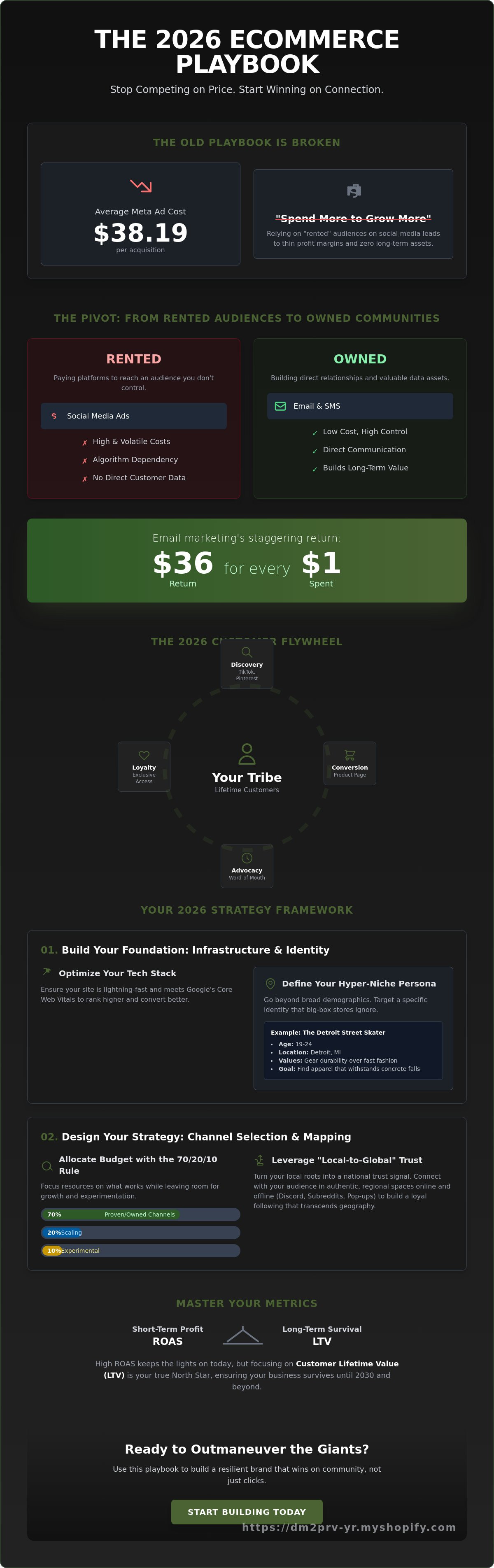
Ecommerce marketing in 2026 isn't just about buying traffic; it's the strategic orchestration of every digital touchpoint to attract, convert, and keep customers. A modern ecommerce marketing strategy requires you to stop thinking like a tenant on social media and start thinking like a landlord of your own data. With Meta ads averaging a $38.19 cost-per-acquisition this year, relying solely on "rented" audiences is a recipe for thin margins. You're essentially paying a tax to access your own followers. To stay profitable, you have to prioritize owned channels like email and SMS where you control the narrative and the timing.
The gap between niche retailers and general marketplaces is widening. While giants like Amazon or Temu compete on logistics and rock-bottom pricing, niche brands win through "Community-Led Growth." This approach uses authentic connections to reduce your reliance on expensive paid ads. While traditional digital marketing strategies often focus on broad reach, your success depends on depth. You don't need everyone to like you; you just need your specific tribe to trust you more than they trust a faceless algorithm.
The 2026 Marketing Funnel: From Discovery to Advocacy
The traditional linear funnel has evolved into a customer flywheel. Discovery no longer starts with a Google search box for many shoppers. Instead, they use TikTok and Pinterest as visual search engines to find products that fit their specific aesthetic. Your goal isn't just a transaction; it's advocacy. By giving customers exclusive access or early drops, you turn a one-time buyer into a brand disciple who handles your word-of-mouth marketing for you.
Core Objectives: CAC, LTV, and ROAS
For a Michigan-based online shop, success depends on balancing three specific metrics. Customer Acquisition Cost (CAC) tells you what it costs to get a new shopper through the door, but Customer Lifetime Value (LTV) is your true North Star. In a high-inflation economy, you can't afford to buy every single sale. You must balance short-term Return on Ad Spend (ROAS) with long-term brand equity. While high ROAS keeps the lights on today, a sophisticated ecommerce marketing strategy focuses on LTV to ensure your business survives until 2030. Remember, email marketing still offers a staggering return of $36 for every $1 spent, making it your most powerful tool for boosting that lifetime value.
Building Your 2026 Ecommerce Strategy: A 5-Step Framework
Building a sustainable brand in 2026 requires more than just a list of tactics; you need a comprehensive plan for how you will attract customers and turn them into repeat buyers. This five-step framework turns abstract goals into a concrete ecommerce marketing strategy that works for niche retailers. By following a structured approach, you can stop guessing which ads might work and start investing in the infrastructure that actually scales.
Step 1 & 2: Infrastructure and Identity
Your tech stack is the foundation of your growth. In 2026, search engines prioritize sites that meet strict Core Web Vitals standards, so your Shopify or Wix site must be lightning-fast. Once your site is optimized, you must define your "Hyper-Niche" persona. Don't just target "people who like clothes." Instead, focus on a specific identity, like a Detroit street skater who cares about heavy-duty denim for concrete falls rather than a casual hoodie wearer. Your Ideal Customer Profile is a 19 to 24 year old Detroit resident who spends weekends at local skate parks and prioritizes gear durability over fast-fashion trends. This regional specificity allows you to speak a language that national big-box retailers simply can't mimic.
Step 3 & 4: Channel Selection and Mapping
Success depends on meeting your audience where they already hang out. For a niche Michigan brand, this might mean active participation in regional Discord servers or subreddits rather than dumping money into broad Facebook interest groups. Use the 70/20/10 rule for your budget: 70% goes to proven "owned" channels like email, 20% to scaling social commerce on platforms like TikTok, and 10% to experimental tactics. You can integrate local events, such as a pop-up shop in Grand Rapids or a sponsorship for a Flint community festival, into your digital content calendar. This creates a "Local-to-Global" trust signal that proves your brand is real, grounded, and reliable for national buyers. If you're ready to see how these signals look in practice, you can review our latest community-driven collections to see these tactics in action.
The final step is implementing "Agile Marketing" cycles. Instead of planning a year in advance, work in 30-day sprints. Test a specific tactic, like a new SMS automation or a localized landing page, and analyze the data. If it works, double down. If it doesn't, pivot quickly. This agility is your greatest advantage over massive competitors who are bogged down by corporate bureaucracy. A successful 2026 ecommerce marketing strategy isn't a static document; it's a living system that adapts as fast as your customers do.
The "Local-to-Global" Advantage: Competing with Ecommerce Giants
Scaling a niche brand doesn't mean you have to hide your roots. In fact, being "Detroit-based" or "Michigan-grown" is one of your most potent trust signals for national buyers. In an era where shoppers are bombarded by AI-generated storefronts and dropshipping schemes, showing a physical connection to a real community proves your brand is legitimate. While giants like Amazon compete on sheer volume, your ecommerce marketing strategy should focus on "Niche Authority." A specialist who lives and breathes the culture of Independent Trucks or specific deck molds will always beat a generalist marketplace that treats products like commodities.
Physical pop-ups in cities like Ann Arbor or Royal Oak do more than just sell inventory. They serve as content factories for your digital presence. You can capture authentic photos, record interviews with local enthusiasts, and collect "Zero-Party Data" through QR codes at the checkout. This data is far more valuable than the "rented" data from social platforms because it comes directly from your most loyal fans. These e-commerce marketing strategies allow you to build a moat around your business that no algorithm can easily cross.
Local SEO for Ecommerce
You can dominate regional searches by optimizing your Google Business Profile for specific Michigan cities. This drives "Buy Online, Pick Up In Store" (BOPIS) orders, which are gold for local retailers. Create city-specific landing pages for Grand Rapids, Brighton, or Fenton to capture regional search intent. When a local blog in Lansing links back to your shop, it doesn't just help your Michigan rankings; it boosts your overall domain authority, making you more competitive for national keywords. It's about winning your backyard to fund your national expansion.
Building Trust Through Authenticity
Humanizing your brand is your best defense against generic competitors. Show the team behind the screen packing orders in your Michigan warehouse. This transparency builds a bridge that AI-generated brands can't build. Encourage your customers to share User Generated Content (UGC) by tagging the shop in their skate clips from local parks. When shoppers see a brand actively supporting their local scene, they feel a sense of shared identity that naturally increases conversion rates by removing the "scam" anxiety common in online shopping. This local pride creates a halo effect that resonates with buyers from California to New York who want to support authentic, community-driven businesses.
High-Impact Marketing Channels for Niche Retailers
Social media platforms are projected to generate $2.9 trillion in sales by 2026. This massive shift means your ecommerce marketing strategy must prioritize social commerce, where customers buy directly on TikTok or Instagram without ever leaving the app. For a niche shop, broad advertising is often a waste of resources. You get better results by targeting long-tail SEO keywords like "durable skate shoes for kids" or "best trucks for street skating." These specific terms have lower competition and higher intent than generic phrases. You aren't just looking for traffic; you're looking for the right traffic.
Influencer marketing has also evolved. Instead of chasing national celebrities, focus on micro-influencers within the Michigan skate scene. A skater in Flint or Grand Rapids with 5,000 engaged followers often provides a better return on investment than a pro with a million passive fans. These local creators have built real trust. When they demo a new deck or pair of shoes, their audience listens because the connection is authentic. This localized approach lowers your acquisition costs while building a foundation of social proof that national competitors can't easily buy.
Mastering Social Commerce and Video
The rise of "Shop-tainment" has changed how hardware is sold. Use live streams to demo new skateboard hardware, showing exactly how a specific bearing or wheel performs. Your short-form video strategy should balance educational content with pure product showcases. Don't just show the product; teach your audience how to use it. By integrating Shopify with your social platforms, you ensure that inventory levels stay synced across every channel. This prevents the frustration of overselling limited stock during a viral moment.
Retention Marketing: Email and SMS
Email marketing remains the powerhouse of "Owned Media," boasting an average return of $36 for every $1 spent as of mid-2026. You should set up automated flows for abandoned carts, post-purchase follow-ups, and win-back campaigns to keep your brand top-of-mind. Segmentation is key here. Group your customers by their specific interests, such as "Volcom fans" or "Skateboard builders," to ensure every message is relevant. SMS marketing is particularly effective for "Drop" culture. Send a quick text to create urgency for limited streetwear releases or local event tickets. If you want to see how we handle these exclusive releases, shop our latest limited-edition drops before they sell out.
Executing Your Strategy: Scaling with Precision
Execution is where most founders stumble. You don't need a hundred tactics; you need one ecommerce marketing strategy that you can actually finish. Start by identifying the single channel that is already showing signs of life. If your Instagram stories are getting replies, double down there before trying to master Pinterest. In 2026, most brands spend between 10% and 20% of their monthly revenue on advertising. You shouldn't reach those levels until your foundation is solid and your conversion rates are stable. Precision beats volume every time.
Artificial intelligence is a tool for efficiency, not a replacement for your soul. Use AI to automate tedious tasks like drafting product descriptions or analyzing real-time data. However, keep your brand voice human. If you use AI-driven chatbots for customer service, remember that the EU AI Act requires full disclosure of these interactions starting August 2, 2026. Your customers value transparency. They want to know they're talking to a brand with real Michigan roots, even if a bot is helping them track a package. Authentic connection is your protection against rising advertising costs.
The 90-Day Execution Roadmap
- Month 1: Foundation and SEO Cleanup. Fix your Core Web Vitals and optimize for long-tail keywords. Ensure your Shopify site is compliant with the latest 2026 privacy laws in states like Indiana and Kentucky.
- Month 2: Content Engine and Social Integration. Launch your "Shop-tainment" live streams and integrate your inventory with TikTok Shop. Focus on micro-influencers who can tell your story to the Michigan skate community.
- Month 3: Paid Scaling and Retention Automation. Once your organic engine is humming, start testing paid ads with a target of beating the ecommerce median ROAS of 2.87x. Set up your automated email flows to capture that $36 return for every dollar spent.
Scaling Beyond Michigan
Moving from a local focus to national ad targeting requires a shift in your data strategy. You must maintain the "Small Shop" feel even as you process hundreds of orders a day. Use your Michigan identity as a badge of quality and grit. National buyers in 2026 are looking for brands that stand for something. By the time you reach national scale, your local signals will have built a moat that big-box retailers can't cross. Ready to level up? Explore our latest skateboard and streetwear collections today!
Take Control of Your Growth in 2026
The landscape of online retail has shifted from broad reach to deep connection. Success now depends on your ability to turn local trust into national authority while protecting your margins from rising ad costs. By prioritizing owned media and leveraging your unique niche identity, you create a resilient ecommerce marketing strategy that big-box giants can't replicate. You've seen the roadmap. Now it's time to execute by focusing on the channels that drive real community engagement and long-term loyalty.
We've been trusted by Michigan skaters since our inception, and we're here to help you stay ahead of the curve. We offer a curated selection of top-tier brands like Volcom, Vans, and Independent, with fast shipping available across the US and Canada. Upgrade Your Gear and Your Strategy at Our Shop to see how an authentic, community-focused brand operates in the modern era. You have the tools and the blueprint to outmaneuver the competition. Start building your legacy today.
Frequently Asked Questions
What is the most effective ecommerce marketing channel in 2026?
Email and SMS marketing remain the most effective channels for driving actual conversions because they represent owned media. While social platforms are great for discovery, owned channels allow you to bypass rising ad costs and unpredictable algorithm shifts. Focusing on these ensures you aren't constantly paying a tax to reach your own customers. It's the most reliable way to build a sustainable business over time.
How much should a small ecommerce business spend on marketing?
Most ecommerce brands allocate between 7% and 12% of their gross revenue to marketing activities. If you're in a high-growth phase or launching a new product line, you might increase this to 20% to gain market share. This budget should cover everything from paid search ads to content creation and email software subscriptions. Tracking these costs helps you maintain healthy profit margins.
Does SEO still matter for ecommerce with the rise of social media shops?
SEO is more critical than ever because it captures high-intent shoppers searching for specific solutions. While social shops excel at impulse buys, search engines drive customers who are already looking to purchase. A balanced ecommerce marketing strategy uses SEO to build long-term, organic traffic that offsets the volatile costs of social advertising. It provides a stable foundation that social media alone cannot offer.
How can a local Michigan business compete with national ecommerce giants?
You compete by leaning into your regional identity and specialized expertise that massive marketplaces simply can't replicate. Use your Michigan location to build authentic community ties and offer personalized customer service. This local authority creates a powerful trust signal. It resonates with national buyers who are tired of generic experiences and are looking for specialized gear backed by an honest brand story.
What is social commerce and do I need it for my streetwear brand?
Social commerce is the process of selling products directly within social media apps like TikTok and Instagram. For a streetwear brand, it's essential because your target audience spends a significant portion of their day on these platforms. It streamlines the buying process by removing the need for customers to click through to an external website. This reduction in friction leads to higher conversion rates for visual products.
How do I calculate the ROI of my ecommerce marketing strategy?
Calculate your ROI by subtracting your total marketing spend from your total attributed revenue, then dividing that result by your marketing spend. You should track this metric across different channels to see which ones are truly profitable. A successful ecommerce marketing strategy aims for a positive return that covers both your product costs and operational overhead. Consistent tracking allows you to pivot away from underperforming tactics quickly.
What are the biggest ecommerce marketing mistakes to avoid in 2026?
The biggest mistake is over-reliance on a single "rented" platform like Meta or TikTok. If an algorithm changes or your account is restricted, your revenue could vanish overnight. Another common error is ignoring new data privacy regulations, which can lead to heavy fines and a loss of customer trust. Diversifying your channels and staying compliant with state and federal laws are non-negotiable for long-term survival.
Disclaimer
Some content published on this website may be developed with the assistance of AI-powered research and writing tools to help streamline research, organization, and content creation. All articles are reviewed, edited, and approved by Marvin Growth Partners to ensure they align with our perspectives, experience, and intended messaging.
While we strive to provide accurate and up-to-date information, blog content is intended for informational and educational purposes only and should not be considered legal, financial, or professional advice. Readers should independently verify information and consult qualified professionals when appropriate.