

Ecommerce Marketing Strategy Detroit: Scaling Your Brand in 2026
What if the secret to beating coastal Shopify giants isn't a bigger ad budget, but your Detroit zip code? You've likely felt the sting of rising Amazon fulfillment fees and the 70% of Midwest business leaders reporting negative impacts from recent tariffs. It's frustrating to watch your margins shrink while generic national agencies deliver leads that don't convert. You know that Michigan's central location offers a massive logistics edge, but you haven't yet unlocked how to turn that 1 to 2 day ground shipping advantage into a marketing powerhouse. Building a winning ecommerce marketing strategy detroit brands can actually scale requires moving past basic tactics and embracing the unique economic recalibration of our city.
We're here to help you master the Motor City Growth Framework. This guide shows you how to build a resilient, high-converting Shopify store that leverages local 3PL advantages to slash your customer acquisition costs. You'll learn how to manage Michigan's 6% sales tax and the 1.8% small business credit while scaling your brand through 2026. We will walk through the exact roadmap for integrating local fulfillment with digital agility to ensure your brand stands out in a crowded marketplace.
Key Takeaways
- Learn how to leverage the "Michigan Advantage" to outperform coastal competitors by utilizing Detroit's lower operational costs and industrial heritage.
- Discover the five core pillars of a successful ecommerce marketing strategy detroit brands use to sync retail storefronts with Shopify data and predictive AI tools.
- Identify the critical technical requirements for selecting a local marketing agency capable of managing complex ERP and warehouse management integrations.
- Drastically reduce transit times to the East Coast by optimizing your Shopify shipping zones and partnering with strategic Midwest-based 3PL providers.
- Follow a structured 90-day execution roadmap that moves from a deep technical audit to a creative sprint aligned with the authentic Detroit brand aesthetic.
The 2026 Detroit E-commerce Landscape: Why Strategy Starts Locally
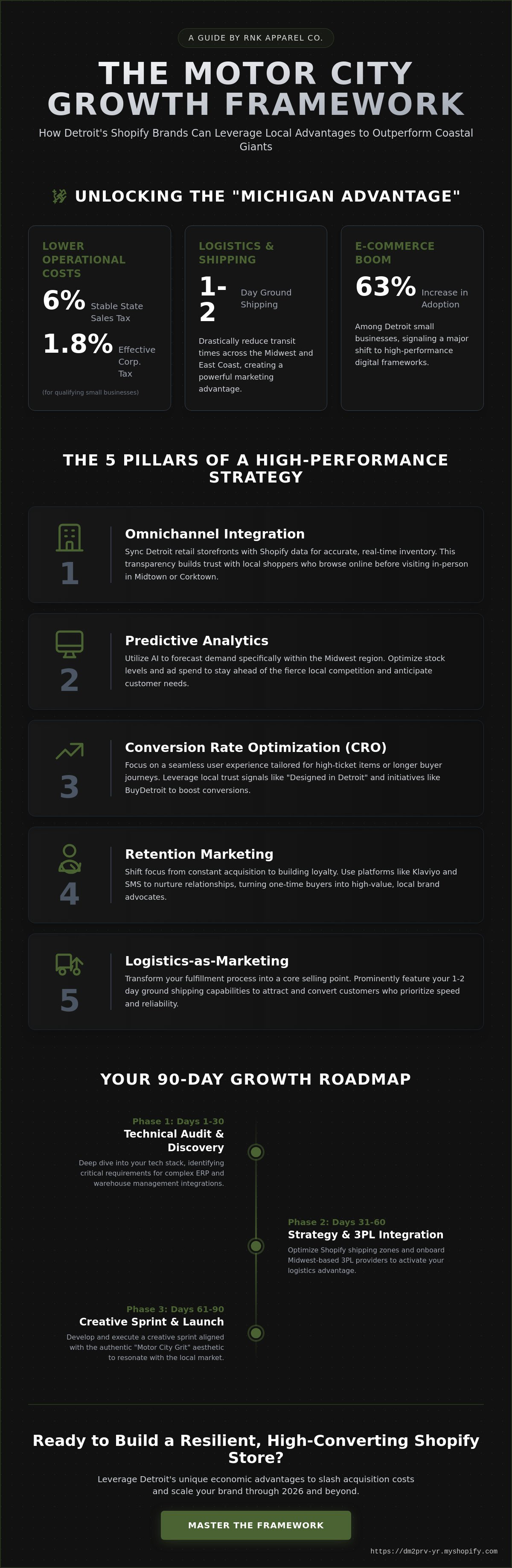
Detroit's economic identity is undergoing a radical transformation. The city's industrial roots are now the foundation for a digital renaissance where traditional manufacturing meets high-growth retail. An effective ecommerce marketing strategy detroit entrepreneurs use in 2026 doesn't just copy what brands are doing in California; it leans into the "Michigan Advantage." This advantage is built on a stable 6% state sales tax and a small business alternative credit that can drop the effective corporate income tax rate to 1.8% for qualifying firms. These lower operational costs provide a significant runway for growth compared to coastal tech hubs where overhead eats margins before a single product ships.
The evolution of e-commerce has allowed local manufacturers to bypass traditional middle-men and reach global markets from their own backyard. However, a generic national strategy often fails to capture the specific nuances of the Flint-to-Brighton consumer base. Michigan shoppers value authenticity over artificial polish. They want to see the "Motor City Grit" reflected in brand storytelling. A successful ecommerce marketing strategy detroit companies implement relies on this blend of local grit and global reach, using an industrial aesthetic that resonates with the region's history while utilizing cutting-edge tech to deliver a seamless experience.
The Shift to Hyper-Local Consumer Trust
By 2026, consumers are increasingly prioritizing regional brands to reduce their carbon footprints and support local economies. Featuring "Made in Michigan" or "Designed in Detroit" labels on your Shopify store isn't just a point of pride; it's a powerful conversion tool. Trust is built through proximity. Brands that engage with communities in Fenton or Grand Rapids through local events often see higher lifetime value from customers who feel a personal connection to the warehouse just a few miles down the road.
E-commerce as a Tool for Industrial Modernization
Detroit's automotive and manufacturing firms are no longer just B2B entities. Many are migrating to Shopify Plus to bridge the gap between legacy dealer portals and direct-to-consumer sales. With a 63% increase in e-commerce adoption among Detroit small businesses this year, the focus has shifted to high-performance frameworks. These systems allow legacy companies to scale quickly while maintaining the rugged reliability their customers expect from a Midwest brand.
5 Pillars of a High-Performance Ecommerce Marketing Strategy in Detroit
Scaling a brand in the 313 requires more than just a functional website. It demands a sophisticated tech stack that bridges the gap between digital storefronts and physical operations. A winning ecommerce marketing strategy detroit brands use in 2026 focuses on five core pillars that turn local presence into a competitive advantage. This starts with Omnichannel Integration. By connecting Detroit retail storefronts directly with Shopify data, you ensure that inventory levels stay accurate across all channels. This transparency builds trust with local shoppers who might browse online before visiting a physical location in Midtown or Corktown.
Data is the fuel for this growth. Successful merchants are now using Predictive Analytics to forecast demand specifically within the Midwest region. With 63% of Detroit small businesses increasing their e-commerce adoption this year, the competition for attention is fierce. Using AI to anticipate what customers will need before they even search for it allows you to optimize stock levels and ad spend. This level of precision is essential for Conversion Rate Optimization (CRO), especially for high-ticket industrial components or premium lifestyle goods where the buyer journey is often longer and requires more touchpoints. You can even leverage local support systems like the BuyDetroit initiative to strengthen your B2B procurement presence and community ties.
Retention is where the real profit lives. Instead of constantly chasing new traffic, use Retention Marketing through platforms like Klaviyo and SMS to turn one-time buyers into local loyalists. Finally, treat Logistics-as-Marketing. When you can offer 1 to 2 day ground shipping across the Great Lakes region, that speed becomes your most powerful closing tool on the product page. If you're ready to refine these pillars, it's time to connect with Marvin Growth Partners who understand the unique rhythm of the Michigan market.
Technical SEO and Core Web Vitals for 2026
Site speed is no longer optional. In 2026, AI-driven search engines prioritize stores that load instantly and provide clear, structured data. Your technical SEO must be optimized for "near me" searches across Southeast Michigan. This means ensuring your store's metadata and local listings are perfectly synced so you appear first when a customer in Royal Oak or Troy searches for your products. A fast, mobile-optimized experience is the foundation of every high-performance Detroit e-commerce strategy.
Content Strategy: From Product Pages to Lifestyle Authority
Content should do more than describe a product; it should sell a lifestyle. Creating high-value guides establishes your brand as an authority in your niche. For example, many brands are adopting the skateboard lifestyle in 2026 framework to build brand affinity through high-energy, authentic storytelling. Use video content filmed at iconic Detroit locations like the Dequindre Cut or the historic Packard Plant to ground your brand in the city's unique aesthetic. This visual connection creates an emotional bond that generic national competitors simply can't replicate.
Selecting the Right Shopify Marketing Agency in Michigan
Choosing a partner to handle your ecommerce marketing strategy detroit based growth isn't just about finding someone who can run ads. In 2026, the technical requirements for a successful store have become far more complex. You need a specialist who understands the Shopify ecosystem inside and out. Generalist agencies often struggle with the specific liquid code customizations or the intricate app integrations that high-volume Michigan brands require. If an agency can't explain how they plan to sync your store with your Midwest warehouse management system (WMS), they aren't the right fit for a brand looking to scale.
Technical depth is mandatory, but culture fit is the "X factor." Detroit's economic recalibration has created a unique business environment where resilience and efficiency are prized. Your agency should understand the local landscape. They should know that a customer in Grand Rapids has different expectations than one in downtown Detroit. Red flags in a 2026 proposal include vague promises of "increased traffic" without a clear plan for contribution margin or lifetime value (LTV). If they don't mention how they'll handle the 70% of Midwest businesses currently struggling with tariff-related cost increases, they aren't looking at the full picture of your profitability.
When interviewing potential partners, ask about their experience with ERP and WMS integrations. A scalable ecommerce marketing strategy detroit merchants can trust relies on data flowing seamlessly between sales and fulfillment. If your marketing team doesn't know what's in stock at your 3PL, they'll waste your budget on products you can't ship. Look for agencies that prioritize these technical foundations before they ever spend a dollar on creative assets.
Shopify Plus vs. Standard: Which Agency Partner Do You Need?
Deciding when to move to Shopify Plus is a critical milestone. For many Detroit brands, the transition happens when the need for advanced automation and lower transaction fees outweighs the $2,300 per month starting cost. Your agency must have a proven track record of managing migrations from legacy systems like Magento or WooCommerce. Always verify their credentials in the Shopify Experts directory to ensure they have the technical chops to handle a Plus-level enterprise.
Transparency and Reporting in the 2026 Market
Monthly PDF reports are a relic of the past. In today's fast-moving market, you need real-time dashboards that show exactly where every dollar is going. Demand a focus on "North Star" metrics like your contribution margin and customer acquisition cost (CAC). A truly local partner will also value onsite strategy sessions in Brighton or Flint. These face-to-face meetings build a level of strategic alignment that a Zoom call simply can't match.
The Midwest Logistics Advantage: Shipping and Fulfillment
Logistics is the secret weapon of any successful ecommerce marketing strategy detroit brands use to outpace national competitors. While coastal brands struggle with port congestion and high overhead, Michigan businesses sit in a prime position. From a Detroit-based warehouse, you can offer 1 to 2 day ground shipping to the massive East Coast market. This speed isn't just a convenience; it's a high-impact conversion tool you should highlight on every product page. With Amazon increasing fulfillment fees as of January 15, 2026, leveraging local 3PL providers has become a financial necessity for protecting your margins.
Managing the technical side of Michigan fulfillment within Shopify is straightforward but requires precision. You must automate the state's flat 6% sales tax collection and ensure your shipping zones are optimized for regional carriers. Many local brands are also implementing Buy Online, Pick Up In-Store (BOPIS) for the Detroit metro area to eliminate shipping costs entirely for local fans. In the Midwest, 3PL storage costs in 2026 typically range from $18 to $35 per pallet per month. If you need help setting up these complex shipping rules, consult with our Shopify growth team to optimize your backend for maximum efficiency.
Fulfillment Hubs: Flint, Grand Rapids, and Beyond
Grand Rapids has emerged as a premier e-commerce fulfillment hub due to its proximity to major interstate corridors and lower industrial vacancy rates compared to Chicago. By utilizing regional carriers across Michigan, you can bypass the standard surcharges often applied by national parcel giants. Local fulfillment increases repeat purchase rates because customers associate your brand with reliability and speed. Whether you're shipping from Flint or a warehouse in the city, regional proximity is your greatest marketing asset.
Cross-Border Strategy: Selling from Michigan to Canada
Detroit brands have a unique opportunity to tap into the Windsor and Toronto markets using Shopify Markets. Being minutes away from the border allows for efficient cross-border logistics that West Coast brands can't match. You'll need to navigate customs and duties carefully to maintain a positive customer experience. Many high-growth brands are following the pro-grade gear framework to manage international shipping complexities. This approach ensures that your Canadian customers receive their orders without unexpected fees or long delays.
Onboarding and Execution: Your 90-Day Growth Roadmap
A successful ecommerce marketing strategy detroit brands implement isn't built overnight. It requires a disciplined 90-day execution plan that moves from technical foundations to creative storytelling and aggressive scaling. The first 30 days focus on Phase 1: The Tech Audit. This is where you identify every leak in your Shopify conversion funnel. We look at everything from checkout friction to mobile responsiveness, ensuring your site can handle the traffic we intend to drive. If your technical foundation is weak, every dollar spent on ads is essentially wasted. We prioritize fixing speed issues and broken integrations to ensure a seamless path to purchase.
Once the tech is solid, we move into Phase 2: The Creative Sprint. This phase is about aligning your brand with the Detroit aesthetic. We move away from generic stock photos and toward authentic, gritty visuals that tell the story of your brand's Michigan roots. This isn't just about looking good; it's about building trust with a consumer base that values hard work and industrial quality. By day 60, we launch Phase 3: Scaling Ad Spend. Here, we use the data gathered in the first two months to dominate the Midwest market. We don't just throw money at broad audiences; we target the specific demographics in the Great Lakes region that are most likely to convert based on regional buying patterns.
To ensure long-term viability, we use the "Agile Detroit" model. This approach relies on continuous optimization rather than "set it and forget it" campaigns. We iterate on creative, refine audience targeting, and adjust shipping strategies based on real-time performance data. This keeps your brand flexible and ready to pivot as the 2026 economic landscape shifts. By the end of the 90 days, your ecommerce marketing strategy detroit focus will have moved from a theoretical plan to a high-performance engine for growth.
Setting 2026-Ready KPIs for Your Strategy
In 2026, ROAS (Return on Ad Spend) is a vanity metric. To build a resilient business, you must focus on POAS (Profit on Ad Spend). This metric accounts for your cost of goods, shipping, and the 6% Michigan sales tax to give you a true picture of profitability. Setting realistic growth targets for the first 12 months is vital for managing cash flow. You should also measure the direct impact of local SEO. When a customer in Royal Oak or Troy finds you via a "near me" search, the acquisition cost is significantly lower, providing a major boost to your overall contribution margin.
Scaling from Local Favorite to National Powerhouse
Transitioning to a national audience doesn't mean losing your Detroit roots. In fact, your Detroit identity is often your strongest selling point to coastal customers looking for authentic Midwest quality. Use Shopify's global features to scale your brand while maintaining your Michigan-based operations. This includes localized currency for international sales and automated tax compliance. The final step of your roadmap is ensuring your logistics can handle the increased volume. Once your 90-day sprint is complete, you'll have the framework needed for Michigan-based e-commerce dominance.
Secure Your Brand's Future in the Motor City
The path to e-commerce dominance in 2026 requires more than just a Shopify store. It demands a localized approach that turns Michigan's unique logistics and tax advantages into a scalable marketing engine. By mastering the 90-day roadmap, you can move from a technical audit to a creative sprint that resonates with the authentic Detroit aesthetic. You've seen how regional fulfillment and predictive analytics can slash your acquisition costs while building a loyalist base right here in the Midwest.
Success comes down to execution. A resilient ecommerce marketing strategy detroit brands use must bridge the gap between industrial reliability and digital speed. Whether you're optimizing for 1 to 2 day shipping or integrating complex warehouse systems, the right partner makes the difference. We are experts in Michigan logistics, specialists in 2026 Shopify tech stacks, and we have a track record of delivering proven ROI for Detroit lifestyle brands.
Don't let national competitors outpace you with generic tactics. Build Your Winning E-commerce Strategy with Detroit Experts and start scaling your brand with precision. Your growth journey starts now.
Frequently Asked Questions
Why do I need a specific ecommerce marketing strategy for Detroit?
Detroit's unique logistics advantage and regional tax structure require a tailored approach that generic national strategies often overlook. By leveraging the city's central location, you can offer 1 to 2 day ground shipping to the East Coast, which is a massive conversion driver. A localized ecommerce marketing strategy detroit brands use also leans into the city's industrial heritage, building a level of trust and authenticity that coastal competitors can't easily replicate.
What is the average cost of hiring a Shopify marketing agency in Michigan?
Agency costs vary based on your specific needs, technical complexity, and growth goals for 2026. Some emerging AI-powered agencies offer flat-rate marketing packages, while full-service growth partners typically provide custom quotes based on the scope of your project. It's best to evaluate potential partners based on their ability to handle complex integrations and their understanding of the Midwest market rather than just the initial price tag.
How does local SEO help a Detroit-based e-commerce store?
Local SEO captures high-intent shoppers in Southeast Michigan who are searching for regional brands and faster shipping. By optimizing for "near me" searches in cities like Royal Oak, Troy, and Ann Arbor, you can significantly lower your customer acquisition costs. This strategy builds a loyalist base in your own backyard, providing a stable foundation of recurring revenue before you attempt to scale your brand to a national audience.
Can a Detroit agency help with B2B wholesale on Shopify?
Yes, local agencies are particularly skilled at transitioning Detroit's traditional manufacturing and automotive firms into the world of digital wholesale. They use Shopify's B2B features to bridge the gap between legacy dealer portals and modern, direct-to-consumer experiences. This modernization is a core part of a winning ecommerce marketing strategy detroit businesses implement to remain competitive in a global market while maintaining their industrial roots.
What are the best shipping carriers for Michigan e-commerce brands?
Regional carriers often provide the best rates and transit times for shipments within the Great Lakes region. For broader reach, the Midwest's central location makes USPS and FedEx highly efficient for reaching East Coast hubs within two days. Many growing brands also utilize LTL (Less-Than-Truckload) shipping for wholesale orders, which has become a cost-effective alternative to standard parcel shipping as shipment sizes have trended smaller in 2026.
How long does it take to see results from a new e-commerce strategy?
You'll typically see measurable improvements in site performance and conversion rates within the first 90 days of execution. The initial phase focuses on technical audits and "quick win" optimizations that fix leaks in your sales funnel. While ad scaling and brand authority take longer to fully mature, most Detroit merchants see a significant shift in their "North Star" metrics like contribution margin by the end of the first quarter.
Is Shopify Plus necessary for businesses in the Detroit area?
Shopify Plus becomes necessary when your growth requires advanced automation, lower transaction fees, or complex B2B functionality. With Plus plans starting at $2,300 per month in 2026, it's an investment geared toward high-volume merchants who need enterprise-level support. If you're managing multiple international stores or require a highly customized checkout experience to beat your competitors, the move to Plus is often the right strategic choice.
How do I integrate my Detroit retail store with my Shopify site?
The most effective way to integrate is through Shopify POS combined with a real-time warehouse management system (WMS). This setup ensures that your inventory in locations like Midtown or Corktown stays perfectly synced with your online store. This omnichannel approach allows you to offer services like Buy Online, Pick Up In-Store (BOPIS), which is increasingly popular among Detroit metro customers looking to avoid shipping fees.
Disclaimer
Some content published on this website may be developed with the assistance of AI-powered research and writing tools to help streamline research, organization, and content creation. All articles are reviewed, edited, and approved by Marvin Growth Partners to ensure they align with our perspectives, experience, and intended messaging.
While we strive to provide accurate and up-to-date information, blog content is intended for informational and educational purposes only and should not be considered legal, financial, or professional advice. Readers should independently verify information and consult qualified professionals when appropriate.