

Ecommerce Marketing Strategy for Kids Sports Brands: The 2026 Growth Playbook
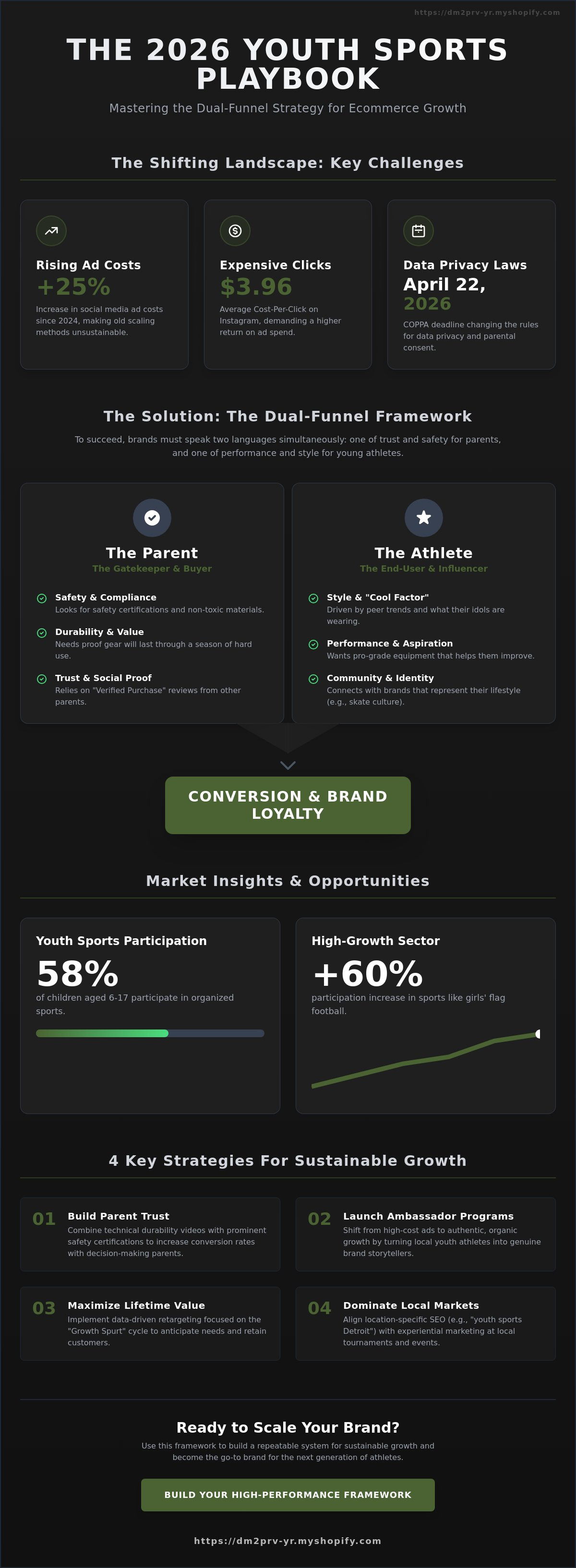
With social media ad costs rising up to 25% since 2024 and Instagram CPCs averaging $3.96, the old way of scaling is no longer sustainable. You've likely felt the pressure of trying to look "cool" to a middle school athlete while simultaneously proving to a skeptical parent that your products are safe and durable. Executing a successful ecommerce marketing strategy for kids sports brands in 2026 means walking a tightrope between athlete excitement and strict safety standards, especially as the April 22 COPPA deadline changes the rules for data privacy and parental consent.
We agree that balancing these two distinct audiences is the most frustrating part of scaling a youth brand. This guide promises to help you master a "Dual-Funnel" framework that validates safety for parents while selling performance and lifestyle to kids. We'll show you how to tap into high-growth sectors like girls' flag football, which saw a 60% participation increase recently, and use AI-powered personalization to lower your customer acquisition costs. From navigating the latest privacy laws to leveraging micro-influencers, this is your roadmap for building a repeatable system for sustainable online growth.
Key Takeaways
- Master the "Dual-Funnel" ecommerce marketing strategy for kids sports brands to effectively bridge the gap between parental trust and athlete excitement.
- Increase conversion rates by layering technical durability videos with the specific safety certifications that decision-making parents demand.
- Shift from high-cost ads to organic growth by launching a micro-ambassador program that turns local youth athletes into authentic brand storytellers.
- Maximize customer lifetime value using data-driven retargeting strategies designed specifically for the "Growth Spurt" cycle of young athletes.
- Drive local dominance by aligning Michigan-focused SEO with experiential marketing at tournaments and skate parks in key hubs like Detroit and Grand Rapids.
The 2026 Landscape of Ecommerce Marketing for Kids Sports Brands
The youth sports market has transformed into a high-stakes environment where 58% of children aged 6-17 are actively participating in organized activities. For brands, this means an ecommerce marketing strategy for kids sports brands must now account for two entirely different sets of motivations. You aren't just selling a product; you're selling a solution to a parent and a dream to an athlete. This shift is driven by the rise of niche technical gear that replaces the generic equipment found in traditional big-box stores. 2026 is the year of "Performance Education," where brands must teach young athletes why specific gear matters for their physical development while ensuring compliance with the April 22, 2026, COPPA updates.
The Dual-Audience Marketing Framework
Marketing to families requires a split-brain approach. Parents act as the primary gatekeepers and decision makers. Their priorities are grounded in safety, durability, and long-term value. They want to know that a pair of cleats won't fall apart mid-season and that a helmet meets the latest safety certifications. Conversely, the child is the end user driven by peer-group relevance and style. If a brand doesn't look "cool" on social media, the child won't wear it, regardless of its safety rating. Brands must bridge this gap by using technical transparency to prove quality to parents while maintaining high-energy lifestyle branding for the kids.
Why Niche Authority Beats Big-Box Retail
Generic retailers are losing ground to specialized brands that offer pro-grade equipment tailored for specific disciplines. As participation in sports like girls' flag football grows by 60%, families are seeking out experts rather than generalists. These niche brands use sophisticated digital marketing strategies to build direct relationships with their communities. By providing expert content on how gear affects performance, smaller companies can out-rank major retailers who rely on volume over value. This transition is particularly evident in subcultures like the skateboard lifestyle, where authenticity and technical specs are more important than a low price tag.
Mobile-first shopping has become the standard for these transactions. Parents often research and purchase gear from the sidelines of a game or during a carpool commute. If your site isn't optimized for a three-tap checkout, you're losing sales to more agile competitors. The current market demands a seamless transition from a social media discovery phase to a high-trust, mobile-optimized storefront that answers safety questions before they are even asked.
Building a High-Conversion Storefront for Youth Sports Gear
Your storefront is where the dual-audience challenge meets its resolution. While high-energy social content grabs the child's attention, the product page must convert the parent. A winning ecommerce marketing strategy for kids sports brands prioritizes high-trust UI elements that answer safety and durability concerns immediately. This includes using video to show equipment in action. Seeing a skateboard withstand a drop test or a jersey survive a muddy slide provides the "cool factor" for the athlete and the durability proof for the buyer.
Trust Signals and Social Proof for Parents
Parents are naturally skeptical of online claims. They rely heavily on "Verified Purchase" reviews from other parents who've already tested the gear in real-world conditions. Highlighting specific safety features, such as non-toxic materials or safety-tested hardware, is no longer optional. With the COPPA compliance deadline of April 22, 2026, brands must also be transparent about data collection. Understanding the nuances of online marketing to children ensures your storefront remains compliant while building long-term authority. Consider offering "kid-proof" guarantees or extended warranties to remove the risk from the purchase.
Interactive Sizing and Fit Technology
Returns are the silent killer of ecommerce margins. Static size charts are often confusing for parents buying gear for growing children. Modern storefronts now use AI-powered personalization tools and interactive "Find My Size" quizzes to provide accurate recommendations. 3D product views allow parents to see the scale of equipment against a child-sized model, reducing the guesswork involved in buying technical gear like helmets or pads. This level of detail is a core part of a modern ecommerce marketing strategy for kids sports brands.
Simplifying the entry point is another powerful conversion tactic. "Bundled Starter Kits" that include all necessary equipment for a specific sport remove the mental load from new sports parents. This approach not only increases average order value but also positions your brand as a helpful partner in their child's athletic journey. If you're looking to upgrade your equipment selection, you can explore our latest high-performance gear designed for the next generation of athletes. By combining these technical trust signals with a frictionless mobile experience, you turn skeptical browsers into loyal brand advocates.
Multi-Channel Growth: Social Proof and Community Influence
Social media discovery is the primary engine driving traffic to your store, but it requires a strategy that serves two masters. While high-performance trick videos on TikTok capture a child's imagination, the community engagement surrounding those videos builds the trust a parent needs to click "buy." An effective ecommerce marketing strategy for kids sports brands in 2026 leverages this dual interest by turning customers into advocates. Instead of relying solely on expensive top-tier athletes, successful brands are shifting budgets toward micro-ambassador programs. Nano-influencers with 1,000 to 10,000 followers often charge between $50 and $250 per post, making them a cost-effective way to build local authority and authentic social proof.
Email marketing serves as the bridge for the parent audience. Once a parent joins your list, your role shifts from "seller" to "coach." You can provide immense value by sending maintenance tips, safety checklists, and even drills they can do with their kids. This "Behind the Brand" storytelling humanizes your company. It shows parents that you aren't just a faceless corporation, but a team of experts dedicated to their child's athletic progression. This approach builds a lifestyle ecosystem that keeps your brand top-of-mind when it's time to replace outgrown gear.
UGC: The New Gold Standard for Youth Brands
User-generated content (UGC) is more persuasive than any polished studio ad. Encourage parents to share unboxing videos or "Play of the Week" clips by offering small rewards or featuring them on your official channels. This creates a sense of belonging for the child and provides real-world durability proof for other parents. However, privacy is paramount. With the April 22, 2026, COPPA compliance updates now in full effect, you must have mandatory written data security policies. Always obtain separate, explicit parental consent before featuring any minor in your marketing materials or sharing their data with third-party platforms.
Educational Content as a Lead Magnet
Parents often feel overwhelmed when buying technical equipment for a sport they might not play themselves. You can solve this pain point by creating high-value educational resources. Guides such as "How to Choose Your First Skateboard" or pro-grade gear guides establish your brand as a technical authority. By answering common questions about sizing, materials, and safety, you reduce the friction that often stops a parent from completing a purchase. These resources don't just drive organic traffic; they nurture leads by proving that your brand cares about the athlete's success as much as the parent does.
Dominating Local Markets: Michigan Youth Sports SEO and Events
Michigan is a powerhouse for youth athletics, ranking 8th nationally with 298,246 high school sports participants during the 2024-25 academic year. For a brand to truly scale, your ecommerce marketing strategy for kids sports brands should include a localized layer that dominates specific hubs like Detroit, Grand Rapids, and Flint. Parents in regions like Fenton and Brighton often search for niche equipment using "near me" queries. If you don't have a digital presence that highlights local availability or fast regional shipping, you're handing sales to big-box competitors. Localizing your SEO ensures that when a parent in the Detroit Metro area searches for high-performance gear, your brand is the first they see.
Michigan-Specific Digital Strategy
Success in the Michigan market requires more than just generic ads. You should build localized landing pages tailored to Detroit and Grand Rapids customers, highlighting community-specific events or local pickup options. Geo-fencing ads around major sports complexes and skate parks allows you to reach parents exactly where they spend their weekends. Mentioning "Fast Michigan Shipping" for residents in Flint and Brighton can be the deciding factor for a parent who needs gear before next Saturday's tournament. This hyper-local approach builds a level of trust that national retailers can't easily replicate.
IRL Brand Activations at Local Parks
Digital strategy is most effective when paired with "In Real Life" (IRL) activations. Hosting "Demo Days" at popular spots like Modern Skate & Surf allows young athletes to feel the quality of your gear firsthand. These events provide the perfect opportunity to collaborate with local Michigan influencers who already have the ear of the community. You can also build long-term loyalty by hosting "Pop-up" shops in Fenton or Brighton during local league registrations. These physical touchpoints create the "cool factor" that kids crave while giving parents a chance to inspect the equipment's durability.
Sponsoring local tournaments in the Detroit Metro area is another high-impact way to increase brand visibility. As youth sports tourism continues to grow, being a visible partner at these events positions your brand as a staple of the local sports culture. If you're ready to get your gear into the hands of more athletes, shop our pro-grade equipment collection today. By combining geo-targeted digital ads with physical community involvement, you create a dominant market presence that thrives both online and on the sidelines.
Scaling Your Brand: The High-Performance Framework
Scaling is the final hurdle in a successful ecommerce marketing strategy for kids sports brands. Once you've established trust in local hubs like Detroit or Grand Rapids, the goal is to expand that authority nationwide. This transition requires moving beyond a single-product focus and building a lifestyle ecosystem. If a parent trusts your technical gear, they're significantly more likely to purchase your apparel and accessories. This shift doesn't just increase your average order value; it cements your brand as a permanent fixture in the athlete’s daily life. Long-term success depends on your ability to stay relevant as the child matures from a beginner to a competitive player.
Brand purpose and community involvement are the engines of long-term customer lifetime value (LTV). Modern parents want to buy from companies that give back to the sports their children love. Whether it's sponsoring a local league in Flint or supporting initiatives to close the participation gap for low-income families, these actions build a "social bank account" of goodwill. When your brand stands for more than just profit, you create a loyal community that resists the pull of cheaper, generic competitors.
The "Growth Spurt" Retargeting Strategy
Children outgrow equipment at a predictable rate. You can use this to your advantage by tracking purchase dates and sizes to forecast future needs. If a parent buys a starter kit for a seven-year-old, your system should trigger an automated "Upgrading Your Setup" flow twelve to eighteen months later. These data-driven touchpoints show parents you're paying attention to their child's development. Offering loyalty discounts for these returning customers significantly lowers your long-term acquisition costs. It turns a one-time transaction into a multi-year relationship that survives every growth spurt.
Finalizing Your 2026 Marketing Roadmap
Your roadmap should prioritize the channels where your niche audience is most active. While social media provides the discovery, your email and SMS lists provide the retention. Set realistic KPIs that account for the dual-audience sales cycle. You aren't just looking at immediate ROAS; you're measuring brand sentiment among parents and peer-group relevance among kids. This is the core of a modern ecommerce marketing strategy for kids sports brands. Partnering with experts who understand the technical nuances of buying skateboards online can help you avoid common pitfalls in product descriptions and sizing tools. By following this high-performance framework, you'll build a legacy brand that grows alongside the next generation of athletes.
Future-Proof Your Brand for the Next Generation of Athletes
Scaling a youth sports brand in 2026 requires more than just high-energy social clips. It demands a sophisticated balance between technical transparency for parents and cultural relevance for kids. By mastering the dual-funnel approach and leveraging hyper-local authority in Michigan hubs like Detroit and Grand Rapids, you can build a brand that outlasts the competition. Your ecommerce marketing strategy for kids sports brands must evolve alongside the athletes you serve, using data to predict their needs as they enter new stages of physical development.
We're trusted by Michigan athletes and provide expert guides to help you navigate the complexities of pro-grade youth sports gear. With fast shipping across Detroit and Grand Rapids, we're here to support your growth every step of the way. Upgrade Your Brand’s Digital Strategy with Our Pro-Grade Framework. The youth sports market is expanding rapidly and showing no signs of slowing down. Now is the perfect time to claim your place at the front of the pack and build a legacy that lasts for seasons to come.
Frequently Asked Questions
What is the best ecommerce platform for a kids sports brand in 2026?
Shopify and BigCommerce are the leading choices for youth sports brands due to their mobile-first designs and extensive app ecosystems. Shopify offers a Basic plan for $39 monthly, which includes the necessary tools for integrating AI sizing quizzes and product bundles. BigCommerce is an excellent alternative for brands looking to avoid additional transaction fees as they scale their sales volume.
How do I market to parents without sounding too "corporate" for kids?
You should adopt a "Dual-Funnel" strategy that separates your technical messaging from your lifestyle branding. Use your website and email flows to provide parents with safety certifications and durability data. On social media, focus on high-energy content that emphasizes performance and peer relevance. This ensures your ecommerce marketing strategy for kids sports brands appeals to the parent's logic and the child's aspirations.
Are sponsorships worth it for small ecommerce sports brands?
Localized sponsorships offer a much higher return on investment for smaller brands than broad national campaigns. Partnering with Michigan-based youth leagues or regional tournaments in the Detroit Metro area builds grassroots authority and trust. These partnerships allow you to get your gear into the hands of athletes and parents in a high-trust environment, leading to better long-term brand loyalty.
How can I compete with major retailers like Dick’s Sporting Goods?
You can beat major retailers by focusing on niche expertise and pro-grade equipment that generalist stores often ignore. Big-box retailers prioritize volume and "toy-grade" gear, leaving a gap for specialized technical products. By providing expert educational content and precise sizing tools, you position your brand as the authoritative choice for families who take their child's athletic development seriously.
What social media platform is best for reaching youth athletes?
TikTok is currently the most effective platform for reaching young athletes through algorithm-driven discovery and trick-shot challenges. It's the ideal space for organic unboxing videos and athlete-led content that builds peer-group excitement. Instagram Reels remains a vital secondary channel because it allows you to reach the parent demographic while still showcasing the "cool factor" of your equipment to the kids.
How do I handle shipping and returns for bulky sports equipment?
Managing bulky gear requires a combination of flat-rate shipping and localized logistics strategies. For brands with a strong Michigan presence, offering local pickup in hubs like Grand Rapids or Detroit can significantly lower your shipping overhead. You should also implement a clear "Easy Exchange" policy to reduce the parent's perceived risk when purchasing large, technical items like skate ramps or goal posts.
Is influencer marketing effective for youth sports gear?
Influencer marketing is highly effective when you partner with micro-influencers who have 10,000 to 100,000 followers. These creators often charge between $250 and $1,500 per Instagram post and provide the authentic social proof that skeptical parents require. Integrating these partnerships into your ecommerce marketing strategy for kids sports brands helps demonstrate real-world durability that traditional studio photography cannot replicate.
What are the legal considerations for marketing to children online?
You must strictly adhere to the updated COPPA regulations that became enforceable on April 22, 2026. These rules now include a broader definition of personal information and require mandatory written data security and retention policies. Obtaining separate parental consent for sharing data with third parties is essential. Failure to comply can result in significant fines and aggressive enforcement from the Federal Trade Commission.
Disclaimer
Some content published on this website may be developed with the assistance of AI-powered research and writing tools to help streamline research, organization, and content creation. All articles are reviewed, edited, and approved by Marvin Growth Partners to ensure they align with our perspectives, experience, and intended messaging.
While we strive to provide accurate and up-to-date information, blog content is intended for informational and educational purposes only and should not be considered legal, financial, or professional advice. Readers should independently verify information and consult qualified professionals when appropriate.