

Ecommerce Marketing Strategy for Sporting Goods Brands in Michigan: The 2026 Growth Framework
With Michigan's sporting goods market projected to hit $3.2 billion in 2026, why are so many local shops still losing ground to national giants? It's often because a generic, one-size-fits-all approach fails to resonate with the Great Lakes lifestyle. To win, you need a specialized ecommerce marketing strategy for sporting goods brands Michigan residents actually trust. You've likely felt the sting of high shipping costs for bulky gear and the inevitable revenue dip when winter hits. It's frustrating to watch national competitors dominate search results while your deep knowledge of local trails and lakes goes unnoticed.
Marvin Growth Partners is here to change that. Our framework promises to help you master the localized digital tactics needed to scale your brand and outmaneuver big-box retailers. You'll learn how to navigate new legal hurdles like Senate Bill 351, optimize your ad spend for cities like Flint and Grand Rapids, and build a community that stays loyal year-round. We'll break down the exact steps to leverage Michigan's $15.1 billion outdoor recreation economy through seasonal agility and AI-powered personalization.
Key Takeaways
- Learn how to craft a high-performing ecommerce marketing strategy for sporting goods brands Michigan that turns the state's unique "mitten" geography into a competitive advantage.
- Discover the five pillars of Michigan-centric growth, including hyper-local SEO tactics for Detroit and Grand Rapids and content strategies that educate beginner athletes.
- Maximize year-round revenue by implementing weather-triggered marketing campaigns that sync your product promotions with Michigan's unpredictable seasonal shifts.
- Build a loyal local community by integrating user-generated content from recognizable landmarks like Hart Plaza into your social media and email strategy.
- Streamline your operations with AI-driven personalization and logistics tools designed to manage multi-location inventory across the Great Lakes State.
The Michigan Sporting Goods Landscape: Why Localized Ecommerce Wins
In 2026, an effective ecommerce marketing strategy for sporting goods brands Michigan isn't just about moving inventory. It's about demonstrating a deep connection to the specific terrains and cultures of the Great Lakes State. While national giants aim for broad appeal, local brands find success by catering to niche markets that big-box retailers overlook. This localized approach recognizes that the mitten geography creates distinct consumer behaviors. For instance, the marketing imagery and product selection for inland lake enthusiasts in Fenton should look vastly different from the high-energy street culture gear favored in Detroit.
This regional focus taps into a massive market projected to reach $3.2 billion in 2026. According to verified data, the outdoor recreation industry contributed $15.1 billion to the state's economy in 2024. Gaining a foothold in Michigan's diverse economy requires shifting from a global scale mindset to one of local authority. Buyers in Grand Rapids or Flint increasingly favor brands that support the community, seeing Michigan-based labels as a mark of quality and shared values.
Defining the Michigan Advantage in 2026
Success in 2026 depends on analyzing the high density of outdoor enthusiasts in areas like Grand Rapids and Brighton. These regions aren't just zip codes; they're communities where gear is put to the test against unpredictable weather. By using marketing imagery that features the Great Lakes or local trailheads, you signal that your products are designed for the actual conditions your customers face. This authenticity is something national competitors struggle to replicate with stock photography. Highlighting your proximity to the lakes builds immediate trust with shoppers who value durability.
The Challenge of National Competition
National retailers don't always fill the gaps in their local SEO strategies, often focusing on broad keywords that ignore regional identity. You can disrupt their ad placements by using Flint-tough or Detroit-centric branding that resonates with local pride. Instead of being just another storefront, your brand wins by acting as a community leader. This involves engaging with local athletes and creators to ensure your ecommerce marketing strategy for sporting goods brands Michigan feels like a natural extension of the local scene. You aren't just selling a product; you're supporting the local lifestyle.
The Support Local movement has evolved from a sentimental trend into a powerful competitive advantage. In 2026, Michigan shoppers are savvy. They know that a local brand understands the grit required for a Detroit winter or the specific gear needed for a weekend in the Upper Peninsula. This trust allows smaller brands to achieve a higher Return on Ad Spend (ROAS) because their messaging hits home. When you position your brand as the expert on Michigan's 3,101 sporting goods stores and its unique manufacturing landscape, you're offering expertise that a corporate algorithm can't match.
5 Pillars of a Michigan-Centric Ecommerce Marketing Strategy
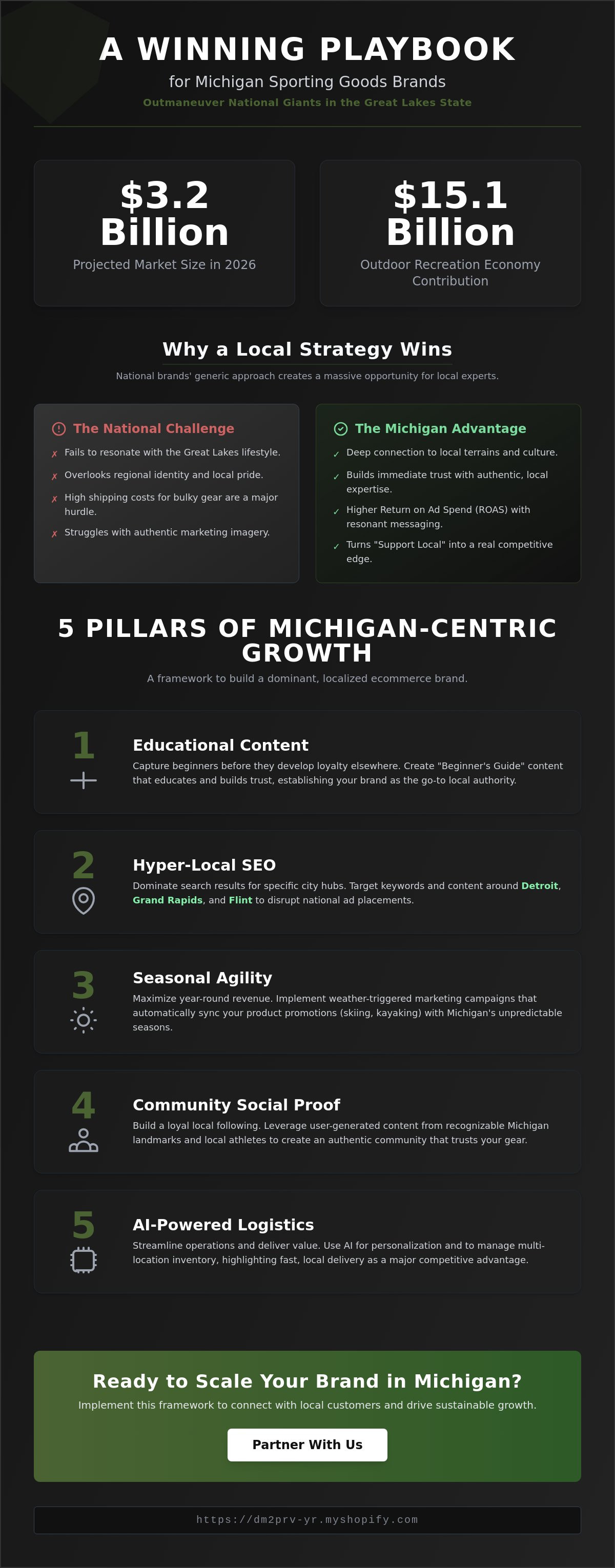
Building a brand that survives against national conglomerates requires a shift in focus. A successful ecommerce marketing strategy for sporting goods brands Michigan must go beyond simple Facebook ads. It needs to ground itself in the daily lives of residents from the Upper Peninsula to the Detroit suburbs. According to recent Michigan online shopping statistics, consumers here are increasingly comfortable spending on specialty items online, provided the brand feels authentic. With a projected $3.2 billion market size in 2026, the opportunity is massive for those who can connect with local outdoor enthusiasts.
The five pillars of this framework include:
- Educational Content: Capturing beginners before they develop brand loyalty elsewhere.
- Hyper-Local SEO: Dominating search results for specific city hubs like Flint or Ann Arbor.
- Seasonal Agility: Using weather data to trigger relevant marketing for skiing or kayaking.
- Community Social Proof: Leveraging local voices who actually use the gear in Michigan's climate.
- Logistics: Highlighting fast, local delivery as a major competitive value proposition.
The 'Beginner's Guide' Content Strategy
Many national retailers ignore the "curious beginner" segment, focusing instead on high-margin professional gear. This is a mistake. Educating newcomers is the most effective way to build long-term lifetime value (LTV). When a customer learns a new skill through your content, they associate your brand with their success. You can capture top-of-funnel traffic by creating comprehensive resources like our guide on How to Choose Your First Skateboard Without Wasting Money. This approach builds trust and authority before a purchase even happens, making you the go-to source as they progress in their sport.
Hyper-Local SEO: Beyond the State Level
Generic keywords are expensive and crowded. Instead, target high-intent phrases like "skate shop Detroit" or "outdoor gear Grand Rapids" as part of your broader ecommerce marketing strategy for sporting goods brands Michigan. Create landing pages that mention local landmarks, such as the Joe Louis Greenway or the Grand River. This signals to both Google and your customers that you're physically and culturally present. If you have a showroom, optimize your Google Business Profile to encourage Buy Online, Pick Up In-Store (BOPIS) options. It's a powerful way to bridge the gap between digital convenience and local reliability. If you're ready to optimize your presence, consider browsing our expert-led Michigan gear hub for inspiration.
Finally, treat your logistics as a marketing tool. Shipping bulky sporting goods is a major pain point for Michigan buyers. By highlighting your ability to deliver within 1 to 2 days across the state, you remove a significant barrier to purchase that national sellers can't always match. This localized speed, combined with weather-triggered emails that offer snow gear the moment a Detroit storm hits, ensures your brand stays relevant and responsive.
Leveraging Michigan's Seasonal Shifts for Revenue Growth
Michigan's weather is famously unpredictable. A successful ecommerce marketing strategy for sporting goods brands Michigan must be as agile as the athletes it serves. Unlike national competitors who run generic "Winter Sale" banners across the entire country, local brands win by syncing their digital storefronts with the local forecast. When the first heavy lake-effect snow hits Detroit, your email sequences should already be live, offering cold-weather essentials and survival gear. This level of responsiveness builds a connection that big-box retailers simply can't match.
Managing inventory during the "shoulder seasons" in towns like Brighton and Fenton requires specific precision. These transitional months in early spring and late fall are often when buyers are most active but least certain about their gear needs. You should pivot your homepage hero images weekly to reflect the current outdoor reality. If it's a muddy March in the Mitten, show gear that handles the slush rather than pristine summer equipment. This tactical agility ensures your brand remains relevant every week of the year.
Winter Survival Strategies for Non-Winter Brands
For brands that don't sell skis or snowboards, Michigan winters can feel like a revenue desert. The key is shifting your narrative from outdoor performance to indoor mastery and lifestyle maintenance. Skate brands, for example, can market balance boards, indoor ramps, or technical apparel designed for cold-weather layering. By promoting the Skateboard Lifestyle as a year-round mindset, you maintain engagement even when the parks are buried in snow. Use this "off-season" to host indoor workshops or virtual training sessions that keep your community active until the thaw.
Summer Peak Optimization
The Michigan summer is short, intense, and incredibly profitable. To capitalize on this window, your ecommerce marketing strategy for sporting goods brands Michigan must focus on "Great Lakes" themed campaigns that celebrate water and street sports. Prepare your logistics for the "Spring Surge" in hubs like Grand Rapids and Flint. This is when participation in traditional team sports and pickleball skyrockets. Wholesale sales for pickleball gear increased by 22% in 2025, and Michigan's growing court density makes this a prime target. Ensure your inventory is stocked and your shipping team is ready for high-volume weeks between May and August.
- Sync email triggers with local weather stations in Detroit and Grand Rapids.
- Update social media creative to match the actual sky outside your customers' windows.
- Focus on indoor training gear during the January and February deep freeze.
- Highlight fast shipping for summer gear to beat the short season's end.
Community-First Marketing: From Detroit to Grand Rapids
National brands treat Michigan as a single demographic. You shouldn't. A winning ecommerce marketing strategy for sporting goods brands Michigan recognizes the cultural difference between a Detroit street skater and a Grand Rapids hiker. Partnering with local athletes isn't just about reach; it's about relevance. When you see a creator using your gear at Hart Plaza or enjoying a post-session drink at Founders Brewing, the authenticity is undeniable. Neighbor-to-neighbor trust is something Amazon can't buy.
- Partner with Michigan-based creators who actually use your gear in local climates.
- Feature user-generated content (UGC) from recognizable spots like the Joe Louis Greenway.
- Reward loyalty with a "Michigan League" program for local heroes.
Consider hosting physical pop-up shops in hubs like Fenton or Brighton. These events serve as high-impact customer acquisition tools for your online store. They allow you to capture email addresses and SMS opt-ins from people who have touched your product. You can then nurture these leads with exclusive rewards for those who represent your brand across the state. This localized strategy turns a one-time visitor into a lifelong advocate.
The Power of Local Social Proof
A five-star review from a generic buyer is fine, but a review from a Detroit local carries much more weight. Encourage your customers to share photos of their gear at recognizable Michigan landmarks. Such content builds a visual "Spot Guide" on your site. This type of content doesn't just improve your search visibility; it helps newcomers feel like they're joining a real community. It turns your blog into a destination for local knowledge rather than just another sales pitch. It's about being the authority in your own backyard.
Omni-channel Engagement
You must bridge the gap between the physical Michigan experience and the digital realm. If you want customers to buy skateboard online through your store, they need to feel that same local vibe they get in person. Use SMS marketing to alert fans in specific zip codes about local meetups or Michigan-only product drops. Segmenting your email list by city allows you to send personalized offers, like a Grand Rapids-themed discount during ArtPrize. High-level personalization makes your brand feel like a local staple. Ready to see how we're building the future of Michigan sports? Explore our pro-grade Michigan collection today.
Implementing the 2026 Framework: Tech and Logistics
Executing a high-performing ecommerce marketing strategy for sporting goods brands Michigan requires more than just a functional website. In 2026, your tech stack must be as rugged as the gear you sell. It needs to handle Michigan's specific regulatory environment, including compliance with Senate Bill 351 regarding telemarketing and Senate Bill 759 for consumer protection. Since shipping charges are taxable in Michigan when the item itself is taxable, your checkout system must be configured to handle the state's 6% sales tax rate accurately across every transaction. National competitors often miss these nuances, giving local brands a head start on compliance and trust.
Use AI-driven personalization to create a dynamic shopping experience. A visitor from Marquette in November should see different product recommendations than someone browsing from Detroit. While the Detroiter might be looking for indoor training gear or street apparel, the Upper Peninsula resident is likely hunting for heavy-duty winter essentials. By leveraging local warehouses, you can offer next-day delivery within the state. This speed is a massive advantage over national competitors shipping from out-of-state hubs, especially when customers need gear before a weekend trip to the dunes or the slopes.
The Michigan Tech Stack
Choose a platform like Shopify that excels at multi-location inventory management. This allows you to sync stock between a physical showroom in Grand Rapids and your online warehouse seamlessly. Use apps that offer geo-targeted pop-ups to alert local shoppers about "Buy Online, Pick Up In-Store" (BOPIS) options. This is highly effective for bulky sporting goods that are expensive to ship. Data from your tech stack should help you predict when Flint or Grand Rapids customers are ready to buy based on local sporting calendars and weather patterns.
Scaling Beyond the Mitten
Once you've mastered the Michigan market, use this localized framework as a blueprint for Midwest expansion. The loyalty you've built in Detroit and Flint proves that community-first marketing works. You can ship nationally while maintaining your brand's "local soul" by continuing to highlight your Michigan roots and design process. Before you expand, ensure your 2026 readiness with this checklist:
- Audit your SMS and email flows for SB 351 compliance to avoid private right of action lawsuits.
- Verify that your tax settings reflect Michigan's 6% rate on both items and shipping.
- Set up geolocation triggers for personalized product collections based on zip code.
- Establish a 24-hour shipping guarantee for all in-state orders to outpace national retailers.
Ready to scale your sporting goods brand? Discover how Marvin Growth Partners can help you master pro-grade gear positioning and achieve your 2026 growth targets.
Dominating the Great Lakes Market in 2026
Success in the Michigan sporting goods industry requires more than just listing products online. It demands a commitment to the local culture and an agile response to our unique regional challenges. By prioritizing community-first marketing and leveraging localized logistics, you can build a brand that national competitors simply cannot displace. You've seen how seasonal agility and hyper-local SEO form the backbone of a resilient ecommerce marketing strategy for sporting goods brands Michigan businesses need to scale. Now it's time to put these pillars into practice.
We've spent years mastering the nuances of Michigan-based skate and street culture to help brands find their edge. Our proven framework for high-performance gear positioning ensures your products don't just sit on a digital shelf; they become part of the local lifestyle in Detroit, Flint, and Grand Rapids. Whether you're navigating new shipping regulations or building a "Local Hero" loyalty program, the right strategy makes all the difference. Explore Pro-Grade Gear Strategies at Our Michigan Shop and start out-localizing the competition today. The Michigan market is ready for brands that actually understand the mitten.
Frequently Asked Questions
What is the best ecommerce platform for Michigan sporting goods brands?
Shopify is the most effective platform for Michigan brands because it handles multi-location inventory and state-specific tax calculations effortlessly. It integrates well with local shipping carriers, allowing you to offer the fast delivery speeds Michigan shoppers expect. Since the platform supports advanced geo-targeting, you can easily implement a tailored ecommerce marketing strategy for sporting goods brands Michigan that shows different gear to customers in different climate zones.
How do I compete with national sporting goods retailers on a smaller budget?
You win by focusing on hyper-local authority and community trust that national big-box stores can't replicate. Instead of outspending them on broad keywords, target long-tail, city-specific phrases and build relationships with local creators. Use your knowledge of Michigan's specific trails and parks to provide value-driven content. Smaller brands often see higher conversion rates when they position themselves as the local experts who actually use the gear in Michigan conditions.
How does Michigan's weather affect ecommerce marketing strategies?
Michigan's weather dictates the entire product lifecycle, requiring brands to be agile with their digital storefronts. You should use weather-triggered email flows that automatically promote winter gear during a snowstorm or water sports equipment during a heatwave. This level of responsiveness ensures your ads and emails feel relevant to the customer's immediate environment. It prevents the disconnect often seen with national retailers who run summer promos while Michigan is still under a spring frost.
What are the most important SEO keywords for Michigan-based sports brands?
Focus on "near me" searches and city-specific combinations like "Detroit skate shop" or "Grand Rapids hiking gear." These high-intent keywords help you capture local traffic that is ready to buy or visit a showroom. Don't ignore regional identifiers like "Great Lakes" or "Mitten-made" in your meta descriptions. These terms signal authenticity to local buyers who prefer supporting businesses within the state's borders.
Should I focus on Detroit or smaller Michigan cities like Fenton and Brighton?
A balanced approach is best, but your messaging must change based on the location. Detroit offers high-volume opportunities for street culture and team sports; however, towns like Fenton and Brighton are hubs for lake life and trail activities. Segmenting your ecommerce marketing strategy for sporting goods brands Michigan allows you to run targeted ads that reflect the specific recreation habits of each area. This precision leads to a much higher return on ad spend.
How can I use social media to build a local Michigan community?
Use social media to highlight recognizable Michigan landmarks and local athlete stories rather than just posting product shots. Share user-generated content from popular spots like Sleeping Bear Dunes or the Dequindre Cut to build visual proof. Host contests for local event tickets or shop credits to boost engagement within the state. This strategy transforms your followers from passive observers into a loyal community that identifies with your brand’s Michigan roots.
What is the role of 'Beginner Guides' in a sporting goods marketing strategy?
Beginner guides are essential for capturing customers at the start of their journey, which builds long-term brand loyalty. By explaining how to choose the right equipment for Michigan's specific terrain, you establish yourself as a helpful mentor rather than a pushy salesperson. These guides are excellent for organic SEO and provide shareable content for social media. They help reduce the choice paralysis that often prevents new athletes from making their first big purchase.
How do I optimize my ecommerce site for Michigan-based mobile users?
Prioritize lightning-fast load speeds and simplified navigation for athletes who are often searching for gear while at the park or beach. Ensure your "Buy Online, Pick Up In-Store" (BOPIS) options are prominent on mobile product pages. Since many Michigan residents shop while traveling through areas with varying signal strength, a lightweight and responsive design is crucial. Use large, tappable buttons and a streamlined checkout process to minimize friction for users on the go.
Disclaimer
Some content published on this website may be developed with the assistance of AI-powered research and writing tools to help streamline research, organization, and content creation. All articles are reviewed, edited, and approved by Marvin Growth Partners to ensure they align with our perspectives, experience, and intended messaging.
While we strive to provide accurate and up-to-date information, blog content is intended for informational and educational purposes only and should not be considered legal, financial, or professional advice. Readers should independently verify information and consult qualified professionals when appropriate.