

How Often to Meet Your Michigan Marketing Consultant
What if the traditional monthly check-in is actually the reason your marketing results have stalled? You're likely asking, "How Often Should I Meet With My Marketing Consultant?" because you're tired of meetings that feel like fluff while your operational to-do list grows. It's a common struggle for Michigan business owners who must balance daily demands with the need to stay competitive. You want to ensure your strategy is on track, especially as local regulations like Senate Bill 351 change how we reach customers. It's natural to worry that a lack of communication might be the only thing standing between you and your next growth milestone.
We understand that your time is your most valuable asset. You need a communication schedule that produces actionable tasks rather than just another empty calendar invite. This article breaks down how to find your ideal "Strategy Velocity" to balance marketing ROI with your busy schedule. You'll learn how to establish a cadence that keeps your team accountable, ensures your AI-driven SEO is performing, and gives you total confidence that your marketing investment is actually working.
Key Takeaways
- Learn how to align your meeting frequency with "Strategy Velocity" to ensure your marketing agility matches your specific business goals.
- Identify the five critical factors, such as project phase and market volatility, that determine whether you need high-intensity contact or simple maintenance updates.
- Resolve the question, "How Often Should I Meet With My Marketing Consultant?" by exploring the distinct advantages of weekly, bi-weekly, and monthly cadences.
- Understand the unique benefits of in-person strategy sessions for Michigan businesses to build trust and capture nuances that digital communication often misses.
- Master the "No Agenda, No Meeting" rule to transform every consultation from a time-sink into a productive session focused on actionable KPIs.
Finding the Right Cadence: Why Meeting Frequency Matters for Your ROI
A meeting cadence isn't just a recurring calendar event; it's the rhythmic heartbeat of your business growth. In the context of marketing management, this cadence dictates how quickly your brand responds to market shifts and consumer data. For many Michigan business owners, the question of "How Often Should I Meet With My Marketing Consultant?" arises from a desire to see tangible results without losing hours to "fluff" conversations. The goal is to find your "Strategy Velocity," which is the speed at which your specific market changes and your team executes tasks. If your cadence is too slow, you miss opportunities. If it's too fast, you're paying for talk instead of action.
The correlation between communication and campaign agility is direct. In a year where 53% of small businesses are increasing investments in fast-moving channels like video marketing and advertising, waiting a month to review performance can be a costly mistake. High-velocity strategies require tighter feedback loops. However, many local entrepreneurs fall into the "Meeting Fatigue" trap, where they spend more time discussing the plan than actually implementing it. To maximize your ROI, your meeting schedule must be a tool for momentum, not a hurdle to productivity.
The Cost of Under-Communication
When you don't meet often enough, brand messaging starts to drift. In competitive hubs like Detroit or Grand Rapids, "set it and forget it" marketing is a recipe for stagnation. You might miss critical signs that a campaign is failing, or worse, ignore new state regulations like the 2026 Michigan Telephone Solicitation Act (SB 351) that could impact your outreach. Signs you aren't meeting enough include feeling "out of the loop" on spending, seeing inconsistent brand visuals across platforms, or realizing your consultant is unaware of major internal business changes.
The Hidden Drain of Over-Communication
Conversely, meeting too often carries a heavy opportunity cost. Every hour you spend in a status meeting is an hour you aren't managing operations or closing sales. It's important to recognize when "status updates" become a substitute for actual marketing work. If your consultant spends 20% of their billable time preparing for and attending meetings, that's 20% less time spent on SEO, content creation, or lead generation. You should be wary if meetings lack a clear agenda or if you find yourself asking "How Often Should I Meet With My Marketing Consultant?" because the current schedule feels like it's just padding the consultant's hours without moving the needle.
5 Factors That Determine Your Ideal Marketing Meeting Schedule
Finding the perfect cadence isn't a one-size-fits-all decision. When asking, "How Often Should I Meet With My Marketing Consultant?", you must look at the specific variables of your business. A startup in Grand Rapids launching a new service will need a vastly different schedule than a long-standing manufacturing firm in Lansing simply maintaining its search presence. Your meeting frequency should be a reflection of your current business needs, not just a default setting on a calendar.
Consider these five critical factors when setting your schedule:
- Project Phase: Onboarding typically requires three times more contact than a maintenance phase. The first 90 days involve heavy data sharing and goal setting.
- Market Volatility: Fast-moving industries require tighter feedback loops. If your competitors are aggressive, you can't afford to wait a month to react.
- Consultant Scope: A specialist focusing on a single task like SEO needs less face-time than a fractional CMO who is steering your entire business strategy.
- Internal Capability: If your local team handles the execution, meetings will focus on guidance. If the consultant does everything, they need more frequent check-ins to ensure alignment.
- Budget vs. Value: Your meeting schedule should align with your contract size. Don't let administrative talk eat up the budget meant for creative work.
If you feel your current strategy is lacking direction, it might be time to consult with a professional to realign your goals and communication style.
Launch Phases vs. Steady State
Weekly sprints are essential during a new website launch or a major brand refresh. During these high-stakes periods, daily or weekly touchpoints prevent small errors from becoming expensive delays. Once the campaign reaches a "steady state," you can usually transition to a bi-weekly or monthly rhythm. It's smart to set specific triggers to increase frequency again, such as a sudden dip in lead quality or a 10% drop in organic traffic.
The Complexity of Your Marketing Stack
As of 2026, 47% of small businesses are increasing their spending on both search and social media advertising. Managing a multi-channel strategy is far more complex than running a single ad. When your consultant oversees SEO, PPC, and social media, they need more time to synthesize data from different platforms. This complexity often requires more frequent, data-heavy meetings to ensure every dollar is working toward a unified goal. You're no longer just asking "How Often Should I Meet With My Marketing Consultant?" but rather how often you need to review the integrated performance of your entire digital presence.
Weekly, Monthly, or As-Needed? Decoding the Pros and Cons
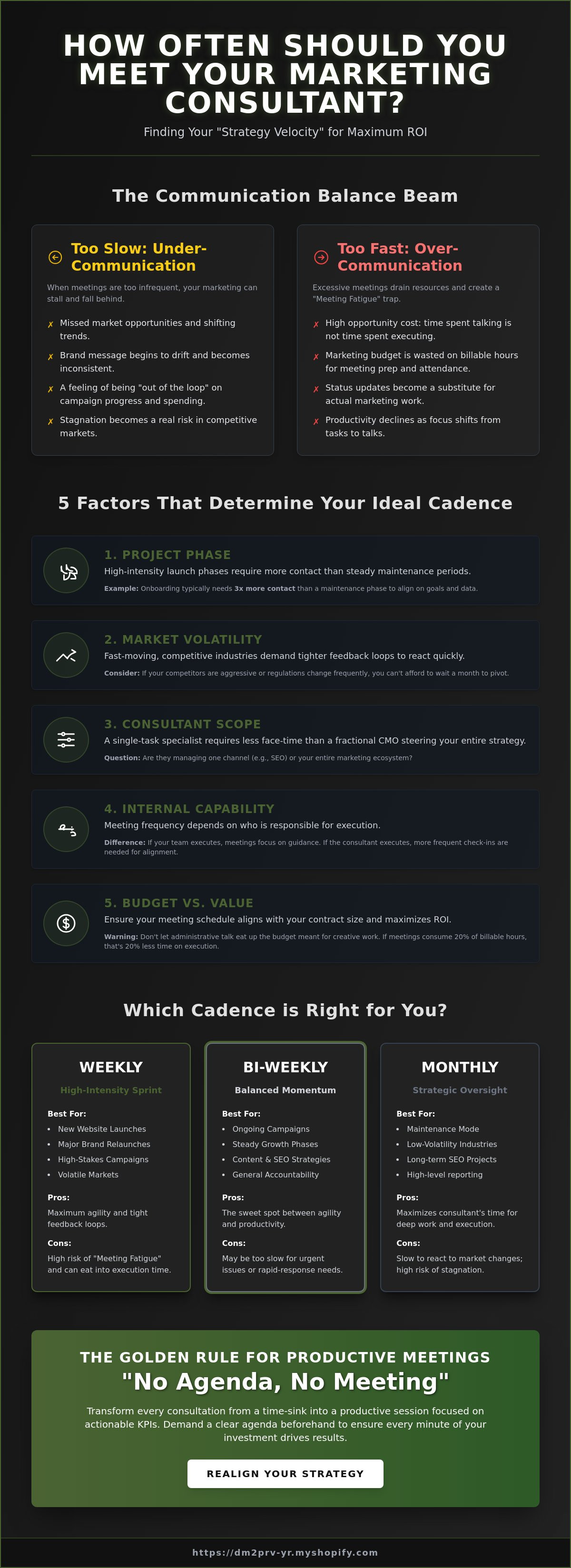
Choosing a meeting frequency is a balancing act between staying informed and staying productive. If you meet too often, you're micromanaging the process. If you don't meet enough, you lose the competitive edge that agile marketing provides. When asking, "How Often Should I Meet With My Marketing Consultant?", you should categorize your needs into tactical updates or high-level strategy. Most successful Michigan businesses find their rhythm in one of these three standard models.
- Weekly Check-ins: These are best for high-growth startups or businesses in the middle of a major campaign launch. They keep momentum high and ensure no detail is missed.
- Bi-Weekly (Fortnightly): Often called the "Goldilocks" zone, this works well for businesses in Fenton and Brighton. It provides enough time for the consultant to execute tasks while keeping the owner updated on progress.
- Monthly Strategy Sessions: This is the ideal pace for established brands focused on long-term SEO goals. It allows for significant data collection before making any pivots.
- Quarterly Business Review (QBR): This is a non-negotiable deep dive. Every three months, you must step back to look at the total ROI and ensure your marketing still aligns with your annual business objectives.
When to Choose Weekly Sprints
Weekly sprints are vital when you're managing high-spend PPC campaigns that require rapid optimization. If you're spending thousands of dollars a week on ads, waiting a month to review the data could result in massive waste. For busy Flint business owners, these meetings provide a layer of accountability that prevents marketing from falling off the radar. A Weekly Sprint is a tactical, 20-minute alignment designed to clear roadblocks and confirm immediate priorities. It's not the time for a deep dive; it's a quick pulse check to ensure the engine is running smoothly.
The Power of the Monthly Strategy Deep-Dive
The monthly meeting should represent a shift in tone. Instead of asking "what did we do last week," the conversation moves toward "what did we learn from this data." In broader markets like Detroit or Grand Rapids, consumer behavior can shift based on seasonal trends or new local competitors. You'll want to analyze long-tail trends that aren't visible in a week-over-week view. This is the time to ensure your consultant is still aligned with your 2026 business goals. By looking at a full 30 days of performance, you can make informed decisions about shifting budgets or doubling down on successful content strategies. It's the best way to answer the question, "How Often Should I Meet With My Marketing Consultant?" while keeping your eyes on the big picture.
Maximizing Local Impact: The Case for In-Person Strategy in Michigan
Digital tools have bridged many gaps, but there's no substitute for the chemistry of an in-person meeting. Michigan business owners often find that the "Body Language Bonus" is a real factor in campaign success. When you're sitting across from a consultant in Detroit or Grand Rapids, you can sense hesitation or excitement that a Zoom call might mask. This level of trust is essential when navigating the evolving regulatory landscape, such as the stricter consumer protection rules under Senate Bill 759. You aren't just hiring a service; you're building a partnership that understands the local culture and economic climate of the Great Lakes State.
Meeting at local landmarks or creative hubs can also spark fresh ideas. Whether it's a coffee shop in Brighton or a creative space in Detroit, changing the environment grounds your marketing strategy in the actual community you serve. This physical connection helps answer the question, "How Often Should I Meet With My Marketing Consultant?" by making the meetings feel like a collaborative event rather than a chore on a to-do list. When you share the same local context, your consultant can better tailor your message to resonate with Michigan consumers who value community engagement and transparency.
Strategic Benefits of Face-to-Face Meetings
Brainstorming is significantly more fluid when you can whiteboard ideas in real time. If you're in a Flint office mapping out a plan to capture the 30% of small businesses moving into social media marketing this year, the physical space encourages creative leaps that screen sharing often stifles. You should insist on face-to-face sessions for annual planning or whenever your business faces a major pivot. These high-stakes moments require the full attention and shared energy that only a local, in-person partnership provides. It also allows you to network within the local business community, strengthening your brand's roots.
Optimizing the Hybrid Communication Model
You don't need to drive across the state every week to see results. A hybrid approach often yields the best ROI for busy owners. Use Zoom for monthly data reviews and tools like Slack or Asana for daily "noise" to keep your scheduled time focused on high-level strategy. Setting clear expectations for response times ensures that communication remains crisp without the need for constant meetings. Local proximity in Fenton or Brighton reduces friction, allowing for spontaneous site visits that a remote-only agency simply can't provide. This balance keeps your strategy moving at a high velocity while respecting your operational schedule.
Ready to build a strategy that works for your local market? Schedule a consultation with a Michigan marketing expert today to find your perfect meeting rhythm.
How to Make Every Marketing Consultation Count
Efficiency is the difference between a marketing expense and a marketing investment. When you ask, "How Often Should I Meet With My Marketing Consultant?", the answer is only as good as the structure of the meeting itself. If you walk away from a session feeling like you just had a "nice chat," you've likely wasted your time. You must demand preparation. Implement a strict "No Agenda, No Meeting" rule. If your consultant hasn't sent a list of discussion points at least 24 hours in advance, cancel the session. This forces both parties to focus on high-value strategy rather than administrative filler.
Shift the conversation from activities to outcomes. It doesn't matter how many social media posts were scheduled if they didn't drive traffic to your branded website. Since 81% of consumers believe a website is essential for a business, your meetings should focus on how those posts converted into site visits and leads. Focus on KPIs like lead conversion rates and search engine visibility. Every session should end with a 5-minute recap that clearly defines "Owner" and "Consultant" tasks. This ensures accountability and keeps the strategy moving forward without any ambiguity. Every six months, audit your communication to ensure you aren't just meeting out of habit.
Setting the Standard Agenda
Your agenda should be a living document that tracks wins and losses based on specific Michigan market data. Review your KPIs to see if you're hitting the targets set for 2026, especially as 92% of marketers now prioritize AI-powered search strategies. Don't let the consultant do all the talking. They must present roadblocks where they need your input or approval to proceed. This keeps the project from stalling between sessions and ensures you're getting the full value of their expertise. It's the most effective way to answer "How Often Should I Meet With My Marketing Consultant?" because the results will dictate the frequency.
Post-Meeting Accountability
The work doesn't end when the call hangs up. Demand a written summary or a link to the recorded session within 24 hours. These summaries should be archived so you can track the evolution of your strategy over time. All action items must be logged in a shared project management tool like Asana or Slack to prevent tasks from slipping through the cracks. If a meeting felt unproductive, provide that feedback immediately. A professional consultant will appreciate the honesty and adjust their approach to better suit your business needs and schedule.
Taking Control of Your Marketing Momentum
Your meeting schedule shouldn't be a fixed obstacle in your calendar. It's a dynamic tool that evolves with your business goals. By prioritizing "Strategy Velocity" over standard monthly defaults, you ensure that every conversation leads to measurable growth. Whether you're navigating the 2026 Michigan economy or responding to new state regulations, the key is to focus on outcomes rather than just activities. You've learned that the answer to "How Often Should I Meet With My Marketing Consultant?" depends on your current project phase and the complexity of your digital stack. Structured agendas and clear post-meeting tasks transform these sessions from simple status updates into powerful engines for ROI.
We specialize in serving businesses across Flint, Detroit, and Grand Rapids with expert strategy tailored for today's market. If you're ready to stop wasting time on fluff and start seeing real results, streamline your strategy with a local Michigan marketing expert. Our focus remains on actionable ROI and building a partnership that respects your busy schedule. You have the tools to build a better cadence; now it's time to put them into practice and watch your business thrive.
Frequently Asked Questions
Is a weekly meeting too much for a small business marketing plan?
A weekly meeting isn't too much if you're in a high-growth phase or launching a complex campaign. It provides the accountability needed to keep projects moving fast. However, if your marketing is in a maintenance state, weekly calls can quickly become unproductive. You should adjust the frequency based on how much new data or execution has happened since the last call.
Can I change my meeting frequency mid-contract with my consultant?
You can and should change your meeting frequency if your business needs evolve. Most consultants are flexible because they want to focus on execution rather than unnecessary talk. If you've moved past a launch phase, suggest switching from weekly to bi-weekly sessions. This shift protects your budget while ensuring the consultant has enough time to produce meaningful results between updates.
What should I do if my marketing consultant keeps cancelling meetings?
Consistent cancellations are a red flag that requires a direct conversation about expectations. You're paying for their expertise and their time, so missed meetings directly stall your campaign momentum. If a consultant cancels more than twice without a major emergency, it's a sign of poor project management. You need a partner who values your schedule as much as their own.
Do I have to pay for the time spent in marketing meetings?
Most consultants bill for meeting time as part of their professional services. This is a primary reason why you should ask, "How Often Should I Meet With My Marketing Consultant?" before signing a long-term contract. To get the best ROI, ensure every paid minute is spent on strategy or problem-solving. Avoid using billable hours for simple updates that could be sent via email or Slack.
Should I meet in person if my consultant is located in Detroit or Grand Rapids?
Meeting in person is a smart move for major planning sessions if your consultant is nearby. While digital calls work for routine updates, being in the same room in Detroit or Grand Rapids helps with complex brainstorming. It strengthens the partnership and ensures everyone is aligned on the brand's vision. Use a hybrid model to get the benefits of local proximity without the travel fatigue.
What is the difference between a status update and a strategy session?
A status update is a tactical review of completed tasks and immediate next steps. In contrast, a strategy session is a high-level meeting where you analyze performance data to make long-term decisions. You don't need a full hour for a status update; ten minutes often suffices. Strategy sessions require more time because they involve pivoting your approach to maximize your marketing budget.
How long should a typical marketing consultation last?
A tactical check-in should be a punchy 20-minute session focused on immediate priorities. Monthly strategy deep-dives usually require 60 to 90 minutes to properly review data and plan for the coming month. If your meetings regularly exceed their scheduled time without producing clear action items, it's a sign the discussion lacks focus. Efficiency is key to keeping both parties productive and motivated.
What are the signs that we are meeting too often?
You're likely meeting too often if the consultant hasn't had enough time to implement the tasks discussed in the previous session. If you're struggling with the question, "How Often Should I Meet With My Marketing Consultant?", look for signs of repetitive conversations. Meetings should only happen when there is new data to analyze or a critical decision to make. If they feel like a chore, it's time to pull back.
Disclaimer
Some content published on this website may be developed with the assistance of AI-powered research and writing tools to help streamline research, organization, and content creation. All articles are reviewed, edited, and approved by Marvin Growth Partners to ensure they align with our perspectives, experience, and intended messaging.
While we strive to provide accurate and up-to-date information, blog content is intended for informational and educational purposes only and should not be considered legal, financial, or professional advice. Readers should independently verify information and consult qualified professionals when appropriate.