

How to Get the Most Value From a Fractional CMO in 2026
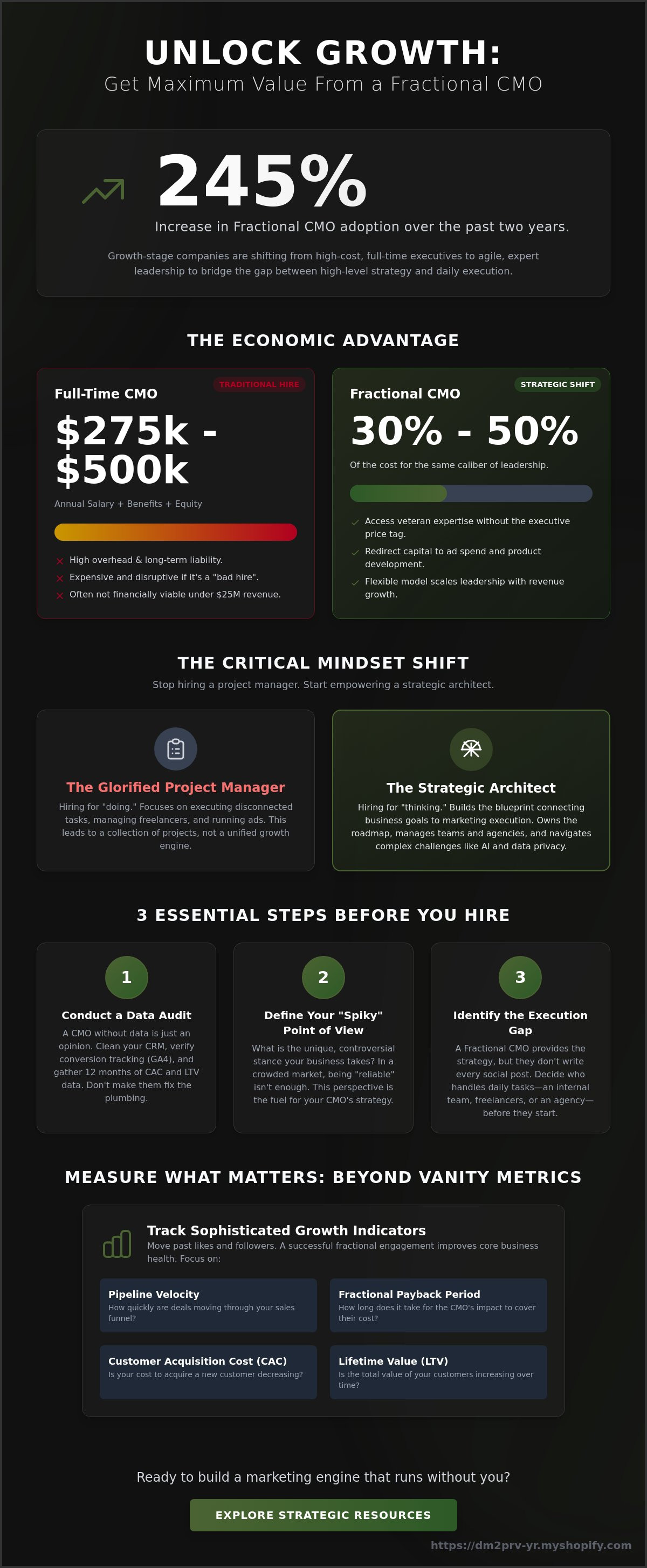
With the adoption of fractional CMOs growing by 245% over the past two years, more businesses are realizing they don't need a full-time executive at a $500,000 price point to see real growth. However, hiring a part-time leader is only half the battle. If you want to learn How to Get the Most Value From a Fractional CMO, you have to stop treating them like a project manager and start treating them like a strategic architect.
You probably feel like your marketing spend is a black hole, or perhaps you're exhausted from managing a team that lacks clear direction. It's frustrating to be burned by agencies that under-deliver, leaving you to wonder if a professionalized department is even possible. We've developed a framework to help you turn this around. This article provides the strategic roadmap to ensure your fractional leader drives a higher ROI on ad spend and builds a marketing engine that runs without the CEO. We'll cover everything from organizational integration to setting measurable benchmarks for 2026.
Key Takeaways
- Learn why growth-stage companies are shifting to fractional leadership to bridge the gap between high-level strategy and daily execution.
- Discover how auditing your internal data and defining a "Spiky Point of View" prepares your business for a successful marketing transformation.
- Understand how to get the most value from a Fractional CMO by positioning them as a strategic architect instead of a project manager.
- Move beyond vanity metrics to track sophisticated growth indicators like pipeline velocity and the specific fractional payback period.
- Explore the unique competitive advantages of hiring leadership with deep roots in the Michigan business ecosystem and local networks.
What is a Fractional CMO and Why is the Model Shifting in 2026?
A Fractional CMO is more than just a part-time consultant; they are a deeply embedded leader who operates on a retainer or subscription basis. Unlike a freelancer who focuses on specific deliverables, this role owns the entire marketing function. To understand How to Get the Most Value From a Fractional CMO, you must recognize that "fractional" refers to their time, not their accountability. They carry the same weight of responsibility for growth as a full-time hire would. In fact, a fractional executive often brings a higher level of intensity because they are hired specifically to solve complex problems or navigate transitions.
It's vital to distinguish this role from other partners. A marketing consultant provides advice but rarely stays for the implementation. An agency executes specific tactics like SEO or social media. A Fractional CMO, however, manages both the consultants and the agencies. They own the roadmap. By 2026, the market has shifted dramatically. Mid-sized firms across Michigan, from the manufacturing hubs of Flint to the tech circles in Grand Rapids, are moving away from traditional hiring. With 47% of startups now relying on fractional leadership, the model has moved from a budget option to a strategic preference.
The Strategic Architect vs. The Tactical Executor
Hiring for "doing" instead of "thinking" is a common trap that kills marketing ROI. In 2026, marketing isn't just about running ads; it's about navigating AI integration, shifting data privacy laws, and managing fragmented digital channels. If you hire someone just to execute tasks, you're missing the high-level coordination required to scale. A Fractional CMO acts as the bridge between your business goals and marketing execution. They build the blueprint that your internal team or external agencies follow. Without this architectural layer, your marketing efforts will likely remain a collection of disconnected projects rather than a unified growth engine.
Economic Advantages for Michigan Business Owners
The math for Michigan businesses is compelling. A full-time CMO in 2026 can cost between $275,000 and $500,000 annually. For many growth-stage companies in the Detroit-Flint-Grand Rapids corridor, that's a massive overhead commitment. A fractional model provides access to that same caliber of veteran leadership for 30% to 50% of the cost. This allows you to redirect capital toward advertising spend or product development while mitigating the risk of a "bad hire." If a full-time executive isn't a fit, the exit is expensive and disruptive. With a fractional leader, you gain specialized expertise during pivot phases without the long-term liability. Learning How to Get the Most Value From a Fractional CMO means leveraging this flexibility to scale your leadership as your revenue grows toward the $25 million breakeven point where a full-time hire finally makes financial sense.
3 Essential Steps to Prepare Your Business for a Fractional CMO
Hiring a fractional leader without internal preparation is like buying a high-performance engine for a car with no wheels. To understand How to Get the Most Value From a Fractional CMO, you must first build the chassis. This begins with a rigorous data audit. If your CRM is a mess or your GA4 isn't tracking conversions accurately, a CMO will spend their first three months fixing plumbing instead of driving growth. You can't fix what you can't see. Before they log on for their first day, ensure your historical data is accessible and honest.
Next, define your "Spiky Point of View." In a crowded Michigan market, simply being "reliable" isn't enough to stand out. What is the unique, potentially controversial stance your business takes? Whether you're in manufacturing in Flint or professional services in Fenton, this perspective is the fuel for your CMO's strategy. You also need to identify the "Execution Gap." A Fractional CMO provides the strategy, but they aren't there to write every social post or set up every email automation. Before they start, decide who will handle the daily tasks. If you aren't sure where to start with your internal audit, you can explore our strategic resources to help clarify your current standing.
The Data Readiness Checklist
A CMO without data is just a consultant with an opinion. Your readiness checklist should focus on moving beyond vanity metrics to capture true business health. Ensure you have gathered historical Customer Acquisition Cost (CAC) and Lifetime Value (LTV) data from at least the last 12 months. This allows your new leader to develop a marketing plan that is rooted in financial reality rather than guesswork. If your CRM doesn't distinguish between a raw lead and a marketing-qualified lead, fix that now. Clear data allows for immediate strategic pivots that actually move the needle.
Aligning the Leadership Team
Introducing a new leader to your Flint or Fenton-based team requires transparency and clear boundaries. Define the CMO's authority over the budget and vendor selection before the first meeting. Can they fire an underperforming agency? Do they have the final say on the ad spend? Setting these expectations prevents friction and power struggles. During the first 90 days, focus on discovery and identifying "quick wins." This period should transition from a broad audit to a fully documented strategic roadmap. By aligning your leadership team around these specific milestones, you ensure you know exactly How to Get the Most Value From a Fractional CMO from day one.
Avoiding the "Glorified Project Manager" Trap
The most expensive mistake a CEO can make is hiring a strategic genius and then asking them to fix a broken link in an email signature. It's easy to default to task-based delegation because it feels productive. However, if your fractional leader spends their limited hours managing calendars or proofreading every blog post, you're losing money. To understand How to Get the Most Value From a Fractional CMO, you have to shift your mindset from assigning tasks to delegating outcomes. If they are stuck in the weeds, they can't see the horizon where your next big growth opportunity lies.
You'll know your engagement is slipping into the tactical trap when your meetings focus exclusively on "what happened yesterday" instead of "what we're building for next quarter." A strategic leader should be questioning your market positioning and optimizing your customer journey, not just checking off boxes on a Trello board. To prevent this, you must set your fractional CMO up for success by providing them with the necessary execution support. Without a team to handle the daily "doing," the strategic "thinking" will inevitably suffer.
Building the Execution Layer
Success in 2026 requires what we call a "Pod" model. This structure places the CMO at the top for strategy, supported by an internal Marketing Coordinator or Junior Manager who owns the daily execution. You can also leverage local Michigan freelancers from the Detroit or Grand Rapids creative scenes to handle specialized tasks like graphic design or technical SEO. In this dynamic, the CEO remains the "Visionary" who sets the broad business goals, while the CMO acts as the "Integrator" who turns those goals into a functional marketing machine. This keeps high-level leadership focused on architecture rather than assembly.
Setting a High-Value Meeting Cadence
Don't let your CMO get sucked into daily Slack fires. Use asynchronous communication for status updates so your face-to-face time stays high-level. A 15-minute weekly sync is plenty for clearing blockers, while a monthly two-hour deep dive is where the real work happens. These longer sessions allow you to analyze real-time Detroit market data and pivot your strategy before your competitors do. By protecting this "thinking time," you ensure you know exactly How to Get the Most Value From a Fractional CMO by keeping them focused on the high-impact levers that actually move the needle for your business.
Measuring ROI: The Magic Numbers for Fractional Engagements
Measuring the success of a high-level executive requires looking beyond vanity metrics like "likes" or "impressions." If you want to know How to Get the Most Value From a Fractional CMO, you must focus on how they accelerate your business goals. While companies using fractional leaders report 40-70% cost savings compared to full-time hires, the real value lies in the "Fractional Payback Period." This is the timeframe where the strategic shifts and optimized ad spends begin to outweigh the monthly retainer. For most growth-stage companies, you should expect to see a clear shift in lead quality and pipeline movement within the first six months of the engagement.
In the Michigan industrial sector, where sales cycles are often long and complex, attribution modeling is essential. A lead might originate at a trade show in Detroit but take months to convert in a Grand Rapids boardroom. Your CMO should be able to distinguish between Marketing Originated Revenue and Marketing Influenced Revenue. This distinction helps you understand which strategies are driving new business and which ones are effectively nurturing your existing Flint or Fenton-based prospects through the finish line. If you're ready to see how these metrics apply to your specific situation, book a strategy audit to evaluate your current marketing ROI.
Quantitative KPIs: The Growth Levers
Success in 2026 is driven by data, not gut feelings. You should track your Cost Per Qualified Lead (CPQL), especially in competitive landscapes like Grand Rapids where ad costs can fluctuate. Pipeline Velocity is the ultimate health metric for a CMO because it measures how quickly prospects move through your sales funnel to generate revenue. By monitoring the speed at which a lead turns into a closed deal, your fractional leader can identify exactly where the friction exists in your customer journey and pivot resources accordingly.
Qualitative Wins: The Invisible ROI
Not every win shows up on a spreadsheet immediately. One of the most significant qualitative returns is the standardization of the "Sales-Marketing Handshake." This ensures that your sales team isn't wasting time on junk leads and your marketing team understands what a "good" prospect actually looks like. Additionally, a veteran CMO provides a repeatable "Growth Playbook" that stays with your Michigan business even after the engagement ends. Perhaps most importantly, you're paying for executive-level pushback. A great fractional leader will tell the CEO "no" when a "shiny object" idea threatens to derail the core strategy, saving the company thousands in wasted effort and diverted focus.
Scaling Your Michigan Business with Local Fractional Leadership
A remote agency in California might understand digital trends, but they often struggle to grasp the specific rhythm of the Detroit-Flint-Grand Rapids corridor. To truly understand How to Get the Most Value From a Fractional CMO, you should consider the power of local context. A leader who understands Michigan's unique B2B landscape can leverage existing networks that a remote-only provider simply cannot access. Whether it's navigating the manufacturing ecosystem in Flint or the growing tech hubs in Grand Rapids, local knowledge translates into faster partnerships and more relevant co-marketing opportunities.
As your business grows, your leadership needs will evolve. Data indicates that the breakeven point where a full-time CMO becomes more economical than a fractional one is typically around $25 million to $30 million in annual revenue. Until you hit that milestone, the fractional model offers a superior balance of high-level strategy and cost efficiency. Interestingly, fractional executives stay in their roles 71% longer than full-time executives. This longevity provides the stability needed to professionalize your marketing department without the high turnover risks often associated with traditional executive hires in the competitive Detroit talent market.
The Michigan Market Advantage
Michigan's B2B manufacturing and tech sectors require a nuanced approach to marketing. A local Fractional CMO understands how to manage regional trade shows and Detroit-based media outlets to maximize your visibility where it matters most. They also bring a cultural alignment that is essential for companies based in Brighton or Fenton. This "Fractional Fit" ensures that your marketing leader isn't just a voice on a Zoom call, but a partner who understands the local economic pressures and opportunities facing your team every day.
Your Next Steps: From Strategy to Execution
When you begin your search, look for leaders who offer a "Spiky Point of View." You want someone who challenges your assumptions and brings clear, independent thinking to the table. We recommend a 30-day "Trial Sprint" model for new engagements. This allows both parties to test the working relationship and ensures the CMO can deliver immediate strategic clarity. By focusing on these early wins, you'll see exactly How to Get the Most Value From a Fractional CMO while building a foundation for long-term scaling.
Ready to scale? Connect with a Fractional CMO who knows the Michigan market.
Building Your 2026 Growth Engine
Transitioning to fractional leadership is a pivotal step for any mid-sized firm aiming to scale without the heavy overhead of a traditional executive. By prioritizing high-level strategy over simple task delegation and ensuring your internal data systems are ready for analysis, you set the stage for measurable results. Understanding How to Get the Most Value From a Fractional CMO requires a commitment to this professionalized model, where pipeline velocity and strategic breakthroughs finally replace vanity metrics.
Success in the local market demands more than generic advice. It requires a partner with deep expertise in the Detroit and Grand Rapids B2B landscapes who can implement 2026-ready AI and data-driven marketing strategies. If you're ready to professionalize your marketing department and stop the drain on your internal resources, it's time to take the next step. Book a Strategic Growth Audit for Your Michigan Business today to see how we specialize in scaling firms just like yours. Your roadmap to a self-sustaining marketing engine that runs without the CEO starts with a single strategic conversation.
Frequently Asked Questions
What is the typical monthly cost of a Fractional CMO in Michigan?
Industry averages for monthly retainers vary based on the scope of the engagement and the business's revenue. While a full-time executive often commands a total compensation package between $275,000 and $500,000, a fractional leader typically costs 30% to 50% of that amount. This model allows growth-stage firms to access senior strategy without the long-term financial commitment of a permanent hire.
How many hours a week does a Fractional CMO actually work?
Most fractional leaders dedicate between 5 and 15 hours per week to a single client, depending on the complexity of the roadmap. However, the focus is on strategic outcomes rather than clocking hours. To understand How to Get the Most Value From a Fractional CMO, you should measure their success by the achievement of key milestones and the velocity of your marketing pipeline rather than their weekly time log.
Do I need a Marketing Manager before hiring a Fractional CMO?
You don't necessarily need a manager in place, but having an execution layer significantly improves results. This could be a junior coordinator or a set of reliable freelancers who can handle the daily tasks. A Fractional CMO designs the blueprint, but they need someone to help build the structure. If you lack internal staff, your fractional leader can often help you recruit the right tactical talent.
Can a Fractional CMO help with sales team alignment in B2B companies?
Yes, a primary responsibility of a Fractional CMO is standardizing the "Sales-Marketing Handshake." In B2B sectors like Michigan's manufacturing industry, alignment is critical for ensuring leads don't wither in the funnel. They work to define what constitutes a qualified lead and ensure the sales team has the collateral and data needed to close deals effectively, bridging the gap between departments.
What is the difference between a Fractional CMO and a Marketing Agency?
An agency is a tactical partner that executes specific services like SEO or paid ads, while a Fractional CMO is a strategic leader who owns the entire marketing function. The CMO manages your agencies, sets the budget, and ensures all efforts align with your business goals. Think of the agency as the crew and the CMO as the captain of the ship.
How long does it take to see ROI from a fractional marketing leader?
Most businesses begin to see measurable shifts in strategy and lead quality within the first 90 days. However, a full return on investment typically requires a minimum engagement of six months. This timeframe allows your leader to audit existing data, implement new frameworks, and optimize ad spend to achieve a sustainable payback period where growth outweighs the retainer cost.
Should I hire a local Detroit or Grand Rapids CMO, or is remote okay?
Remote work is common, but hiring a leader who understands the Detroit-Flint-Grand Rapids corridor offers a distinct competitive advantage. Local CMOs bring existing regional networks and an understanding of the Michigan B2B ecosystem that remote leaders might miss. This regional expertise is especially valuable for managing local trade shows and navigating the specific talent markets in Brighton or Fenton.
What happens if we need to transition to a full-time CMO later?
A Fractional CMO is often the person who helps you hire your first full-time CMO when your revenue hits the $25 million to $30 million breakeven point. They professionalize the department and build the "Growth Playbook," making the transition to a permanent executive seamless. This ensures you know How to Get the Most Value From a Fractional CMO during your growth phase while preparing for long-term scale.
Disclaimer
Some content published on this website may be developed with the assistance of AI-powered research and writing tools to help streamline research, organization, and content creation. All articles are reviewed, edited, and approved by Marvin Growth Partners to ensure they align with our perspectives, experience, and intended messaging.
While we strive to provide accurate and up-to-date information, blog content is intended for informational and educational purposes only and should not be considered legal, financial, or professional advice. Readers should independently verify information and consult qualified professionals when appropriate.