

How to Increase Shopify Conversion Rate for Detroit Brands
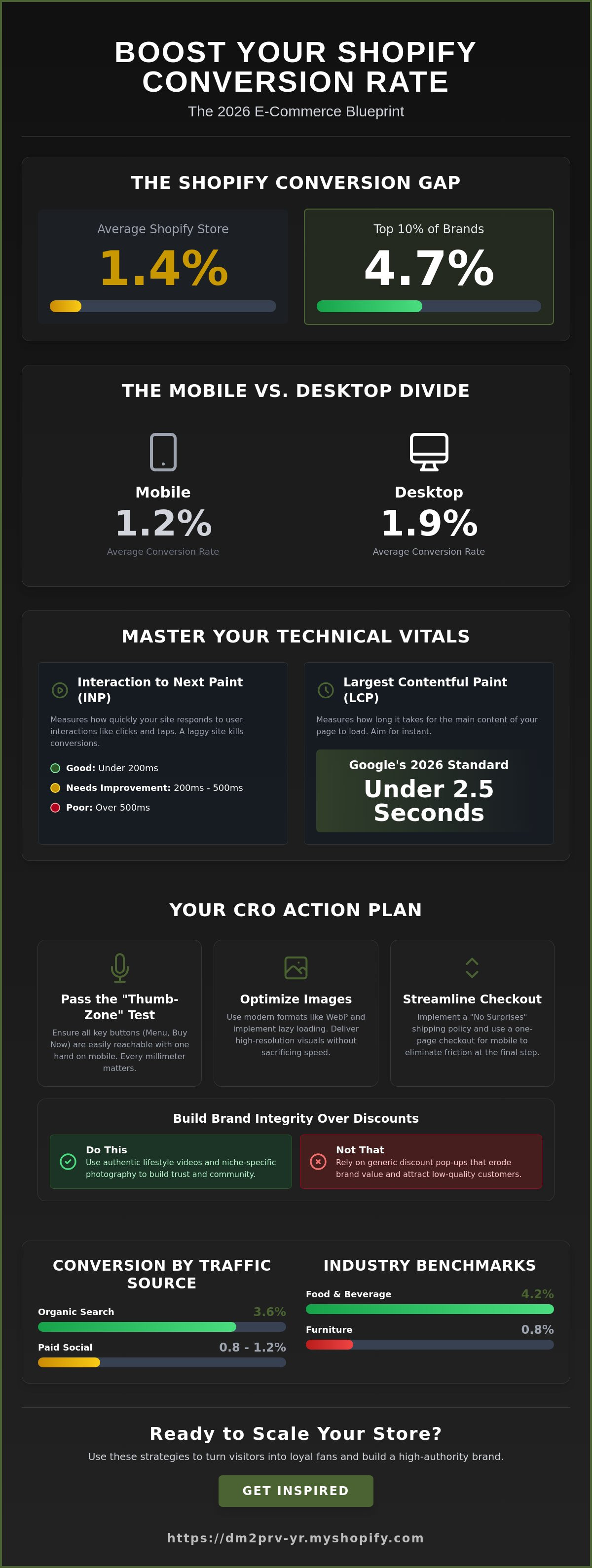
Did you know that while the average Shopify store in 2026 converts at just 1.4%, the top 10% of brands are seeing rates as high as 4.7%? If you're running a Detroit brand, you've likely asked yourself why people are visiting your store but leaving without buying anything. It's frustrating to watch high ad spend result in a low ROI, especially when technical jargon like Interaction to Next Paint (INP) or Cumulative Layout Shift (CLS) feels like a foreign language. You aren't alone in feeling the sting of cart abandonment at the shipping stage or struggling with a mobile conversion rate that sits at a measly 1.2% compared to desktop's 1.9%.
We understand that you want your store to perform as well as it looks. This guide will teach you exactly how to increase shopify conversion rate by mastering the technical, visual, and psychological strategies required for modern e-commerce. We'll provide a clear checklist of CRO improvements to boost your average order value and ensure your site meets Google's 2026 standards, such as keeping your LCP under 2.5 seconds. From leveraging the latest Shopify API 2026-04 features to navigating the legal risks of Michigan Senate Bill 351, you're about to learn how hyper-transparency and local authority can turn your visitors into loyal fans.
Key Takeaways
- Learn how to increase shopify conversion rate by optimizing for Interaction to Next Paint (INP) and passing the "Thumb-Zone" test for mobile navigation.
- Discover why authentic lifestyle video and niche-specific photography are more effective at building brand integrity than generic discount codes.
- Eliminate checkout friction by adopting a "No Surprises" shipping strategy and implementing a streamlined one-page checkout for mobile shoppers.
- Apply a community-first blueprint to transform your store from a simple retailer into a high-authority destination that turns customers into ambassadors.
Understanding the 2026 Shopify Conversion Landscape
Your Shopify Conversion Rate (CVR) is the percentage of visitors who complete a purchase. To calculate it accurately, divide your total number of orders by the total number of unique sessions over a specific period, then multiply by 100. While basic math tells you the "what", Conversion rate optimization (CRO) explains the "why". In 2026, the average Shopify store sees a conversion rate between 1.4% and 1.8%. However, local Detroit brands aiming for the top 10% should target 4.7% or higher. Understanding these benchmarks is the first step in learning how to increase shopify conversion rate without simply slashing prices.
Shoppers have evolved beyond the era of constant discount pop-ups. In 2026, brand integrity is the primary currency. Customers want to know if a Detroit streetwear brand actually supports the local scene or if it's just another dropshipping facade. High-performing stores identify "leaky buckets" in their sales funnel by analyzing the Shopify "Online store conversion" report. If your "Reached Checkout" percentage is high but your "Purchased" percentage is low, your shipping costs or technical errors are likely the culprits. Using Shopify Analytics to find these gaps is essential. Since mobile conversion rates average 1.2% compared to 1.9% on desktop, a significant gap in your own data suggests your mobile UX is failing. Identifying these specific friction points is how you master how to increase shopify conversion rate.
The Shift from Passive Browsing to Intent-Based UX
The way people find your products has fundamentally changed with the "RenAIssance" Edition of Shopify. AI shopping agents like ChatGPT and Perplexity now discover and recommend products directly to consumers. This means users often land on your product pages with high intent rather than browsing your homepage. Choice paralysis remains a major hurdle. If you offer 50 different black t-shirts without clear differentiation, you'll lose the sale. Transitioning from a massive catalog to a curated, story-driven experience helps guide these high-intent visitors toward a quick decision.
Setting Realistic Conversion Goals for 2026
Success looks different depending on what you sell. While food and beverage stores enjoy a 4.2% conversion rate, furniture stores often hover around 0.8%. Streetwear and skate shops typically sit in the middle, though they face unique seasonal challenges in Michigan. A local brand might see a surge during the summer skate season but a dip in January. Don't ignore micro-conversions like email or SMS sign-ups during these slower months. These are leading indicators of future revenue. In fact, organic search traffic currently converts at roughly 3.6%, which is much higher than the 0.8% to 1.2% seen from paid social media.
Technical Foundations: Speed, Mobile, and INP Optimization
Technical performance is no longer just a backend concern; it's the bedrock of your sales strategy. If you want to know how to increase shopify conversion rate, you must start with Interaction to Next Paint (INP). In 2026, Google identifies INP as the most critical metric for measuring user experience. A good INP score is under 200 milliseconds. If your store takes longer than 500 milliseconds to respond to a click or a tap, visitors will likely assume the site is lagging and abandon their session. This responsiveness is vital because it mirrors the physical "feel" of a high-end retail experience.
Most Detroiters are shopping on their phones while on the move, making the "Thumb-Zone" test a mandatory audit for your store. This test is simple: can you reach every primary navigation element and the "Buy Now" button with just your thumb while holding the phone naturally? If your menu is tucked away in a corner that requires two hands to reach, you're creating unnecessary friction. Since mobile conversion rates in 2026 average just 1.2%, every millimeter of placement matters for your bottom line.
Every app you add to your Shopify backend injects code that can slow down your site. Audit your apps monthly. If a tool isn't directly contributing to your revenue or customer experience, delete it. For visual brands, high-resolution imagery is non-negotiable, but it shouldn't kill your load times. Use WebP formats and implement lazy loading so that heavy graphics, like detailed skate deck art, only load as the user scrolls. You can see how a streamlined, high-performance store operates by visiting dm2prv-yr for design and speed inspiration.
Mastering Mobile-First Responsiveness
Designing for "Scroll Culture" means placing your most important information, such as price and local shipping availability, above the fold. Don't make users hunt for the "Add to Cart" button. It should be large, high-contrast, and placed exactly where a thumb naturally rests. Always test your store on a 4G or LTE connection to mimic real-world conditions. While your office Wi-Fi might be fast, your customers in Detroit might be browsing on a spotty mobile signal while at a skate park or a coffee shop.
Reducing Technical Friction in the User Journey
Intrusive pop-ups are the fastest way to drive a mobile user away. They hurt your mobile SEO and tank your conversion rates by blocking the content the user came to see. Instead, implement "Quick View" options that allow users to see product details without leaving the collection page. This reduces page-to-page lag and keeps the shopping momentum going. A mere 0.5-second increase in mobile load speed can reduce your bounce rate by as much as 15%.
Visual Storytelling: Building Trust Through Niche Authenticity
Visuals are the bridge between a visitor's interest and their final decision to buy. While studio photography provides a clean look at your inventory, it often fails to communicate the "soul" of a brand. For a Detroit skate or streetwear shop, lifestyle photography is the most effective tool in your kit. Skaters don't just want to see a deck against a white background; they need to see the pop of the tail during a trick or how a hoodie drapes while in motion. This visual context proves that your gear is functional, not just fashionable. When you're looking for how to increase shopify conversion rate, remember that high-quality lifestyle imagery can bridge the gap between a 1.4% average conversion rate and the 4.7% seen by top-tier stores.
Short-form video has become a mandatory element for product pages in 2026. A 15-second clip showing the durability of a graphic or the weight of a fabric provides more information than a dozen static images. This type of content reduces the perceived risk of a purchase, which is a common cause of cart abandonment. You can further enhance this trust by integrating user-generated content (UGC). Showcasing real customers from the local community wearing your gear creates a "skater-owned" vibe that resonates far more than polished corporate ads. Place these social proof elements, including specific customer reviews, directly near the "Add to Cart" button to provide a final nudge of confidence.
The Anatomy of a High-Converting Product Page
A high-converting product page speaks the specific language of its audience. Instead of generic descriptions, use technical terms like "concave," "ply," or "GSM weight" for fabrics. This level of detail shows expertise and builds authority. Include "Trust Badges" that matter to your niche, such as "Detroit-Based" or "Tested by Local Pros." High-resolution zoom functionality is also essential for streetwear, as it allows customers to inspect stitching and fabric textures, mimicking the in-store experience of feeling the material before buying.
Authenticity as a Conversion Lever
Your Michigan roots are a powerful asset for building local trust. Highlighting your connection to cities like Detroit, Flint, or Grand Rapids humanizes your brand and separates you from faceless global retailers. Show the team behind the store to give your digital presence a face and a story. Authentic reviews are another critical lever; encourage customers to leave feedback that mentions specific performance details, such as how a board held up after a month of use. This granular feedback is exactly how to increase shopify conversion rate by proving your products actually perform in the real world.
Frictionless Checkout and Local Logistics Strategies
One of the most significant barriers when figuring out how to increase shopify conversion rate is the "shipping shock" that occurs at the final step. The "No Surprises" rule dictates that shipping costs and delivery timelines must be transparent long before the customer reaches the payment field. In 2026, shoppers expect to see these details on the product page or within the cart drawer. If a customer in Grand Rapids adds a deck to their cart only to find a $20 shipping fee at the very end, they'll likely abandon the purchase. Providing clear data on how to increase shopify conversion rate involves removing these hidden friction points as early as possible in the user journey.
Shopify's 2026 platform updates have moved toward greater standardization, particularly with the implementation of the one-page checkout. This streamlined experience is mandatory for capturing mobile sales, which currently convert at a lower rate than desktop. By reducing the number of fields and pages a user must navigate, you minimize the "drop-off" points where a customer might change their mind. Integrating flexible payment options like "Buy Now, Pay Later" is also essential for high-ticket items, such as complete skate setups or premium outerwear, allowing customers to spread the cost over time without delaying the sale.
For Michigan-based brands, local logistics offer a unique competitive advantage that global retailers can't replicate. Offering local pickup in areas like Brighton or Fenton can significantly boost your conversion rate by removing shipping costs entirely for nearby customers. It also builds a sense of community and trust that is vital for niche brands. You can explore how dm2prv-yr manages local logistics to see how a community-focused approach can streamline the path to purchase.
Optimizing for the Michigan Market
Promoting fast shipping specifically to Detroit, Grand Rapids, and Flint tells local shoppers that they won't have to wait weeks for their gear. This local focus helps combat the "winter slump" in Michigan, where skate sales might naturally dip. During these months, pivot your messaging to focus on indoor park gear or heavy-duty streetwear that handles the cold. This ensures your conversion tactics remain relevant to the local climate and the immediate needs of your audience.
Eliminating Checkout Abandonment
Forcing a customer to create an account is a guaranteed conversion killer. Always offer a guest checkout option to keep the shopping momentum going. You can use progress bars to show the user exactly how close they are to finishing, which reduces "checkout fatigue" during the final steps. A transparent, easy-to-find return policy reduces the perceived risk of a purchase and directly correlates to higher initial conversion rates by providing shoppers with a safety net.
The dm2prv-yr Blueprint: Scaling Your Shopify Store
Scaling a brand in the Detroit market requires more than just a functional website; it requires a distinct voice. While general retailers often fall victim to high bounce rates due to an overwhelming and impersonal inventory, dm2prv-yr succeeds by doubling down on niche authority. By focusing exclusively on skate and streetwear, the store provides a curated experience that resonates with a specific lifestyle. This targeted approach is a masterclass in how to increase shopify conversion rate because it eliminates the noise that leads to choice paralysis. When a customer lands on a page that feels "for them," the psychological barrier to purchase drops significantly.
Building this authority doesn't happen in a vacuum. By stocking iconic brands like Volcom, Vans, and Dr. Martens, dm2prv-yr leverages "borrowed authority." These established names signal quality and reliability to the shopper, which transfers trust to the store itself. This strategy is complemented by a community-first philosophy. Instead of treating customers as mere transactions, the brand fosters a culture where shoppers feel like ambassadors for the local scene. This organic loyalty often leads to word-of-mouth growth that paid ads simply can't buy.
Optimization is a continuous process, not a one-time setup. You don't need a massive budget to perform A/B testing on your Shopify store. Simple changes, such as testing two different "Add to Cart" button colors or alternating between lifestyle and studio hero images, can provide actionable data. Using Shopify's native analytics tools allows you to see which version performs better in real-time. This data-driven mindset is the most reliable way to understand how to increase shopify conversion rate over the long term.
Curating the Perfect Collection
Inventory management is a conversion tool. Carrying a smaller, high-quality selection of brands like Obey or Independent trucks often converts better than a massive warehouse of low-quality goods. A curated list allows you to tell a better story and focus your marketing efforts. Implementing "limited drop" psychology also creates a sense of urgency that encourages immediate action. To see how a focused inventory looks in practice, see our latest skateboard hardware guide for inspiration.
Actionable Next Steps for Your Store
Start with a 24-hour audit of your own site. Look for broken links, slow-loading images, or confusing navigation that might be frustrating your visitors. Reach out to your local Michigan customers and ask for honest feedback on their shopping experience. Building this feedback loop ensures your store evolves alongside your community's needs. If you're ready to take the next step, optimize your skate gear collection today and apply these proven tactics to your own brand.
Transform Your Detroit Brand's Digital Performance
Success in the 2026 e-commerce landscape requires a deliberate blend of technical precision and local authenticity. By optimizing your store for Interaction to Next Paint (INP) and prioritizing mobile-first navigation, you eliminate the friction that drives potential customers away. Visual storytelling through lifestyle photography and transparent shipping policies are the most effective ways to build the brand integrity that modern shoppers demand. Mastering how to increase shopify conversion rate isn't just about small tweaks; it's about creating a curated experience that speaks directly to your Michigan audience.
If you're looking for inspiration or the right gear to build your own community-first brand, we're here to help. With our deep Michigan-based expertise and a curated selection of top brands like Volcom and Vans, we understand what it takes to thrive in this market. We also provide fast local shipping across Detroit and Grand Rapids to keep your customers satisfied. Scale your Shopify store with the best skate and streetwear gear from dm2prv-yr and start turning your visitors into loyal brand ambassadors. Your store's potential is limitless when you combine the right technical foundations with a genuine local connection.
Frequently Asked Questions
What is a good conversion rate for a Shopify store in 2026?
A good conversion rate in 2026 typically falls between 1.4% and 1.8% for the average store, while top-tier performers reach 4.7%. These benchmarks vary significantly by industry. For instance, food and beverage brands often hit 4.2%, while furniture stores may stay around 0.8%. Tracking your data against these specific industry standards helps you set realistic goals for your own Detroit-based brand and identify areas for improvement.
How can I increase my Shopify conversion rate without spending money on ads?
You can improve your performance by focusing on organic search and community engagement rather than paid traffic. Organic search traffic converts at roughly 3.6%, which is far more efficient than the 0.8% to 1.2% seen from paid social ads. Optimizing your product pages with high-intent keywords and building local authority are proven ways to learn how to increase shopify conversion rate without increasing your advertising budget.
Does free shipping always increase conversion rates?
Free shipping is a powerful incentive, but transparency about costs is even more vital for conversion. Hidden shipping fees discovered at the final checkout stage are the primary reason for cart abandonment. If offering free shipping isn't feasible, you should display calculated shipping costs early in the customer journey. Providing this information upfront prevents sticker shock and ensures that only serious buyers proceed to the payment screen.
Which Shopify apps are best for increasing conversion rates?
The best strategy in 2026 is to minimize app usage to maintain site speed and avoid code bloat. Focus on essential tools that provide AI-driven product recommendations or streamlined one-page checkouts. Always choose apps that are compatible with Shopify's latest API and Online Store 2.0 framework. This ensures your site remains fast and responsive, which is a fundamental requirement for anyone looking to learn how to increase shopify conversion rate.
How do I fix a high cart abandonment rate on my Shopify store?
Reducing cart abandonment requires a frictionless checkout experience that prioritizes user convenience. Start by enabling guest checkout to remove the barrier of forced account creation. Implement a progress bar to show customers exactly how many steps remain in the process. Additionally, placing trust signals like secure payment icons and clear return policies near the checkout button can alleviate last-minute doubts and encourage shoppers to finalize their orders.
Can I increase conversion rates by just changing my Shopify theme?
Changing to a modern, mobile-first Shopify theme can definitely improve your conversion rate if your current layout is outdated. A theme built on the Online Store 2.0 architecture will typically offer better loading speeds and more intuitive navigation. However, a theme change is most effective when paired with high-quality visual storytelling and clear product descriptions. The design must work in harmony with your content to successfully guide users toward a purchase.
How does local pickup affect e-commerce conversion for Michigan stores?
Local pickup is an excellent tool for Michigan brands to boost conversion by offering instant gratification and removing shipping costs. It allows customers in areas like Detroit or Brighton to buy online and collect their gear the same day. This option builds deep local trust and encourages customers to interact with your brand in person. Stores that offer local pickup often see higher conversion rates from nearby shoppers who value convenience.
Is mobile speed more important than desktop speed for Shopify SEO?
Mobile speed is paramount because the majority of e-commerce traffic now comes from mobile devices. With an average mobile conversion rate of just 1.2% compared to 1.9% on desktop, every millisecond of speed matters on smaller screens. Google's mobile-first indexing also means your search rankings depend heavily on your mobile performance. Keeping your Largest Contentful Paint (LCP) under 2.5 seconds is essential for keeping mobile users engaged and ready to buy.
Disclaimer
Some content published on this website may be developed with the assistance of AI-powered research and writing tools to help streamline research, organization, and content creation. All articles are reviewed, edited, and approved by Marvin Growth Partners to ensure they align with our perspectives, experience, and intended messaging.
While we strive to provide accurate and up-to-date information, blog content is intended for informational and educational purposes only and should not be considered legal, financial, or professional advice. Readers should independently verify information and consult qualified professionals when appropriate.