

How to Lower Customer Acquisition Cost in Ecommerce: A 2026 Strategy
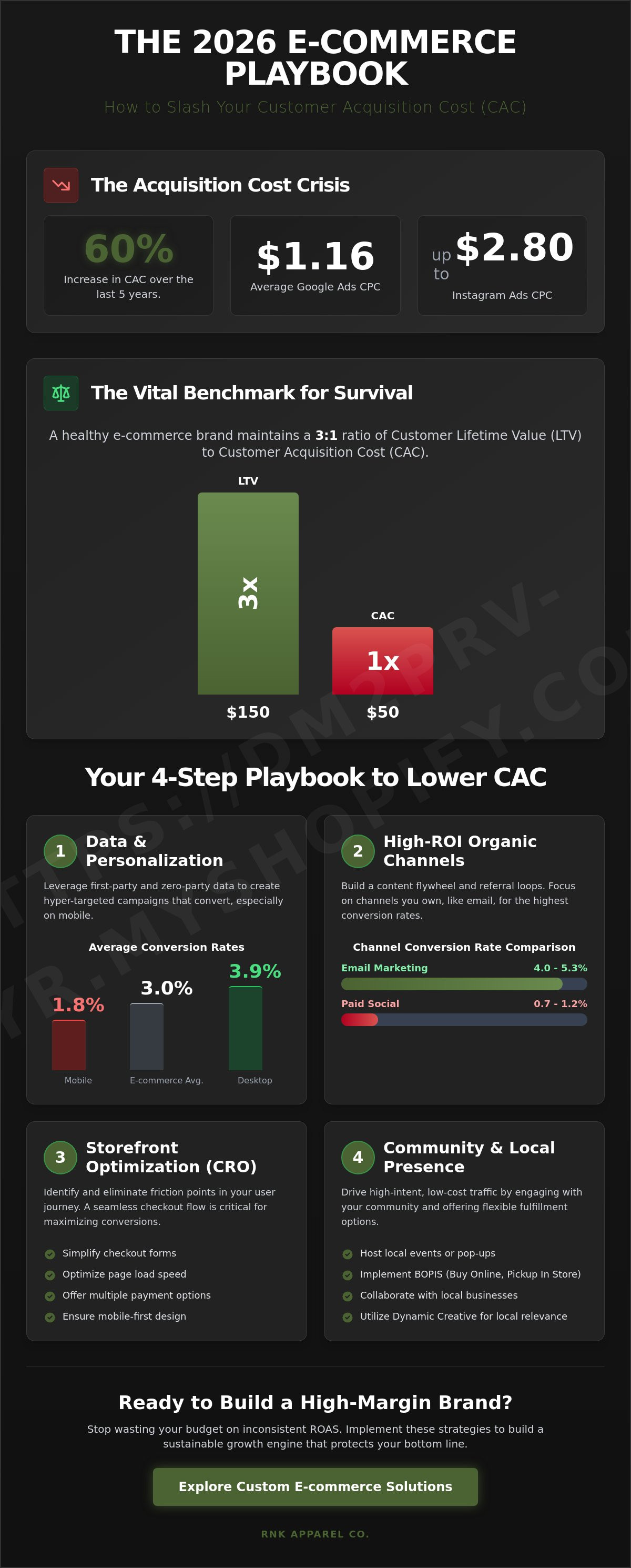
Did you know that customer acquisition costs have surged by as much as 60% over the last five years? You are likely feeling the squeeze as Google Ads CPCs for ecommerce search hit $1.16 and Instagram ads climb as high as $2.80. It's frustrating to watch your profit margins vanish into the pockets of Big Tech while your ROAS remains stubbornly inconsistent. You're searching for how to lower customer acquisition cost ecommerce because the old playbook of simply buying growth doesn't work in 2026.
At Marvin Growth Partners, we're here to help you break free from ad dependency. This guide will show you how to master the frameworks needed to slash your CAC and build a sustainable, high-margin brand. You'll learn how to leverage first-party data to combat new CCPA regulations, optimize for the current 3.0% average conversion rate, and build a community-driven ecosystem. We'll show you how to shift from "hacking" platforms to building a strategic moat that protects your bottom line for the long haul.
Key Takeaways
- Understand why the 3:1 LTV to CAC ratio is the vital benchmark for your brand’s survival and how to track it accurately.
- Learn how to leverage first-party data and hyper-targeted personalization to reduce "bounce-to-buy" time and marketing waste.
- Discover the framework for building a content "flywheel" that turns existing customers into an organic acquisition engine.
- Identify the conversion rate optimization tactics that show you how to lower customer acquisition cost ecommerce by fixing friction points in your checkout flow.
- Explore how local community engagement and flexible fulfillment options like BOPIS can drive high-intent, low-cost traffic to your online store.
What is Customer Acquisition Cost (CAC) in 2026?
In 2026, understanding Customer Acquisition Cost (CAC) requires looking beyond your Facebook Ads Manager dashboard. It is the total investment in sales and marketing required to earn a single new customer. While simple on paper, the "fully loaded" cost now includes creative production, agency fees, and the ballooning price of data privacy compliance. If you're wondering how to lower customer acquisition cost ecommerce, you first need to measure it accurately.
The benchmark for a healthy brand remains a 3:1 Customer Lifetime Value (LTV) to CAC ratio. If your LTV is $150, you shouldn't spend more than $50 to acquire that customer. However, with CAC increasing by 60% over the last five years, hitting that 3:1 target is harder than ever. Brands must distinguish between Channel-Specific CAC, which is what a single platform reports, and Blended CAC, which is your total marketing spend divided by all new customers. Blended CAC often reveals the hidden "halo effect" of your organic efforts.
The 2026 CAC Formula for Modern Ecommerce
To calculate your CAC today, you must use a comprehensive numerator. It's not just your $1,000 to $10,000 monthly Google Ads budget. You have to add in your Shopify Grow plan ($105/month), payment processing fees (2.5% to 2.9% + $0.30), and the 30-40% increase in privacy compliance costs. It is also vital to separate the costs of acquiring brand-new shoppers from the expenses used to retain existing ones. Fully Loaded CAC in 2026 is the total sum of all marketing payroll, software subscriptions, creative assets, and media spend divided by the number of new customers acquired in a specific period.
Why Traditional Paid Search and Social are Getting More Expensive
The days of cheap traffic are gone. With Google Ads CPCs for search hitting $1.16 and TikTok CPMs averaging $9, competition is fierce. AI-driven bidding wars have turned platforms into high-stakes auctions where only those with the best data win. Michigan brands often face higher risks by relying on a single platform. If a new "mini-TCPA" law like Michigan Senate Bill 351 increases litigation risks for SMS, or if ad fatigue sets in on Instagram where CPCs can reach $2.80, your entire growth engine could stall. You must diversify your mix to find how to lower customer acquisition cost ecommerce without losing volume.
Implementing Data-Driven Personalization to Boost Efficiency
With Instagram CPCs climbing as high as $2.80, you cannot afford to treat every visitor like a stranger. Efficiency in 2026 is built on data-driven personalization, which ensures your ad spend is laser-focused on high-intent shoppers. By leveraging first-party data, you can create hyper-targeted audience segments that actually convert. This approach is essential for anyone figuring out how to lower customer acquisition cost ecommerce without sacrificing scale.
One of the easiest ways to waste your budget is paying for clicks from people who have already purchased. By excluding existing customers from your top-of-funnel campaigns, you redirect that capital toward fresh prospects. AI now plays a massive role here. It predicts customer intent before they even click, helping you serve tailored product recommendations that reduce the "bounce-to-buy" time. Since mobile conversion rates are currently around 1.8% compared to 3.9% on desktop, shortening the path to purchase for mobile users is a non-negotiable tactic for protecting your margins. Integrating these data points into your CRM is a proven way to master how to lower customer acquisition cost ecommerce by minimizing the cost of trial and error.
Leveraging Zero-Party Data via Quizzes and Surveys
Email marketing remains a powerhouse with a 4.0-5.3% conversion rate, significantly higher than the 0.7-1.2% seen on paid social. You can fuel this channel by collecting zero-party data through simple quizzes or surveys. Ask your visitors about their specific needs, such as whether they prefer streetwear or performance gear. These insights allow you to trigger personalized welcome sequences that resonate immediately. This strategy increases initial click-through rates and ensures you aren't guessing what your audience wants. If you're ready to see how these strategies fit into a broader growth plan, you can explore our custom ecommerce solutions.
Dynamic Creative Optimization (DCO)
Local relevance is a major trend for 2026. Dynamic Creative Optimization (DCO) allows you to automate ad creative to match specific user demographics in cities like Detroit or Grand Rapids. You can test "lifestyle" shots featuring local landmarks against "product-only" shots to see what resonates with Michigan shoppers. Using AI-assisted design tools also helps slash creative production costs. This ensures your ads stay fresh and relevant without the heavy overhead of traditional photo shoots, directly impacting your bottom line.
Developing High-ROI Organic Channels and Referral Loops
Paid ads are rented; content is owned. Relying solely on "rented" traffic from Big Tech is why many brands saw their CAC increase by 60% over the last five years. To build a sustainable brand, you must shift your budget from temporary ad placements to permanent assets like SEO and community-driven content. Developing organic channels is a core pillar of how to lower customer acquisition cost ecommerce because it builds equity over time. While Google Ads might offer a 2:1 return on investment, that math only works as long as you keep feeding the machine with cash. SEO and content marketing, though requiring an upfront time investment, eventually drive traffic without a per-click fee.
Creating a "Flywheel Effect" is the ultimate goal. This happens when your existing customers become your primary marketing engine. By implementing a structured referral program, you can incentivize word-of-mouth and gain new customers at a fraction of the cost of a Facebook lead. Since paid social media currently has a low conversion rate of 0.7% to 1.2%, a recommendation from a friend carries much more weight. It bypasses the skepticism of traditional ads and lands directly in the hands of a high-intent audience. This organic momentum is the most effective way to understand how to lower customer acquisition cost ecommerce while scaling your brand's reach.
Turning Customers into Advocates with UGC
In the skate and street scene, authenticity is everything. Encourage your customers to share "unboxing" or "trick" videos in exchange for loyalty points or exclusive discounts. This User Generated Content (UGC) often outperforms professional studio shoots because it feels real. Integrating this social proof directly onto your product pages reduces buyer friction and increases trust. It’s a low-production, high-impact strategy that turns every sale into a potential marketing asset.
Affiliate and Influencer Marketing for Local Brands
Partnering with Michigan-based micro-influencers in Detroit or Grand Rapids allows you to tap into established communities. Instead of paying massive flat fees, structure "Pay-on-Performance" deals where influencers earn a commission on every sale. This eliminates upfront risk and ensures your marketing spend is tied directly to revenue. Use dedicated landing pages for each partner to track your CAC with precision and identify which local voices truly move the needle for your brand.
Optimizing Your Storefront for Maximum Conversion (CRO)
If your website is a leaky bucket, pouring more money into ads won't fix your revenue problems. You are likely paying for clicks that never turn into customers due to friction points you can't see without tools like heatmaps. Heatmaps reveal where users get stuck; perhaps they're clicking on non-linked images or finding the "Add to Cart" button hidden below the fold on mobile. Improving your conversion rate is the most direct answer to how to lower customer acquisition cost ecommerce. For instance, if your current conversion rate is 1% and you double it to 2%, you effectively cut your CAC in half without spending an extra dime on Google or Meta. With the global average ecommerce conversion rate sitting between 2.5% and 3.0%, many stores have significant room to grow by simply making it easier to buy pro skateboards and other high-performance gear.
Mobile-First Design and One-Click Checkout
Mobile conversion rates currently lag at approximately 1.8%, while desktop rates reach 3.9%. This gap represents a massive waste of ad spend since most social traffic is mobile. You must optimize for the "skater on the go" by implementing one-click checkout options like Shop Pay, Apple Pay, and Google Pay. These tools remove the friction of typing in credit card numbers on a small screen. Every millisecond of load speed matters. A slow site leads to immediate ad-click abandonment, meaning the money you spent to get that click is gone forever. Faster load times ensure that the traffic you paid for actually sees your products, which is a fundamental step in how to lower customer acquisition cost ecommerce.
Psychological Triggers: Scarcity, Urgency, and Trust
Trust and urgency are powerful tools for closing the sale and protecting your margins. Using "Low Stock" alerts for limited streetwear drops creates a natural sense of scarcity that encourages immediate action. However, trust is equally important for conversion. Displaying clear return policies and trust badges reduces the anxiety that often prevents a first-time visitor from hitting the buy button. Providing detailed sizing guides for specific items like vans pro skate also helps lower costs by reducing the rate of expensive returns and customer service inquiries. If you want to see these conversion tactics in action, check out our latest pro-grade inventory and see how a streamlined shopping experience feels.
Leveraging Community and Local Presence in Michigan
Most ecommerce guides treat the internet as a purely digital, borderless vacuum. This is a mistake. For Michigan-based brands, your physical proximity to your audience is a secret weapon. While global competitors are fighting over Google Ads with $1.16 CPCs, you can drive "free" traffic by showing up where your customers actually live. Engaging with the community in Flint and Detroit allows you to build a brand presence that exists outside of a browser window. This is a powerful, often overlooked strategy for how to lower customer acquisition cost ecommerce because it replaces expensive ad clicks with real-world relationships.
One of the most effective ways to slash costs is through "Buy Online, Pick Up In-Store" (BOPIS) for local residents. This eliminates the rising costs of shipping and provides an immediate solution for the customer. It also creates an opportunity for hyper-local SEO. By targeting keywords like "skate shop Detroit" or "best boards in Flint," you can win low-competition search traffic that global brands simply cannot touch. Building this local trust is also a smart hedge against the "mini-TCPA" risks of Michigan Senate Bill 351. When customers know and trust you personally, they are far more likely to opt-in to your marketing and stay loyal for years.
Geo-Targeted Content for Michigan Cities
You can dominate the local market by creating content that resonates with specific Michigan regions. Try publishing a guide to the "Best skate spots in Grand Rapids" to attract high-intent local leads. You can also offer Michigan-specific shipping perks to convert residents in Fenton or Brighton who might be on the fence. Partnering with local skate parks for cross-promotion is another low-cost way to get your brand in front of the right eyes. These local initiatives help you master how to lower customer acquisition cost ecommerce by focusing on high-conversion, low-competition pockets of traffic.
The Skateboard Lifestyle as a Brand Moat
In 2026, community is your most sustainable moat. By building a brand that represents the skateboard lifestyle, you move beyond being a mere commodity. Hosting events like "Skate Jams" in Detroit allows you to collect first-party email and SMS data at zero ad cost. This data is gold in an era of strict privacy regulations like the updated CCPA. Some industry professionals report that community-led brands see retention rates as much as 40% higher than those relying solely on ads. This long-term loyalty is what ultimately offsets acquisition costs and builds a high-margin business.
Future-Proof Your Brand Beyond the Ad Auction
The landscape of 2026 demands more than just a healthy ad budget. Success now requires a strategic shift toward first-party data, high-converting storefronts, and a deep connection to your local community. By mastering how to lower customer acquisition cost ecommerce, you aren't just saving money; you're building a sustainable moat that Big Tech cannot dismantle. Focus on turning your existing customers into advocates and ensuring your mobile experience is seamless and fast.
We've been serving the Michigan skate community since our inception, providing the hardware and streetwear you need to perform. Whether you're in Detroit, Flint, or Grand Rapids, you can count on fast local shipping and expert-curated gear. It's time to stop renting your growth and start owning your future. Optimise your ecommerce strategy with pro-grade gear today. You have the tools to thrive, so go build something that lasts.
Frequently Asked Questions
What is a good Customer Acquisition Cost for ecommerce?
A good CAC is one that maintains at least a 3:1 LTV to CAC ratio to ensure long-term profitability. While specific dollar amounts vary by industry, your acquisition cost must leave enough margin to cover COGS, shipping, and overhead. If you're selling high-ticket pro boards, you can afford a higher CAC than a brand selling low-margin accessories. Always measure your CAC against the total profit a customer generates over their lifetime.
How do I calculate CAC if I sell multiple types of products?
To calculate CAC for multiple product lines, you must segment your marketing spend and new customer data by category. Assign specific ad sets and creative costs to the corresponding collections, like streetwear versus hardware. This granular approach helps you identify which products are most expensive to sell. It's the most effective way to see how to lower customer acquisition cost ecommerce by shifting budget toward your most efficient categories.
Can I lower my CAC without increasing my marketing budget?
You can lower your CAC without spending more by optimizing your existing traffic through conversion rate optimization. Improving your site speed or simplifying your checkout process can turn more visitors into buyers from the same ad spend. Additionally, encouraging user-generated content and referrals can bring in new customers for free. These tactics allow you to scale your revenue while keeping your total marketing investment flat.
Does SEO actually help lower CAC in the short term?
SEO is primarily a long-term strategy, but it can provide short-term CAC relief through bottom-funnel keyword targeting. By optimizing for high-intent "buy" terms, you capture users who are ready to purchase right now. This reduces your reliance on expensive paid auctions. Over time, organic traffic becomes your most cost-effective channel, but the initial phase requires consistent content production before you see a significant drop in blended acquisition costs.
How does customer retention impact my acquisition costs?
Customer retention indirectly lowers your CAC by increasing the lifetime value (LTV) of every person you acquire. When a customer returns for a second or third purchase, the initial cost to get them is spread across a much larger revenue pool. High retention also fuels organic word-of-mouth. This creates a referral loop where your most loyal fans bring in new shoppers, effectively lowering your blended acquisition costs across the entire store.
What are the best tools for tracking CAC in 2026?
In 2026, the best tools for tracking CAC are those that prioritize first-party data and multi-touch attribution. Platforms like Triple Whale or Northbeam help you see the true path to purchase across different devices and channels. Since third-party cookies are less reliable, using a server-side tracking setup is essential. These tools provide the transparency needed to understand how to lower customer acquisition cost ecommerce by identifying which touchpoints actually drive conversions.
How often should I audit my ecommerce CAC?
You should audit your blended CAC at least once a month, though active campaigns require weekly monitoring. Monthly audits allow you to spot long-term trends and adjust your overall marketing mix based on platform performance. Weekly check-ins help you catch sudden spikes in CPC or CPM before they drain your budget. Consistent auditing ensures that your 3:1 LTV to CAC ratio remains stable as market conditions and platform algorithms shift.
Disclaimer
Some content published on this website may be developed with the assistance of AI-powered research and writing tools to help streamline research, organization, and content creation. All articles are reviewed, edited, and approved by Marvin Growth Partners to ensure they align with our perspectives, experience, and intended messaging.
While we strive to provide accurate and up-to-date information, blog content is intended for informational and educational purposes only and should not be considered legal, financial, or professional advice. Readers should independently verify information and consult qualified professionals when appropriate.