

How to Measure Fractional CMO Success: The 2026 Growth Scorecard
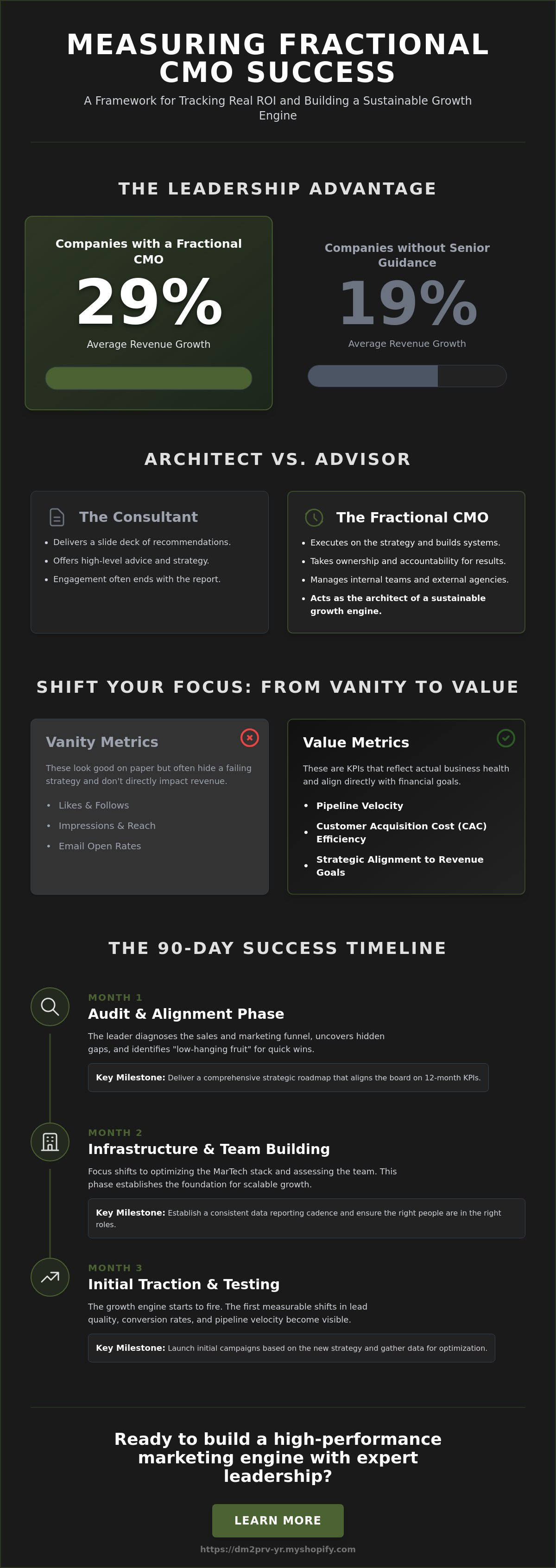
Companies that partner with a fractional executive see an average revenue growth of 29%, while those without senior marketing guidance lag behind at just 19%. This data highlights the massive potential of high-level leadership, yet many CEOs still struggle with how to measure fractional cmo success beyond a simple gut feeling. You aren't just hiring a consultant to offer advice; you're hiring an architect to build a sustainable growth engine. If you're tired of "consultant fluff" and want to see actual execution, it's time to move past vanity metrics and look at the structural health of your marketing.
It's natural to feel uneasy when you can't see a clear line between executive strategy and your daily bottom line. You need peace of mind that your investment is actually improving lead quality and scaling your revenue. This guide provides the exact metrics and qualitative milestones used to evaluate a leader's impact on your business ROI. We'll explore the 2026 Growth Scorecard, a reporting framework that tracks everything from 30-day quick wins to the long-term scalability of your marketing engine.
Key Takeaways
- Shift your focus from tactical outputs like email counts to strategic outcomes like market share and revenue alignment.
- Track a clear 90-day timeline that begins with a diagnostic audit to identify immediate growth opportunities.
- Master the five essential quantitative KPIs, such as CAC trends, to understand how to measure fractional cmo success through your financial data.
- Assess qualitative impact by looking at brand equity and leadership influence within your specific industry niche.
- Adapt your growth strategy to the unique economic shifts and talent availability within the Michigan business landscape.
Defining Success: Moving Beyond Vanity Metrics to Real Growth
True success isn't found in a lower payroll bill. While saving 50-70% compared to a full-time hire is a significant financial perk, the real answer to how to measure fractional cmo success lies in revenue alignment. A successful engagement means your marketing activities finally speak the same language as your sales department. Instead of counting how many emails were sent, you should be tracking how much market share was gained. In 2026, the market has shifted from "growth at all costs" to "efficient growth." This requires a full-funnel approach where the CMO optimizes every touchpoint, not just the top-of-funnel lead generation.
Companies using fractional CMOs report revenue growth of 29%, compared to 19% for those without senior guidance. This 10% gap isn't a fluke; it's the result of building a "Growth Engine." This concept involves creating repeatable systems, documented processes, and automated workflows that outlast any individual consultant. If your marketing slows down the moment your leader steps away, you haven't built a system; you've just hired a temporary helper.
The Difference Between a Consultant and a Fractional CMO
A consultant's job usually ends with a slide deck of recommendations. A fractional CMO's job begins with the execution of those ideas. When you're evaluating performance, you're measuring ownership rather than advice. Does the CMO manage the internal team or external agencies? Do they take accountability when a campaign misses the mark? Accountability is the primary indicator of a successful fractional engagement. They shouldn't just tell you what to do; they should lead the people doing it.
Vanity Metrics vs. Value Metrics
It's easy to get distracted by "likes" and "impressions," but these often hide a failing strategy. To truly understand impact, you must look at a specific Key Performance Indicator (KPI) that moves the needle for your business. In 2026, consumer confidence is low, and buyers prioritize practical value over brand cues. This means your metrics must reflect actual business health.
- Pipeline Velocity: You need to know how fast leads move through your sales stages.
- CAC Efficiency: Is your cost of acquiring a customer dropping as your brand becomes more established?
- Strategic Alignment: Every marketing goal must directly support the CEO's five-year exit or expansion plan.
Measuring how to measure fractional cmo success requires looking at these value-based metrics. If the strategy doesn't improve the financial trajectory of the company, the marketing is just noise.
The 90-Day Success Timeline: What to Measure and When
Success is a moving target. It evolves as your fractional leader integrates into the daily rhythm of your business. You can't expect a complete revenue overhaul in the first week, but you should expect a structured progression. Understanding how to measure fractional cmo success requires looking at the engagement in three distinct 30-day blocks. Each phase has its own specific milestones that indicate whether you're on the path to a scalable growth engine or just spinning your wheels.
Month 1: The Audit and Alignment Phase
The first 30 days are about diagnosis. A high-level leader with over 15 years of experience, a trait shared by 72.8% of fractional executives, will spend this time uncovering hidden gaps in your sales and marketing funnel. Determining how to measure fractional cmo success during this phase is about spotting the difference between busy work and strategic insight. You'll know this month is successful when you receive a comprehensive audit that identifies "low-hanging fruit" and aligns the board on 12-month KPIs. Discovery ROI in the first month is defined by the financial value of the waste identified and the clarity of the strategic roadmap provided.
Month 2: Infrastructure and Team Building
Once the gaps are identified, the focus shifts to the "MarTech" stack and the people operating it. Since 68% of fractional professionals are now using AI to drive efficiency, your CMO should evaluate if your current tools are modern or obsolete. Success in month two is measured by the CMO's ability to assess your team. Do you have the right doers in the right seats? This is also when you establish a consistent reporting cadence, ensuring that every executive decision is backed by clean, first-party data. If you are looking for a leader to manage your marketing infrastructure, this phase is where their strategic value truly begins to shine.
Month 3: Initial Traction and Testing
By day 90, you should see the first measurable shifts in lead quality or conversion rates. This isn't about massive scale yet; it's about the "Pilot Program." A successful CMO will launch small-scale tests in specific channels to gather data before committing a large budget. You're measuring their ability to pivot. If a test fails, do they have the data to explain why and a plan to adjust? According to a 2025 survey, 61% of companies see improved marketing ROI within six months, but the foundation for that growth is built right here in the third month of execution.
The Fractional CMO Scorecard: 5 Key Quantitative KPIs
While the first 90 days focus on setting the stage, the long-term evaluation of how to measure fractional cmo success depends on hard data. In a 2026 economy characterized by cautious consumer behavior and a focus on practical value, your marketing must be a profit center, not a cost center. Quantitative success is inextricably tied to the financial health of your company. It isn't enough to see "up and to the right" charts on a social media dashboard; those lines must translate directly to your balance sheet.
The first metric to watch is the Customer Acquisition Cost (CAC) Trend. In an efficient growth model, your CAC should stabilize or decrease as your brand authority grows. If your CMO is building a proper engine, you'll see your Marketing Originated Pipeline increase. This measures the percentage of total sales that began with a marketing-led initiative. Finally, the LTV to CAC Ratio remains the gold standard for 2026 growth companies. You're looking for a ratio of at least 3:1, ensuring that the lifetime value of a customer significantly outweighs the cost to win them.
Pipeline Velocity and Lead Quality
Speed is a metric. Pipeline velocity measures the time it takes for a lead to move from the initial "Interest" phase to "Closed-Won." A skilled fractional leader identifies where deals get stuck and implements automation or content to grease the wheels. You should also monitor the conversion rate from Marketing Qualified Leads (MQL) to Sales Qualified Leads (SQL). Don't be surprised if a successful CMO actually decreases your total lead volume. Increasing lead quality often means tightening filters so your sales team only spends time on high-intent prospects, which ultimately drives more revenue with less waste.
Return on Ad Spend (ROAS) and Channel Efficiency
In 2026, multi-channel attribution is essential because third-party tracking has become unreliable. Your CMO should be able to tell you which platforms are actually driving revenue, not just clicks. A major success signal is their ability to cut spend on underperforming channels without a corresponding drop in revenue. Instead of focusing on "Cost per Click," which is often a vanity metric, focus on the Cost per Opportunity. This tells you exactly what it costs to get a qualified buyer into a sales conversation. If this number is shrinking while your pipeline is growing, your fractional leadership is delivering a high ROI.
Qualitative Indicators: Strategy, Culture, and Leadership
Spreadsheets tell you what happened, but qualitative indicators tell you why it happened and whether the growth is sustainable. While quantitative KPIs provide the backbone of your reporting, the "soul" of leadership is found in the intangible shifts within your organization. Part of how to measure fractional cmo success involves looking at strategic clarity. Does every employee, from the sales floor to the back office, understand your unique value proposition? In a 2026 market where consumer confidence is low, a leader who can distill complex strategies into a single, unified mission is invaluable.
Brand equity is another vital signal that often evades a simple spreadsheet. In the Michigan business landscape, particularly within the Detroit and Grand Rapids corridors, being perceived as a local industry leader is a competitive necessity. Michigan ranks 4th in the nation for workforce development, and a successful fractional CMO leverages this by building a culture of internal growth. If your marketing staff feels mentored and retention rates are rising, your fractional leader is providing value that far exceeds their hourly rate. They aren't just managing tasks; they're building a team that can eventually function without them.
Sales and Marketing Alignment
One of the most telling signs of a successful engagement is the death of the "silo" mentality. We look for "Smarketing" alignment, where the sales team actually likes and uses the materials marketing provides. You should measure the frequency and quality of joint strategy sessions. The CMO bridges the gap between prospecting and closing by aligning the brand promise with the reality of the sales conversation. When sales reps stop complaining about lead quality and start asking for more of the same, you know your marketing leadership is hitting the mark.
Board and Executive Influence
A high-level fractional executive must be able to translate complex attribution data into "CEO-speak." This means focusing on business outcomes rather than clicks or impressions. A major success signal is when the Board of Directors expresses increased confidence in the growth roadmap. The CMO should contribute to high-level business pivots, helping the company find better product-market fit in a shifting economy. If your leadership team is seeking this level of strategic guidance to navigate the 2026 landscape, explore our fractional leadership options to see how we align marketing with your executive goals.
Maximizing ROI in the Michigan Business Landscape
The Michigan business environment in early 2026 has specific nuances that a national consultant might miss. While the state ranks 4th in the nation for workforce development, certain cyclical industries like office furniture and automotive parts are experiencing soft spots. For mid-market firms in Detroit or Grand Rapids, a "Local-First" strategy often outperforms generic national campaigns. When evaluating how to measure fractional cmo success, you should look for a leader who builds community authority in regional hubs like Brighton or Fenton.
A successful fractional leader leverages the deep Michigan-based talent pool for execution roles. Instead of relying on disconnected offshore teams, they tap into local experts for SEO, content creation, and PPC. This ensures your marketing message resonates with the specific industrial and tech culture of our region. Determining how to measure fractional cmo success in this context requires looking at the strength of local partnerships and your brand's growing presence in regional industry circles. This approach builds a foundation of first-party data that protects you from the unreliability of third-party tracking.
Navigating Regional Market Shifts
Measuring success against local competitors in the Detroit and Grand Rapids corridors is essential for mid-market growth. Your CMO should demonstrate an ability to pivot strategies based on Michigan's specific economic shifts. A key success signal is high engagement or attendance at local Michigan industry events. This indicates that your marketing is moving beyond digital noise and building real-world influence. If your fractional leader can't explain how they are positioning you against other Michigan firms, they aren't fully optimizing your local growth engine.
Choosing the Right Michigan Fractional Partner
Proximity remains a significant factor for high-level strategic alignment. Having a CMO who can join board meetings in person helps bridge the gap between abstract strategy and executive decision-making. You should also evaluate a CMO based on their existing network of local Michigan vendors. A leader with deep roots in the state can quickly assemble a team of proven agencies, saving you months of trial and error. If you are ready to scale, connect with a Michigan-based growth expert today to ensure your marketing engine is built for our unique economic landscape.
Build Your Future Growth Engine
Success in marketing isn't an accident; it's the result of a deliberate, data-backed strategy. By moving beyond vanity metrics and focusing on pipeline velocity and LTV:CAC ratios, you've gained a clear understanding of how to measure fractional cmo success. You've also seen that the first 90 days are critical for establishing infrastructure and team alignment. Now, it's about applying those frameworks to the unique economic landscape of the Detroit and Grand Rapids corridors.
Building a scalable marketing engine requires a leader who understands both high-level strategy and the local Michigan culture. We bring expertise in the Detroit and Grand Rapids markets and use data-driven 90-day growth frameworks to ensure your investment translates into measurable revenue. We have a proven track record of helping Michigan mid-market firms navigate shifting consumer behaviors and complex regional dynamics. Don't leave your executive decisions to chance. Book a Growth Strategy Audit for your Michigan Business and start turning your marketing into a predictable profit center today. Your path to efficient, sustainable growth starts with a single, strategic step.
Frequently Asked Questions
How long does it take to see results from a Fractional CMO?
Expect to see quick wins and tactical improvements within the first 30 to 90 days. Sustainable pipeline growth and significant strategic shifts typically take three to six months to become evident. A 2025 CMO Council survey found that 61% of companies saw improved marketing ROI within six months. This timeline allows for the initial audit, infrastructure building, and testing phases to yield reliable data.
What is a reasonable monthly budget for a Fractional CMO in 2026?
Budgets depend on the level of integration and the specific hours required to meet your goals. Because these leaders work on a part-time or project basis, they often save a company 50% to 70% compared to the total compensation of a full-time executive. Most businesses choose a monthly retainer that covers strategic leadership and team oversight without the heavy overhead of a permanent hire.
Should I measure a Fractional CMO differently than a full-time hire?
You should focus more on specific milestones and strategic outcomes rather than hours spent at a desk. Because fractional leaders are results-oriented, how to measure fractional cmo success often centers on their ability to build a repeatable growth engine. While a full-time hire might focus on long-term culture, a fractional CMO is measured by their speed of impact and the scalability of the systems they implement.
What are the red flags that a Fractional CMO is failing?
A major red flag is a lack of accountability for execution and a focus on "consultant fluff" over real outcomes. When considering how to measure fractional cmo success, look for a clear audit within the first 30 days. If lead quality remains stagnant after six months or if the leader refuses to manage your internal team, the engagement isn't delivering the high-level leadership you need.
Can a Fractional CMO help with my sales team's performance?
Yes, they play a critical role in bridging the gap between prospecting and closing. A successful fractional leader improves sales performance by tightening lead qualification and creating high-value sales enablement materials. When marketing and sales are aligned, you'll see an increase in the conversion rate from Marketing Qualified Leads to Sales Qualified Leads, making your sales team much more efficient.
What specific reports should I expect to see every month?
You should receive a scorecard that tracks quantitative KPIs like Customer Acquisition Cost (CAC) trends and Marketing Originated Pipeline. This report should also include qualitative updates on strategic projects, such as brand positioning or tech stack optimizations. The report must translate complex data into "CEO-speak" so the board can understand the direct impact on the company's financial health.
How do I know if my marketing team is actually improving under their leadership?
Look for increased strategic clarity and higher morale within the internal team. A successful fractional leader acts as a mentor, helping your staff develop new skills and follow documented processes. If your team is hitting their individual KPIs more consistently and requires less tactical direction from the CEO, it's a clear sign that the CMO's leadership is having a positive effect.
Is it possible to measure the ROI of brand awareness campaigns?
It is possible by tracking indirect metrics like branded search volume and direct traffic to your website. In 2026, where consumer confidence is low, brand equity is measured by how often your company is perceived as a leader in its specific niche. While these campaigns take longer to show a direct return, they ultimately lower your CAC by making your sales outreach more effective.
Disclaimer
Some content published on this website may be developed with the assistance of AI-powered research and writing tools to help streamline research, organization, and content creation. All articles are reviewed, edited, and approved by Marvin Growth Partners to ensure they align with our perspectives, experience, and intended messaging.
While we strive to provide accurate and up-to-date information, blog content is intended for informational and educational purposes only and should not be considered legal, financial, or professional advice. Readers should independently verify information and consult qualified professionals when appropriate.