

How to Reduce Shopping Cart Abandonment Rate: A 2026 Guide for E-commerce Success
Did you know that 70.22% of online shoppers walk away right at the finish line? In 2026, research from the Baymard Institute confirms that nearly three quarters of your hard-earned traffic is vanishing before the transaction is complete. It's incredibly frustrating to see your Michigan-based store drive high traffic only to lose sales to complex checkout apps or unexpected shipping fees. You're likely wondering why your customers are leaving right before purchasing and how to reduce shopping cart abandonment rate without spending a fortune.
You aren't alone in feeling that your mobile experience, which now sees a staggering 80.02% abandonment rate, is working against you. This guide provides actionable strategies to recover your share of the $260 billion in lost revenue through radical transparency and technical speed. We'll explore how to streamline your checkout process using one-page designs, digital wallets, and AI-powered recovery tools to keep your local customers loyal and your conversion rates high.
Key Takeaways
- Audit your checkout flow to remove friction and implement one-page solutions that keep your customers focused on completing their purchase.
- Eliminate "sticker shock" by displaying shipping costs early and using free shipping thresholds to increase your average order value.
- Master a multi-channel recovery sequence using automated email and SMS to learn exactly how to reduce shopping cart abandonment rate and win back lost revenue.
- Build deep trust with Michigan shoppers by offering local delivery perks and highlighting your community roots throughout the checkout process.
Understanding the High Stakes of Shopping Cart Abandonment in 2026
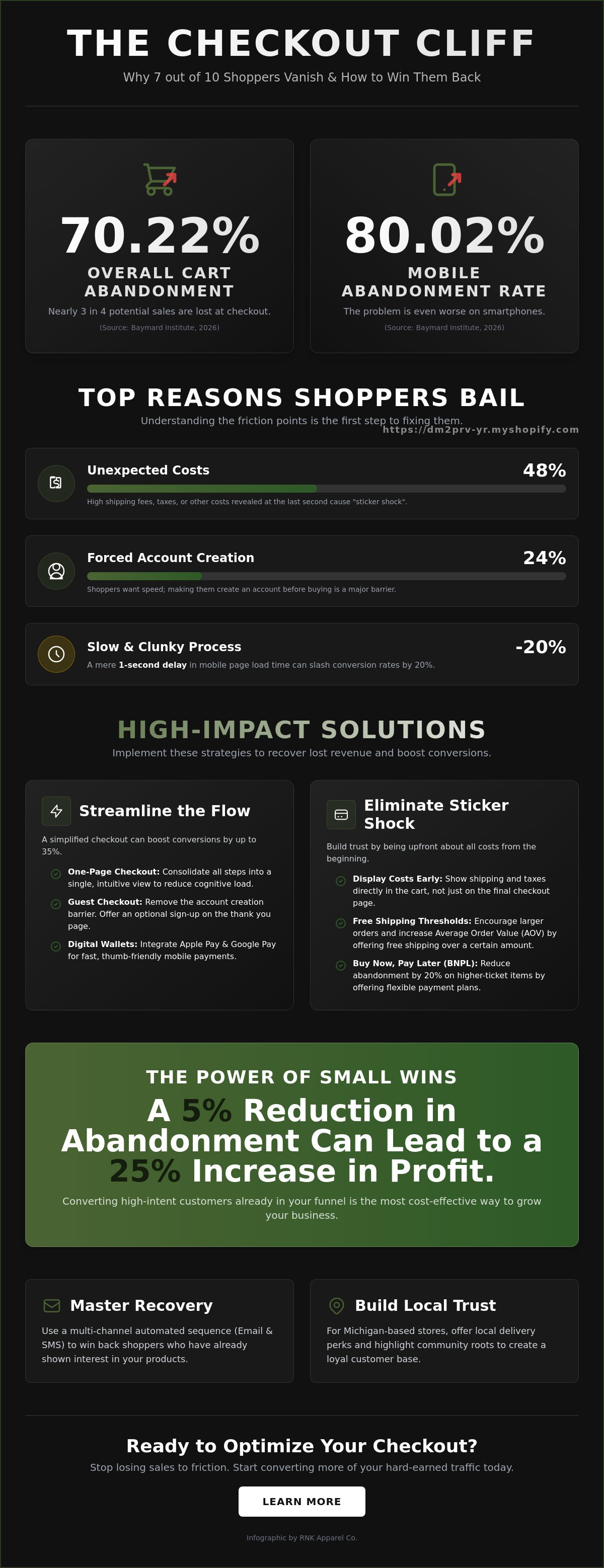
Shopping cart abandonment occurs when a potential buyer adds items to their digital basket but exits the store before finishing the transaction. It remains the single biggest hurdle for e-commerce growth. In 2026, the Baymard Institute reports a 70.22% average Abandonment rate across the industry. This isn't just a missed sale; it's a breakdown in the customer journey at its most critical stage. For streetwear and retail brands, the stakes are even higher as mobile shoppers bail at a rate of 80.02%. Learning how to reduce shopping cart abandonment rate is no longer optional if you want to stay competitive.
The psychological "tipping point" usually happens the moment a user sees the final price tag. If the perceived value of the product doesn't outweigh the total cost including shipping, they leave. This abandonment directly inflates your Customer Acquisition Cost (CAC). You've already paid for the social media ads, the SEO effort, and the email marketing to get them to the site. When they walk away at the final step, those marketing dollars are effectively wasted. Capturing even a fraction of these lost users significantly lowers the cost of doing business.
The Financial Impact on Small Businesses
For a small business in Michigan, the "Lost Revenue Gap" represents thousands of dollars in unrealized monthly sales. Research indicates that a 5% reduction in abandonment can lead to a profit increase of up to 25%. This is because you're converting high-intent customers who are already deep in your sales funnel. There's also the hidden issue of "inventory lock." This happens when popular items are effectively removed from your available stock while they sit in inactive carts, preventing other ready-to-buy customers from purchasing your best-sellers.
Top Reasons Shoppers Bail in 2026
User expectations are higher than ever, and even minor friction can kill a sale. Here are the primary reasons shoppers walk away:
- Hidden Costs: 48% of shoppers leave because of unexpected taxes or shipping fees revealed only at the final step.
- Forced Account Creation: 24% of users will abandon their purchase if they're forced to create an account rather than using a guest checkout.
- Mobile Speed Issues: On mobile devices, a one-second delay in page load time can slash conversion rates by 20%.
If your site feels slow or asks for too much personal information, modern shoppers won't hesitate to find a faster alternative. Mastering how to reduce shopping cart abandonment rate starts with identifying these specific points of friction and removing them before they frustrate your customers.
Streamlining Your Checkout Flow for Faster Conversions
A friction-filled checkout is the fastest way to lose a customer who is ready to buy. In 2026, a streamlined experience is the key to success in digital commerce. Research shows that simplifying your checkout process can boost conversion rates by up to 35%. For Shopify users, the transition to the native One-Page Checkout is a game-changer. It consolidates shipping, billing, and payment into a single view, which reduces the cognitive load that often leads to a "save for later" mindset. If you're struggling with conversions, understanding how to reduce shopping cart abandonment rate through technical simplification is the first step.
If you sell higher-ticket items like pro-grade skateboards, adding "Buy Now, Pay Later" (BNPL) options is essential. For orders over $100, offering BNPL can reduce abandonment by 20%. It gives your customers the financial flexibility they need without delaying your sale. This is a critical part of learning how to reduce shopping cart abandonment rate for specialty retail. Providing these diverse payment options caters to modern preferences and keeps your brand accessible to a wider audience.
The Power of Guest Checkout
Forcing a shopper to create an account is a major roadblock. About 24% of people will leave their cart if they can't check out as a guest. You can still grow your marketing list by including a discrete "Keep me updated" checkbox. This captures the email address without making the user jump through hoops before they've even paid. Speed should always take priority over data collection during the transaction. Once the order is placed, you can offer an incentive for them to create an account on the thank-you page.
Mobile-First Payment Integration
Since mobile abandonment is significantly higher than desktop, your checkout must be thumb-friendly. Digital and mobile wallets like Apple Pay and Google Pay are projected to account for 54% of global e-commerce transactions by 2026. These tools allow for one-tap purchases, which eliminates the need for customers to type in long credit card numbers while walking through downtown Detroit or Grand Rapids. By optimizing for mobile, you'll discover how to reduce shopping cart abandonment rate for users on the go. Using auto-fill address tools also prevents the "fat finger" errors that frustrate mobile users.
Your checkout page should feel like a natural extension of your brand. Ensure the design is as sleek and responsive as your streetwear collections. If you want to see how a high-performance store handles this flow, you can browse our shop to experience a frictionless path to purchase.
Eliminating Sticker Shock with Transparent Pricing and Shipping
Sticker shock is a silent killer of e-commerce conversions. According to 2026 data, unexpected extra costs cause nearly half of all abandoned carts. To master how to reduce shopping cart abandonment rate, you must stop surprising your customers at the very end of their journey. Instead of waiting for the final checkout screen, move your shipping calculators directly onto the product pages. This allows shoppers to see exactly what they'll pay before they invest time in the checkout process. For business owners in Michigan, being upfront about sales tax and providing estimated delivery dates for hubs like Flint or Brighton builds immediate credibility.
Transparency should start the moment an item is added to the cart. If a customer doesn't see the total cost until they've entered their credit card details, they feel misled. Displaying a clear breakdown of taxes and fees early on prevents the frustration that leads to a quick exit. This strategy is especially important for mobile users who want to make fast decisions without navigating through multiple form fields just to find a shipping price.
The "All-In" Pricing Strategy
Testing an "All-In" pricing strategy can reveal what your specific audience values most. Some brands find success by rolling shipping costs into the product price, while others prefer a lower base price with transparent shipping tiers. Using a progress bar is a highly effective tactic here. It visually shows the customer how much more they need to add to their cart to unlock free shipping. This naturally increases your average order value while solving the abandonment problem. If you're targeting a local audience, don't forget to offer local pickup. It's a great way for customers to bypass shipping fees entirely while supporting a local business.
Building Trust Through Policy Transparency
Trust is the foundation of every successful transaction. Following Checkout Optimization Best Practices means making your policies easy to find. Link to your return policy directly from the shopping cart so customers don't have to go searching for it. A "No-Hassle" guarantee is particularly effective for technical products like pro-grade skate gear. When shoppers know they can return a product that doesn't meet their expectations, their purchase anxiety drops significantly. Use micro-copy near the payment buttons to reassure them about data security and encryption. This final layer of transparency is a proven way to learn how to reduce shopping cart abandonment rate effectively.
Implementing High-Impact Abandoned Cart Recovery Strategies
Even with a perfect checkout, some users will still walk away. This is where your recovery strategy acts as a safety net. In 2026, abandoned cart emails boast an average open rate of 50.5%, which is five times higher than standard marketing blasts. If you want to master how to reduce shopping cart abandonment rate, you need a multi-channel approach that combines timing with personalization. A three-part automated email sequence is the industry standard. Send the first nudge within one hour while the intent is fresh. Follow up at 24 hours with a focus on benefits, and send a final reminder at 48 hours, perhaps with a small incentive to close the gap.
SMS marketing is another powerful tool for time-sensitive "Back on Board" reminders. Because text messages have nearly instant read rates, they're perfect for high-demand items that might sell out. You should also consider "Exit Intent" pop-ups. These trigger the moment a user's cursor moves toward the browser's close button. Offering a limited-time discount right then can save a session before it officially ends. Personalizing these messages with the specific items left in the cart makes the recovery feel like a helpful service rather than a generic sales pitch.
The Art of the Recovery Email
Your subject line determines whether your recovery effort succeeds or fails. Avoid generic "You forgot something" headers. Instead, try helpful or curious phrases that stand out in a crowded inbox. Inside the email, use high-quality product imagery to remind them exactly what they're missing. AI-powered recovery emails are particularly effective in 2026, seeing an 8.17% conversion rate compared to just 4.1% for standard templates. You don't always need to offer a discount immediately. Sometimes, simply asking if they had a technical problem or need help with sizing is enough to bring them back.
Retargeting with Social Proof
Retargeting ads on platforms like Meta and TikTok keep your brand top-of-mind after the customer leaves your site. These ads shouldn't just repeat the product image; they should use customer reviews and social proof to overcome final objections. Aligning your recovery content with the skateboard lifestyle ensures your brand voice remains consistent across every touchpoint. When a shopper sees a peer praising the durability of your gear, it builds the trust needed to return and finish the transaction. This cohesive strategy is a proven way to learn how to reduce shopping cart abandonment rate and build long-term loyalty.
Ready to see these strategies in action? You can explore our latest collections and experience a store designed for high performance and easy recovery.
Leveraging Local Trust to Drive Sales in Michigan
While global e-commerce tactics provide a solid foundation, Michigan-based businesses have a unique home-field advantage. Building local trust is a powerful way to bridge the gap between a browser and a buyer. By highlighting your Michigan roots in your site's footer and throughout the checkout process, you tap into a "shop local" sentiment that big-box retailers can't replicate. Use imagery of recognizable Detroit landmarks or local skater spots in Grand Rapids to build regional authenticity. When a customer feels a personal connection to your brand, they're much less likely to exit the site at the final hurdle. This local focus is a highly effective, often overlooked answer to how to reduce shopping cart abandonment rate.
Offering "Local Delivery" perks specifically for residents in Detroit, Grand Rapids, and Flint creates a sense of exclusivity and care. It transforms a cold transaction into a community interaction. Showcase your involvement in local events or partnerships with Michigan non-profits to build an emotional connection. This regional pride provides the final push a shopper needs to click "buy," knowing their money stays within the local economy. In an era of rising Amazon FBA fees and impersonal service, your local identity is a competitive edge that keeps shoppers from drifting elsewhere.
The Advantage of Regional Shipping
Shipping speed is a major factor in 2026. While national carriers often struggle with logistics, you can promise 1-2 day delivery for Fenton or Brighton residents. This hyper-local speed is a massive selling point that you should feature prominently on your product pages. You can also highlight the reduced environmental impact of local shipping, which appeals to eco-conscious shoppers in the Great Lakes region. If a problem arises, a local customer support team will always beat a generic help desk. This human element turns a potentially frustrating shipping delay into a trust-building moment.
In-Store Pickup as a Conversion Tool
Implementing "Buy Online, Pick Up In-Store" (BOPIS) is perhaps the most direct way to solve the shipping cost problem. Since shipping fees remain the primary reason for cart abandonment, eliminating them entirely for your Michigan customers is a strategic move. A seamless bridge between your online store and your physical presence in Michigan makes the purchase feel safer. Shoppers can order gear online and have it in their hands at a local shop within hours. By offering this omnichannel experience, you'll discover how to reduce shopping cart abandonment rate while driving more foot traffic to your physical locations.
Take Control of Your Conversion Strategy Today
Reducing the gap between a full cart and a completed sale is the most direct path to increasing your profit margins in 2026. By implementing a one-page checkout and being radically transparent about shipping costs early on, you remove the friction that drives nearly half of all shoppers away. Whether you're refining your automated email sequences or leveraging your local Michigan roots to build community trust, every small adjustment helps. You now have the blueprint for how to reduce shopping cart abandonment rate by combining technical speed with regional reliability.
We've been serving Michigan skaters since day one, and we understand what it takes to deliver a premium experience. From expert-curated streetwear and hardware to fast regional shipping across Detroit and Grand Rapids, we're here to support your journey. Optimize your e-commerce setup with pro-grade gear and start capturing the revenue you've been leaving behind. Your store has the potential to thrive; take these steps today and watch your customer loyalty grow.
Frequently Asked Questions
What is a good shopping cart abandonment rate for a retail store in 2026?
A good rate is anything below 65%, though the 2026 industry average sits at 70.22% according to the Baymard Institute. While these numbers vary by industry, streetwear and retail brands often see higher rates due to mobile browsing habits. Aiming for a 5% to 10% improvement over your current baseline is a realistic and profitable goal for most small businesses.
How do I calculate my current cart abandonment rate?
Divide your total number of completed transactions by the number of initiated carts, subtract that result from one, and multiply by 100. If 500 people add items to their cart but only 150 finish the purchase, your abandonment rate is 70%. Tracking this monthly helps you measure how to reduce shopping cart abandonment rate as you implement new checkout optimizations or payment options.
Does offering free shipping really reduce abandonment?
Yes, offering free shipping is one of the most effective ways to convert browsers into buyers. Unexpected costs like shipping and taxes are the primary reason 48% of shoppers walk away at the final step. If you can't offer free shipping on every order, try a "Free Shipping Threshold" to increase your average order value while removing the psychological barrier of extra fees.
What is the best time to send an abandoned cart recovery email?
Send your first recovery email within one hour of the session ending to capture the customer while their intent is still high. Research shows that early reminders have significantly higher open rates than those sent a day later. A three-part sequence at the one-hour, 24-hour, and 48-hour marks provides the best balance between being helpful and remaining top-of-mind without becoming an annoyance.
Can I reduce abandonment without offering a discount code?
You can definitely lower abandonment by focusing on technical performance and trust signals rather than just price cuts. Improving your mobile page load speed and offering a guest checkout option are two of the most effective non-discount strategies. Many shoppers leave because of technical friction or security concerns, so displaying clear return policies and security badges can often win the sale on its own.
Is guest checkout better than requiring an account for repeat customers?
Guest checkout is essential for modern e-commerce because 24% of users will bail if forced to create an account. While accounts are great for loyalty, they shouldn't be a barrier to entry. For repeat customers, use digital wallets like Apple Pay or Google Pay to recognize them and speed up the process. This approach helps you learn how to reduce shopping cart abandonment rate by prioritizing the customer's time.
How does site speed affect my cart abandonment rate?
Site speed has a massive impact, as a one-second delay in mobile page load times can slash conversion rates by 20%. In 2026, where mobile abandonment is a staggering 80.02%, every millisecond counts. If your checkout feels sluggish or the payment processor hangs, customers will likely assume the site is broken or insecure. Ensuring an instant, responsive experience is critical for keeping shoppers engaged until the final click.
Disclaimer
Some content published on this website may be developed with the assistance of AI-powered research and writing tools to help streamline research, organization, and content creation. All articles are reviewed, edited, and approved by Marvin Growth Partners to ensure they align with our perspectives, experience, and intended messaging.
While we strive to provide accurate and up-to-date information, blog content is intended for informational and educational purposes only and should not be considered legal, financial, or professional advice. Readers should independently verify information and consult qualified professionals when appropriate.