

Marketing Agency vs. Consultant: Best Choice for Detroit
Hiring a full team of experts sounds like the fastest way to scale your Detroit business, but for many brands in 2026, it's actually the quickest way to burn through a budget. You might be asking, "What's the Difference Between a Marketing Agency and a Marketing Consultant?" The real choice isn't just between hiring one person or a full team. It's between buying a strategic roadmap or buying an execution engine. With 78% of digital agencies now shifting toward retainer-based pricing, making the wrong choice can lock you into a monthly commitment that doesn't align with your specific growth goals.
You’ve likely felt the frustration of paying high fees to an agency that just posts content without delivering a clear return on investment. It's a common pain point for Michigan business owners who lack the internal bandwidth to manage multiple freelancers but worry about confusing hourly rates. This guide provides a clear framework to help you compare strategy, execution, and cost structures. We’ll help you determine the perfect partner for your needs, lowering the risk of a bad hire while finding someone who understands the unique competitive landscape in Detroit and Grand Rapids.
Key Takeaways
- Identify whether your business needs a high-level advisor to build a roadmap or a specialized team to execute technical tasks like SEO and design.
- Discover "What's the Difference Between a Marketing Agency and a Marketing Consultant?" by evaluating who holds accountability for your lead generation and long-term strategy.
- Compare the financial impact of monthly retainers versus project fees to ensure your marketing spend aligns with your current growth phase.
- Apply a Michigan-specific framework to determine if your Detroit brand is ready for a full-service agency or a more agile consulting partnership.
- Explore the emerging 2026 hybrid model that bridges the gap between fractional strategic leadership and daily marketing execution.
Defining the Roles: What Is a Marketing Consultant vs. an Agency?
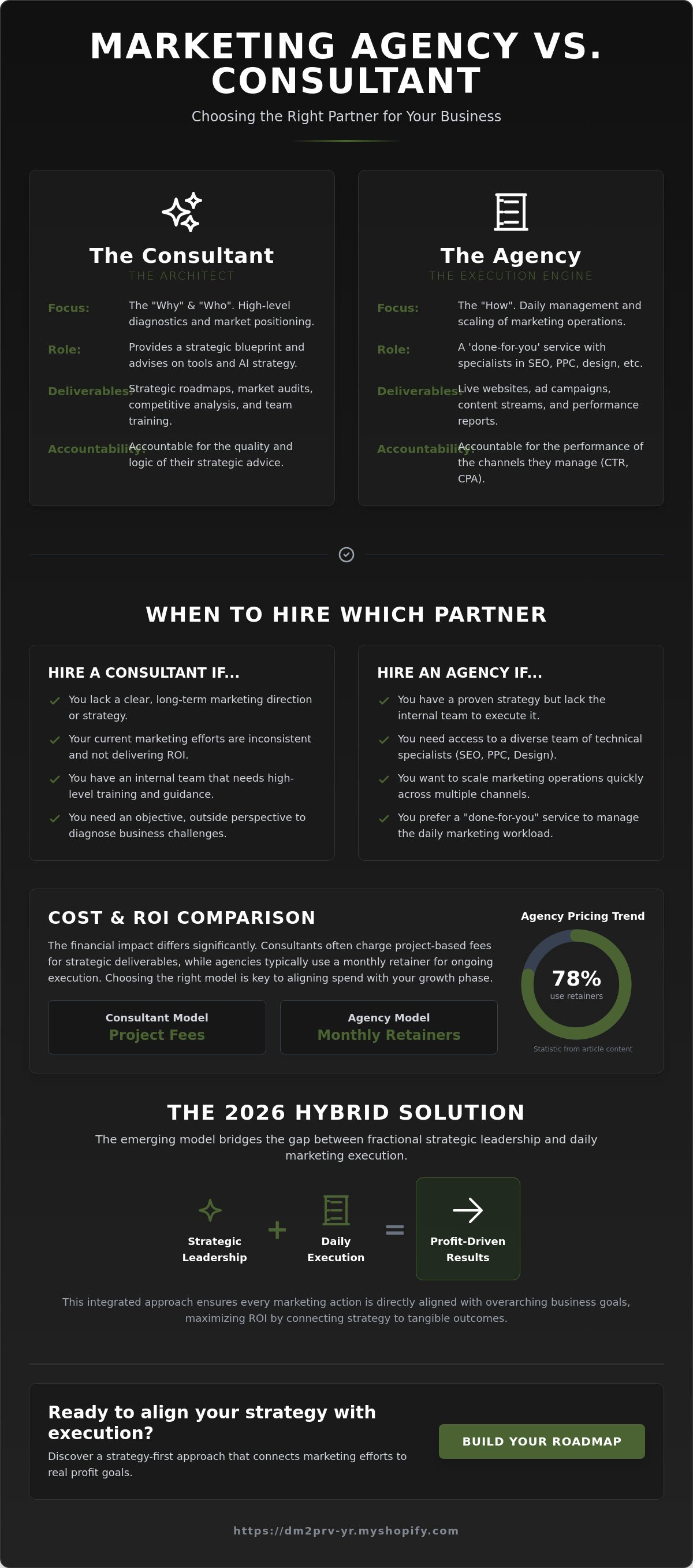
Choosing between these two partners often feels like a coin flip, but the impact on your bottom line is vastly different. To maximize your budget, you first need to understand: What's the Difference Between a Marketing Agency and a Marketing Consultant? A consultant is essentially your business architect. They don't swing the hammers; they draw the blueprints. They specialize in high-level diagnostics, looking at your market positioning and business goals to determine why your current efforts might be stalling. Think of the consultant as the person who tells you which mountain to climb. The agency provides the gear and does the climbing with you.
The Role of the Marketing Consultant
Consultants focus on the 'Why' and the 'Who.' They deep dive into your messaging to ensure it resonates with your target audience. Usually, a consultant is a solo expert or part of a small boutique firm with years of specialized experience. Their deliverables aren't social media posts or ad campaigns. Instead, they provide audits, strategic roadmaps, and high-level training for your internal staff. In 2026, their value has shifted toward AI strategy. They help you decide which automated tools are worth the investment and which are just expensive distractions.
The Role of the Marketing Agency
An agency is your execution engine. They focus on the 'How.' When you hire an advertising agency, you're buying access to specialists like SEO experts, PPC managers, and designers. They provide a 'done-for-you' service that manages the daily grind of your marketing presence. Their output is tangible: live websites, ad reports, and content streams. Agencies also use modern AI-driven tools to scale content production and optimize ad bidding in real-time. While the consultant creates the plan, the agency builds and maintains the engine.
Understanding this distinction is vital for your ROI. If you hire an agency without a solid strategy, you'll likely end up with high-quality assets that don't convert. If you hire a consultant without a way to execute their advice, you're left with a brilliant plan gathering dust on a shelf. The best choice for your Detroit business depends on whether you lack a clear direction or the hands to get the work done. In many cases, the most successful brands find a way to integrate both perspectives to ensure every dollar spent on execution is backed by a proven strategic roadmap.
Core Differences in Strategy, Execution, and Accountability
When you look beneath the surface of what's the difference between a marketing agency and a marketing consultant, the most critical factor is accountability. It isn't just about who sits at the table; it's about whose neck is on the line when the leads dry up. While both partners aim for your success, they measure their own performance through different lenses. Understanding these operational gaps prevents the common frustration of paying for "activity" that doesn't move the needle for your Michigan business.
Who Owns the Results?
Consultants are primarily accountable for the logic and quality of their advice. If their strategy is sound but your team fails to implement it, the consultant has technically fulfilled their role. Agencies, however, own the performance of the channels they manage. If you hire an agency to run your Google Ads, they're responsible for the click-through rates and cost-per-acquisition. The danger for many Detroit brands is "siloed" agency work. An agency might hit their traffic targets while your overall revenue stays flat because no one is looking at the holistic business strategy. For those seeking a partner that bridges this gap, exploring a strategy-first approach can align execution with actual profit goals.
Execution Capacity: Head vs. Hands
An agency provides the "hands" needed for the heavy lifting of content creation, technical SEO, and daily ad management. They have the infrastructure to scale your operations quickly across the Great Lakes region. Conversely, a consultant provides the "head." They ensure those hands move in a direction that actually matches your long-term vision. Many businesses fail because they hire "hands" before they have a "head," resulting in expensive campaigns for products that don't have a clear market fit.
The "doer gap" is another major hurdle when hiring a consultant. Because consultants rarely handle the execution, their recommendations often create a massive to-do list for your internal staff. If your team is already at capacity, a consultant's roadmap might sit untouched for months. Agencies solve this by providing a "done-for-you" model, but this convenience comes with higher retainer fees. When deciding, ask yourself if you have the internal bandwidth to manage the work or if you need a partner who can ramp up execution immediately. Data from 2026 suggests that businesses using a consulting-led hybrid model see a 14% higher return on ad spend, as it combines high-level accountability with expert execution.
Comparing Costs and ROI: Agency vs. Consultant
Financial clarity is often the deciding factor for businesses in Flint or Grand Rapids. When asking, "What's the Difference Between a Marketing Agency and a Marketing Consultant?" you must look past the initial invoice. The billing structures in 2026 differ fundamentally. Industry data shows that 78% of digital agencies now use a retainer-based pricing model, providing predictable monthly costs. Consultants, however, often lean toward project-based fees or high hourly rates for their specialized expertise. This choice dictates whether you're paying for a continuous engine or a targeted strike.
The True Cost of a Marketing Agency
Hiring an agency gives you immediate access to a team of three to five specialists. While the monthly cost might seem higher than a solo advisor, you aren't paying for just one person's time. You're paying for a suite of professional tools and technical execution that happens in parallel. Agency ROI is defined by speed to market and the ability to scale campaigns without the business owner acting as a project manager. You trade a higher upfront fee for the luxury of a "done-for-you" system that doesn't require your daily supervision.
The True Cost of a Marketing Consultant
Consultants usually demand a higher hourly rate, but your total monthly spend might be lower because they focus on high-impact strategy rather than daily tasks. However, the "implementation cost" is a hidden trap for many Detroit brands. If a consultant identifies a need for ten new landing pages, you still have to pay someone to build them. Their ROI is found in efficiency gains and stopping wasteful ad spend. For instance, businesses using a consulting-led hybrid model at specific budget levels have seen a 14% higher return on ad spend compared to those using traditional agencies alone.
For small businesses with a monthly ad spend around $10,000, industry benchmarks suggest a consultant can be more cost-effective by avoiding heavy management fees. Once your spend exceeds $20,000, the complexity of execution usually makes an agency's bundled services a better investment. This distinction is vital for Michigan brands trying to decide between building an internal system or outsourcing their growth engine indefinitely. The long-term value lies in whether you want to own the marketing process or simply own the results it produces.
Decision Guide: When to Hire Which in the Michigan Market
Selecting the right partner requires an honest look at your current marketing infrastructure. While previous sections explored the cost and strategy gaps, the actual decision often comes down to your local market goals. If you're still asking, "What's the Difference Between a Marketing Agency and a Marketing Consultant?" look at your internal team. A consultant fixes the strategy; an agency builds the department. For a business in Detroit, the choice often hinges on whether you're trying to fix a broken blueprint or if you simply need more hands to swing the hammers.
Hire a Marketing Consultant If...
- Your in-house team lacks direction: You have talented people, but they're working in silos without a cohesive strategic roadmap.
- You're expanding geographically: Moving into new territories, such as expanding from Brighton to Detroit, requires a high-level market entry plan rather than just more ads.
- Your marketing is "busy" but not profitable: You're seeing high activity levels, but your ROI hasn't budged in the last six months.
Hire a Marketing Agency If...
- You have specific, measurable goals: You know exactly what you need, such as "I need 20 qualified leads per month from Google Ads."
- You have zero internal marketing staff: You need a "department in a box" that can handle everything from copywriting to technical SEO without your daily involvement.
- You need specialized production: Your strategy requires complex marketing automation or high-end video production that a solo consultant cannot provide.
The Local Advantage: Why Michigan Businesses Need Regional Expertise
Consumer behavior in Grand Rapids differs significantly from the buying patterns in Detroit or Flint. A national agency often applies a "one-size-fits-all" template that misses these regional nuances. For example, the media landscape and networking opportunities in Fenton require a different approach than a campaign targeting the tech-heavy corridors of Ann Arbor. Local expertise ensures your messaging resonates with the specific values and pain points of Michigan residents.
When you're ready to stop guessing and start growing, it's time to choose a partner that understands the local landscape. If you need a team that combines high-level strategy with the technical execution required to dominate the Detroit market, explore our tailored marketing solutions designed for Michigan growth. Choosing the right model now prevents a costly "bad hire" that could set your 2026 growth goals back by months.
The 2026 Hybrid Solution: The Best of Both Worlds
Choosing between a solo advisor and a full-service firm often feels like a compromise. You either get a brilliant strategy with no one to build it, or a high-speed engine driving in the wrong direction. In 2026, the most successful Detroit businesses are moving away from this binary choice. They're adopting a hybrid model that combines the high-level oversight of a fractional CMO with the tactical power of an execution team. This approach ensures that your marketing spend isn't just an expense, but a calculated investment in measurable growth.
When people ask, "What's the Difference Between a Marketing Agency and a Marketing Consultant?" they're usually trying to solve a specific problem: lack of results. The hybrid solution addresses this by removing the friction between the architect and the construction crew. Instead of hiring two separate entities that might clash over priorities, a strategy-first partner provides a single point of accountability. This model is particularly effective in the Michigan market, where mid-market firms need to remain agile while competing with national brands.
What is a Strategy-First Agency?
A strategy-first agency functions as your external marketing department, led by a strategic consultant. It eliminates the "doer gap" discussed earlier by ensuring the people running your ads or writing your copy are directly managed by the person who designed the strategy. This synergy is why businesses using a consulting-led hybrid model have seen a 14% higher return on ad spend (ROAS) compared to those using traditional agencies. It saves you time because you don't have to act as the middleman between a consultant's roadmap and an agency's task list. You get the diagnostic depth of a consultant with the "doing" power of a specialized team.
Your Path Forward
Before you sign a new retainer or hire a specialist, you need to verify where your current engine is leaking. Jumping into execution without a diagnostic audit is the fastest way to waste a 2026 marketing budget. Start by identifying your "North Star" metric. Is it total lead volume, customer lifetime value, or perhaps brand authority within the Grand Rapids tech sector? Once you have this clarity, you can determine if you need a roadmap, a crew, or a hybrid partner to lead the way.
The Detroit business landscape moves fast, and your marketing partner should move faster. If you're tired of "activity" that doesn't lead to revenue, it's time to change your approach. Ready to scale your Michigan business? Let's build your 2026 strategy together. By auditing your needs first, you lower the risk of a bad hire and ensure every dollar spent is backed by a proven strategic framework.
Secure Your Marketing Future in the Great Lakes State
Identifying the right partner means looking beyond a simple list of services. You now understand that the real answer to What's the Difference Between a Marketing Agency and a Marketing Consultant? lies in whether you need a strategic blueprint or a high-performance execution engine. Whether you're operating in Detroit, Grand Rapids, or Fenton, your success depends on aligning your internal team's capacity with the right external expertise. Choosing a strategy-first approach helps you avoid the common trap of paying for activity that doesn't actually drive revenue.
Don't let your 2026 growth goals stall due to a lack of direction or wasteful ad spend. We've developed frameworks ready for the modern landscape to help you scale with confidence and precision. It's time to bridge the gap between high-level thinking and daily execution to ensure your brand stands out in a competitive market.
Take the first step toward a more profitable marketing engine today. Book a Strategy Audit for Your Michigan Business to uncover hidden opportunities and stop the leaks in your funnel. You've got the vision; let's build the roadmap to reach it together.
Frequently Asked Questions
Is a marketing consultant cheaper than an agency?
A consultant's total monthly bill is often lower, but their hourly rates can be significantly higher than an agency's blended rate. In 2026, consultant rates range from $50 to over $500 per hour, while small agency retainers typically fall between $1,500 and $4,000 per month. You're often paying for deep, specialized expertise with a consultant and a broad team of executors with an agency.
Can a marketing consultant also execute the work?
Some consultants offer light execution, but they usually aren't built for high-volume production. They focus on the "why" behind your campaigns rather than the daily grind. If you need fifty blog posts, a new website, and daily social media management, an agency's team of specialists is a better fit. A consultant's value is in making sure those assets actually convert.
How do I know if my Michigan business is ready for an agency?
You're ready for an agency when your primary bottleneck is execution speed rather than strategic confusion. If you have a clear offer that works but you lack the internal staff to manage complex PPC or technical SEO, an agency provides that "department in a box." Businesses with monthly ad spends exceeding $20,000 often find agency management fees more justifiable for the complexity involved.
What is the average length of a contract for a consultant vs. an agency?
Agencies typically require six to twelve month retainers to allow enough time for SEO or ad campaigns to mature and show results. Consultants are more flexible, often working on three month strategic projects or month to month advisory retainers. This difference is a key part of What's the Difference Between a Marketing Agency and a Marketing Consultant? when planning your long-term budget and commitment levels.
Do I need a consultant if I already have a marketing manager?
A consultant can support a marketing manager by providing high-level strategy that a busy internal employee doesn't have time to develop. While your manager handles daily vendor relations and internal communications, the consultant looks at market positioning and long-term ROI. This partnership prevents your manager from burning out on high-level decision-making while they focus on tactical implementation.
What are the red flags to look for when hiring a marketing partner in 2026?
Avoid partners who can't explain how they integrate AI into their workflow to improve efficiency without sacrificing quality. Other red flags include a lack of specific Michigan market case studies and contracts that don't tie fees to performance milestones. If a partner focuses entirely on traffic instead of revenue or lead quality, they likely don't understand your specific business goals.
Should I hire a local Detroit agency or a national one?
A local Detroit agency offers a distinct advantage in understanding the regional economic climate and consumer behavior. National agencies often use standardized templates that might ignore the unique nuances of the Michigan market. A local partner can also leverage regional networking and media connections that a distant firm simply doesn't have, providing a more tailored growth strategy.
Can I hire a consultant to help me find the right agency?
Yes, hiring a consultant for an "agency search" is a smart way to ensure you don't make an expensive hiring mistake. They can help you define What's the Difference Between a Marketing Agency and a Marketing Consultant? for your specific needs. The consultant vets the technical claims of potential agencies and ensures their proposed scope matches your actual strategic requirements and budget.
Disclaimer
Some content published on this website may be developed with the assistance of AI-powered research and writing tools to help streamline research, organization, and content creation. All articles are reviewed, edited, and approved by Marvin Growth Partners to ensure they align with our perspectives, experience, and intended messaging.
While we strive to provide accurate and up-to-date information, blog content is intended for informational and educational purposes only and should not be considered legal, financial, or professional advice. Readers should independently verify information and consult qualified professionals when appropriate.