

Product Bundling Strategies for Shopify: The 2026 Guide to Boosting AOV
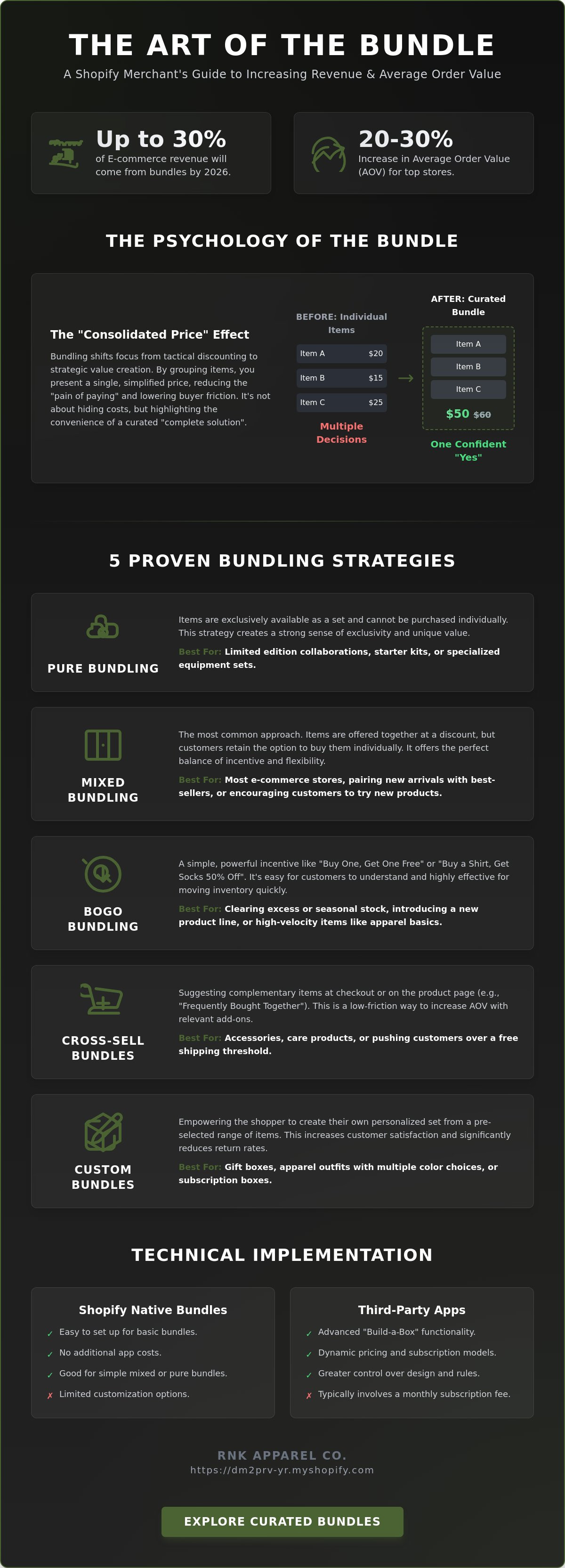
Did you know that up to 30% of e-commerce revenue in 2026 now comes from bundled products? If you're tired of high shipping costs eating into small individual orders, it's time to rethink your product bundling strategies for shopify. Most merchants treat bundling as a simple discount tool, but it's actually a curation strategy designed to solve your customer's complete setup problem.
You likely already know that getting a customer to the checkout page is only half the battle. This guide will help you master the art of bundling to increase your average order value by the 20-30% range seen by top-performing stores this year. We'll explore data-driven methods to protect your margins, clear out excess inventory, and communicate clear value to every shopper. From mix-and-match offers to staying compliant with the latest Michigan consumer protection laws, you'll get a complete roadmap to higher lifetime value and faster inventory turnover.
Key Takeaways
- Understand the psychology of consolidated pricing and how grouping items into a single unit reduces buyer friction at checkout.
- Implement five distinct product bundling strategies for shopify to drive exclusivity through pure bundles or offer flexibility with mixed sets.
- Master the AOV formula and use price floor calculations to ensure every bundle remains profitable after accounting for shipping and overhead.
- Evaluate the differences between Shopify's native bundling features and advanced third-party apps for complex "Build-a-Box" or subscription models.
- Learn to market your bundles effectively by optimizing for local search intent and using targeted email sequences to upsell customers from single items to curated sets.
What is Product Bundling and Why Does it Work for Shopify Stores?
At its core, What is Product Bundling involves grouping multiple individual items into a single sellable unit. While it sounds simple, the strategy is a powerful psychological lever. When you implement effective product bundling strategies for shopify, you're moving away from tactical discounting and toward strategic value creation. Instead of just slashing prices to move old stock, you're curating a "complete solution" that makes sense for the shopper's lifestyle. Shopify's robust ecosystem makes it the ideal platform for this because you can quickly pivot between different bundle types based on real-time sales data.
The "Consolidated Price" effect is the primary driver of success here. It reduces buyer friction by presenting one price for a collection of goods rather than forcing the customer to evaluate the cost of four or five separate items. This single price point lowers the "pain of paying" and simplifies the mental math required to justify a purchase. Strategic bundling isn't about hiding the cost; it's about highlighting the convenience and the curated nature of the offer. It transforms a transaction from a series of small decisions into one confident "yes."
The Core Benefits for Michigan E-commerce Merchants
For store owners operating out of Detroit, Flint, or Grand Rapids, bundling serves as a critical tool for managing logistics. Shipping costs are a constant pressure on margins, especially when fulfilling small, individual orders. By encouraging customers to buy sets, you're effectively packing more value into a single box, which significantly reduces your shipping overhead per item. This is particularly useful for Michigan brands dealing with seasonal streetwear or outdoor gear. Bundling allows you to clear out seasonal inventory faster by pairing high-demand new arrivals with slower-moving accessories. Beyond the numbers, it also improves the unboxing experience. Receiving a thoughtfully curated set feels like a premium service, fostering better brand loyalty than a scattered box of loose parts.
Choice Overload: How Bundles Simplify the Buying Process
Modern shoppers often suffer from decision fatigue. When a beginner visits your store looking for a "complete setup," they might feel overwhelmed by the technical specifications of individual parts. Bundles act as an expert recommendation, guiding them toward products that are guaranteed to work together. This is especially true for gift shoppers during the holiday rush who want a high-value present without the stress of missing a necessary component. Mixed bundling, where products are sold together at a discount while remaining available for individual purchase, has become the industry standard for 2026 due to its balance of flexibility and incentive.
5 Proven Product Bundling Strategies for Shopify Stores
Moving from theory to execution requires selecting the right framework for your specific catalog. Not every bundle serves the same purpose. Some clear out old stock, while others highlight premium new arrivals. Research highlights that while bundling is effective, there is a catch: forcing customers into a bundle when they only want one component can backfire. This makes choosing the right 5 Proven Product Bundling Strategies essential for maintaining customer trust.
- Pure Bundling: These items are only available as a set. This creates a sense of exclusivity and is perfect for limited edition collaborations or specialized kits.
- Mixed Bundling: This is the most common approach. You sell items together at a discount, but customers can still buy them individually. It offers the best of both worlds for flexibility and value.
- Buy-One-Get-One (BOGO): Excellent for high-velocity inventory like basic tees or socks. It helps move units fast without requiring the customer to do complicated math.
- Cross-sell Bundles: These typically appear at the cart stage. Suggesting a small accessory for a 10% discount often pushes a customer over the free shipping threshold.
- Custom "Build Your Own" Bundles: This empowers the shopper. They choose the specific colors or styles they want, which increases the likelihood of satisfaction and reduces return rates.
Success with these product bundling strategies for shopify depends on your ability to match the offer to the buyer's intent. To see how these curated looks come together in a live environment, you can explore our curated collections for inspiration.
The "Complete the Look" Strategy for Streetwear
Streetwear brands thrive on visual cohesion. By pairing essential tees with cargo pants and matching accessories, you solve the "what do I wear with this?" problem for the customer. You can use Shopify tags to automate these suggestions on product pages, ensuring the recommendations are always relevant. For new customers in Fenton or Brighton, try creating "Starter Packs" that include three core basics at a slightly reduced price point. This introduces them to your brand's quality across multiple categories at once.
The "Pro-Kit" Strategy for Skateboard Hardware
Skateboarders often need multiple components at once, especially when building a fresh setup. A "Ready to Roll" bundle that includes a deck, trucks, wheels, and bearings simplifies a complex purchase. This strategy targets the "Gift for Skater" search intent perfectly. Use tiered pricing to guide the customer: a Basic kit for beginners, a Pro kit for intermediate riders, and an Elite hardware bundle for those wanting top-tier specifications. Implementing these product bundling strategies for shopify within your hardware category ensures that customers don't leave your site to find a missing component elsewhere.
Calculating the ROI: Using an Ecommerce Average Order Value Calculator
Understanding the math behind your store is the only way to ensure your growth is profitable. Average Order Value (AOV) is a straightforward calculation: Total Revenue divided by the Number of Orders. While this number is easy to find in your Shopify dashboard, it doesn't tell the whole story. To truly master product bundling strategies for shopify, you must look at the unit economics of every bundle you create. This means setting a price floor that accounts for "pick and pack" fees, packaging costs, and increased shipping weights.
Protecting your margins is often counterintuitive. You might worry that offering a 10% discount on a bundle will hurt your bottom line. However, shipping one box containing three items is significantly cheaper than shipping three separate boxes to different customers. By consolidating the shipping cost and the labor required to fulfill the order, that 10% discount often results in a higher net profit than three individual sales. This efficiency is why a Harvard Business School study on bundling emphasizes that mixed bundling strategies often lead to the highest revenue outcomes for retailers.
Key Metrics to Track Before and After Bundling
Top-line revenue is a vanity metric if your margins are shrinking. You should specifically monitor your "Bundle Attachment Rate," which measures what percentage of your total orders contain a bundle. High attachment rates indicate that your curation resonates with your audience. More importantly, track your Gross Margin per Order. Because fixed costs like customer acquisition and base shipping fees are spread across more items, an AOV increase of just 15% can sometimes double your net profit per transaction. This happens because the additional revenue from the bundle has a much higher contribution margin than the initial "hook" product.
Setting Your Bundle Pricing Strategy
When deciding how much to discount, use the "Rule of 100." If a bundle price is under $100, a percentage discount (like 15% off) usually sounds more appealing to the customer. If the price is over $100, a flat dollar amount (like $25 off) often carries more psychological weight. You can easily implement this by using "Compare at Prices" on Shopify to visually highlight the savings. Don't be afraid to test different thresholds. You might find that customers in Grand Rapids respond better to free shipping bundles, while shoppers in Detroit prefer a deep percentage discount on high-velocity streetwear sets. Data-driven testing ensures your product bundling strategies for shopify remain optimized for your specific demographic.
Technical Implementation: Shopify Native Bundles vs. Third-Party Apps
Selecting the right tools to power your product bundling strategies for shopify is just as important as the strategy itself. By mid-2026, the divide between native features and third-party apps has shifted. You're no longer forced to buy an expensive app for basic grouping. Instead, the decision depends on your inventory complexity and how much control you want over the customer experience. Using the right product bundling strategies for shopify ensures that whether you're on the Shopify Basic plan at $39 per month or the Advanced plan at $399 per month, your technical setup supports your growth without adding unnecessary overhead.
Shopify Native Bundles: Pros and Cons
The Shopify Bundles app is a great starting point for small boutiques in Fenton or Brighton. Its primary benefit is that it uses your existing inventory data. When a bundle sells, the stock for each component updates instantly. This prevents the nightmare of overselling a specific item that's part of three different sets. However, native bundles have limitations. They don't support complex logic or "Build-a-Box" features. If your streetwear brand has dozens of color and size variants for a single hoodie, you might hit the variant limit quickly. It's a clean, SEO-friendly solution, but it lacks the "smart" features of high-end alternatives.
Third-Party App Features for High-Growth Stores
High-growth stores with complex hardware SKUs often require the advanced features found in third-party apps like Simple Bundles or Fast Bundle. These apps allow for advanced inventory mapping. This is essential when a single "Pro-Kit" sale needs to deduct a deck, trucks, and bearings from different warehouse locations. They also offer AI-driven "Frequently Bought Together" recommendations that can dynamically suggest bundles based on a shopper's cart contents. For brands offering subscription-based bundling for recurring streetwear drops, these apps are currently the only way to manage recurring billing and inventory sync simultaneously.
If you operate a physical storefront in Detroit or Grand Rapids, consider how these tools work with Shopify POS. Native bundles usually sync perfectly, allowing your staff to sell a "Complete Setup" with one tap. This keeps your data consistent across all sales channels. To see how a professional setup looks on the front end, you can check out our latest product sets to see these technical strategies in action. Managing your tech stack correctly ensures you don't lose the 20-30% AOV gains that successful bundling provides.
Marketing Your Bundles: Reaching Michigan Customers
Creating a high-value set is only the first step. To see a real return on your investment, you must actively market your product bundling strategies for shopify to the right audience. In 2026, general advertisements are often ignored by savvy shoppers. You need a targeted mix of local search optimization, community-focused social proof, and highly specific email sequences. If you've already calculated your price floors and set up your technical inventory sync as discussed previously, your focus should now shift to communicating that curated value to local shoppers who prioritize convenience and expertise.
Local SEO Strategies for Bundled Products
For merchants with deep roots in the Great Lakes State, local search intent is a goldmine. When you optimize a bundle product page, don't just use generic terms. Include city names like Flint or Grand Rapids in your
Take Control of Your Store's Growth
You've seen how moving from individual sales to curated sets can transform your unit economics. By mastering the right product bundling strategies for shopify, you're not just increasing your average order value; you're providing a better shopping experience. The shift from tactical discounting to strategic curation allows you to solve customer problems while protecting your bottom line. Whether you utilize native Shopify tools or advanced third-party apps, the key is to base every decision on your store's unique sales data and inventory needs.
Implementing these precision tactics requires a balance of technical expertise and creative marketing. If you want to scale effectively, we provide Shopify-certified expertise and dedicated local Michigan support for businesses in Detroit and Grand Rapids. Our data-driven ROI focus ensures that your bundling efforts lead to real, measurable growth. Optimize your Shopify store with expert bundling strategies today. It's time to stop leaving revenue on the table and start building a more profitable e-commerce future.
Frequently Asked Questions
Do product bundles work for every Shopify store?
Yes, they work for almost any store that has complementary items or multiple units of the same product. Even niche brands can benefit from volume discounts or "frequently bought together" sets. The key is choosing product bundling strategies for shopify that match your customer's buying habits. If your items solve a collective problem, a bundle will likely improve your conversion rates and AOV.
How do I handle returns for items purchased in a bundle?
You must define your policy clearly to avoid confusion. Many stores use pro-rated refunds where the discount is spread across all items in the set. Alternatively, you can require a return of the complete bundle to receive any refund. This prevents shoppers from buying a bundle just to get a discount on a single item and returning the rest immediately.
Will bundling products mess up my Shopify inventory counts?
Your inventory remains accurate as long as your bundle is mapped to individual SKUs. Whether you use the native Shopify Bundles app or a third-party solution, the system tracks the components. When a customer buys a curated set, the stock level for each specific part drops automatically. This ensures you never oversell a deck or a pair of trucks that belongs to a larger kit.
Can I offer a bundle discount and a separate discount code together?
Shopify allows you to configure whether discounts can be stacked. You can set your bundle to be "combinable" with other order or shipping discounts in the admin settings. However, you should be careful with this. Allowing a 20% bundle discount plus a 15% welcome code can quickly eat into your profit margins and lead to unsustainable sales.
How many products should be included in an ideal Shopify bundle?
The most effective bundles typically contain two to four items. This range provides enough variety to feel like a significant value-add without overwhelming the shopper. If you add too many products, the total price might exceed the customer's impulse-buy threshold. Focus on creating a "Complete Look" or an "Essentials Kit" that feels curated and necessary for the buyer's success.
What is the best way to promote bundles on my homepage?
Visual storytelling is the most effective way to promote sets on your homepage. Use a dedicated "Bundle & Save" section with lifestyle photography that shows all items in use. Highlighting the total savings compared to individual prices right on the banner helps drive urgency. It's also helpful to place these offers near your best-selling individual products to capture interested shoppers.
Is an ecommerce average order value calculator necessary for small stores?
Yes, it is vital for understanding your unit economics. Even if you're only processing a few orders a week, you need to know if your product bundling strategies for shopify are actually increasing profit. A calculator helps you set a price floor that covers your shipping and labor. Without it, you're just guessing whether your bundles are helping or hurting your bottom line.
Disclaimer
Some content published on this website may be developed with the assistance of AI-powered research and writing tools to help streamline research, organization, and content creation. All articles are reviewed, edited, and approved by Marvin Growth Partners to ensure they align with our perspectives, experience, and intended messaging.
While we strive to provide accurate and up-to-date information, blog content is intended for informational and educational purposes only and should not be considered legal, financial, or professional advice. Readers should independently verify information and consult qualified professionals when appropriate.