

Shopify Product Page Design Best Practices: The 2026 Michigan Guide
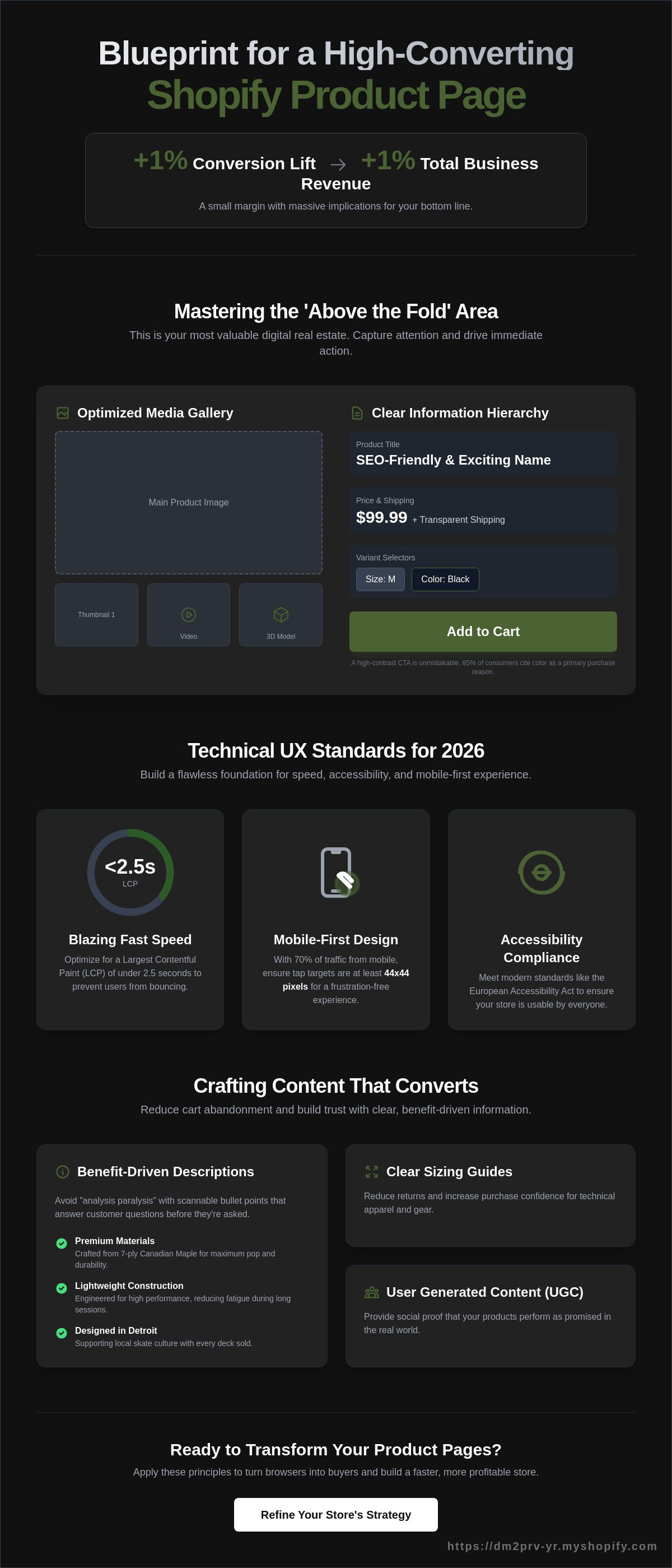
Did you know that a mere 1% conversion lift on a single product page can result in a 1% revenue increase for your entire business? It's a small margin with massive implications for your bottom line. To capture that growth, mastering shopify product page design best practices is no longer optional. It's the foundation of a successful online store. Whether you're shipping from Detroit or Grand Rapids, your digital storefront needs to work harder than ever to turn browsers into buyers.
You likely know the frustration of watching potential customers bounce because your mobile site feels sluggish or your high-quality images take too long to load on Michigan mobile networks. It's difficult to balance a professional look with the performance required for modern commerce. This guide will show you how to transform your Shopify product pages into high-converting sales machines using 2026 design standards and local expertise.
We will explore the latest Online Store 2.0 features, dive into mobile-first optimization for 44x44 pixel tap targets, and ensure your site meets the latest European Accessibility Act standards. From leveraging Shopify Magic's AI tools to optimizing for a Largest Contentful Paint of under 2.5 seconds, you're about to get a clear roadmap for a faster, more profitable store.
Key Takeaways
- Discover how to strategically arrange elements above the fold to capture customer attention and drive immediate action.
- Master shopify product page design best practices by integrating immersive 3D models and video to bridge the gap between digital and physical shopping.
- Reduce cart abandonment and returns by utilizing bulleted benefit lists and clear sizing guides for technical products like skate gear.
- Ensure your store performs flawlessly on Michigan mobile networks with a relentless focus on page load speeds and 2026 accessibility standards.
- Learn to evaluate when a premium Shopify theme is sufficient and when a custom Liquid build is necessary to scale your unique brand vision.
Mastering the Information Hierarchy for Shopify Product Pages
Successful shopify product page design best practices begin with a clear understanding of information hierarchy. Think of your product page as a blueprint. It's the strategic arrangement of text, media, and interactive elements designed to guide a shopper toward a single goal: the purchase. When you're selling high-performance skate decks or premium streetwear, your layout must act like a digital sales assistant that answers questions before they're even asked.
The "Above the Fold" area remains your most valuable digital real estate. With over 70% of e-commerce traffic now originating from mobile devices, you have only seconds to prove your value. If a customer has to scroll past three large images just to see the price, they're likely to bounce. High-intent shoppers in Detroit expect immediate transparency. Displaying clear pricing and shipping expectations right at the top builds instant trust and satisfies local expectations for straightforward business dealings.
Reducing cognitive load is essential for conversion. When a customer browses complex items like technical skate shoes, they shouldn't feel overwhelmed by a wall of text. By applying fundamental conversion rate optimization principles, you can structure your data so the most important facts stand out first. This approach prevents "analysis paralysis" and keeps the momentum moving toward the checkout.
Your "Add to Cart" button needs to be the star of the show. Color choice is a heavy hitter here. Since 85% of consumers state that color is the primary reason for their purchasing decisions, your CTA button should use a high-contrast shade that pops against your background. It's not just about aesthetics; it's about making the next step in the journey unmistakable.
The Core Elements of an Effective PDP
Every high-converting page relies on four pillars: the Title, Price, Description, and Media Gallery. For Michigan boutique brands, titles should be SEO-friendly but descriptive enough to excite streetwear enthusiasts. Using the latest Shopify Dawn 15.4.1 theme blocks allows you to place variant selectors for size and color directly beneath the price. This modular approach ensures that skaters can quickly check if their size is in stock without hunting through a cluttered sidebar.
Establishing Trust Through Visual Hierarchy
Typography does more than just display words; it guides the eye. Use bold, larger fonts for product names and slightly smaller, clean weights for secondary details. In a crowded market, white space is your friend. It prevents visual clutter and allows your photography to breathe. For long-form pages, implementing a "sticky" add-to-cart button ensures the option to buy is always visible, even as the user scrolls through detailed technical specs or brand stories. This keeps the path to purchase open at every stage of the scroll.
Optimising Visual Media for Maximum Impact and Engagement
Visual media is the heartbeat of your store. While the information hierarchy we discussed earlier provides the structure, your imagery provides the soul. For high-end skate brands, professional photography isn't a luxury; it's a baseline requirement. Grainy or poorly lit photos suggest a lack of quality that can instantly alienate a discerning customer. To build real connection, you should include lifestyle images that showcase your gear in its natural habitat, such as the concrete landscapes of Detroit’s skateparks.
While some industry guides suggest massive 2000px widths for zoom functionality, they often ignore the performance impact on Michigan mobile users. You must balance high-resolution clarity with Shopify’s native image compression to ensure your pages don't lag. Research from the Nielsen Norman Group on ecommerce product page guidelines highlights that shoppers need to see a product from multiple perspectives to feel confident in their purchase. This confidence is further bolstered by User Generated Content (UGC), which provides social proof that your products perform as promised in the real world.
If you want to refine your store's visual strategy, focusing on the technical execution of your media gallery is the first step. High-quality visuals bridge the gap between the digital screen and the physical product.
High-Resolution Imagery and Video Best Practices
Effective shopify product page design best practices now include 360-degree views for technical hardware. This allows a skater to inspect the geometry of skateboard trucks or the concave of a deck from every angle. Video loops are equally vital for apparel. A five-second clip showing the "drape" of skate cargo pants provides more information than five static photos ever could. Don't forget to optimize your alt-text for every piece of media; it's a critical component for both accessibility and Shopify SEO.
Leveraging 3D Models and Augmented Reality
By 2026, 3D models have become the gold standard for technical gear. Shopify’s built-in support for AR allows customers to virtually "place" a skateboard in their room to check the size and graphics before hitting the checkout button. This immersive experience is a core part of modern shopify product page design best practices because it reduces the "uncertainty gap" that leads to returns. Implementing these models requires clean 3D assets, but the payoff in engagement and conversion is substantial for brands aiming for a premium market position.
Crafting High-Converting Descriptions and Trust Signals
Once you've established a solid layout and high-quality media gallery, your written content must seal the deal. Effective shopify product page design best practices rely on copy that speaks directly to the customer's needs while removing any lingering doubts. For technical products like skate shoes, a hybrid approach to formatting works best. Use bulleted lists to highlight essential benefits like impact protection or reinforced stitching, then follow with a short paragraph that captures the brand's lifestyle and energy. This structure allows scanners to find facts quickly while still engaging those who want to read the full story.
Trust is built through transparency and precision. Including detailed size guides is non-negotiable for brands like Vans or Dr. Martens, where fit can vary significantly between models. A well-placed size chart reduces purchase anxiety and slashes your return rates. In Michigan, local trust signals carry immense weight. Mentioning "Fast Shipping to Grand Rapids" or "Same-Day Dispatch for Metro Detroit" creates a sense of proximity and reliability that national retailers often struggle to match. These small details transform a generic store into a community-focused business.
Social proof should live where the eyes go first. Integrating star ratings and review counts directly beneath the product title provides immediate validation. When a shopper sees that dozens of others have successfully used a deck or a pair of wheels, the perceived risk of the transaction drops. Clear return policies should also be visible near the "Add to Cart" button. If a customer knows they can easily swap a size if it doesn't fit, they're far more likely to complete the checkout.
Writing Copy That Sells to the Skate Community
Selling to skaters in cities like Flint and Fenton requires a brand voice that feels authentic rather than corporate. You must balance technical specifications like maple wood grades and bearing ABEC ratings with the emotional benefits of a smoother ride or better pop. Authenticity is everything in streetwear culture. For example, Independent Trucks require specific technical copywriting because seasoned skaters look for precise details like axle width and hanger height to ensure compatibility with their deck setup. If you miss these details, you lose the customer's confidence.
Integrating Social Proof and Trust Badges
The best reviews aren't just text; they're stories. Encourage your customers to upload photos of their gear in action. Seeing a new set of wheels on a local Michigan sidewalk builds more trust than any studio shot ever could. Use trust badges like "Secure Checkout" or "Michigan-Owned" to reinforce safety, but keep them subtle to avoid a spammy appearance. Logistics are also a powerful trust-building factor, so highlighting fast shipping skateboard canada options can reassure international buyers that your fulfillment process is professional and efficient.
Technical UX Standards: Speed, Accessibility, and Mobile-First Design
Technical performance is the invisible engine of your store. You can have the most beautiful deck graphics and the sharpest streetwear photography, but if your page takes five seconds to load on a mobile network at a Brighton-area skatepark, you've already lost the sale. Speed is revenue. In the world of shopify product page design best practices, technical optimization is just as important as visual appeal. High-intent shoppers are often browsing on the go; they expect a frictionless experience that respects their time and their data plans.
Accessibility is no longer a "nice to have" feature; it's a legal and ethical requirement. As of June 2026, e-commerce stores must adhere to the Web Content Accessibility Guidelines (WCAG) 2.1 Level AA to remain compliant with the European Accessibility Act. This includes ensuring your site is navigable via screen readers and that your color contrast ratios are high enough for all users to read. Beyond compliance, accessible design simply makes your store better for everyone. It broadens your reach and demonstrates that your brand values every member of the community.
Code bloat is a common silent killer for Shopify stores. Every app you install adds a layer of Liquid code or JavaScript that can slow down your Largest Contentful Paint (LCP). You should regularly audit your theme to remove "ghost" code from uninstalled apps and ensure you're using "Lazy Loading" for images and videos below the fold. This ensures that only the content the user is currently seeing is loaded immediately, which significantly improves perceived performance. If your store feels sluggish, it's time to optimize your Shopify performance to reclaim those lost conversions.
The Mobile-First Design Checklist
Mobile-first design means building for the thumb, not just the eye. Your "Add to Cart" button and variant selectors must have a minimum tap target of 44x44 pixels to prevent "fat-finger" errors. Navigation menus should be simplified for one-handed use; keeping essential links within easy reach of the bottom of the screen. Always test your checkout flow on local Michigan mobile networks rather than just office Wi-Fi. This real-world testing ensures that your customers in Brighton or Howell can complete a purchase without the session timing out due to heavy assets.
Optimizing for Speed and Core Web Vitals
Shopify’s Online Store Speed report is your best friend for identifying bottlenecks. Aim for an LCP of under 2.5 seconds to keep your bounce rates low. You can achieve this by minifying your CSS and JS files, which strips out unnecessary characters without breaking your custom features. Pay close attention to your Cumulative Layout Shift (CLS); nothing frustrates a user more than a button moving just as they are about to click it. Keeping your design stable as it loads is a hallmark of professional shopify product page design best practices.
Implementing Your Design Strategy with Professional Shopify Support
Implementing these shopify product page design best practices requires a clear choice between off-the-shelf solutions and bespoke development. For many boutique shops, a premium Online Store 2.0 theme provides enough flexibility to build a professional storefront. However, as you scale toward a national presence, you might find that "out-of-the-box" features limit your vision. That's when custom Liquid builds become necessary. They allow you to strip away the excess and create a lean, high-performance experience that a standard theme just can't match.
A/B testing is your secret weapon for long-term growth. Don't guess what your customers want; let the data tell you. Try testing a "Michigan-Made" badge against a "Free Local Pickup" banner to see which resonates more with your Detroit or Grand Rapids audience. Even small changes to your information hierarchy or media placement can result in significant conversion lifts. By systematically testing these elements, you ensure your design strategy remains agile and effective in an ever-changing market.
Choosing the Right Shopify Apps for Design
Apps are great for adding functionality, but they're a double-edged sword. To maintain the speed standards we discussed in the previous section, you must be selective. Use apps like Judge.me or Loox to integrate social proof seamlessly without bogging down your code. If you need advanced product options or custom bundles for your gear, look for apps that are known for clean integration. App fatigue is real; every unnecessary plugin increases your page load time and risks breaking your mobile UX. If an app isn't directly contributing to your conversion rate, it's probably time to cut it loose.
The Value of Local Michigan E-commerce Expertise
Working with a local expert provides a perspective that a global agency might miss. A Detroit-based designer understands the regional marketing nuances and the specific shipping logistics that matter to your neighbors. Whether you're scaling a small shop in Flint or aiming to become a national powerhouse, having a partner who knows the local landscape makes a difference. They can help you navigate the transition from a community favorite to a digital leader while keeping your brand's soul intact. Ready to upgrade? Visit our Shopify store for inspiration or to see these design principles in action with our latest gear.
Your product page is never truly "finished." It's a living part of your business that requires constant refinement. Take the time today to audit your current store using these 2026 shopify product page design best practices. Look at your mobile speed, check your accessibility compliance, and ensure your trust signals are clear. By staying proactive and focusing on the user experience, you'll build a store that doesn't just look professional, it drives results.
Future-Proof Your Shopify Strategy
Building a digital storefront that converts requires more than just a sleek template. By mastering shopify product page design best practices, you've learned to prioritize information hierarchy, leverage immersive 3D media, and optimize for the mobile-first reality of 2026. These technical and creative improvements don't just lower your bounce rates; they build lasting trust with your customers by proving you value their time and their shopping experience.
Whether you're fine-tuning your accessibility standards or refining your local trust signals, the goal is always a frictionless path to purchase. If you're looking for inspiration or need to refresh your own setup, we're here to help. Upgrade your skate gear at our Michigan-based Shopify store to see these principles in action. We offer local Michigan support and fast shipping to Detroit and Grand Rapids, alongside a curated selection of Volcom and Vans.
The e-commerce landscape moves fast, but with a solid foundation and a focus on user experience, your store is ready to lead the way. It's time to take these insights and turn them into your brand's next major growth milestone.
Frequently Asked Questions
How do I improve my Shopify product page speed in 2026?
Improving speed starts with auditing your theme for app bloat and optimizing your Liquid code. You should aim for a Largest Contentful Paint (LCP) of under 2.5 seconds by using lazy loading for images below the fold and minifying your CSS. Reducing the number of external scripts is a core part of shopify product page design best practices to ensure your store remains fast on mobile networks.
What is the best image size for Shopify product pages to ensure zoom works?
The best size for high-quality zoom functionality is 2048 x 2048 pixels. This resolution provides enough detail for customers to inspect textures and materials without creating excessively large file sizes. You should always use Shopify’s native image compression or a third-party app to ensure these high-resolution images don't negatively impact your page load times for mobile shoppers.
How do I add customer reviews to my Shopify product page?
You can add reviews by installing a dedicated Shopify app like Judge.me or Loox and using the Online Store 2.0 theme editor. These apps allow you to drag and drop a "Reviews" block directly under your product title or description. Displaying social proof is one of the most effective shopify product page design best practices for building immediate trust with new visitors.
Can I use 3D models and video on a standard Shopify plan?
Yes, Shopify supports 3D models and video files on all standard plans through the native product media gallery. You can upload .glb or .usdz files for 3D objects and .mp4 or .mov files for video directly in the Shopify admin. These features are built into the platform's architecture, allowing you to provide an immersive experience without needing an expensive custom build.
Why is mobile-first design important for Michigan-based e-commerce stores?
Mobile-first design is critical because over 70% of e-commerce traffic now originates from mobile devices. Local shoppers in cities like Brighton or Ann Arbor are often browsing while on the move, requiring fast load times and touch-friendly buttons. If your site isn't optimized for a smaller screen, you risk losing customers who find the navigation difficult or the checkout process too slow.
How do I write product descriptions that improve my Shopify SEO?
Focus on writing unique, descriptive content that naturally incorporates your target keywords. Avoid using the default manufacturer descriptions, as duplicate content can hurt your search rankings. Instead, describe the specific benefits and technical details of your gear, using headings and bullet points to make the information easy for both search engines and customers to read and understand.
What are trust badges and which ones should I use on my store?
Trust badges are small icons that reassure customers about the security and reliability of your business. For a Michigan-based shop, you should use badges like "Secure Checkout," "Michigan-Owned," or "Official Dealer." These signals are especially important for high-ticket items like premium skateboards, where customers need to know their payment data is safe and they're buying from a legitimate local source.
How can I make my Shopify product page accessible for all users?
Making your page accessible involves following WCAG 2.1 Level AA standards, which is now a legal requirement for many stores. You should add descriptive alt text to all images, ensure your text has a high color contrast against the background, and verify that all buttons can be navigated using a keyboard. These steps ensure that every customer, regardless of ability, can enjoy a seamless shopping experience.
Disclaimer
Some content published on this website may be developed with the assistance of AI-powered research and writing tools to help streamline research, organization, and content creation. All articles are reviewed, edited, and approved by Marvin Growth Partners to ensure they align with our perspectives, experience, and intended messaging.
While we strive to provide accurate and up-to-date information, blog content is intended for informational and educational purposes only and should not be considered legal, financial, or professional advice. Readers should independently verify information and consult qualified professionals when appropriate.