

Stage-Based Growth Strategy Guide for SMEs
Most small business owners hit a wall not because revenue stalls, but because cash runs out while revenue is climbing. That contradiction is more common than you’d think, and it’s exactly what a stage-based growth strategy guide is designed to solve. Known more formally as a phased growth framework, this approach matches your tactics, spending, and financing decisions to the specific stage your business is actually in, not the stage you wish you were in. This guide covers the cash conversion cycle, rolling forecasts, runway benchmarks, and the governance habits that keep growth from becoming a liquidity crisis.
Table of Contents
- Key Takeaways
- Your stage-based growth strategy guide starts here
- The cash conversion cycle and why it controls your growth speed
- Building a rolling 13-week cash flow forecast
- Cash runway benchmarks and financing by revenue stage
- Common growth mistakes and how to avoid them
- My take on growth strategy and cash discipline
- How Marvingrowthpartners can support your growth
- FAQ
Key Takeaways
| Point | Details |
|---|---|
| Match strategy to your stage | Applying the wrong growth playbook creates inefficiency, chaos, or missed opportunity depending on your business growth stage. |
| CCC is your cash timing signal | The cash conversion cycle reveals how long cash is tied up and directly shapes how much runway you actually have. |
| 13-week forecasts beat annual plans | A rolling weekly forecast gives you real liquidity visibility that accrual accounting and annual budgets simply cannot provide. |
| Runway targets vary by revenue size | Sub-$1M businesses need 12+ months of runway; $25M+ companies can operate on 4 to 6 months plus a credit facility. |
| Scenario planning prevents surprises | A growth plan without base, upside, and downside scenarios is a plan built on hope rather than data. |
Your stage-based growth strategy guide starts here
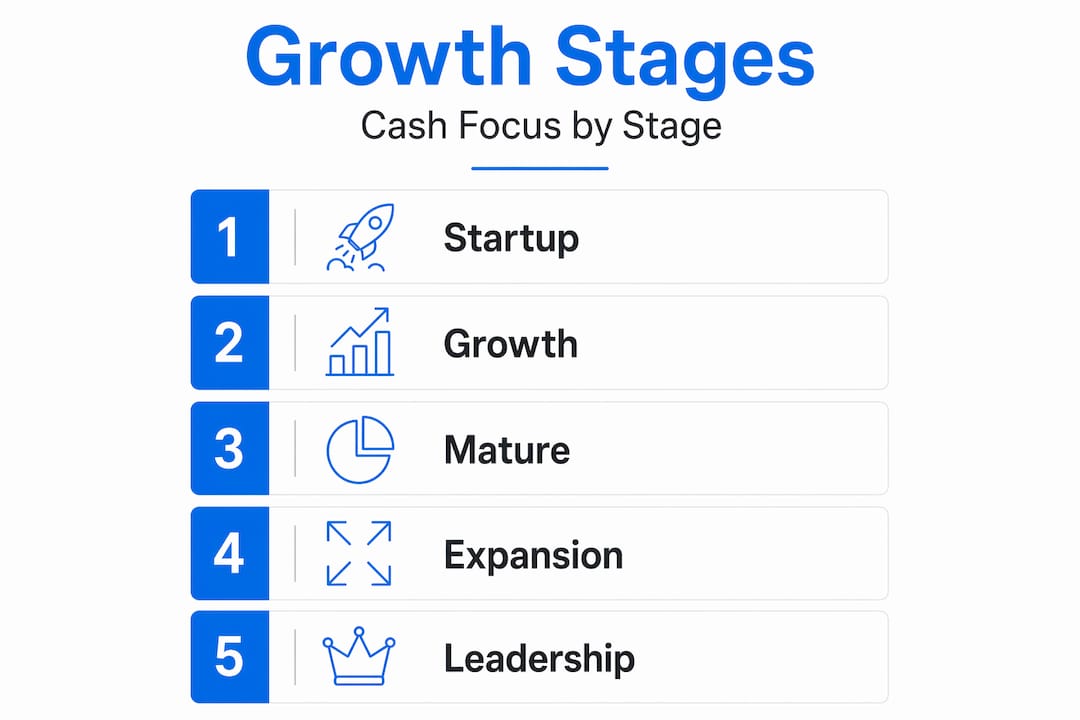
Before you can apply the right growth strategy framework, you need to know which stage you’re actually in. Most SMEs cycle through five recognizable phases: Startup, Growth, Expansion, Maturity, and Renewal or Decline. Each one demands a completely different set of priorities, and confusing them is one of the most expensive mistakes a business owner can make.
| Stage | Primary Focus | Key Cash Flow Risk |
|---|---|---|
| Startup | Customer acquisition and product fit | Burn rate exceeds early revenue |
| Growth | Scaling operations and team | Working capital consumed by volume increases |
| Expansion | New markets or product lines | Capex and implementation costs precede inflows |
| Maturity | Efficiency and margin improvement | Complacency erodes competitive positioning |
| Renewal/Decline | Innovation or strategic pivot | Misallocated spend on the wrong bets |
The wrong growth playbook by stage is the most common scaling error businesses make. Early-stage companies that start building enterprise-level processes before they have product-market fit waste months on structure they don’t need. Post-startup companies that cling to scrappy startup methods when they need systems and delegation create a different kind of chaos.
Here’s what each stage actually demands from a cash perspective:
- Startup: Keep burn tight, extend runway, and validate before scaling spend.
- Growth: Hire slightly ahead of demand but model the cash timing of each hire.
- Expansion: Treat capex and market entry costs as financing events, not operating expenses.
- Maturity: Shift focus from top-line growth to free cash flow margin and working capital efficiency.
- Renewal: Protect core cash generation while funding experiments with defined budgets and kill criteria.
Stage-wise business development only works when you’re honest about where you actually are, not where your pitch deck says you should be.
The cash conversion cycle and why it controls your growth speed
The cash conversion cycle, or CCC, is the single most underused financial tool in small business management. It measures exactly how many days cash is tied up between paying your suppliers and collecting from your customers. The formula is straightforward: CCC = DIO + DSO minus DPO, where DIO is days inventory outstanding, DSO is days sales outstanding, and DPO is days payable outstanding.

What this number tells you is how long your business is effectively financing its own operations before cash comes back in. A CCC of 60 days means you’re funding 60 days of operations out of pocket before a single dollar of revenue hits your bank account. When you’re scaling, that number multiplies fast.
Here’s a concrete example. Say your CCC is 45 days and you’re growing revenue 30% month over month. Every new dollar of revenue you generate requires 45 days of cash to support it before it returns. At scale, this creates a working capital drag that can make a profitable business look insolvent on its bank statement.
Pro Tip: Treating changes in DSO, DIO, and DPO as governance tools, not just accounting metrics, gives you real levers to manage working capital during growth phases.
The practical levers are worth knowing. Shortening DSO means tightening payment terms or incentivizing early payment. Reducing DIO means improving inventory turns or shifting to just-in-time purchasing where possible. Extending DPO means negotiating longer payment windows with suppliers without damaging those relationships. Each lever you pull frees cash that can fund the next growth move without requiring outside financing.
Building a rolling 13-week cash flow forecast
Annual budgets tell you where you planned to be. A rolling 13-week cash flow forecast tells you where you’re actually going. This is the operational backbone of any credible strategic growth plan, and it’s the tool that separates businesses that survive growth from those that get surprised by it.
Here’s how to build and maintain one:
- Start with your AR collections timing. Don’t use revenue recognition dates. Use the actual dates cash historically hits your account based on your payment terms and customer behavior.
- Map your AP payment timing. List every vendor payment, when it’s due, and whether there’s any flexibility. Most businesses have more negotiating room here than they use.
- Lock in fixed commitments. Payroll, rent, loan payments, and subscriptions go in first. These are non-negotiable and set your floor.
- Include tax payments and irregular items. Quarterly estimated taxes, annual insurance premiums, and seasonal inventory builds are the items that blindside businesses most often.
- Update the forecast every single week. Compare actual cash flows to your prior week’s forecast, identify variances, and adjust your assumptions accordingly.
Weekly updates with variance analysis refine accuracy to within 5 to 10% after several cycles. That level of precision is what lets you make confident decisions about hiring timing, marketing spend increases, and when to draw on a credit line.
Pro Tip: Skipping weekly updates leads to confident but inaccurate forecasts. A forecast that hasn’t been updated in three weeks is worse than no forecast because it creates false confidence.
The forecast also becomes your most powerful communication tool with lenders, investors, and your leadership team. When you can show a 13-week cash position with variance analysis attached, you’re demonstrating the kind of financial discipline that earns trust and better financing terms.
Cash runway benchmarks and financing by revenue stage
Not every business needs the same amount of runway. The right target depends on your revenue size, gross margin, working capital cycle, and access to credit. Here’s how the benchmarks break down in practice:
| Revenue Stage | Runway Target | Key Consideration |
|---|---|---|
| Sub-$1M | 12+ months | Limited credit access; high volatility |
| $1M to $5M | 9 to 12 months | Working capital cycles becoming meaningful |
| $5M to $25M | 6 to 9 months | Credit facilities available; CCC management critical |
| $25M+ | 4 to 6 months plus credit | Predictable cash flows; revolving credit as buffer |
Below 3 months of runway signals danger and requires urgent action regardless of revenue stage. That’s the threshold where growth decisions become survival decisions.
When it comes to financing, timing matters more than amount. The most common mistake is waiting until cash is tight to seek financing. By then, your negotiating position is weak and your options are limited. The right approach is to size and time financing around your forecasted cash low point, not your average balance.
Financing amounts and timing should be sized around the minimum forecasted cash balance plus a buffer. If your 13-week forecast shows a cash low point of $80,000 in week nine and you want a $50,000 buffer, you need financing in place before week nine, not after.
Here’s a quick framework for matching financing type to stage:
- Bootstrap: Works at Startup stage when burn is low and validation is the priority.
- Revolving credit line: Best for Growth and Expansion stages to smooth working capital timing gaps.
- Term debt: Appropriate for Expansion stage capex with predictable repayment from incremental cash flows.
- Equity: Consider only when the return on invested capital clearly exceeds the cost of dilution.
Common growth mistakes and how to avoid them
Growth can appear profitable on a P&L yet destroy cash liquidity because working capital, capex, and implementation spend almost always precede cash inflows. This is the trap that catches businesses that manage by their income statement instead of their cash position.
Driver-based cash flow modeling is the fix. Instead of projecting revenue and assuming cash follows, you model the specific drivers: units sold, average collection days, headcount additions, and inventory builds. Each driver converts into a cash timing event, and the model shows you exactly when cash goes out and when it comes back.
“A growth plan without scenario modeling is just a hope plan; scenarios reveal funding needs under realistic uncertainties and prevent surprises.” (Scenario Planning in Growth Cash Flow Models)
Assigning distinct working capital assumptions per scenario prevents faulty cash flow modeling and supports real stress testing. Your base case uses historical DSO and DIO. Your downside case stretches them by 15 to 20%. Your upside case compresses them. The spread between those three scenarios tells you your actual financing risk.
Governance practices that prevent these mistakes include a weekly forecast review cadence, defined runway trigger alerts (for example, a rule that any forecast showing less than 90 days of runway triggers a financing review), and written decision criteria for major spend commitments. These aren’t bureaucratic exercises. They’re the habits that let you grow fast without losing control.
My take on growth strategy and cash discipline
I’ve watched businesses with genuinely great products and real revenue momentum run out of cash because they treated their P&L as a proxy for their bank account. It’s a painful thing to see, and it’s almost always preventable.
What I’ve found is that the businesses that grow sustainably share one habit: they plan backward from their cash low point. They ask, “When is our cash position at its worst, and what do we need in place before that moment?” That single question changes how they hire, when they launch, and how they structure financing. It’s the kind of thinking that stage-based growth planning is built on.
The rolling 13-week forecast is the tool I recommend most often, not because it’s complicated, but because it forces a weekly conversation about reality. When leadership reviews actual versus forecast cash every week, the quality of decisions improves fast. People stop making commitments based on revenue projections and start making them based on cash timing.
I also want to push back on the idea that one growth playbook fits all. I’ve seen early-stage companies copy the processes of $50M businesses and grind to a halt. I’ve seen mature businesses cling to startup-style decision-making and create organizational chaos. Stage discipline isn’t limiting. It’s what lets you move fast with confidence.
The businesses that get this right treat their growth stage as a constraint that shapes every decision, not a label they put on a slide deck.
— Eric
How Marvingrowthpartners can support your growth
If this guide has you thinking about where your business actually sits on the growth curve, and whether your cash planning matches your ambitions, that’s exactly the conversation Marvingrowthpartners is built for.

Marvingrowthpartners specializes in aligning executive-level strategy with hands-on execution for SMEs that are serious about scaling without the cash surprises. That means building the rolling forecasts, designing the driver-based cash models, and developing the stage-specific playbooks that match where your business is today and where it’s going. Unlike generic consulting engagements, every engagement starts with your real numbers and your real constraints. You get a growth and cash flow system you can actually run, without needing to hire a full-time CFO to maintain it. Reach out through the Marvingrowthpartners about page to learn more about how the team works and what a tailored engagement looks like for your stage.
FAQ
What is a stage-based growth strategy?
A stage-based growth strategy is a phased growth approach that matches your tactics, spending, and financial planning to the specific development stage your business is in. It prevents the common mistake of applying the wrong playbook at the wrong time.
How does the cash conversion cycle affect growth?
The CCC measures how many days cash is tied up between paying suppliers and collecting from customers. A longer CCC means more working capital is consumed per dollar of growth, which directly limits how fast you can scale without outside financing.
How many months of cash runway should my business have?
Runway targets depend on your revenue size. Sub-$1M businesses need 12 or more months, while $25M+ businesses can operate on 4 to 6 months plus a credit facility. Below 3 months of runway at any stage signals an urgent problem.
Why use a 13-week rolling forecast instead of an annual budget?
A rolling 13-week forecast tracks actual cash timing, not accrual accounting. Updated weekly, it gives you a reliable liquidity picture that an annual budget simply cannot provide, especially during periods of rapid growth.
When should I seek outside financing for growth?
Seek financing before your cash low point, not after it. Size the financing around your minimum forecasted cash balance plus a buffer, and approach lenders when your position is strong, not when it’s already tight.