

The Role of Community Marketing for Local Business
Most local business owners treat marketing as a series of campaigns. Run an ad, see a bump, stop the ad, watch it fade. That cycle is expensive, and it builds nothing permanent. The role of community marketing for local business is something different entirely. It is about earning trust, showing up consistently, and turning your customers into the people who sell for you. This article breaks down what community marketing actually means in practice, which tactics drive real results, how to measure the impact, and how to avoid the pitfalls that kill most programs before they gain traction.
Table of Contents
- Key Takeaways
- The role of community marketing for local business growth
- Strategies that actually work for local engagement
- Measuring the business impact of your efforts
- Common pitfalls that stall community marketing programs
- My honest take on community marketing
- How Marvingrowthpartners can help you build it right
- FAQ
Key Takeaways
| Point | Details |
|---|---|
| Community marketing builds lasting trust | Consistent local engagement converts one-time buyers into loyal advocates who refer others. |
| Referrals create compounding returns | Referred customers generate significantly more secondary referrals, multiplying your program’s ROI. |
| Measurement requires CRM integration | Connecting community touchpoints to CRM data reveals true business impact beyond surface-level metrics. |
| Tactics must invite participation | Passive audiences stall growth. Design programs that require active involvement from customers. |
| Authenticity is non-negotiable | Token gestures and sporadic outreach damage trust faster than no outreach at all. |
The role of community marketing for local business growth
Community marketing is not a social media strategy with a local filter. It is a discipline with its own name in professional marketing circles: community-driven marketing. The term describes an ongoing practice of two-way engagement where the business participates in its local ecosystem rather than broadcasting at it. Community marketing earns trust through consistent presence and active listening, and that trust converts into advocacy, referrals, and repeat business.
Here is where local business owners often get confused. Social media marketing is a channel. Community-driven marketing is a relationship model that can operate through many channels at once, including in-person events, sponsorships, email, social platforms, and direct customer conversations. The channel is not the point. The relationship is.
Why does this matter practically? Because community marketing lowers customer acquisition cost by driving advocacy and lifecycle outcomes when tied to CRM data. When customers trust you and feel connected to your business, they stay longer and refer more people. That is a fundamentally more efficient growth engine than paid ads, especially for businesses operating in a defined geographic market.
The difference from general community building is scope and intent. You are not trying to create a Facebook group with a thousand members. You are building a structured marketing practice designed to produce measurable outcomes: higher retention, more referrals, greater organic visibility, and lower dependence on paid channels.
Pro Tip: Start by reviewing marketing fundamentals before building a community marketing program. Knowing the difference between customer acquisition and customer retention cost, for example, will shape every tactical decision you make.
Strategies that actually work for local engagement
Getting community marketing right requires more than posting on Instagram or sponsoring a Little League team once. Here are the approaches that produce compounding returns when executed with consistency.
-
Show up in local life on a schedule. Participate in recurring events, neighborhood markets, school fundraisers, and professional association meetings. The word recurring matters here. One appearance is a photo opportunity. Monthly presence over a year builds recognition and trust. Make a calendar commitment, not a casual intention.
-
Solicit and respond to every review. Reviews are public proof of your relationship with the community. Ask for them after every positive interaction. Respond to every one, positive or negative. Your responses are not just for the reviewer. They are visible to every potential customer reading that page. How you handle a complaint tells people more about your values than any ad you run.
-
Create serialized content that invites participation. A single blog post does nothing for community engagement. A weekly local spotlight series featuring customers, neighbors, or community organizations builds an audience that returns and shares. Design each piece so it creates a reason for someone to tag a friend or share with their network.
-
Build a referral program with timing built in. Generic “refer a friend” prompts are easy to ignore. Well-timed personalized referral prompts outperform generic calls-to-action by 20% or more. The most effective trigger is immediately after a great experience, not three weeks later in a bulk email. Automate the timing using your CRM or point-of-sale system.
-
Use digital tools to sustain what you cannot do manually. Automated review requests sent 24 hours after a purchase or service, loyalty program notifications, and community newsletter segments are not shortcuts. They are the infrastructure that makes a human-centered practice scalable without losing authenticity.
The role of social media in this mix is to amplify what is already happening in person, not to substitute for it. A photo from a community event shared by three customers reaches more people than a paid post, and it carries social proof that no budget can buy.
Pro Tip: When you ask for a referral, personalize the message to reflect the specific experience the customer just had. “You mentioned you loved the service today” converts far better than “Know anyone who needs us?”
Measuring the business impact of your efforts
Most local business owners stop measuring at sales. That is the wrong place to start and the wrong place to stop. Effective measurement for community-driven marketing tracks a layered set of outcomes.

| Metric category | What to track | Why it matters |
|---|---|---|
| Engagement | Event attendance, post interactions, survey responses | Signals community relationship depth |
| Advocacy | Referral rates, reviews per month, word-of-mouth leads | Measures organic growth engine strength |
| Retention | Repeat visit frequency, customer lifetime value | Shows loyalty built through community ties |
| Revenue influence | Pipeline touched by community activities within 90 days | Connects participation to business outcomes |
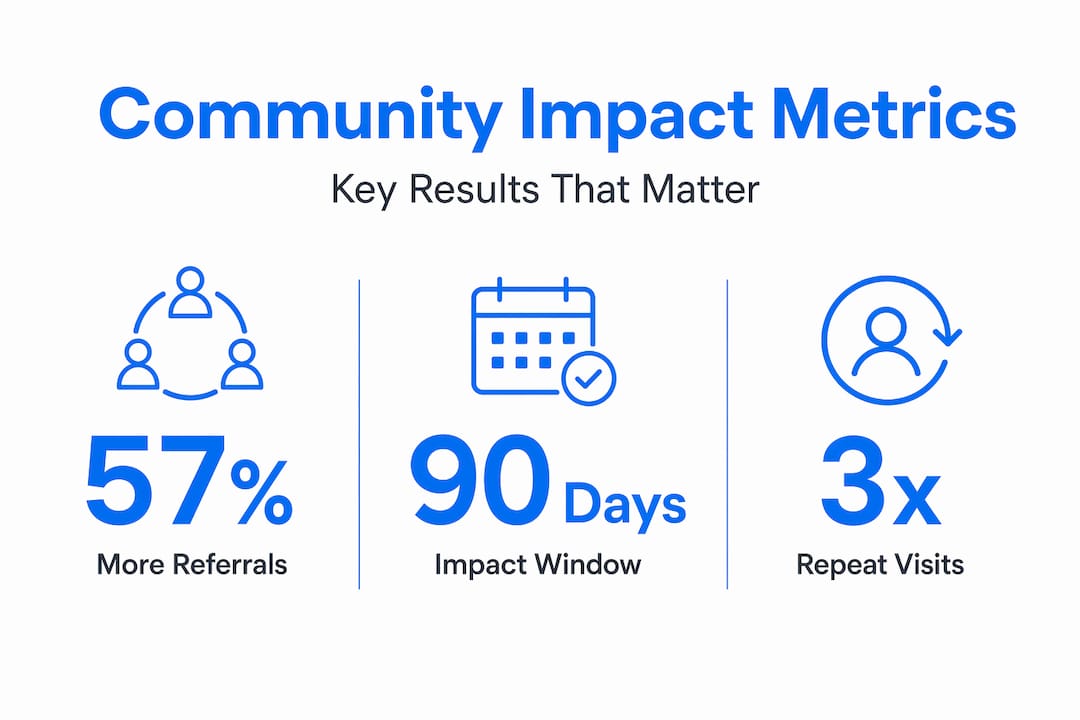
The 90-day window is not arbitrary. Tracking CRM engagement within 90 days of a community activation, like a sponsored event or a local partnership, is a proven method for measuring the revenue influence of sponsorships and event participation. It gives you a defined attribution period without letting every future purchase count as community-driven.
Referral measurement deserves special attention. Research shows referred customers generate 31 to 57 percent more referrals than customers acquired through other channels. If you are not tracking secondary referrals, you may be undervaluing your program’s true ROI by as much as 36%. That means programs that look marginally profitable on the surface are actually delivering significant returns once the full chain of referrals is counted.
The key operational step is connecting your community touchpoints to your CRM. When someone attends your event, checks in at your location, or comes in through a referral, that data point should live in your CRM and tag their customer record. Connecting community touchpoints to CRM is what separates businesses that scale their community programs from those that treat it as a cost center.
Common pitfalls that stall community marketing programs
Even well-intentioned programs fail. The patterns are predictable, and knowing them in advance saves months of wasted effort.
-
Token gestures without follow-through. Sponsoring one event and expecting loyalty from it is transactional thinking wearing a community marketing costume. The impact comes from repetition and relationship, not a single branded moment.
-
Building passive audiences. Without a repeatable engagement cadence, community programs drift into broadcast mode. You post, customers scroll past, and nothing builds. Design every campaign with a specific ask: leave a review, share this, attend this, refer someone. Passive audiences do not convert.
-
Ignoring the listening half of the conversation. As Dean Taylor, CEO and Founder of Contagion, put it, community marketing is a conversation, not a broadcast. If you are not responding to comments, reading feedback, and adjusting based on what your community tells you, you are performing community marketing without practicing it.
-
Scaling without staying local. As your program grows, there is a temptation to use generic content that applies everywhere. That is where local brands lose their edge. The specificity of your community is your competitive advantage. A national chain cannot credibly celebrate your city’s high school basketball team winning a championship. You can.
-
Keeping community data separate from your marketing systems. If your event attendance list lives in a spreadsheet and never touches your email platform or CRM, you cannot measure the impact or automate meaningful follow-up. Integration is not optional. It is the infrastructure that makes everything else measurable.
My honest take on community marketing
I have worked with local businesses across a wide range of industries, and the ones that grow with the least friction are almost always the ones that treat their community as a stakeholder rather than an audience. What I’ve seen consistently is that the business owners who resist community marketing do so because they want faster results. They want the ad to work now. I understand that pressure completely.
What I’ve also learned is that the businesses running ads without community trust are in a constant bidding war for attention. They pay more every year for the same number of customers. The businesses that have built genuine community relationships see a measurable lift in transactions tied directly to their loyalty and community engagement programs. That is not a soft benefit. That is competitive insulation.
My view is that digital tools are a multiplier, not a replacement, for real human engagement. The businesses I have seen fail at community marketing are the ones that automate everything and show up for nothing. The ones that succeed do both: they invest in genuine presence and use technology to scale the follow-up.
Patience is the hardest part to sell. Community trust takes six months to feel and twelve months to prove. But when it proves itself, it proves itself in customer lifetime value, referral rates, and a local reputation no paid campaign can manufacture.
— Eric
How Marvingrowthpartners can help you build it right
Community-driven marketing works. The gap for most local businesses is not motivation. It is a system. Marvingrowthpartners specializes in exactly this: aligning strategy with execution so that community engagement programs are measurable, repeatable, and tied to real business outcomes rather than good intentions. From CRM integration that connects your community touchpoints to revenue data, to referral program architecture, to local engagement campaign design, the team at Marvingrowthpartners builds the infrastructure behind the relationships. You bring the local knowledge. We bring the growth framework that makes it scale. If you are ready to stop relying on ad spend alone and start building something your competitors cannot copy, explore what a tailored strategy looks like for your market.
FAQ
What is community marketing for local businesses?
Community marketing is a relationship-based practice where local businesses build trust through consistent participation, two-way engagement, and advocacy programs rather than one-way advertising. It is designed to convert existing customers into active advocates who refer others and increase organic visibility.
How does community marketing differ from social media marketing?
Social media marketing is a channel. Community marketing is a relationship model that operates across multiple channels, including events, sponsorships, email, and social platforms, with the goal of sustained engagement and measurable advocacy rather than reach and impressions.
How do you measure the impact of community marketing?
Track a layered set of metrics: engagement rates, referral rates, review volume, repeat visit frequency, and CRM-attributed revenue within a defined window like 90 days after a community activation. Connecting community touchpoints to CRM data is what makes the impact visible and provable.
How long does community marketing take to show results?
Results typically begin to appear within three to six months of consistent execution. Programs tied to loyalty communication show measurable transaction lifts within 90 days, but the deeper compounding effects on referrals and retention build over 12 months or more.
What is the biggest mistake local businesses make with community marketing?
The most common mistake is inconsistency. Single-event sponsorships or sporadic posting signals transactional intent to the community, which erodes trust rather than building it. Sustainable community marketing requires a repeatable cadence, not periodic bursts of activity.