

The Ultimate Ecommerce Conversion Rate Optimization Checklist 2026
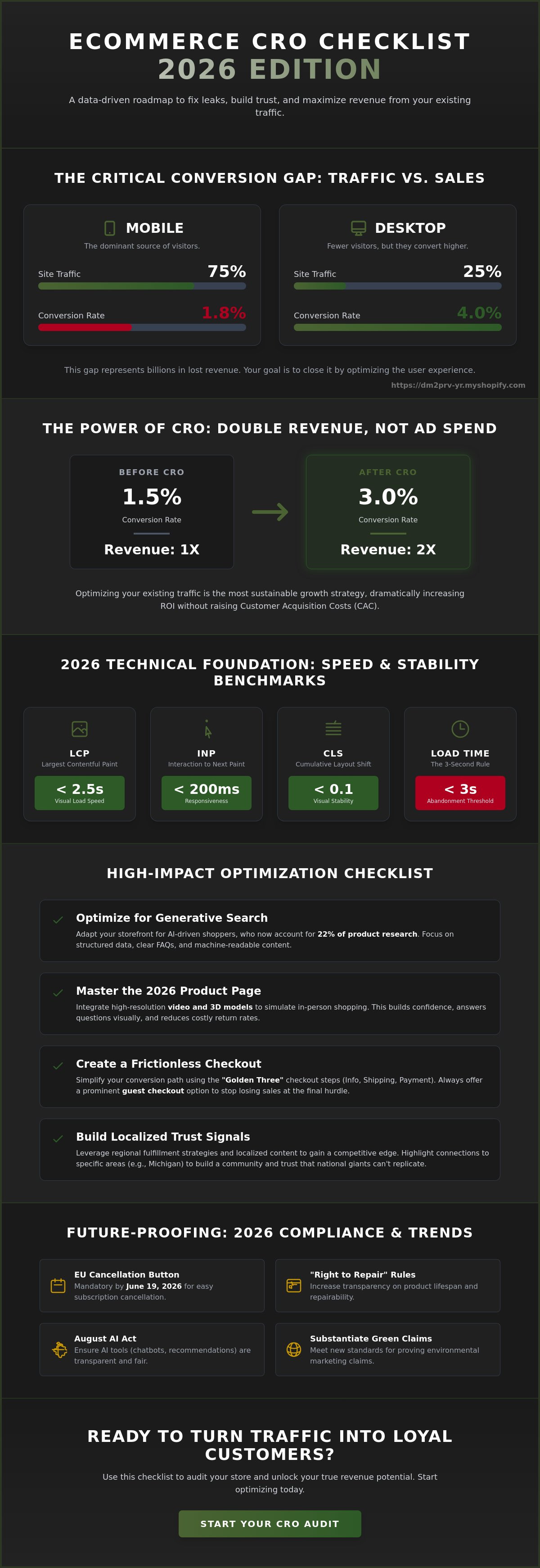
Did you know that while mobile devices drive up to 75% of your traffic, their conversion rates still lag at just 1.8% compared to 4% on desktop? It's a gap that costs online retailers billions, especially as the global average conversion rate remains stuck between 1.7% and 2.86%. You're likely feeling the squeeze of rising ad costs and high cart abandonment, wondering which technical updates actually move the needle. It's exhausting to keep track of shifting Core Web Vitals and new mandates like the EU's June 19, 2026, cancellation button requirement.
This ecommerce conversion rate optimization checklist 2026 is designed to end that confusion. You'll learn how to audit your online store with a data-driven approach that eliminates friction, builds localized trust, and maximizes revenue. We'll walk through essential technical benchmarks like the 200ms Interaction to Next Paint (INP) limit, the impact of the August AI Act, and how to substantiate environmental claims to meet new transparency standards. By the end, you'll have a clear roadmap to turn your 2026 traffic into loyal customers.
Key Takeaways
- Adapt your storefront for the rise of generative search tools and AI-driven shoppers who now dominate the early stages of product discovery.
- Master the 2026 Product Page Blueprint by integrating high-resolution video and 3D models to simulate in-person shopping and reduce costly return rates.
- Audit your store against this ecommerce conversion rate optimization checklist 2026 to identify and fix the "leaky bucket" technical issues that waste your marketing spend.
- Simplify your conversion path using the "Golden Three" checkout steps and guest checkout options to stop losing sales at the final hurdle.
- Leverage localized trust signals and regional fulfillment strategies to gain a significant competitive edge for your Michigan-based online business.
Why Your Ecommerce Conversion Rate Strategy Needs a 2026 Reset
By 2026, the global e-commerce market is projected to reach $6.88 trillion, but the competition for those dollars has never been more intense. With 22% of shoppers now using AI search tools to research brands before they buy, your website is no longer just a digital brochure. It's a destination that must be optimized for both human intent and machine readability. This is why a standard ecommerce conversion rate optimization checklist 2026 is essential for any store owner who wants to stop wasting their marketing budget on traffic that doesn't convert.
The traditional approach to Conversion Rate Optimization (CRO) often focused on aggressive persuasion and flashy pop-ups. In 2026, the goal has shifted toward radical friction removal. When the average Shopify store sees a conversion rate of just 1.4%, it indicates a "leaky bucket" problem where potential revenue escapes through small technical and psychological gaps. For local Michigan businesses, this reset is an opportunity. By leaning into localized relevance in regions like Detroit, Flint, or Grand Rapids, you can build a level of trust and community connection that national giants simply can't replicate.
The Cost of Inaction: ROI of CRO vs. Paid Ads
Many retailers try to solve stagnant sales by doubling their ad spend, but this often leads to diminishing returns as customer acquisition costs (CAC) continue to climb. If you double your conversion rate from 1.5% to 3%, you effectively double your revenue without spending an extra dime on traffic. For a 2026 business owner, CRO ROI is the net profit gained by streamlining the user journey and reclaiming lost sales from your existing visitor base. It's the only sustainable way to grow when ad platforms are saturated and costs are rising.
Identifying Your Store's 'Silent No's'
A "silent no" happens when a customer leaves your site without telling you why. It might be a Largest Contentful Paint (LCP) that takes longer than 2.5 seconds, or a lack of clear information regarding the EU's new "right to repair" rules for your international customers. To fix these issues, you need qualitative data. Heatmaps and session recordings help you understand the "why" behind the bounce. Modern ecommerce design requires empathy; you must anticipate the user's hesitation and provide the answer before they decide to click away. Following a comprehensive ecommerce conversion rate optimization checklist 2026 helps you identify these friction points systematically before they impact your bottom line.
The Technical Foundation: Speed, Security, and Core Web Vitals
Your site's technical health is the invisible hand that either guides a customer to the checkout or pushes them away. In 2026, technical performance isn't just a backend concern; it's a primary driver of trust. If a page takes more than three seconds to load on a mobile device, you've likely lost that sale before it even began. High-performing stores must follow a strict ecommerce conversion rate optimization checklist 2026 to ensure they meet the modern standards of the "3-Second Rule." This means prioritizing Interaction to Next Paint (INP) over older metrics, ensuring your site responds to user inputs in 200 milliseconds or less.
Google's Core Web Vitals have become the ultimate benchmark for user experience. To stay competitive, your Largest Contentful Paint (LCP) must clock in at 2.5 seconds or less, while your Cumulative Layout Shift (CLS) should stay below 0.1. When elements jump around while a page loads, it creates a "friction point" that kills confidence. According to authoritative best practices, even a minor delay in visual stability can lead to a measurable drop in conversion, particularly for shoppers on the go. If you're looking to see these standards in action, you can explore the high-performance gear at The Operator.
Mobile Performance and Accessibility
Mobile-first is no longer a choice. It's the only standard. Since mobile accounts for 65-75% of ecommerce traffic, your design must be thumb-friendly. This means placing your primary "Add to Cart" buttons within the natural reach of a user's thumb. Whether you're selling a streetwear collection or complex hardware, the interface must be adaptive. Accessibility (ADA) compliance is also a major factor in 2026. Sites that are easy to navigate for everyone, including those using screen readers, naturally see higher engagement and better SEO rankings.
Trust Signals and Technical Security
Security signals now go far beyond the standard SSL certificate. In 2026, shoppers are highly aware of data privacy, especially with new comprehensive laws in effect in Indiana, Kentucky, and Rhode Island. Displaying recognized "Safe Checkout" badges and providing transparent data policies isn't just about compliance; it's about conversion. When customers buy skateboard online or invest in pro-grade gear, they need to know their payment data and personal info are shielded by modern encryption and clear privacy standards. A secure technical foundation is the first step in turning a cautious browser into a confident buyer.
High-Impact Product Page & UX Optimizations
By 2026, the product page has evolved from a simple catalog entry into a rich, immersive experience. Static images and dry bullet points are no longer enough to capture a buyer's attention in a world where 22% of shoppers use AI search tools to find specific product attributes. A modern ecommerce conversion rate optimization checklist 2026 must prioritize visual commerce and radical price transparency to move the needle. You're not just selling a product; you're providing the certainty a customer needs to click "buy" without hesitation.
Visual commerce is the standout driver for reducing return rates, which remain a major drain on revenue. By integrating high-resolution video and interactive 3D models, you allow customers to inspect every angle of a deck or the texture of a hoodie. This level of detail, combined with user-generated content (UGC) baked directly into your media gallery, builds Social Proof 2.0. It's about showing real people using your gear in the real world. To stay ahead, you must also conduct thorough market research and competitive analysis to ensure your dynamic pricing and shipping incentives are clearly visible before the user even considers the checkout button.
The Anatomy of a High-Converting Product Page
Success starts with "Benefit-First" product titles. Instead of "Black Skateboard Deck," try "Impact-Resistant Carbon Fiber Deck for Technical Street Skating." This speaks directly to the skater's needs. Your "Above the Fold" layout should be a fortress of clarity. The price, shipping costs, and a high-contrast Buy Button must be visible without a single scroll. You can use ethical urgency, such as "Only 3 left in our Grand Rapids warehouse," to encourage action without resorting to the spammy tactics that erode brand trust.
Comparison: Essential vs. High-Performance Features
To truly dominate your niche, you need to know which features are baseline requirements and which ones provide a competitive edge. Use this breakdown to audit your current product page strategy.
| Feature Category | Standard (Essential) | 2026 Optimized (High-Performance) |
|---|---|---|
| Visuals | High-res static images | 3D models and Augmented Reality (AR) for fitment |
| Social Proof | Star ratings and text reviews | Video reviews and UGC integrated into the gallery |
| Upselling | "You might also like" sliders | "Frequently Bought Together" bundles to increase AOV |
| Pricing | Static price display | Dynamic pricing showing "Final Price" including tax/shipping |
Implementing these high-performance features, like AR for sizing streetwear, helps bridge the gap between digital browsing and the physical feel of a pro-shop. This approach is a core component of any ecommerce conversion rate optimization checklist 2026, ensuring your store doesn't just attract visitors, but converts them into loyal advocates.
Frictionless Checkout and Post-Purchase Retention
The checkout process is the final hurdle in your customer's journey, yet it's often where the most revenue is lost. While desktop conversion rates hover around 3.5%, mobile rates struggle at 1.8%, largely due to friction during payment. A high-performance ecommerce conversion rate optimization checklist 2026 must prioritize the "Golden Three" steps: shipping info, payment method, and final review. Anything more than that creates a barrier that invites cart abandonment. Forcing users to create an account is the primary conversion killer in 2026; guest checkout should be your default setting to respect the shopper's time and intent.
The "One-Click" revolution has moved from a luxury to a baseline requirement. Integrating digital wallets like Apple Pay, Google Pay, and Shop Pay allows customers to bypass tedious form fields entirely. In the European market, initiatives like "Wero" are gaining traction, offering account-to-account alternatives to traditional cards. If you're selling internationally, you must also prepare for the November 20, 2026, implementation of stricter "Buy Now, Pay Later" rules under the Consumer Credit Directive. Transparency during this stage is vital. If you want to see a streamlined experience in action, explore our pro-grade gear collection to see how we handle high-intent traffic.
Checkout Flow Optimization
Every extra form field is an opportunity for a customer to change their mind. Only ask for essential data. Use real-time error validation to fix typos in addresses or credit card numbers before the user hits "submit." Frustration at the final step is rarely recovered. You should also display total costs, including taxes and shipping, as early as possible. Surprising a customer with a 15% price hike at the very last second is a guaranteed way to spike your abandonment rate.
The 'Thank You' Page: Your Second Chance to Convert
Most retailers treat the confirmation page as an ending, but it's actually the beginning of your retention strategy. This is the perfect moment for low-friction upselling or inviting the buyer into the skateboard lifestyle through a newsletter sign-up. Clear communication here reduces "Where is my order?" (WISMO) tickets and builds long-term trust. With the EU's mandatory "Cancellation Button" taking effect on June 19, 2026, making the return and cancellation process transparent actually boosts buyer confidence. When customers know they can easily manage their order, they're more likely to complete the initial purchase.
Implementing CRO for Michigan-Based Ecommerce Stores
For retailers operating out of the Great Lakes State, the ecommerce conversion rate optimization checklist 2026 requires a focus on regional authority. While national giants compete on volume, local shops win on proximity and trust. If you're based in Detroit, Grand Rapids, or Flint, your location is a feature, not a footnote. Shoppers in 2026 are increasingly wary of faceless corporations and prefer brands that contribute to their local economy. Highlighting your Michigan roots isn't just about pride; it's a proven strategy to lower buyer anxiety and boost your bottom line.
Logistics are your secret weapon for conversion. Offering "Local Pickup" or "Same-Day Delivery" for customers in Fenton and Brighton can drastically reduce cart abandonment. When a buyer sees they can get their gear today without waiting for a national carrier, the "friction of waiting" disappears. You should also stay informed on local regulations to maintain trust. For instance, the Michigan Senate passed SB 351 in January 2026 to crack down on deceptive marketing texts. By being transparent about your communication and following the updated Michigan Consumer Protection Act standards from Senate Bill 759, you signal to your customers that you're a legitimate, law-abiding local partner.
Localized Social Proof
Generic reviews are fine, but reviews from "Mike in Grand Rapids" or "Sarah in Detroit" are better. They tell your visitor that people in their own neighborhood trust your store. You can take this further by featuring local skate spots or community events in your product photography. If a skater sees a deck being used at a park they recognize, the product feels more attainable and real. Additionally, mentioning that your support team is Michigan-based provides a safety net that national competitors can't match, especially when technical gear is involved.
Your 2026 CRO Action Plan
Don't try to fix everything at once. Start by auditing your mobile load speeds and ensuring your checkout uses one-click payment options. Once your technical foundation is solid, move to these low-effort, high-impact Michigan wins:
- Update your footer to clearly state your Michigan headquarters and local support hours.
- Add a "Local Pickup" option at checkout for nearby zip codes.
- Feature a "Community" section showing your involvement in local events.
- Run A/B tests on your homepage hero image, comparing a generic lifestyle shot with one taken at a recognizable Michigan landmark.
By following this ecommerce conversion rate optimization checklist 2026, you'll transform your store from a simple website into a trusted community hub. Ready to see how pro-grade gear and localized trust come together? Optimize your store today with our pro-grade gear and start capturing the revenue you've been leaving on the table.
Take Control of Your Store's Future
The digital landscape of 2026 demands more than just a functional website; it requires a seamless, trust-driven experience that anticipates every shopper's need. By shifting your focus from aggressive persuasion to radical friction removal, you've already taken the first step toward reclaiming lost revenue. These strategic shifts turn a struggling store into a high-performance engine.
Use this ecommerce conversion rate optimization checklist 2026 as a living document for your monthly audits. Consistency is the key to staying ahead of rising ad costs and shifting consumer expectations. Since 2020, we've been serving the Detroit and Flint communities with expert-curated skateboard and streetwear collections and fast shipping across Michigan. We understand the value of reliability and technical precision in every transaction.
Upgrade your store's performance with the latest gear at our shop. Your growth is built on the small details that make a big difference for your customers. Keep refining your approach, and the results will follow.
Frequently Asked Questions
What is a good ecommerce conversion rate in 2026?
A good conversion rate typically falls between 1.7% and 2.86%, though this varies significantly by industry. For Shopify merchants, the average rate is around 1.4%, while a rate of 3.2% or higher puts you in the top 20% of all stores. Aiming for these benchmarks is a central goal of any ecommerce conversion rate optimization checklist 2026. Desktop users still convert at higher rates of 3.5% to 4.0% compared to mobile shoppers.
How do I start with CRO if I have a small budget?
Start by removing friction from your existing user journey instead of investing in expensive software. You can improve your results for free by enabling guest checkout, simplifying your navigation menu, and compressing images to boost load speeds. Focus on high-impact areas like mobile button placement and clear shipping information. These small, manual adjustments often yield the highest return on investment for growing shops.
Does site speed really impact conversion rates that much?
Site speed is a primary driver of conversion because mobile devices now account for up to 75% of all ecommerce traffic. You must meet the 2026 Core Web Vitals thresholds, including a Largest Contentful Paint (LCP) of 2.5 seconds or less and an Interaction to Next Paint (INP) of 200 milliseconds or less. Even a one-second delay can lead to a measurable drop in sales as mobile users expect near-instant responses.
Should I use a guest checkout or force account creation?
You should always offer a guest checkout option to avoid losing high-intent shoppers at the final hurdle. Forcing account creation is a leading cause of cart abandonment because it adds unnecessary steps and friction to the buying process. If you want to build a customer list, offer the option to save account details on the "Thank You" page after the transaction is already finalized and the sale is secure.
How can I reduce cart abandonment for my Michigan-based store?
Reduce abandonment by showing clear shipping costs early and complying with state-specific consumer protections like Senate Bill 759. Michigan shoppers value transparency regarding the 6% statewide sales tax and local delivery timelines for their orders. Highlighting your physical presence in cities like Detroit or Grand Rapids can also build the regional trust necessary to push a customer through to the final purchase button.
What are the most important trust signals for ecommerce in 2026?
The most vital trust signals include transparent data privacy policies and clear compliance with new mandates like the EU's June 2026 "Cancellation Button" requirement. Shoppers also look for verifiable environmental claims to avoid "greenwashing" and recognized secure payment badges at checkout. In the U.S., showing compliance with state-level data privacy laws in places like Indiana or Kentucky is equally important for building long-term buyer confidence.
How often should I run A/B tests on my Shopify store?
The frequency of your A/B tests should depend entirely on your traffic volume. If your store has high traffic, you can run tests continuously to refine small details like button colors or CTA copy. For smaller stores, it's better to run one meaningful test per month or quarter. This ensures you have enough data to reach statistical significance before making permanent changes to your ecommerce conversion rate optimization checklist 2026.
Can local pickup options actually increase my online conversion rate?
Offering local pickup can significantly increase conversions by eliminating shipping costs and long wait times for regional customers. It provides an "instant gratification" factor that appeals to local buyers in areas like Fenton or Brighton who want their gear immediately. This hybrid shopping model blends digital ease with physical speed, making it a powerful tool for any regional ecommerce strategy looking to outperform national competitors.
Disclaimer
Some content published on this website may be developed with the assistance of AI-powered research and writing tools to help streamline research, organization, and content creation. All articles are reviewed, edited, and approved by Marvin Growth Partners to ensure they align with our perspectives, experience, and intended messaging.
While we strive to provide accurate and up-to-date information, blog content is intended for informational and educational purposes only and should not be considered legal, financial, or professional advice. Readers should independently verify information and consult qualified professionals when appropriate.