

What is SEO? The 2026 Guide to Search Engine Optimisation for Michigan Businesses
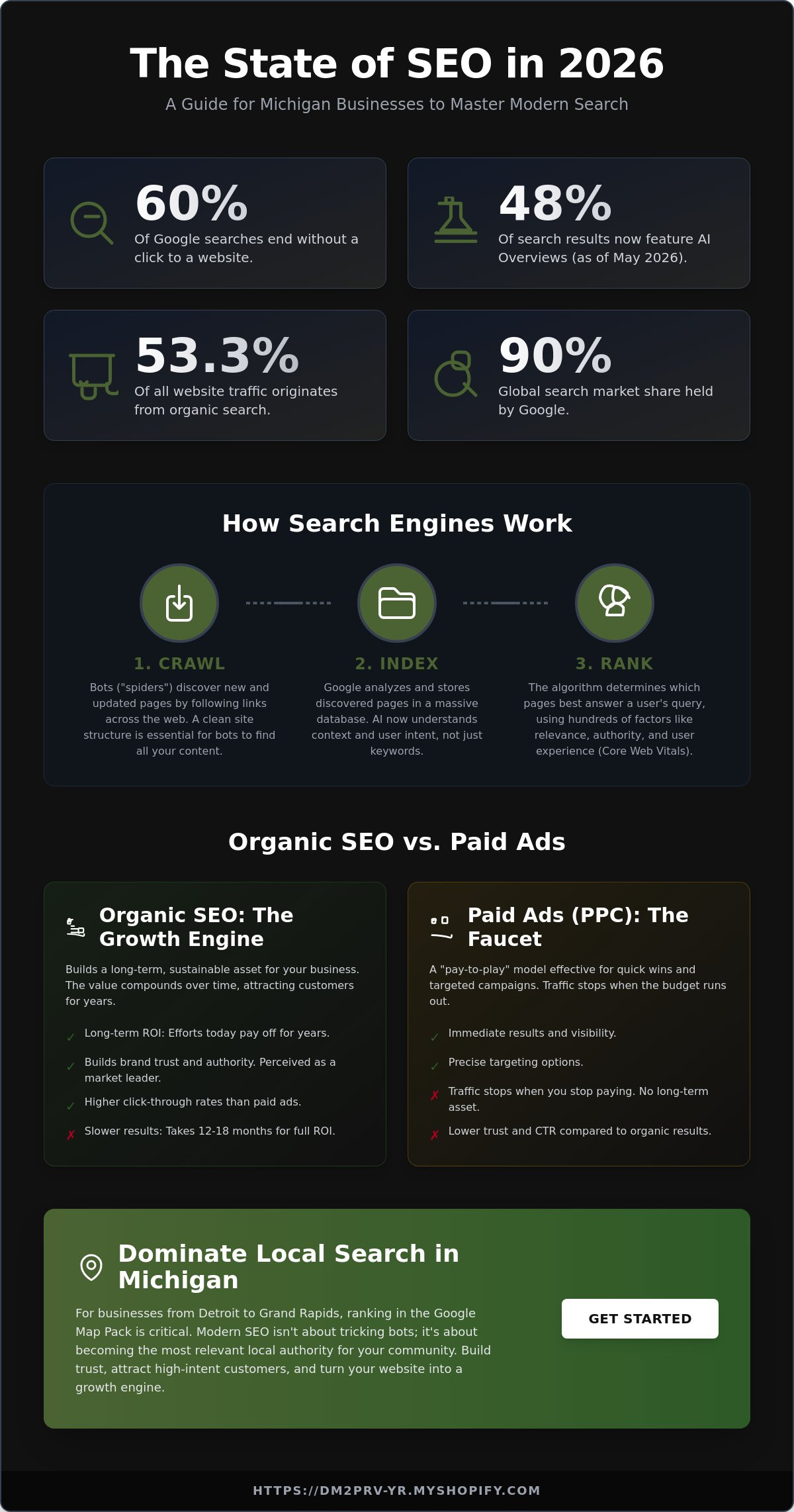
Did you know that 60% of Google searches now end without a single click to a website? With AI Overviews appearing in 48% of search results as of May 2026, the landscape of SEO has fundamentally changed. You're likely feeling frustrated by low traffic or overwhelmed by the constant algorithm changes, like the March 2026 Core Update. It's exhausting to watch your marketing budget disappear into "black hat" services that promise the world but deliver nothing but confusion and technical jargon. You deserve a strategy that actually works.
The good news is that winning in search today isn't about "tricking" a bot; it's about being the most relevant local authority for your Michigan community. This guide will help you master the fundamentals of search engine optimization to grow your visibility, whether you're targeting local customers in Grand Rapids or building a global e-commerce brand. You'll learn actionable steps to improve your ranking and discover how to compete with much larger brands in Detroit. We'll show you exactly how to build trust and turn your website into a growth engine that survives every update Google throws your way.
Key Takeaways
- Learn how the search engine mechanics of crawling and indexing determine exactly how your business appears in search results.
- Discover how to balance the three pillars of a modern seo strategy to build both on-page relevance and a trusted online reputation.
- Master local search tactics to secure your spot in the Google Map Pack and reach customers from Detroit to Grand Rapids.
- Identify the free tools and essential metrics every Michigan business owner needs to track growth and measure real-world conversions.
Understanding Search Engine Optimisation (SEO) in 2026
SEO stands for Search Engine Optimisation. At its simplest, it is the practice of making your business visible when people search for your products or services online. While it used to be about "gaming the system" with hidden keywords, modern seo is about being the most helpful resource in your niche. Google’s March 2026 Core Update reinforced this by focusing on a composite performance score that measures how real humans interact with your site. For those seeking a comprehensive overview of SEO, it's clear the industry has moved from technical tricks to a focus on genuine authority.
For Michigan small businesses, this is often the highest ROI marketing channel available. Why? Because 53.3% of all website traffic comes from organic search. When you rank at the top of the results, you aren't just getting "hits"; you're capturing high-intent leads. If a homeowner in Grand Rapids searches for "emergency plumber," they have an immediate problem you can solve. SEO ensures you are the one they find first. It puts your brand in front of the right person at the exact moment they are ready to make a decision.
The Core Purpose of Modern Search
Google prioritises the user experience over technical checklists. In 2026, search engines use advanced AI to determine if your content actually helps the reader. This "Helpful Content" approach means that a website with perfect technical stats but shallow information will struggle to rank. SEO is the alignment of business value with user search intent. Your goal is to prove to the algorithm that you are the most trustworthy expert for your specific topic. With AI Overviews now appearing in 48% of search results, your content must be authoritative enough to be cited as a primary source.
Organic vs. Paid: Why SEO Wins Long-Term
Paid advertising (PPC) is a "pay-to-play" model. It's effective for quick wins, but the traffic stops the second your budget runs out. SEO offers a compounding interest effect. The high-quality content you create today will continue to attract customers for years without additional costs per click. For local businesses in towns like Brighton or Fenton, relying entirely on ads is a fragile strategy. Organic rankings build a level of brand trust that paid ads can't replicate. When a customer sees your business at the top of the organic results, they perceive you as a market leader rather than just another advertiser. It often takes 12 to 18 months to see a full return on investment, but the long-term stability it provides is unmatched by any other digital channel.
The Mechanics: How Search Engines Crawl, Index, and Rank
To win at seo, you have to understand the three distinct stages Google uses to populate its results. First, "spiders" or bots crawl the web to find new pages. Second, Google indexes those pages by categorising them in a massive digital library. Finally, the algorithm ranks that content based on hundreds of factors to decide which page best answers a user's question. With Google holding 90% of the global search market as of March 2026, playing by these rules isn't optional; it's the only way to be seen. You can find a deeper look at how search engines work through resources provided by Michigan Technological University, which highlight the technical journey from discovery to display.
In 2026, Large Language Models (LLMs) play a massive role in this process. Search engines no longer just look for matching words. They use AI to understand the context and intent behind a search. This is why AI Overviews now appear in 47% of all results. Google is looking for the "why" behind the query. If your content doesn't clearly demonstrate its purpose, the indexer might skip over it entirely, leaving your site invisible to the 54.4% of users who click on the top three results.
Helping Bots Navigate Your Website
Search engine spiders follow links like a roadmap. If your site structure is messy, bots get lost. A clean XML sitemap and a logical hierarchy are essential for Michigan businesses to avoid "crawl blocks." These blocks often happen when technical errors or broken links stop spiders in their tracks. Internal linking is your best tool here; it guides bots from your high-traffic homepage to your deeper service pages. If you're feeling stuck on the technical side, you might want to explore professional support options to ensure your site is fully accessible to search engines.
Ranking Factors That Matter Most in 2026
Ranking is the final competition. The March 2026 Core Update changed the game by introducing holistic Core Web Vitals scoring. This update aggregates LCP, INP, and CLS into one composite performance score. If your site is slow or jumps around while loading, you'll lose your spot. Beyond speed, Google prioritises E-E-A-T: Experience, Expertise, Authoritativeness, and Trustworthiness. They want to see real-world experience. For a local business, this means showing you actually do the work in your community. Mobile-first indexing is also mandatory. Since most local searches happen on smartphones, a site that doesn't work perfectly on mobile will never reach the #1 organic position, which currently enjoys an average 31% click-through rate.
The Three Pillars of a Successful SEO Strategy
A resilient search strategy relies on three interconnected pillars: On-Page, Off-Page, and Technical SEO. Think of these as the foundation, the structure, and the reputation of your digital storefront. When these elements work together, they create a competitive moat that protects your brand from algorithm shifts. While the March 2026 Spam Update targeted low-quality content and reputation abuse, a balanced approach ensures your site remains a trusted resource. For those just beginning, Google's SEO Starter Guide provides the fundamental best practices that still serve as the industry's gold standard.
On-Page: Content and Keywords
On-Page seo is everything your visitors see and read. It starts with finding the specific phrases your customers in Detroit or Grand Rapids actually type into a search bar. You aren't just looking for high volume; you're looking for intent. Your title tags and meta descriptions act as your shop window. They must be compelling enough to earn clicks from the 54.4% of users who focus on the top three organic results. For lifestyle brands in the skate or fashion industries, this pillar includes optimising high-quality images with descriptive alt-text. This helps search engines understand your visual content, which is vital since AI Overviews now appear in 47% of all search results.
Off-Page: Authority and Backlinks
Off-Page strategy is about building your reputation through external signals. In 2026, the quality of your links matters far more than the quantity. Quality beats quantity. A single link from a reputable Michigan news outlet or a local business association carries more weight than dozens of generic links from unrelated sites. Google's recent updates specifically penalise site reputation abuse. This makes ethical link-building the only viable path forward. Social signals also play a role in proving your expertise and trustworthiness. Buying links is a shortcut that often leads to a manual penalty, erasing months of progress in a single day.
Technical SEO: The Foundation
You can have the best content in Michigan, but it won't rank if the foundation is broken. Technical health is the entry fee for modern search. Following the March 2026 update, your site must excel in Core Web Vitals, specifically focusing on Interaction to Next Paint (INP). This is especially critical for e-commerce platforms like Shopify, where slow load times directly kill conversions. A healthy site is fast, secure, and easy for bots to crawl. This ensures that your on-page and off-page efforts aren't wasted on a site that search engines can't properly process. It typically takes 6 to 12 months to see measurable traffic gains, so starting with a solid technical base is non-negotiable.
Local SEO: Dominating Search from Detroit to Grand Rapids
Local search is a specialized branch of seo designed for businesses that serve a specific geographic area. While global search focuses on broad information, local search focuses on proximity and immediate service. If you're a shop in Flint or a service provider in Brighton, you don't need to outrank a global conglomerate. You just need to be the first choice in your neighborhood. Approximately 46% of all Google searches have local intent. This means nearly half of your potential customers are looking for solutions right in their backyard.
The "Map Pack" is the most valuable real estate in these results. It's the box that appears at the top of the page featuring three local businesses and a map. Winning this spot requires more than just a website; it requires a strategy built around local relevance and trust. For Michigan service businesses, the most important factors are your Google Business Profile completeness, review volume, and locally specific service pages. If you're ready to start appearing in the Map Pack for your area, browse our local search optimization services to get your profile professionally managed.
Google Business Profile Masterclass
Your Google Business Profile (GBP) is the cornerstone of your local presence. It's often the first thing a customer sees before they even click on your website. Statistics show that 88% of consumers who perform a local search on their smartphone visit or call a store within 24 hours. To win, you must claim and verify your location for maximum visibility. Respond to every review professionally. High review velocity and regular responses signal that you're active. Uploading fresh, local photos and posting weekly updates provides the "Experience" signals that Google's 2026 updates prioritize.
Geographic Content Strategy
Creating location-specific pages allows you to target "near me" searches in cities like Fenton or Grand Rapids effectively. However, you must avoid creating "doorway" spam. This happens when you create repetitive pages that only change the city name. Instead, provide genuine value by highlighting Michigan-specific events or your community involvement. Mentioning a local project in Detroit or a sponsorship in Brighton proves you're a real part of the community. Local relevance consistently beats global authority for small businesses because Google wants to provide the most convenient, trustworthy solution for the user's specific location.
Consistency across the web is also non-negotiable. Your Name, Address, and Phone number (NAP) must be identical on your website, your GBP, and every local directory. Even small discrepancies can confuse search algorithms and hurt your rankings. By aligning your physical location data with high-quality local content, you build a foundation that even the biggest national brands can't easily replicate in your local market.
Measuring Success and Getting Started with SEO
Measuring your progress is the only way to know if your seo efforts are paying off. Many business owners make the mistake of only tracking keyword rankings. While being at the top for a specific term is a great milestone, it doesn't matter if that traffic doesn't lead to sales. You need to focus on organic traffic growth and, more importantly, conversion rates. Since the top three organic results capture 54.4% of all clicks, moving from position five to position two can fundamentally change your revenue. You should track how many of those visitors actually fill out a contact form or make a purchase in your Detroit or Grand Rapids shop.
Setting realistic expectations is vital for any Michigan business owner. Search engine optimization is a long-term investment. It typically takes 6 to 12 months to see measurable traffic gains. A full return on investment often takes 12 to 18 months. This timeline is due to the current algorithm update cadence, with Google releasing core updates approximately every three months. Patience is a requirement, not an option.
Essential SEO Tools for Beginners
Google Search Console is your most important free resource. It acts as a direct line of communication between your site and the search engine. It alerts you to crawl errors or security issues that could tank your rankings. Google Analytics 4 (GA4) is the next step. It helps you understand what users do once they arrive. Do they stay and read, or do they leave immediately? If you're on Shopify or WordPress, simple plugins like Yoast or SEO Manager can help you handle basic technical tasks without needing to write code.
Building Your 2026 SEO Roadmap
If you want to start today, begin by auditing your existing content. Look for "thin" pages that lack depth or provide no value to the reader. The average blog post on page one of Google is about 1,447 words. Update outdated information to align with the March 2026 Core Update's focus on holistic performance and helpfulness. Fix broken links and compress slow-loading images to improve your Core Web Vitals score. These small technical fixes often provide the quickest wins for local sites. If you're ready to grow your online presence with a professional plan, you can explore our Michigan-focused digital strategies to get a head start. Focus on being the best resource for your community, and the rankings will eventually follow.
Future-Proof Your Michigan Business Today
The landscape of search has shifted from technical tricks to genuine authority. Dominating local results in markets like Detroit or Grand Rapids is now the standard for sustainable growth. While AI Overviews and frequent algorithm updates have changed the rules, your core goal remains the same. You must provide the best answer to your customer's question. Success in seo isn't an overnight win; it's a long-term investment that builds a lasting asset for your brand.
We specialize in helping Michigan companies navigate these digital complexities. Whether you're a local service provider or a Shopify brand looking for e-commerce growth, our focus is on building organic authority that survives every update. You don't have to face these technical hurdles alone. Start growing your Michigan business with professional SEO and turn search visibility into your most reliable revenue stream. Your community is already searching for what you offer. It's time to make sure they find you first.
Frequently Asked Questions
How long does it take to see results from SEO in 2026?
It typically takes 6 to 12 months to see measurable traffic gains from your efforts. A full return on investment usually takes between 12 and 18 months. This timeline exists because Google now releases core algorithm updates roughly every three months. You need to stay consistent through these cycles to see a permanent lift in your rankings.
Is SEO better than social media marketing for local shops?
Organic search accounts for 53.3% of all website traffic, making it a primary growth driver for local shops. Social media is excellent for building a community and brand awareness. However, search captures users with immediate intent. When someone in Grand Rapids searches for a specific service, they're ready to buy, which often leads to higher conversion rates than social media scrolls.
How much does SEO cost for a small business in Michigan?
Pricing for seo varies based on your industry's competitiveness and the geographic area you want to cover. A business in a high-density area like Detroit will likely require a larger investment than one in a smaller town. Most strategies involve either a monthly retainer for ongoing growth or a project-based fee for technical fixes and initial setups.
Can I do my own SEO or do I need an agency?
You can certainly handle basic tasks like updating your Google Business Profile or writing blog posts. However, the technical side of search has become much more complex in 2026. Managing holistic Core Web Vitals scores and navigating major algorithm updates often requires professional expertise to avoid penalties and ensure your budget isn't wasted on ineffective tactics.
What is the most important ranking factor for Google right now?
Google currently prioritizes E-E-A-T and technical performance rather than a single "magic" factor. The March 2026 Core Update introduced a composite score for Core Web Vitals that includes Interaction to Next Paint (INP). Your content must prove real-world experience and expertise to rank well. Search engines want to reward sites that provide a fast, helpful, and trustworthy user experience.
Does Shopify handle SEO automatically or do I need to fix it?
Shopify provides a solid foundation with automated sitemaps and clean URLs, but it isn't a "set it and forget it" solution. You still need to manually optimize your product descriptions, title tags, and image alt-text. Technical performance remains a key area where Shopify users often need to make manual adjustments to ensure their store meets Google's latest speed requirements.
What are "keywords" and how do I find the right ones for my business?
Keywords are the specific words and phrases people type into search engines to find what they need. You can find the right ones by using tools like Google Search Console to see what's already driving traffic to your site. Focus on local intent by including your city name. Understanding the "why" behind a search is more important than just finding high-volume words.
What is the difference between White Hat and Black Hat SEO?
White Hat strategies follow search engine guidelines and focus on providing value to human readers. Black Hat tactics use manipulative shortcuts like scaled AI content abuse or site reputation abuse to trick the algorithm. The March 2026 Spam Update specifically targeted these shortcuts. Using unethical methods will eventually lead to your site being removed from search results entirely.
Disclaimer
Some content published on this website may be developed with the assistance of AI-powered research and writing tools to help streamline research, organization, and content creation. All articles are reviewed, edited, and approved by Marvin Growth Partners to ensure they align with our perspectives, experience, and intended messaging.
While we strive to provide accurate and up-to-date information, blog content is intended for informational and educational purposes only and should not be considered legal, financial, or professional advice. Readers should independently verify information and consult qualified professionals when appropriate.