

What Red Flags Should I Watch for When Hiring a Marketing Consultant? (2026 Guide)
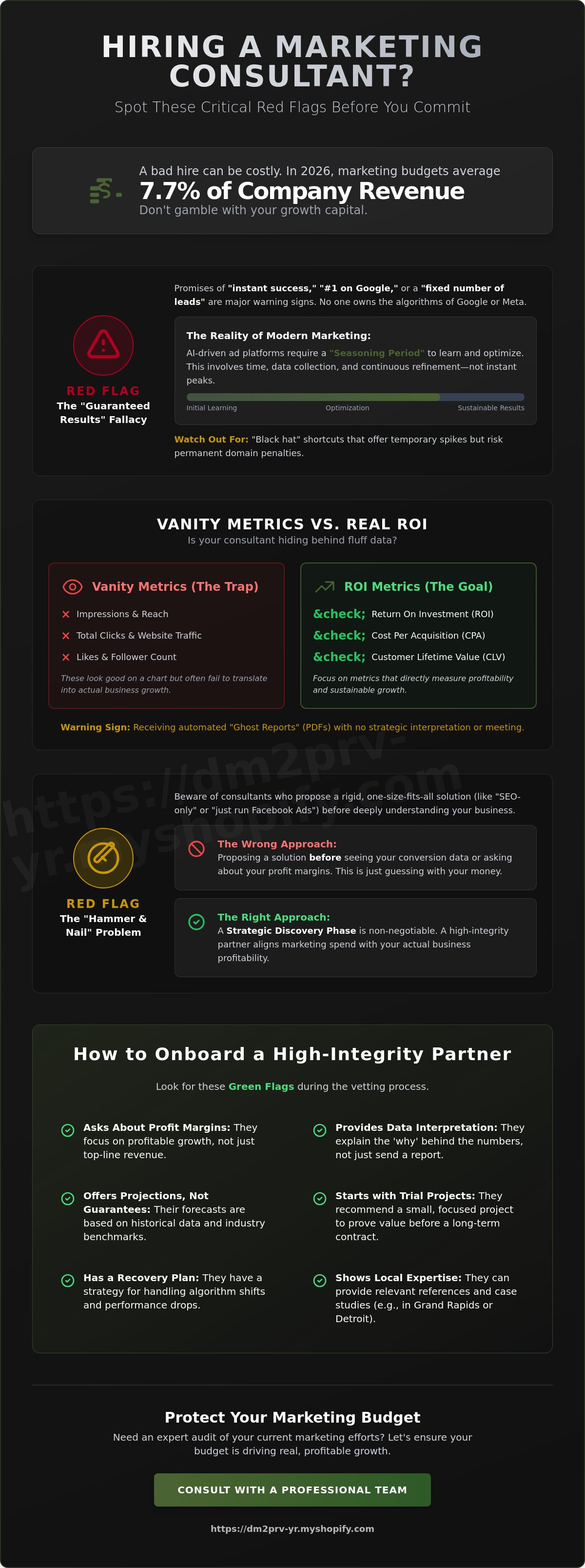
The most dangerous marketing consultant isn't the one who fails to deliver results; it's the one who delivers the wrong kind of results while draining your budget. When you're ready to scale, it's easy to get caught up in flashy presentations and technical jargon that sounds impressive but says very little. You might find yourself asking, "What Red Flags Should I Watch for When Hiring a Marketing Consultant?" especially when the stakes for your business are high. Marketing mistakes are costly. With marketing budgets averaging about 7.7% of company revenue in 2026, a single bad hire can set your growth back by years.
It's frustrating to feel like you're gambling with your hard-earned capital on promises that sound too good to be true. You want a partner who speaks the language of ROI, not just "likes" or "impressions." This guide will help you spot deceptive tactics and amateur shortcuts before you sign a restrictive contract. We'll provide a clear checklist to vet potential partners and explain exactly why "guaranteed results" are often the biggest warning sign of all. By the end, you'll have the confidence to choose a consultant who prioritizes real growth over vanity metrics.
Key Takeaways
- Beware of consultants promising instant success, as modern AI-driven ad platforms require significant "seasoning" time to produce sustainable results.
- Learn how to distinguish between vanity metrics like impressions and actual ROI so you can answer the question: "What Red Flags Should I Watch for When Hiring a Marketing Consultant?"
- Avoid agencies that propose a rigid solution, such as "SEO-only," before they have thoroughly analyzed your specific conversion data and business bottlenecks.
- Identify the importance of local market expertise and why a lack of references in Michigan areas like Grand Rapids or Detroit is a significant warning sign.
- Protect your marketing budget by starting with small trial projects and using specific vetting questions that uncover a consultant's true track record.
The 'Guaranteed Results' Fallacy: Why Instant Success is a Warning Sign
If a consultant promises you the number one spot on Google or a fixed number of leads by next Friday, you should be skeptical. No individual or agency owns the proprietary algorithms of Google or Meta. When asking yourself, "What Red Flags Should I Watch for When Hiring a Marketing Consultant?" the presence of a "guarantee" should be at the top of your list. These promises are usually sales tactics designed to close a deal rather than a reflection of how modern marketing actually works.
By 2026, successful marketing requires a "seasoning" period for AI-driven ad platforms. Google and Meta now rely heavily on machine learning to find your ideal audience. For example, the July 1, 2026, update to Google Ads Terms of Service clarifies that advertisers are responsible for all campaign decisions, even when using automated features. This means a consultant can't just set it and forget it. They must actively monitor and refine campaigns as the AI learns. A fundamental understanding digital marketing principles reveals that these systems need time and data to optimize. Anyone promising instant peaks is likely ignoring the technical reality of how data collection and consent management now function.
High-integrity partners provide projections based on historical data and industry benchmarks. They don't offer ironclad guarantees because they know market conditions change. If a consultant uses high-pressure "buy now or lose your spot" language, they're likely operating a churn-and-burn model. They want your signature before you have time to look closer at their process.
The Danger of 'Black Hat' Shortcuts
Some consultants try to bypass the seasoning period using "black hat" shortcuts. This might include buying low-quality backlinks or using bots to inflate engagement metrics. While these tactics can cause a temporary spike in visibility, they often lead to permanent domain penalties from search engines. You don't want to lose your entire digital presence for a few weeks of artificial growth. Always ask a potential partner about their recovery plan for algorithm shifts. If they don't have a strategy for handling a sudden drop in rankings or ad performance, they aren't thinking long-term.
Red Flag: They Don't Ask About Your Margins
A consultant who focuses solely on "total sales" without asking about your profit margins is a liability. It's easy to spend $10,000 to make $11,000, but if your product costs and overhead are high, that "success" is actually a loss. You need a partner who digs into the math of your business. A deep discovery phase is a non-negotiable green flag. Strategic Discovery is the foundation of any ROI-focused campaign because it aligns marketing spend with actual business profitability. If they propose a solution before they've seen your conversion data, they are just guessing with your money.
Vanity Metrics vs. ROI: Identifying Consultants Who Hide Behind Fluff Data
Numbers often hide the truth. When you're asking, "What Red Flags Should I Watch for When Hiring a Marketing Consultant?" look closely at how they celebrate success. A common trap is the focus on vanity metrics like impressions, reach, or total views. While it feels good to see a report showing "one million views," those numbers are meaningless if they don't lead to revenue. A consultant might show you a chart with a sharp upward trend in website traffic while failing to mention that none of those visitors stayed on the page for more than three seconds. This is the "Impressions Trap," and it's a primary way low-tier consultants justify their fees without delivering value.
Another major red flag is the "Ghost Report." If your consultant sends an automated PDF via email every month without a video walkthrough or a live meeting, you aren't paying for expertise. You're paying for someone to click an export button. High-integrity partners interpret the data for you. They explain why certain campaigns failed and how they plan to pivot. Without this context, you're left guessing about the health of your investment. If you need help auditing your current performance data, you can consult with a professional team to see where your budget is actually going.
Watch out for the attribution shell game. This happens when a consultant takes credit for sales that would have occurred anyway. For example, they might spend your budget bidding on your own brand name in search results. While this inflates their "conversion" numbers, most of those customers were already looking for you. A real expert focuses on incremental growth, showing you the customers you wouldn't have reached without their specific strategy.
Demanding Transparency in Reporting
You must own your data accounts. A significant red flag is a consultant who creates your Google Ads or Meta Business Suite accounts under their own agency profile. If you decide to part ways, you lose years of valuable data and campaign history. Always demand that these accounts are owned by your business, with the consultant granted "manager" access only. Additionally, look for hidden markups. Some agencies claim to charge a flat fee but actually skim a percentage off your total ad spend without disclosing it. A healthy 2026 marketing report should include:
- Customer Acquisition Cost (CAC) by channel
- Return on Ad Spend (ROAS) based on actual profit, not just revenue
- First-party data growth and Consent Mode compliance status
- Clear distinctions between brand and non-brand traffic
The 'AI-Washing' Warning
AI is a powerful tool, but it's not a replacement for human strategy. "AI-washing" occurs when a consultant charges expert rates for basic, unedited output from tools like ChatGPT. If your blog posts or ad copy look exactly like your competitors', you're likely a victim of this shortcut. You can test for this by asking for the "why" behind a specific creative choice. An expert can explain the psychological triggers and brand-specific strategy involved. An AI-washer will give you a generic answer about "best practices."
The 'Hammer Looking for a Nail' Problem: Avoiding Rigid Agencies
When a consultant only offers one service, every business problem looks like it can be solved by that single tool. If you're talking to an "SEO-only" or "Facebook Ads-only" specialist, they might ignore the actual bottleneck in your sales funnel to sell you what they have on the shelf. For example, your website might have plenty of traffic but a broken checkout process. An SEO specialist will promise more traffic, but that won't fix your revenue. When considering "What Red Flags Should I Watch for When Hiring a Marketing Consultant?" you must look for someone who evaluates your entire ecosystem before prescribing a fix.
A massive red flag is a consultant who proposes a specific strategy before they've even looked at your conversion data. They're guessing with your budget. High-performing partners in 2026 don't just guess; they perform a deep audit of your current metrics to see where the real leaks are. If they aren't asking for access to your analytics or your customer lifetime value data during the pitch, they're likely planning to use a generic template on your business.
Watch out for the "Bait and Switch" during the hiring process. You might spend hours impressed by a senior partner's expertise, only to find out after signing that your account is being managed by a junior intern with three months of experience. This is a common agency tactic. Always ask exactly who will be doing the daily work on your account and what their specific track record is. If the person who sold you on the vision isn't the person executing it, you're paying senior rates for entry-level execution.
A new red flag appearing in 2026 is the "AI-Only" consultant. These individuals often act as prompt engineers rather than strategists. While they can generate content or ad copy in seconds, they lack the brand-specific research and psychological insight to make that content actually convert. If their pitch lacks industry-specific research or a unique take on your market, they're probably just letting an AI do the thinking.
One-Size-Fits-All Strategy Red Flags
If the marketing plan you receive looks like a static PDF that could apply to any business, it's a sign of a rigid agency. Your strategy shouldn't just be a list of services; it should be a response to your specific competition. Ask them: "How does this strategy change based on our specific Flint or Detroit competitors?" If they can't speak to local economic cycles or the specific challenges of the Michigan market, they aren't providing a custom solution. Modern marketing requires "omnichannel" awareness, meaning your consultant should understand how your social ads, email marketing, and search presence all work together, even if you only hire them for one of those areas.
The Lack of a 'Test and Learn' Framework
Marketing is a series of controlled experiments. Any consultant who claims to have the "final answer" on day one is being dishonest. A major 2026 red flag is a lack of a clear A/B testing plan. Without constant testing of headlines, images, and landing pages, your campaigns will quickly stagnate as AI-driven platforms change. Agility is the only constant in modern digital marketing. If they don't have a framework for how they will learn from failures and scale successes, they aren't prepared for the speed of today's market.
Vetting Local Experts: Red Flags Specific to the Michigan Marketing Landscape
Hiring a consultant who doesn't understand the unique pulse of Michigan is a recipe for a mismatched campaign. If you are operating a business in Metro Detroit, your marketing partner must understand the influence of "The Big Three" and how automotive economic cycles dictate local consumer spending. When asking, "What Red Flags Should I Watch for When Hiring a Marketing Consultant?" a major warning sign is a candidate who lacks deep ties to the region. A consultant in a different time zone might not realize that a major local event or a shift in manufacturing production can completely alter your target audience's priorities overnight.
A lack of local case studies is another significant red flag. If a consultant claims they can grow your business but cannot provide references from Fenton, Brighton, or Grand Rapids, they likely don't understand the Michigan consumer. Local success stories prove that a consultant knows how to navigate regional competition and cultural nuances. You should also check for their involvement in local business communities, such as the Michigan Chamber of Commerce or regional professional groups. A "remote-only" consultant who has never set foot in the state may struggle to understand the physical geography that impacts your customers' travel and buying habits.
If you want a partner who truly understands the regional landscape and its specific economic drivers, you should work with a Michigan-based marketing consultant who can demonstrate local expertise. This ensures your strategy isn't just a generic template but a plan built for our specific market.
The 'Detroit vs. Grand Rapids' Market Nuance
A strategy that succeeds in a high-tech hub like Austin or Seattle often fails in a manufacturing-heavy region like Flint or Detroit. Each Michigan city has its own economic heartbeat. Grand Rapids has a distinct medical and office furniture industry focus, while Detroit's economy is deeply intertwined with engineering and logistics. A red flag to watch for is a consultant who uses national averages for local lead-generation costs. Michigan's advertising costs vary significantly by county; applying a "one-size-fits-all" national budget to a local campaign will either waste your money or leave you underfunded against savvy local competitors.
Michigan Regulatory and Industry Awareness
Marketing in Michigan requires an understanding of state-specific regulations. For instance, the Michigan Consumer Protection Act was recently amended by Senate Bill No. 759 in April 2026. This bill prohibits deceptive or misleading business practices with strict provisions against misleading advertising. If your consultant is unaware of these local legal standards, they could inadvertently expose your business to compliance risks. Additionally, Michigan-specific seasonality is a critical factor. Winter in Michigan isn't just about snow; it represents a total shift in consumer behavior for home services, real estate, and retail. A consultant who doesn't plan for these seasonal swings is a liability to your long-term growth.
Beyond the Red Flags: How to Onboard a High-Integrity Marketing Partner
Identifying what to avoid is only half the battle. To secure your budget, you must also recognize the "green flags" of a high-integrity partner. One of the most effective strategies is the "Trial Project" approach. Instead of committing to a long-term retainer immediately, start with a standalone audit or a single 30-day campaign. This allows you to see their communication style and technical proficiency in action without a massive financial risk. If you're still wondering, "What Red Flags Should I Watch for When Hiring a Marketing Consultant?" a refusal to start with a small, measurable project is a major one.
Checking references requires more than a simple phone call. To uncover the truth, ask these three specific questions:
- How did the consultant respond when an algorithm update or market shift caused a campaign to underperform?
- Do they explain the data in a way that helps you make business decisions, or do they just read the numbers?
- If you had to start over today, would you hire them again at their current rate?
The Anatomy of a Healthy Contract
A professional contract protects your business as much as it protects the consultant. Avoid any agreement that includes a 12-month lock-in period without a clear "out" clause for non-performance. You should be able to walk away if they consistently fail to meet agreed-upon KPIs. Clear ownership of all creative assets must be in writing. This includes graphics, ad copy, and especially your ad accounts. You don't want to find yourself in a legal battle over your own brand's digital history. Finally, define the communication cadence. Will you meet weekly or monthly? Knowing exactly when to expect updates prevents the "ghosting" often seen with low-quality agencies.
Final Checklist Before You Sign
Before you sign on the dotted line, run through this final mental audit. Did the consultant explain the "why" behind their tactical choices? If they can't connect a specific action to your bottom line, they're just following a generic script. Do they have a clear process for handling failed experiments? Marketing involves risk, and a good partner has a plan for when things don't go as expected. If you're ready to see how a professional strategy can transform your business, Schedule a transparent audit with our Michigan team to see what a green-flag partnership looks like.
Take Control of Your Growth Strategy
Your marketing budget is the fuel for your company's future. It shouldn't be a source of constant anxiety. By now, you know that spotting "guaranteed results" or agencies that hide behind fluff data is the first step toward protecting your capital. You also understand why local market knowledge in cities like Detroit, Grand Rapids, and Flint is non-negotiable for Michigan businesses. When you're asking, "What Red Flags Should I Watch for When Hiring a Marketing Consultant?" remember that transparency and a willingness to test are your best defenses against a bad hire.
Don't settle for a partner who guesses with your money or locks you into restrictive agreements. You deserve a consultant who prioritizes 100% transparent ROI reporting and understands the nuances of our regional economy. If you're ready for a change, you can Book a Strategy Session with a Michigan Marketing Expert today. We offer no-contract trial periods so you can verify the results for yourself before making a long-term commitment. Building a sustainable brand takes time, but with the right partner, you can navigate the 2026 landscape with total confidence.
Frequently Asked Questions
What is the #1 red flag when hiring a marketing consultant?
The absolute most significant red flag is a guarantee of specific rankings or sales figures. Because marketing depends on external factors like platform algorithms and shifting consumer behavior, no honest professional can promise a fixed outcome. Instead, look for consultants who focus on their testing methodology and historical performance data. If they claim to have a "special relationship" with Google to bypass standard rules, they are likely being deceptive.
Should I avoid marketing consultants who use AI tools?
You shouldn't avoid AI tools, as they are essential for campaign optimization and data analysis in 2026. However, you should avoid consultants who use AI to replace original strategy or brand-specific research. A high-quality partner uses AI to enhance efficiency while maintaining human oversight of creative assets. Ask how they ensure AI-generated content complies with your specific brand guidelines and the updated 2026 Google Ads terms of service.
How much should a marketing consultant in Michigan cost in 2026?
In 2026, marketing consultant rates in Michigan typically follow national trends, with entry-level execution starting at $50 per hour and senior strategic consulting reaching $600 or more. Monthly retainers generally range from $1,500 to over $15,000 depending on the complexity of your campaigns. When considering "What Red Flags Should I Watch for When Hiring a Marketing Consultant?" be wary of prices that seem significantly lower than these industry standards, as they often indicate a lack of experience.
Is it a red flag if a consultant doesn't have experience in my specific niche?
It isn't always a red flag if a consultant lacks experience in your specific niche, provided they have a proven framework for learning new industries. A great marketer can apply successful principles across different sectors by conducting deep discovery and competitor analysis. However, if they don't ask detailed questions about your unique business model or customer pain points during the initial pitch, they probably aren't equipped to handle your specific market challenges.
What should I do if I've already signed a contract with a red-flag agency?
If you've already signed with a red-flag agency, the first step is to review your contract for a non-performance or termination clause. Document every instance where they failed to meet agreed-upon milestones or provided opaque reporting. You can often negotiate an early exit if you can prove they aren't delivering the services promised. It's better to pay a small exit fee now than to continue wasting your entire marketing budget on a failing partnership.
How do I verify a consultant's past 'success stories'?
Verifying success stories requires going beyond reading static testimonials on a website. Ask the consultant to perform a live walkthrough of a past campaign's dashboard, showing the actual connection between ad spend and revenue. Additionally, request to speak with at least two current or former clients. Ask these references about the consultant's communication during difficult months and whether the reported metrics actually matched the business's internal sales data.
Can a local Michigan consultant outperform a big national agency?
A local Michigan consultant often outperforms national agencies because they understand regional economic cycles and consumer habits. National agencies frequently use broad, generic strategies that miss the nuances of the Detroit or Grand Rapids markets. Local experts have a better grasp of Michigan's specific seasonality and regulatory environment, such as the 2026 updates to the Michigan Consumer Protection Act. This proximity allows for more agile adjustments based on local competitor shifts.
What questions should I ask a marketing consultant during the first interview?
During the first interview, ask who will own the data accounts and what their process is for handling a failed campaign. You should also ask, "What Red Flags Should I Watch for When Hiring a Marketing Consultant?" to see if they are honest about common industry pitfalls. Ensure they explain how they track ROI and what their onboarding process looks like. If they focus more on their past awards than your current business goals, they likely aren't the right fit.
Disclaimer
Some content published on this website may be developed with the assistance of AI-powered research and writing tools to help streamline research, organization, and content creation. All articles are reviewed, edited, and approved by Marvin Growth Partners to ensure they align with our perspectives, experience, and intended messaging.
While we strive to provide accurate and up-to-date information, blog content is intended for informational and educational purposes only and should not be considered legal, financial, or professional advice. Readers should independently verify information and consult qualified professionals when appropriate.