

Why Video Marketing Works for Local Business
Most local business owners assume video marketing belongs to big brands with big budgets. That assumption is costing them customers every week. Understanding why video marketing works for local business comes down to one core truth: local buyers want proof before they act, and video is the fastest, most credible way to deliver it. This guide breaks down the behavioral, platform, and conversion mechanics behind video’s effectiveness, then gives you a practical framework to apply it without wasting money on content that looks good but does nothing for your bottom line.
Table of Contents
- Key takeaways
- Why video marketing works for local business
- How video builds trust for local buyers
- How video directly boosts conversions and local sales
- Local business video strategies that actually convert
- My honest take on video for local businesses
- Ready to put video to work for your business?
- FAQ
Key takeaways
| Point | Details |
|---|---|
| Video drives higher retention | Viewers retain 95% of a video message versus just 10% from text, making video far more persuasive. |
| Trust accelerates local decisions | Testimonial and team videos reduce buyer hesitation by answering questions visually before a customer calls or visits. |
| Placement determines conversion | Where you put your video matters as much as the content itself; landing page placement can double your conversion rate. |
| Short-form delivers the best ROI | Short videos are easier to produce, test, and share consistently, making them the highest-return format for local businesses. |
| Measure what actually matters | Track calls, bookings, and form fills rather than views or likes to know whether your video is generating real revenue. |
Why video marketing works for local business
The term “video marketing” covers a wide range of content, from polished TV-style ads to a 30-second smartphone clip of your team at work. The industry standard term is video content marketing, which means using video strategically across the customer journey to build awareness, trust, and conversion. Whatever you call it, the mechanics are the same. Video combines visuals, sound, and narrative in a way that text and static images simply cannot match.
Here is why that matters for local businesses specifically. When someone searches for a plumber, a dentist, or a landscaping company near them, they are not browsing casually. They have a problem and they want to solve it fast. Video gives them an immediate read on whether your business feels trustworthy, professional, and relevant to their situation.
The engagement numbers back this up. Social media engagement is now the fastest growing video success metric, with nearly double the adoption compared to the previous year across 900-plus marketing professionals. That shift matters because engagement signals, not just view counts, are what push your content higher in local search results and social feeds.
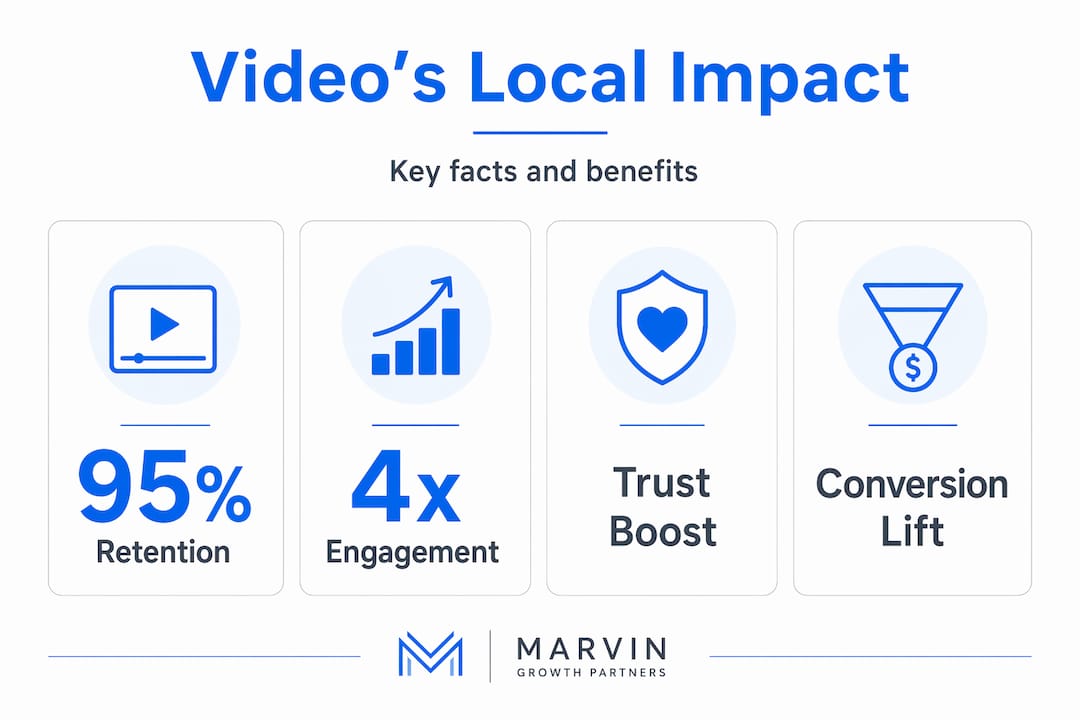
Video also wins on memory. People retain 95% of a message delivered through video compared to roughly 10% from the same content in text form. For a local business trying to stay top of mind when a customer is ready to buy, that gap is enormous.
What makes video especially powerful locally is emotional relevance. When a potential customer sees your actual shop, your real team, and a recognizable neighborhood in your video, the content stops feeling like advertising and starts feeling like a preview of their experience. That emotional connection is something no stock photo or written description can replicate.
How video builds trust for local buyers
Local customers do not hand over their money or their time without some form of validation first. They read reviews, check your website, and ask neighbors. Video fits directly into that research behavior because it provides visible, hard-to-fake proof.
Consider the difference between a written testimonial and a video testimonial. A written review can be fabricated. A video of a real customer describing their experience, in their own words, with genuine emotion, is far more difficult to dismiss. Video testimonials yield a 61% lift in B2C conversion rates because they answer the one question every local buyer is silently asking: “Has this worked for someone like me?”
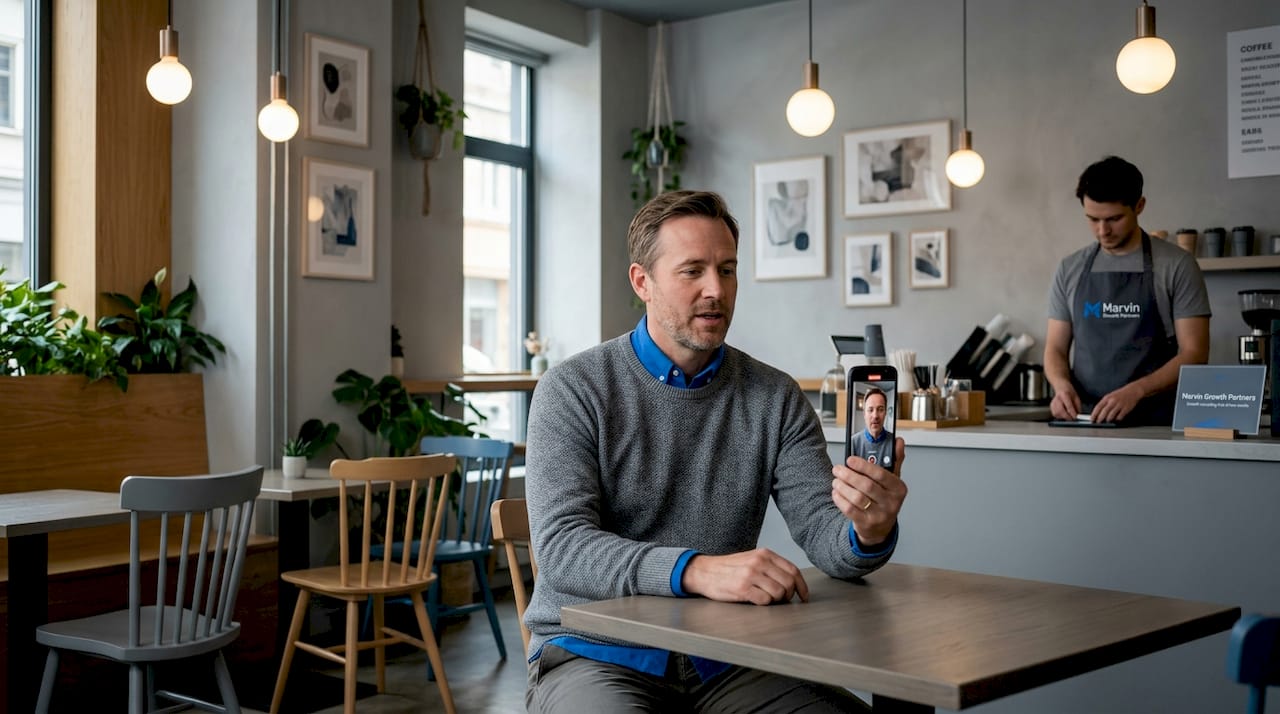
Behind-the-scenes videos serve a similar function. A tour of your workshop, a clip of your team preparing for a job, or a quick walkthrough of your process all reduce the uncertainty that stops people from picking up the phone. Local buyers research and validate before reaching out, and explanatory videos meet them at exactly that moment of hesitation.
The types of trust-building videos that consistently perform well for local businesses include:
- Team introduction clips: Short, genuine introductions from the owner or key staff members that show the human side of the business
- Process walkthroughs: A step-by-step look at how you deliver your service, which reduces fear of the unknown
- Customer testimonial videos: Real clients sharing specific results, not vague praise
- FAQ answer videos: Short clips addressing the most common objections or questions before a customer even asks them
Pro Tip: Film your testimonials immediately after a positive customer interaction. The emotion is fresh, the details are specific, and the authenticity comes through in a way that a scripted or delayed testimonial never quite matches.
How video directly boosts conversions and local sales
This is where the importance of video content becomes undeniable. Trust is good. Conversion is better. And the data on video’s impact on sales is specific enough to plan around.
Placing product or service videos on landing pages increases conversion rates by reducing purchase friction. The core mechanism is simple: video answers “Will this work for me?” faster and more convincingly than any written description. When that question gets answered, the hesitation disappears and the customer acts.
The placement of the video matters as much as the content itself. A lightbox modal, where the video pops up in a focused overlay rather than sitting inline on the page, can lift conversion from 6.5% to 13%. That is a 100% increase from one formatting decision.
Here is a practical comparison of video placement options and their typical impact:
| Placement | Conversion impact | Best use case |
|---|---|---|
| Inline landing page video | Moderate lift | Service explainers, about-us content |
| Lightbox modal video | Up to 2x lift | Testimonials, offer-specific pages |
| Google Business Profile video | Increases profile engagement | Local search discovery |
| Social retargeting video ad | High intent re-engagement | Warm audiences who visited your site |
Short-form video deserves special attention here. 48.6% of marketers now identify short-form as the format with the biggest ROI. For local businesses, this is practical news. You do not need a production crew. A 60-second video filmed on a smartphone, edited with a free app, and posted consistently will outperform a polished annual brand video that sits on a homepage and never gets updated.
“Video marketing is persuasion and confidence-building across the customer journey. Local businesses should map their videos to the specific questions customers have before they call or visit.” — Adobe Business
Local business video strategies that actually convert
Knowing that video works is one thing. Knowing which videos to make and where to put them is what separates businesses that see results from those that spend money on content that gets ignored.
The most useful framework for local businesses is the See → Trust → Act model. This approach maps your video content to the three stages of a local buyer’s decision process, so every video has a clear job to do.
Here is how to apply it in practice:
- See (Awareness): Short promo clips, location-specific ads, and social content that introduces your business to people who do not know you yet. Keep these under 30 seconds. Focus on one clear message.
- Trust (Consideration): Testimonial videos, process walkthroughs, and team introductions for people who found you and are deciding whether to move forward. These can run 60 to 90 seconds.
- Act (Conversion): Explainer videos on your service pages and Google Business Profile that answer final objections and include a direct call to action. These should be concise and specific.
For platform selection, prioritize where your local customers actually spend time. Google and YouTube are non-negotiable for local search visibility. Facebook and Instagram work well for retargeting people who visited your site but did not convert. Radius-based ad targeting on these platforms lets you reach people within a specific mile range of your location, which is a significant advantage that national brands cannot replicate with the same precision.
Pro Tip: Reuse every video across multiple platforms. A 60-second testimonial can live on your website, your Google Business Profile, your Facebook page, and your Instagram Reels. One shoot, five placements, five times the exposure for the same production cost.
Measurement is where most local businesses drop the ball. Views and likes feel good but they do not pay the rent. The metrics that actually tell you whether video is working are calls generated, appointment bookings, form fills, and quote requests. Using UTM tags, call tracking, and CRM data lets you connect a specific video to a specific sale, which turns video from a vague branding expense into a measurable revenue driver.
Here is a simple KPI table to guide your tracking:
| Metric | What it tells you | How to track it |
|---|---|---|
| Call volume after video launch | Direct response from video viewers | Call tracking software with UTM tags |
| Landing page conversion rate | Whether video improves page performance | Google Analytics goal tracking |
| Booking or form fill rate | Bottom-of-funnel video impact | CRM or booking platform reports |
| Video watch time | Whether content holds attention | YouTube Studio or platform analytics |
My honest take on video for local businesses
I’ve worked with enough local businesses to say this plainly: most of them treat video as a branding exercise and then wonder why it doesn’t move the needle. They spend money on a polished brand video, post it once, and call it done. That’s not video marketing. That’s a vanity project.
What actually works is treating video as a sales tool. Every video should answer a specific question a customer has at a specific point in their decision process. When you think about it that way, the content almost writes itself. What do people ask before they call you? What makes them hesitate? What would make them trust you faster? Answer those questions on camera and you have a video strategy.
I’ve also seen businesses get tripped up by chasing production quality over consistency. A polished video posted once a quarter will underperform a genuine, slightly rough video posted every week. Algorithms reward consistency. Customers reward authenticity. You rarely need both at the same time.
The one thing I’d push every local business owner to do right now is track which videos actually generate calls and bookings. Not which ones get the most views. The data will surprise you, and it will change how you allocate your budget immediately.
— Eric
Ready to put video to work for your business?
If you’ve read this far, you already understand the mechanics. The next step is execution, and that’s where most local businesses stall. Marvingrowthpartners works directly with local business owners to build video strategies tied to real conversion goals, not vanity metrics.
From identifying which video formats fit your customer journey to setting up the tracking that proves ROI, the team at Marvingrowthpartners brings the same executive-level thinking to your video marketing that growing companies use to scale without waste. If you want a strategy built around your specific growth stage and customer behavior, this is where to start.
FAQ
Why does video marketing work better than text for local businesses?
Video retains 95% of the message compared to 10% for text, and it delivers emotional proof of quality that written content cannot replicate. For local buyers who want to validate before committing, video answers their questions faster and more convincingly.
What type of video converts best for local businesses?
Testimonial videos and service explainers consistently produce the highest conversion impact. Real customer proof videos reduce hesitation at the exact moment a buyer is deciding whether to call or book.
How long should a local business video be?
Short-form video, typically under 60 seconds, delivers the highest ROI for most marketers and is easier to produce and share consistently. Awareness clips can be 15 to 30 seconds, while trust-building videos can run up to 90 seconds.
Where should local businesses post their videos?
Prioritize your Google Business Profile, website service pages, YouTube, Facebook, and Instagram. Embedding video on service pages with aligned calls to action is especially effective for converting the trust the video builds into actual inquiries.
How do you measure whether a video is actually driving sales?
Track calls, bookings, and form fills tied to specific videos using UTM parameters and call tracking software. Views alone do not indicate revenue impact. Connecting video performance to your CRM data gives you a clear picture of which content is generating real customers.