

Craft Your Startup Story for Marketing Success
A startup story is defined as the full narrative backbone of your company, guiding every marketing decision and customer interaction. It is not a tagline, a mission statement, or a product description. It is the single coherent frame that explains why your startup exists, who it serves, and why the market should care. Founders who craft a startup story for marketing early gain a repeatable communication tool that works across pitch decks, websites, sales calls, and investor meetings. This guide walks you through the essential components, discovery methods, writing steps, and integration practices that turn a vague origin into a story that attracts customers and funding.
What are the essential components of a startup story?
A marketing narrative for startups is a structured explanation that ties mission, product logic, customer pain, and value into one coherent frame. That frame has distinct parts, and each part does a specific job. Skipping one weakens the whole structure.
The four core components every startup story needs are:
- Origin. The founding moment. What happened, when, and to whom. Specific dates, places, and names make this credible.
- Mission. The change you are trying to create in the world. Not what you sell, but what you are working toward.
- Difference. Why your approach is distinct from what existed before. This is where you define the old way and the new way.
- Customer story. A real or representative account of the transformation your customer experiences. The customer is the hero, not your product.
The Magnetic Messaging Framework organizes these components into four narrative anchors: category design, villain framing, old-way/new-way contrast, and promised land outcome. This framework sits beneath your messaging and gives it structure. Without it, messaging feels disconnected across channels.
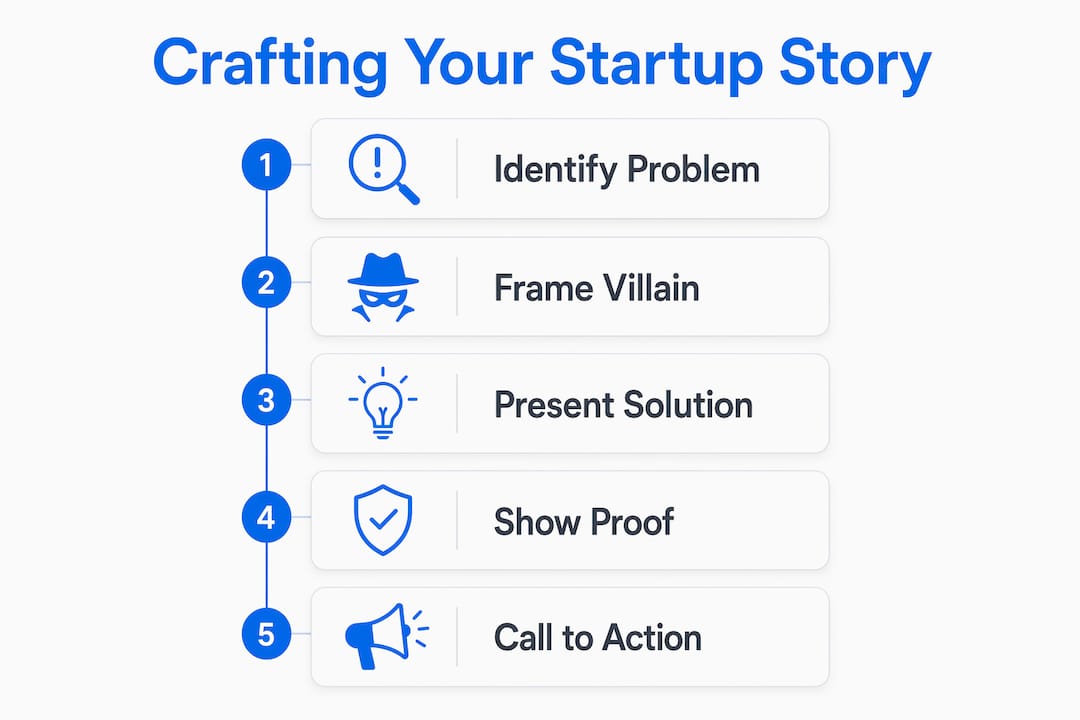
The “villain” concept deserves special attention. The villain is not a competitor. It is the old way of doing things that causes your customer pain. Naming it clearly creates contrast and makes your solution feel necessary. The “promised land” is the transformed reality your customer reaches after working with you. It should be vivid and specific, not abstract.
Story architecture and messaging are not the same thing. Story architecture is the underlying logic. Messaging is the language you use to express it. You build the architecture first, then write the messaging on top of it.

How do you discover and develop your startup’s unique story?
Effective startup stories are found in the field through tension between what a company believes and the world it operates in. They are not invented in workshops. Discovery is an active process that requires going back to founding moments and forward into customer conversations.
-
Revisit the founding tension. Ask yourself what frustrated you enough to start this company. The answer is almost always the seed of your story. Write down the specific moment, not a general feeling. “I was running payroll manually for the third Friday in a row” is a story. “I was frustrated with inefficiency” is not.
-
Interview your best customers. Ask them what their life looked like before they found you, what they tried that did not work, and what changed after. Their language is often more powerful than anything you would write yourself. Record exact phrases.
-
Analyze market tension. What does the market currently believe that you think is wrong? That gap between conventional wisdom and your point of view is the foundation of your difference story.
-
Test the story out loud. Tell it to someone who does not know your industry. If they cannot repeat the core idea back to you, the story is not clear enough. Refine based on what confuses them, not what you think is obvious.
-
Build modular story blocks. A good startup story is modular, consisting of distinct Origin, Mission, Difference, and Customer stories deployed depending on context. Your origin story works at a networking event. Your customer story works in a sales meeting. You do not need to tell all four every time.
Pro Tip: Keep a running document of exact customer quotes from interviews. These become the raw material for your customer story and your website copy. Specificity borrowed from real customers is always more convincing than language you invent.
Specificity is the single biggest differentiator between a forgettable story and a memorable one. Vague stories fail the market test. If your story could belong to any company in your category, it belongs to none of them.
What are the practical steps to craft and write your startup story?
Writing a startup story is a disciplined exercise, not a creative one. Treating story structure as a discipline reduces buyer cognitive load and facilitates behavior change. The goal is clarity, not poetry.
The six-part writing framework:
- Setup. Establish the world as it was before your startup existed. What was the status quo?
- Inciting incident. Name the specific moment or problem that made the status quo unacceptable.
- Commitment. Describe the decision to do something about it. This is where the founder enters the story.
- Struggle. Acknowledge what was hard. Stories without struggle feel fake.
- Turn. The moment the approach started working. What changed?
- Present. Where you are now and what you are building toward.
This framework applies to your full brand story. For shorter contexts, compress it into a mission story. A concise mission story contains three sentences: problem, approach, and outcome, each between 15–25 words, totaling under 100 words. That constraint forces precision.
When writing the old-way/new-way contrast:
- State the old way in one sentence. Make it feel familiar and painful.
- State the new way in one sentence. Make it feel obvious in hindsight.
- Use parallel structure so the contrast lands visually and verbally.
Editing rules that matter:
- Remove any sentence that could appear on a competitor’s website without changes. If it fits them, it does not differentiate you.
- Replace abstract claims with specific names, places, and measurable outcomes. Adding specific names and outcomes increases memorability and effectiveness.
- Place proof close to claims. Do not make a bold statement and then bury the evidence three paragraphs later.
Pro Tip: Read your story aloud. If you stumble on a sentence, your reader will too. Rewrite anything that does not flow naturally when spoken.
The problem, stakes, new way, proof, call to action structure gives you a repeatable template for every marketing asset you build from the story. Apply it to your homepage, your pitch deck introduction, and your sales email sequences.
How does a startup story integrate with your marketing strategy?
Consistent narrative structure across marketing channels reduces buyer cognitive load and accelerates sales cycles by shaping belief and action. Your story is not a one-time document. It is the source code for every piece of marketing you produce.
Most startups do not need massive branding exercises. They need clearer, simpler operational narratives that teams can repeat without distortion. That is the real integration goal: a story simple enough that every team member tells it the same way.
Here is how the story maps to specific marketing assets:
- Website homepage. The hero section should state the customer’s problem and your promised land within the first two sentences. The origin story lives on the About page. The customer story powers your case studies.
- Pitch deck. Open with the villain (the problem) and the market tension. Close with the promised land and your proof. Investors fund stories they believe, not just numbers they can model.
- Sales scripts. Train your sales team to open with the customer’s pain, not your product features. The difference story becomes the answer to “why you?”
- Content marketing. Every blog post, video, and email should connect back to one of the four story modules. This keeps content on-brand without requiring a style guide review every time.
- Customer case studies. Structure them as before/after narratives. Before: the customer’s old way and its costs. After: the transformation and its measurable impact.
Brand strategy experts emphasize that the brand should be the guide or catalyst in the story, not the hero. Your customer is the hero. Your startup is the guide that helps them reach the promised land. Keeping that role clear across all materials is what makes the story feel consistent rather than self-promotional.
As your startup grows, the story evolves. New customer outcomes become new proof points. New market tensions create new villain framings. Review your story every six months and update the evidence, not the architecture. The structure stays. The specifics sharpen. Explore growth strategy frameworks to see how narrative fits into a broader marketing system.
Key Takeaways
A startup story built on the Magnetic Messaging Framework, grounded in real customer language, and deployed consistently across every marketing channel is the most direct path to shorter sales cycles and stronger investor confidence.
| Point | Details |
|---|---|
| Story architecture first | Build the narrative structure before writing any messaging or copy. |
| Four core modules | Origin, Mission, Difference, and Customer stories each serve a specific context. |
| Specificity wins | Replace vague claims with exact names, dates, and measurable outcomes. |
| Customer is the hero | Position your brand as the guide, not the protagonist, in every asset. |
| Consistent deployment | Apply the same story structure to your website, pitch deck, and sales scripts. |
Why most startup stories fail the competitor test
The most common mistake I see founders make is writing a story that sounds like every other startup in their category. They use phrases like “we help businesses grow” or “we make things easier.” Those sentences pass no test. Put them on a competitor’s website and nothing breaks. That is the problem.
The competitor test is simple: read each sentence of your story and ask whether it could appear on a rival’s site without changes. If the answer is yes, rewrite it. Every sentence should be so specific to your founding moment, your customer’s pain, and your approach that it could only belong to you.
I have also watched founders make the opposite mistake. They get so attached to their own origin that they forget the customer entirely. A ten-paragraph founder biography is not a brand story. It is a memoir. The customer does not care how hard you worked. They care whether you understand their problem and have a credible path to solving it.
The strongest startup stories nail four things: the founding tension, the customer transformation, specificity, and provable impact. Not three of four. All four. When one is missing, the story loses its grip. A founder who can articulate all four in under two minutes has a real marketing asset. Most cannot, which is exactly why getting this right creates a genuine competitive edge.
Story is also not a one-time deliverable. Treat it as a living document. Test it with real audiences, update the proof points as you grow, and retire any language that stops resonating. The architecture stays fixed. Everything else should get sharper over time.
— Eric
How Marvingrowthpartners helps founders build story-driven growth
Marvingrowthpartners works with founders who know their product but struggle to translate it into a story that moves customers and investors. The work goes beyond messaging. It connects narrative directly to business growth strategy so that the story you tell actually drives pipeline, not just brand awareness.
The approach at Marvingrowthpartners combines executive-level strategy with hands-on execution. That means your story gets built, tested, and embedded into your marketing assets, not handed off as a document that collects dust. If you are ready to turn your founding narrative into a growth engine, the fractional marketing leadership team at Marvingrowthpartners is built for exactly that stage of growth.
FAQ
What is a startup story in marketing?
A startup story is the full narrative backbone of a company that ties mission, customer pain, and value into one coherent frame. It guides every marketing decision and customer interaction, distinct from a tagline or mission statement alone.
How long should a startup origin story be?
A founder’s origin story should be 30–60 seconds verbally or about 2–3 paragraphs in written form, optimized for contexts like networking or sales discovery.
What is the Magnetic Messaging Framework?
The Magnetic Messaging Framework is a narrative structure built on four anchors: category design, villain framing, old-way/new-way contrast, and promised land outcome. It forms the story architecture beneath all marketing messaging.
How do I know if my startup story is strong enough?
Apply the competitor test: if any sentence in your story fits a rival’s website without changes, rewrite it. Strong stories contain specific names, dates, customer language, and measurable outcomes that belong only to your company.
How often should I update my startup story?
Review your story every six months. Update the proof points and customer outcomes as your startup grows, but keep the core narrative architecture fixed. The structure stays. The specifics sharpen.