

Why Bootstrapped Marketing Strategies Work for SMBs
Bootstrapped marketing is defined as a discipline that forces every dollar to earn its place before the next one gets spent. The reason why bootstrapped marketing strategies work is not luck or scrappiness. It is operational discipline: tight unit economics, channel focus, and compounding owned assets that paid-only approaches never build. Referral customers convert 3–5x better than cold-channel leads. Inbound leads cost 61% less than outbound leads. Those two numbers alone explain why resource-constrained teams consistently outperform bigger spenders who skip the fundamentals.
Why bootstrapped marketing strategies work: unit economics first
Unit economics is the financial backbone of effective bootstrapped marketing. Two metrics define whether your marketing is sustainable: the LTV:CAC ratio and the CAC payback period. A 3:1 LTV:CAC ratio with a payback period under 12 months is the standard threshold for bootstrapped marketing success. That ratio tells you whether a customer is worth acquiring. The payback period tells you how long your cash is tied up before you see a return.
Here is how the math works in practice. CAC equals your total sales and marketing spend divided by the number of new customers acquired in a period. Payback period equals CAC divided by monthly revenue per customer multiplied by gross margin. If you spend $5,000 acquiring 10 customers, your CAC is $500. If each customer pays $100 per month at 70% gross margin, your payback period is roughly 7 months. That is a healthy position for a bootstrapped team.

The critical mistake most SMBs make is tracking LTV:CAC alone. Pairing LTV:CAC with payback period prevents a common trap: a great ratio that hides the fact that your cash is locked up for 18 months before compounding begins. For a bootstrapped business, that cash gap can be fatal. Measuring both metrics together keeps your marketing decisions grounded in cash flow reality, not just theoretical lifetime value.
Pro Tip: Set a hard rule before launching any campaign: if the projected CAC payback exceeds your current cash runway divided by three, do not run the campaign. This single constraint eliminates most wasteful spend before it happens.
| Metric | Formula | Healthy Benchmark |
|---|---|---|
| CAC | Total marketing spend / new customers | As low as possible |
| LTV:CAC Ratio | Customer lifetime value / CAC | 3:1 or higher |
| CAC Payback Period | CAC / (monthly revenue × gross margin) | Under 12 months |
Why do referral programs outperform cold channels?
Referral marketing is the highest-ROI channel available to a bootstrapped team, and most businesses treat it as an afterthought. Referral leads convert 30% better and referred customers retain 37% longer than customers acquired through paid channels. That retention lift directly increases LTV without increasing CAC. The math compounds fast.
The mechanics behind this are straightforward. A referred customer arrives with pre-built trust. They heard about you from someone they already trust, so the skepticism that kills cold-channel conversions is already gone. That trust shortcut is something no ad budget can replicate at the same cost.
Designing a referral program that actually converts requires three elements:
- Double-sided rewards. 78% of referral programs use double-sided incentives, rewarding both the referrer and the new customer. This structure removes the guilt of asking someone to buy something and turns the referral into a gift.
- Simple sharing mechanics. A referral link that takes more than 10 seconds to find and share will not get used. Tools like ReferralHero or Viral Loops generate single-click share links that remove friction entirely.
- Systematic tracking. Without tracking, you cannot identify your top referrers, reward them properly, or optimize the program. A basic UTM parameter setup in Google Analytics handles this at zero cost.
User-generated content and customer reviews work on the same trust principle. A five-star review on Google Business Profile or a case study on your website reduces the friction for every future visitor. These are durable marketing assets that keep working long after the customer who wrote them has moved on. Referral marketing and customer proof should be the backbone of your growth strategy, not a nice-to-have add-on.
How does channel selection affect low-budget marketing?
Channel selection is where most bootstrapped teams either win or waste months of effort. The core principle is simple: match your channel to your cash position and your time horizon. Organic channels typically require 3–6 months for meaningful results. Paid channels deliver results immediately but stop the moment you stop spending.
This creates a practical sequencing problem. You need revenue now to fund the organic work that will lower your CAC later. The answer is to use paid advertising as a bounded learning tool, not a growth engine. Set a fixed test budget, run ads to validate messaging and audience fit, then redirect what you learn into SEO content and email sequences that keep working without ongoing spend.
| Channel | Time to Results | Cost Profile | Asset Value |
|---|---|---|---|
| SEO / Content | 3–6+ months | Low ongoing cost | High, compounds over time |
| Cold Email Outreach | 2–4 weeks | Near zero cost | Medium, requires maintenance |
| Paid Ads (Google, Meta) | Immediate | High, stops when spend stops | Low, no residual value |
| Referral Programs | 4–8 weeks to build | Low setup cost | High, self-reinforcing |
| Community Building | 3–12 months | Time-intensive | Very high, compounding |
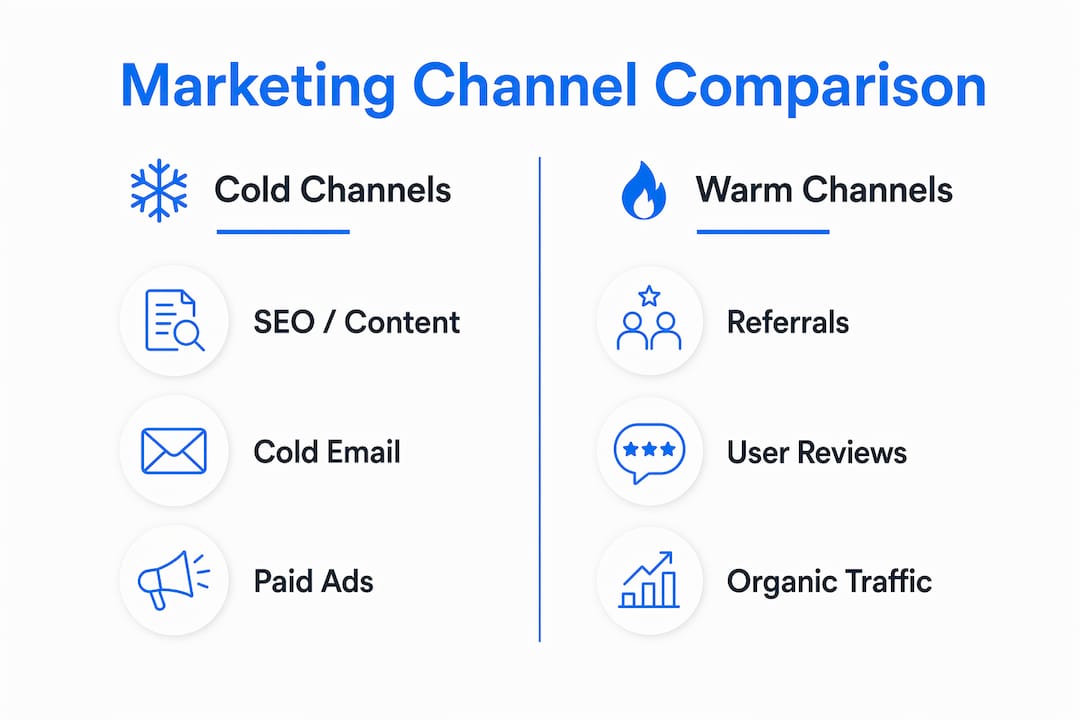
Cold email outreach deserves special mention for early-stage bootstrapped teams. Bootstrapped founders prioritize outbound email over slow organic channels early on because it generates direct feedback on messaging within days, not months. A 200-email cold outreach sequence costs nothing but time and tells you exactly which value propositions resonate before you invest in content around them. That feedback loop is the real asset, not the replies.
For low-cost local marketing tactics and channel prioritization frameworks built specifically for SMBs, Marvingrowthpartners has published practical guides that go deeper on sequencing these channels by growth stage.
Do owned marketing assets really compound over time?
Owned assets are the reason bootstrapped marketing creates lasting competitive advantages that paid-only strategies cannot match. Content, email lists, and communities share one defining characteristic: paid ads stop working the moment spend stops, but owned assets keep delivering leads and building authority indefinitely.
The compounding effect works like this. A blog post published today ranks on page three of Google in month four. By month twelve, it ranks on page one and drives 300 organic visitors per month at zero marginal cost. That same post feeds your email list, which nurtures leads into customers. Those customers become referral sources. Each layer reinforces the next, and your blended CAC drops with every passing month without any additional spend.
The paid-to-organic flywheel is the most powerful version of this model. You use a bounded paid budget to drive traffic to a high-value lead magnet, build an email list, then shift that audience to organic nurture sequences. Carefully bounded paid spend prevents eroding your cash runway while building the owned asset base that eventually makes paid ads optional rather than mandatory.
Pro Tip: Treat your email list as your most valuable marketing asset. A list of 2,000 engaged subscribers who opted in through organic content will consistently outperform a cold audience of 20,000 reached through paid ads, both in conversion rate and in CAC.
Operationalizing this looks like the following for most SMBs:
- Publish two to three SEO-focused articles per month targeting specific buyer questions
- Capture emails with a lead magnet tied directly to your core product value
- Run a monthly email sequence that educates, builds trust, and prompts referrals
- Repurpose every article into LinkedIn posts, short videos, or community discussions to extend reach at no additional cost
The compounding effect of organic growth is not a theory. It is a measurable shift in your blended CAC that shows up in your unit economics within 6–12 months of consistent execution. For a deeper look at how different marketing strategy types fit together for SMBs at different growth stages, Marvingrowthpartners covers the full framework.
Key takeaways
Bootstrapped marketing works because unit economics discipline, referral systems, and owned assets together reduce CAC while increasing customer lifetime value over time.
| Point | Details |
|---|---|
| Unit economics first | Track both LTV:CAC ratio and CAC payback period to keep every campaign cash-flow positive. |
| Referrals outperform cold channels | Referred customers convert 30% better and retain 37% longer, compounding LTV without raising CAC. |
| Channel sequencing matters | Use cold email early for fast feedback, then shift investment to SEO and owned assets for long-term CAC reduction. |
| Owned assets compound | Content, email lists, and communities keep generating leads after the initial investment, unlike paid ads. |
| Paid ads as a learning tool | Bound paid spend tightly to validate messaging, then redirect learnings into organic channels that build lasting value. |
What i’ve learned running bootstrapped campaigns in the real world
The biggest mistake I see SMB owners make is treating bootstrapped marketing as a temporary workaround until they can afford “real” marketing. That framing is backwards. The discipline that budget constraints force on you, specifically the obsession with CAC payback and channel ROI, is exactly what most well-funded companies lack and eventually pay for.
The hidden cost in bootstrapped marketing is not ad spend. It is time-to-feedback. Every week you spend on a channel that gives you no signal is a week you cannot course-correct. That is why I always recommend cold email as the first channel for any bootstrapped team, not because it scales, but because it tells you the truth about your messaging in two weeks instead of six months.
The other thing I push back on consistently is the obsession with vanity metrics. Follower counts, impressions, and website traffic feel like progress. They are not. The only metrics that matter in a bootstrapped context are CAC payback period, referral rate, and email list growth tied to a conversion sequence. Everything else is noise until you have those three numbers moving in the right direction.
Referral programs are the one channel I have never seen a bootstrapped team regret building early. The setup cost is low, the payoff compounds, and it forces you to deliver enough value that customers actually want to tell others. That last part is the real test of whether your product and marketing are aligned.
— Eric
How Marvingrowthpartners helps smbs execute this playbook
Knowing the principles of effective bootstrapped marketing is one thing. Executing them without losing months to trial and error is another challenge entirely.
Marvingrowthpartners specializes in aligning executive-level strategy with hands-on execution for growing SMBs that need results without the overhead of a full internal team. The team builds growth systems grounded in unit economics, referral program design, and owned asset development, tailored to where your business is right now, not a recycled playbook from a different industry. If you want to see how this approach applies to your specific growth stage, explore Marvingrowthpartners’ growth methodology or connect directly for a personalized growth planning conversation.
FAQ
What is bootstrapped marketing?
Bootstrapped marketing is a cost-effective growth approach where businesses prioritize high-ROI channels like referrals, SEO, and email over paid advertising, guided by strict unit economics to keep customer acquisition costs sustainable.
What ltv:cac ratio should bootstrapped teams target?
A 3:1 LTV:CAC ratio with a CAC payback period under 12 months is the standard benchmark for bootstrapped marketing success, ensuring each customer acquired generates positive cash flow within a reasonable timeframe.
Why do referral programs work better for bootstrapped businesses?
Referral customers convert 30% better and retain 37% longer than paid-channel customers, making referral programs the highest-ROI acquisition channel available to teams with limited budgets.
How long does organic marketing take to show results?
Organic channels like SEO and content marketing typically require 3–6 months before delivering meaningful traffic, which is why bootstrapped teams often use cold email outreach in parallel to generate faster feedback and early revenue.
Should bootstrapped businesses use paid advertising at all?
Paid advertising works best as a bounded learning tool for bootstrapped teams, used to validate messaging and audience fit before redirecting those learnings into owned assets like content and email lists that compound over time.