

Why Marketing ROI Matters for SMBs in 2026
Marketing ROI is defined as the financial return a business generates from its marketing spend relative to what that spend costs, and for small and medium-sized businesses, it is the single most important metric for making confident budget decisions. Without it, every dollar you put into Google Ads, email campaigns, or social media is a guess. Marketing ROI links marketing initiatives directly to revenue, transforming marketing from a line-item expense into a measurable profit driver. Understanding why marketing ROI matters for SMBs starts with recognizing that tight budgets leave no room for spending on channels that cannot prove their worth. Tools like NetSuite, monday.com, and Sona each approach ROI tracking differently, but they share one premise: measurement is not optional for businesses that want to grow.
Why marketing ROI matters for SMBs: the core case
Marketing ROI is the metric that separates businesses running on instinct from those running on evidence. For SMBs specifically, where a single misallocated campaign can strain cash flow for a quarter, the importance of marketing ROI is not academic. It is financial survival.
NetSuite defines marketing ROI as a financial metric that measures return relative to cost, connecting marketing activity directly to revenue and improving budget planning. That connection matters because it gives owners a defensible answer when a CFO or business partner asks why the company spent $5,000 on paid search last month.

ROI also creates a common financial language between marketing and leadership. Instead of presenting click-through rates or follower counts to justify spend, you present profit contribution. That shift changes how marketing is perceived inside the organization, and it changes how decisions get made.
What is marketing ROI and how is it calculated for SMBs?
The basic formula is straightforward:
Marketing ROI = (Revenue from marketing – Marketing cost) / Marketing cost × 100
If you spent $2,000 on a campaign and it generated $8,000 in revenue, your ROI is 300%. That number tells you the campaign returned three dollars for every dollar invested.
Here is how to apply it step by step:
- Identify all marketing costs. Include ad spend, agency fees, software subscriptions, staff time, and creative production. Leaving out any cost inflates the result.
- Attribute revenue accurately. Use UTM parameters, CRM data, or call tracking to connect sales back to specific campaigns.
- Calculate gross profit, not just revenue. If your product costs $60 to produce and sells for $100, use the $40 margin in your calculation, not the full $100.
- Factor in customer lifetime value (CLV). A customer acquired through a campaign may buy again. Including CLV gives a more complete picture of what that acquisition was actually worth.
ROI and ROAS (Return on Ad Spend) are not the same metric. ROAS measures revenue per dollar of ad spend only. ROI measures profit after all costs. An SMB running a Facebook campaign with a 4x ROAS might still have a negative ROI once creative costs, management fees, and product margins are factored in. Treat ROAS as an input, not a verdict.
Pro Tip: Start with a simple spreadsheet tracking campaign spend and attributed revenue before investing in software. Accuracy matters more than sophistication at the beginning.
How ROI measurement protects your marketing budget
When economic conditions tighten, marketing budgets are usually the first target for cuts. SMBs with documented ROI data have a concrete defense. Those without it are arguing on faith.
monday.com’s guide stresses that ROI helps protect marketing budgets by proving financial contribution. That proof is the difference between a budget that survives a downturn and one that gets gutted. Consider these specific ways ROI measurement changes budget conversations:
- It shifts marketing from cost to investment. When you can show that $3,000 in email spend generated $18,000 in revenue, marketing stops being discretionary.
- It identifies which channels deserve more money. High-ROI channels are strong candidates for scaling. Low-ROI channels need review before they receive another dollar.
- It accelerates decision-making. Instead of waiting for quarterly reviews, you can reallocate spend mid-campaign based on live ROI data.
- It builds credibility with lenders and investors. If you ever seek outside capital, documented marketing ROI demonstrates that growth is repeatable and not accidental.
“The businesses that survive downturns are not the ones that cut marketing. They are the ones that cut ineffective marketing and double down on what works.” This distinction only exists if you are measuring.
Pro Tip: Review ROI by channel at least monthly. A campaign that looked strong at week two can deteriorate significantly by week six, and catching that early saves real money.
Common challenges in measuring marketing ROI for SMBs
Measuring marketing ROI sounds simple until you try to do it across five channels with three different tools and a sales team that logs deals inconsistently. The reality is messier.
Here are the most common obstacles SMBs face, compared against what they actually require:
| Challenge | What it looks like | What it requires |
|---|---|---|
| Data fragmentation | Ad data in one platform, sales in another, no connection | Integrated CRM linking marketing and sales data |
| Last-click attribution | Google Ads gets credit for a sale that started with an email | Multi-touch attribution or incrementality testing |
| Vanity metrics | Reporting impressions and likes instead of revenue | Shifting focus to lead quality and cost per acquisition |
| Short measurement windows | Judging SEO by 30-day results | Aligning measurement horizon to channel timeline |
Sona recommends basing ROI measurement on revenue impact, lead quality, and cost efficiencies rather than superficial engagement metrics. Impressions do not pay salaries. Revenue does.
Attribution is the trickiest problem. Last-click models give all the credit to the final touchpoint before a sale, which systematically undervalues channels like SEO, content, and email that warm up prospects over time. Incrementality testing addresses this by comparing exposed audiences to control groups to measure true lift. Google’s Think with Google and EMARKETER both define incrementality as the cleanest way to validate whether a channel is actually driving results or just claiming credit.
Long sales cycles distort short-term ROI reporting as well. A business running SEO campaigns may see minimal revenue attribution in the first 90 days, leading owners to cut a channel that would have delivered strong returns at month six. Measurement windows must align with how each channel actually works.
Pro Tip: If you cannot afford a full attribution platform yet, run a simple holdout test. Pause one channel for 30 days in one market and compare results to a similar market where it stayed active. That is incrementality testing at its simplest.
How to use ROI insights to scale SMB growth
Once you have ROI data, the real work begins. The number itself is not the goal. What you do with it is.
Consistent ROI tracking surfaces data gaps like offline conversion blind spots or CRM coverage issues, which forces better measurement discipline across the business. That discipline compounds over time. Here is how to put ROI data to work:
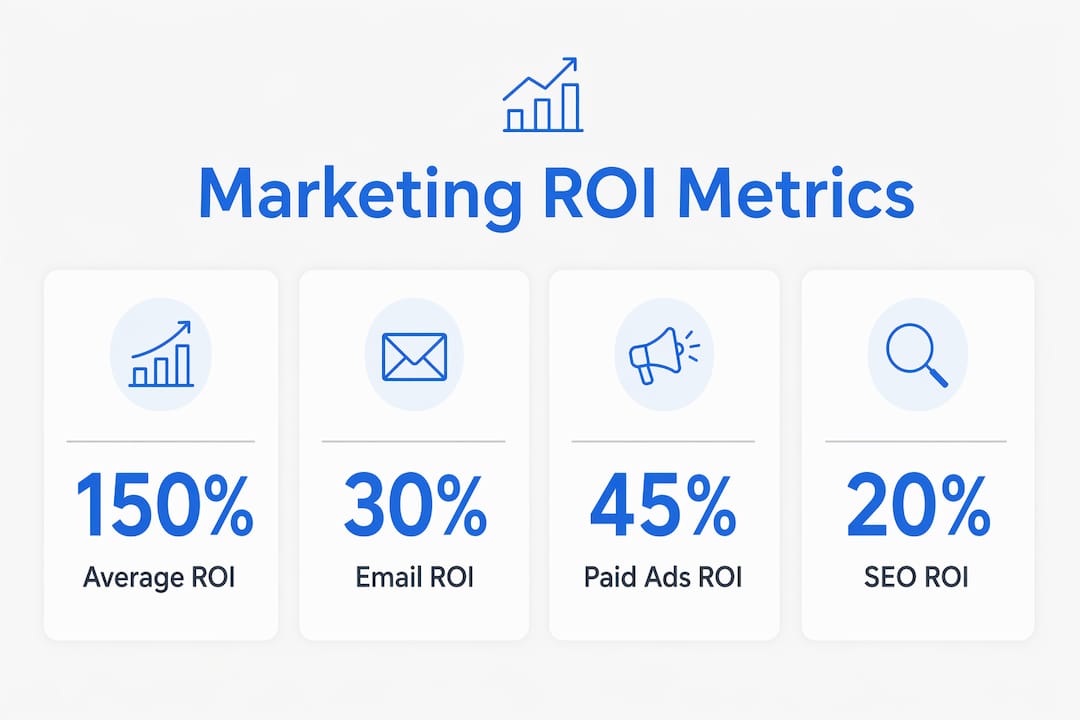
- Scale what works. If email marketing is delivering strong returns, which benchmarks suggest can reach around $36 per $1 spent for well-run programs, allocate more budget there before experimenting with new channels.
- Investigate before cutting. A low-ROI channel might be suffering from poor creative, wrong audience targeting, or a broken landing page. Diagnose before you eliminate.
- Use ROI as a channel comparison tool. When you express every channel in the same financial unit, you can compare paid search against content marketing against referral programs on equal terms. That comparison is where the best budget decisions come from.
- Build a rolling 12-month view. Single-campaign ROI snapshots miss seasonal patterns and compounding effects. A rolling view shows you which channels perform consistently versus which ones spike and fade.
For SMBs looking to build a structured approach, pairing ROI tracking with a clear SMB marketing strategy gives the data context it needs to drive real decisions. Analytics-driven approaches consistently outperform gut-feel allocation, and analytics in marketing gives SMBs the measurement infrastructure to act on what the numbers reveal.
Key takeaways
Marketing ROI is the financial metric that transforms marketing from a cost center into a measurable revenue driver for SMBs.
| Point | Details |
|---|---|
| ROI formula basics | Calculate as (revenue minus cost) divided by cost, using profit margins not gross revenue. |
| Budget defense value | Documented ROI protects marketing spend during downturns by proving direct financial contribution. |
| Attribution accuracy | Last-click models overstate some channels; incrementality testing reveals true marketing lift. |
| Measurement discipline | Tracking ROI consistently surfaces data gaps and improves decision speed across the business. |
| Scale with evidence | Use high-ROI channels as the baseline for budget growth before testing new ones. |
What I have learned from watching SMBs measure ROI the wrong way
Most SMB owners I have worked with start measuring marketing ROI the same way: they pull revenue numbers from one place, ad spend from another, and call the gap their return. That approach feels rigorous. It is not.
The most common mistake is not the formula. It is the inputs. Business owners consistently undercount marketing costs by forgetting agency fees, internal staff time, and software subscriptions. That makes ROI look better than it is, which leads to overconfidence in channels that are actually marginal.
The second mistake is measuring too fast. I have seen owners kill SEO programs at month three because the ROI looked weak. Six months later, a competitor who stayed the course was ranking for every term they abandoned. Measurement horizons must match channel timelines. Paid search can be judged in weeks. Content and SEO need quarters.
My honest recommendation: start simple, stay consistent, and resist the urge to optimize before you have enough data to trust. A 90-day baseline of clean, complete ROI data is worth more than six months of sophisticated attribution modeling built on incomplete inputs. Once you have that baseline, the decisions get easier. You stop arguing about which channel feels right and start following the numbers.
— Eric
Ready to measure what actually moves your business forward?
Most SMBs have the data to calculate marketing ROI. What they lack is a system that connects it, interprets it, and turns it into a spending decision.

Marvingrowthpartners works with SMB owners to build exactly that. From identifying your highest-return channels to building measurement frameworks that hold up under scrutiny, the team at Marvin Growth Partners brings executive-level strategy to businesses that need results without the overhead of a full internal marketing team. If you want to stop guessing and start growing with confidence, explore how Marvingrowthpartners approaches ROI-focused growth for businesses at every stage.
FAQ
What is marketing ROI for a small business?
Marketing ROI measures the financial return a business earns from its marketing spend relative to what that spend costs. For small businesses, it is calculated as revenue from marketing minus marketing cost, divided by marketing cost, multiplied by 100.
How do I calculate marketing ROI accurately?
Include all costs such as ad spend, software, staff time, and creative fees, then attribute revenue using CRM data or UTM tracking. Use profit margin rather than gross revenue to avoid overstating the result.
What is a good marketing ROI benchmark for SMBs?
Benchmarks vary by channel. Email marketing is one of the strongest performers, with well-run programs returning around $36 for every $1 spent. Paid search and social media typically return lower ratios but can scale faster.
Why does marketing ROI measurement often give misleading results?
Last-click attribution assigns all credit to the final touchpoint before a sale, which undervalues channels like SEO and email that build demand over time. Incrementality testing corrects this by isolating the true lift each channel contributes.
How often should SMBs review their marketing ROI?
Monthly reviews give enough data to spot trends without reacting to short-term noise. Channels with longer sales cycles, such as SEO or content marketing, should be evaluated on a quarterly basis to avoid cutting programs before they reach full performance.