

The Role of Social Media in Brand Presence for SMBs
Social media’s role in brand presence is to create human-like, sustained interactions that build trust, amplify identity, and drive measurable engagement across platforms like Facebook, Instagram, and TikTok. For small and medium-sized businesses, this is not a passive benefit. It is a competitive requirement. Brands that treat social media as a broadcast channel miss the deeper mechanics at work: persuasion psychology, platform-specific engagement behavior, and the operational discipline required to respond at scale. This article breaks down exactly how social media shapes brand perception, which platforms deliver real returns in 2026, and what SMBs can do right now to build a presence that compounds over time.
How do social and telepresence influence brand engagement?
Social presence is defined as the degree to which a brand communicates warmth, personality, and human connection through digital interactions. Telepresence is the immersive quality of a digital experience, where a consumer feels genuinely transported into a brand’s world rather than scrolling past content. Both concepts come from communication theory, but their marketing implications are concrete and measurable.

A 2025 study of 373 brand interactors found that social presence significantly impacts the central route of persuasion, with a statistically significant effect (β = 0.179, p = 0.000) on brand engagement. This means content that feels personal and credible, not just visually polished, is what actually moves people to act. Brands that invest in narrative-driven storytelling, behind-the-scenes content, and direct audience dialogue are activating this central persuasion route.
The peripheral route, by contrast, relies on surface-level cues like follower counts or aesthetic consistency. It generates attention but rarely builds lasting loyalty. Brands that create humanized, immersive experiences through storytelling consistently outperform those focused only on posting frequency or visual templates.
- Use video formats that place real people, founders, or team members, front and center
- Write captions that explain your reasoning, not just your offer
- Respond to comments with specificity, not generic thank-yous
- Build series content that rewards returning viewers with continuity
Pro Tip: Focus your content calendar on central-route posts, meaning content that teaches, explains, or reveals something genuine about your brand. One well-reasoned post outperforms ten aesthetic-only posts for building actual brand loyalty.
What platform engagement trends should shape your strategy in 2026?
Not all platforms perform equally, and treating them as interchangeable is one of the most common and costly mistakes SMBs make. Buffer’s 2026 engagement data shows that LinkedIn holds the highest median engagement rate at 8.01%, while Instagram’s median engagement has fallen to 0.61%. These numbers carry a direct implication: organic reach on Instagram has eroded significantly, while LinkedIn rewards consistent, substantive content with outsized visibility.
TikTok tells a different story entirely. Emplifi’s 2026 benchmark report shows that median brand follower counts on TikTok grew 200% year-over-year in 2025, with engagement rates hitting 27.6% in Q4 2025. That is not a niche platform anymore. For brands targeting younger demographics or consumer categories with high visual appeal, TikTok now represents the highest-return organic channel available.
The table below summarizes current platform benchmarks to help you prioritize where your limited resources go.
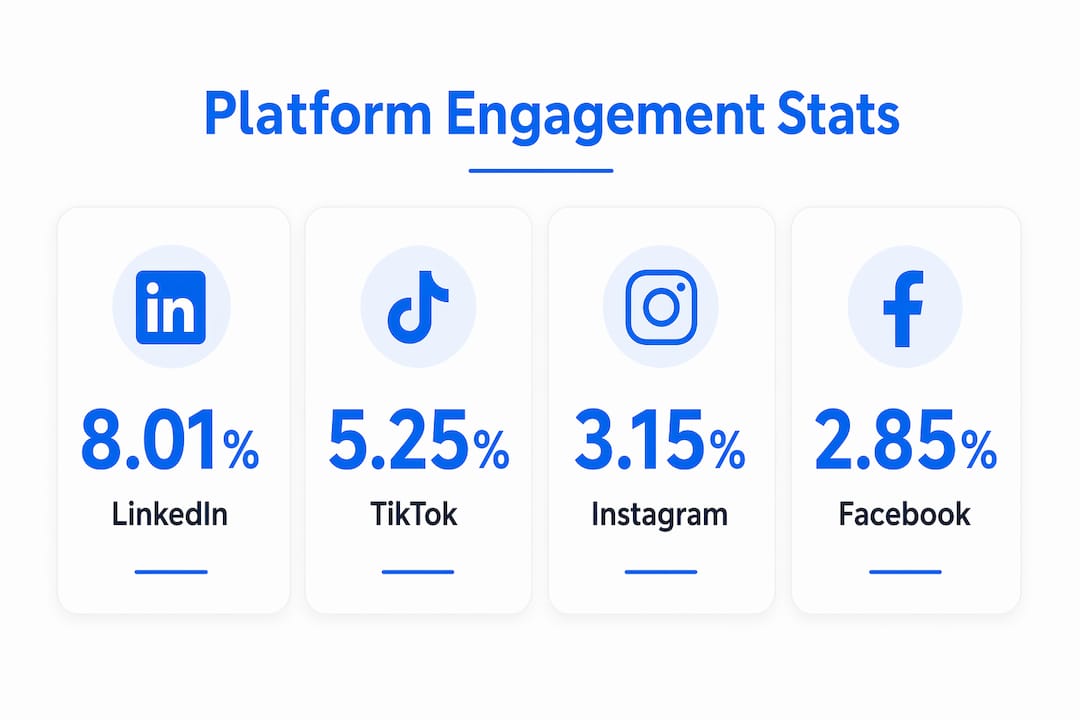
| Platform | Median engagement rate | Notable trend |
|---|---|---|
| 8.01% | Strongest organic reach for B2B and professional brands | |
| TikTok | 27.6% (Q4 2025) | 200% follower growth YOY; highest growth platform |
| 0.61% | Declining organic reach; paid amplification increasingly required | |
| Low organic reach | Community groups and paid ads remain relevant | |
| X (Twitter) | Declining | Niche utility; limited for most SMB brand-building |
| Threads | Emerging | Early-stage; watch for engagement pattern development |
Platform-specific creative strategy impacts ROI significantly. Standardizing content formats across networks leads to suboptimal engagement, because each platform rewards different behaviors, formats, and posting cadences. A LinkedIn article and a TikTok video require entirely different production logic, even if the underlying brand message is identical.
Pro Tip: If you are an SMB with a team of one or two managing social media, pick two platforms maximum and commit fully. Shallow presence on five platforms produces worse results than deep, consistent presence on two.
Why does response speed define your brand reputation online?
Response speed on social media is not a customer service metric. It is a brand reputation signal. Nearly 75% of social media users expect a brand reply within 24 hours or less, according to Sprout Social’s 2026 Customer Experience Management benchmarks. This expectation applies equally to a 10-person company and a 10,000-person enterprise. Customers do not adjust their standards based on your headcount.
The practical consequence is that brands with inconsistent or slow response patterns erode trust even when their content is excellent. Operational readiness, meaning structured monitoring, clear escalation protocols, and pre-approved response frameworks, is the backbone of effective brand presence that most SMBs overlook entirely.
Consider how brands like Grammarly and Casio handle social engagement. Both maintain rapid, personalized response patterns across platforms, treating every public comment as a visible brand interaction, not just a private customer service ticket. That visibility matters because other potential customers read those exchanges and form opinions about the brand’s character.
- Set up a unified social inbox using tools like Sprout Social or Hootsuite to monitor all platforms from one place
- Create a tiered response system: immediate acknowledgment within two hours, full resolution within 24 hours
- Build a library of authentic, pre-approved response templates for common questions that still sound human
- Assign clear ownership so no message falls through the cracks during weekends or off-hours
Pro Tip: Operational readiness with monitoring workflows prevents brand presence erosion even when posting volume is low. A brand that replies slowly to 100 comments undoes the goodwill built by 50 excellent posts.
How do influencers and creator ecosystems amplify brand presence?
Influencers function as trust mediators. They transfer credibility from their established audience relationship to your brand, which is a mechanism no amount of paid advertising can fully replicate. Pew Research Center’s 2026 study of over 5,000 U.S. adults found that 40% get health and wellness information from social media influencers or podcasts. That figure signals how deeply embedded influencer content has become in consumer decision-making across categories, not just health.
The strategic error most SMBs make is treating influencer partnerships as one-off campaigns. A single sponsored post generates a spike, then disappears. Integrating influencers as part of an ongoing brand presence system produces compounding returns because repeated exposure builds genuine association between the creator’s credibility and your brand. You can explore influencer marketing strategies that align creator content with measurable brand visibility goals.
Effective influencer alignment requires more than audience size matching. The creator’s content style, values, and communication tone must align with your brand’s positioning. A misaligned partnership, even with a large following, produces skepticism rather than trust transfer.
- Prioritize micro-influencers (10,000 to 100,000 followers) for higher engagement rates and more targeted audiences
- Negotiate multi-post or ongoing ambassador arrangements rather than single sponsored posts
- Give creators genuine creative freedom within brand guidelines; scripted content reads as scripted
- Track brand mention sentiment and follower overlap to measure actual credibility transfer, not just reach
What practical social media strategies can SMBs implement right now?
Translating platform data and persuasion theory into daily practice requires a structured approach. The SMB marketing strategy guide from Marvingrowthpartners outlines how to align platform selection with business growth stages, which is a critical starting point before investing in content production.
Here are seven steps that produce measurable results for SMBs with limited resources:
- Audit your current platform performance. Pull 90 days of engagement data and identify which platforms generate actual conversations, not just impressions.
- Select two primary platforms based on where your audience is most active and where engagement benchmarks favor organic content.
- Build a content mix that balances central-route and peripheral content. Aim for 60% educational or narrative posts and 40% promotional or visual content.
- Establish a response protocol with defined ownership, response time targets, and a template library that sounds human.
- Identify two to three micro-influencers whose audience overlaps with your ideal customer and propose ongoing collaboration rather than a single post.
- Use platform-native formats. Short-form video on TikTok, long-form articles on LinkedIn, and Stories on Instagram each require distinct production approaches.
- Review analytics monthly and cut underperforming content types without sentiment. Social proof strategies like user-generated content and testimonials can be layered in once your baseline engagement is stable.
Consistency beats volume. A brand that posts three times per week with strong engagement and fast responses outperforms one posting daily with no interaction strategy.
Key takeaways
Effective social media brand presence requires combining psychological engagement, platform-specific strategy, operational responsiveness, and integrated influencer partnerships to build compounding brand credibility.
| Point | Details |
|---|---|
| Social presence drives persuasion | Content with human warmth activates central-route persuasion, producing stronger and more lasting brand engagement. |
| Platform selection determines ROI | LinkedIn leads with 8.01% median engagement; TikTok grew 200% YOY. Choose platforms based on data, not assumption. |
| Response speed is a brand signal | 75% of users expect replies within 24 hours. Slow responses erode trust regardless of content quality. |
| Influencers need ongoing integration | One-off campaigns produce spikes. Sustained creator partnerships build compounding credibility transfer. |
| SMBs should focus, not spread thin | Two platforms executed well outperform five platforms managed poorly for brands with limited marketing resources. |
Why most SMBs are building brand presence backwards
I have worked with enough growing businesses to recognize a pattern that shows up almost every time. The team spends weeks designing a content calendar, picking brand colors for their grid, and scheduling posts across every platform they can name. Then they wonder why engagement is flat three months later.
The problem is sequencing. Most SMBs build the broadcast infrastructure first and the interaction infrastructure never. They treat social media like a billboard when it functions more like a phone line. The brands I have seen grow fastest on social media are the ones that respond to every comment in the first hour, treat their DMs like a sales channel, and post less but with more substance.
The persuasion research backs this up. Peripheral cues, meaning aesthetics, follower counts, and posting frequency, generate awareness. But central-route content, meaning posts that explain, teach, or reveal something real, generates the kind of engagement that turns followers into customers. Most SMBs never get there because they exhaust their resources on production and leave nothing for interaction.
The other mistake I see constantly is platform overextension. A two-person marketing team cannot maintain genuine presence on LinkedIn, TikTok, Instagram, Facebook, and X simultaneously. Spreading thin produces mediocre results everywhere. Picking two platforms and going deep produces a brand that actually feels alive. That feeling is what drives word-of-mouth, repeat engagement, and the kind of organic growth that compounds without a paid media budget behind it.
The marketing glossary at Marvingrowthpartners is a useful reference if you want to get precise about the terms behind these concepts before building your strategy.
— Eric
How Marvingrowthpartners helps SMBs build real brand presence
Building a social media presence that actually converts requires more than a content calendar. It requires a system that aligns platform selection, content strategy, response operations, and influencer partnerships into a single growth engine.
Marvingrowthpartners specializes in exactly this kind of execution. Rather than applying recycled playbooks, the team builds platform-specific strategies grounded in your business’s actual growth stage, audience data, and resource constraints. Whether you need help auditing your current social performance or building a full presence system from scratch, Marvingrowthpartners delivers the strategic clarity and hands-on execution that growing businesses need without the overhead of a full internal marketing team.
FAQ
What is the role of social media in brand presence?
Social media’s role in brand presence is to create sustained, human-like interactions that build trust, amplify brand identity, and drive engagement across platforms. It goes beyond visibility by activating psychological persuasion mechanisms that convert audiences into loyal customers.
Which social media platform has the best engagement for SMBs?
LinkedIn holds the highest median engagement rate at 8.01%, making it the strongest platform for organic brand-building, particularly for B2B and professional service brands. TikTok leads in growth, with brand follower counts rising 200% year-over-year in 2025.
How fast should a brand respond to social media comments?
Brands should reply within 24 hours at maximum, with two hours being the operational target for maintaining strong brand reputation. Sprout Social’s 2026 data shows 75% of social media users hold this expectation regardless of company size.
How do influencers improve brand presence on social media?
Influencers transfer credibility from their established audience relationship to your brand, which accelerates trust-building faster than organic content alone. Ongoing partnerships produce stronger results than single sponsored posts because repeated exposure builds genuine brand association.
How many social media platforms should an SMB focus on?
SMBs with limited marketing resources should focus on two platforms maximum and build genuine, consistent presence there. Shallow activity across five platforms produces weaker engagement and brand recall than deep, responsive presence on two well-chosen channels.