

Marketing Strategy Types for SMBs: 2026 Growth Guide
Marketing strategies for SMBs are classified into two core categories: B2B and B2C, each requiring distinct tactics, messaging, and channels to generate real growth. The types of marketing strategies SMBs use most effectively combine owned digital channels like SEO and email with targeted paid and social tactics, selected based on audience behavior and budget. Salesforce identifies 16+ tactics small businesses use, from LinkedIn ads and white papers for B2B to influencer campaigns and SMS promotions for B2C. The businesses that grow fastest are not the ones doing the most. They are the ones doing the right things consistently, in the right channels, for the right audience.
1. B2B vs B2C marketing strategies for SMBs
The most important decision any SMB owner makes before spending a dollar on marketing is identifying whether they sell to businesses or consumers. That single distinction shapes every channel, message, and budget allocation that follows.
| Dimension | B2B | B2C |
|---|---|---|
| Sales cycle | Long, multi-stakeholder | Short, individual decision |
| Primary channels | LinkedIn, email, SEO, white papers | Instagram, TikTok, SMS, influencer |
| Messaging focus | ROI, problem-solving, trust | Emotion, lifestyle, urgency |
| Content types | Case studies, webinars, data reports | Video, user-generated content, promotions |
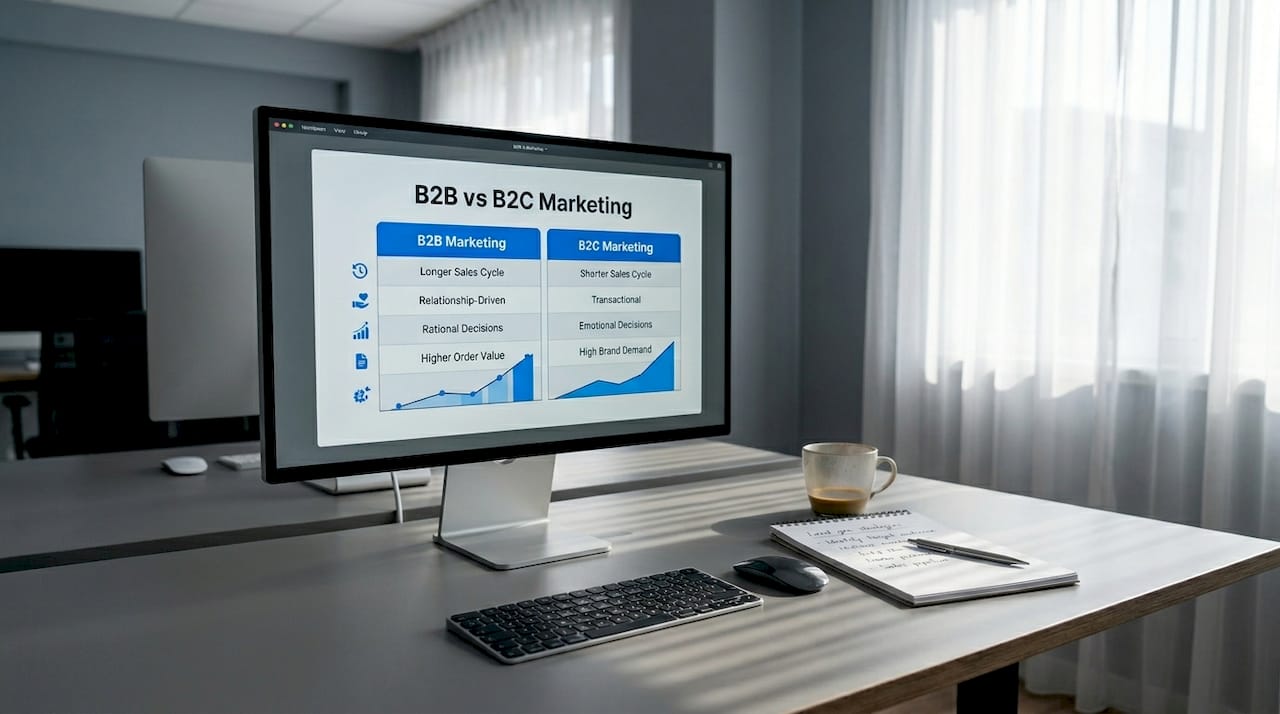
B2B and B2C tactics differ not just in channel but in the psychology behind the message. A B2B buyer evaluates risk and justifies spend to a team. A B2C buyer acts on desire and convenience. Even when both audiences use the same channel, like email, the copy, cadence, and call to action must be built differently.
Pro Tip: If your SMB sells to both businesses and consumers, build two separate audience segments with distinct messaging tracks. Mixing tones in one campaign is one of the fastest ways to underperform in both markets.
2. SEO and content marketing
SEO is the highest-returning owned channel for most SMBs because it compounds over time without requiring ongoing spend. Website and blog SEO ranks as the top channel for B2B SMBs in 2026, used by 48.4% of marketers surveyed by HubSpot. That number reflects a structural advantage: a well-optimized page keeps generating leads for months or years after publication.
Content marketing is the engine that powers SEO. Blog posts, how-to guides, comparison pages, and FAQ content all serve dual purposes. They attract search traffic and build credibility with prospects who are still deciding whether to trust you. For local SMBs, pairing content with Google Business Profile optimization and local keyword targeting accelerates results significantly.
The Marvingrowthpartners marketing glossary is a practical reference if you need to get clear on terms like domain authority, backlinks, or keyword intent before building your SEO plan.
3. Email marketing
Email marketing delivers one of the strongest returns of any affordable marketing tactic available to SMBs. Email marketing ranks second among top channels for B2B SMBs in 2026, with 39.3% of marketers citing it as a primary driver. Unlike social media, your email list is an asset you own outright. No algorithm change can cut your reach overnight.
The most effective email programs for SMBs segment by behavior, not just demographics. A prospect who downloaded a pricing guide gets a different sequence than a customer who bought six months ago. Tools like Mailchimp, Klaviyo, and ActiveCampaign make this segmentation accessible without a dedicated marketing team. Consistency matters more than frequency. A monthly newsletter sent reliably outperforms a burst of five emails followed by three months of silence.
4. Social media marketing
Organic social media is the third most used channel for SMBs, with 38.6% of marketers prioritizing it according to HubSpot’s 2026 data. The key word is organic. Paid social amplifies reach, but matching channels to customer behavior is what determines whether that spend converts or disappears.
LinkedIn works for B2B SMBs targeting decision-makers in professional industries. Instagram and TikTok work for B2C brands with visual products or strong lifestyle positioning. Facebook remains effective for local service businesses running geo-targeted campaigns. Choosing the wrong platform is not a budget problem. It is a strategy problem. Spend 30 minutes mapping where your customers actually spend time before committing to any platform.
Video marketing for local businesses is one of the fastest-growing tactics in this category, with short-form video consistently outperforming static posts for engagement across most platforms.
5. Pay-per-click advertising
PPC advertising through Google Ads or Meta Ads gives SMBs immediate visibility while organic channels build over time. The tradeoff is real: paid ads stop generating leads the moment spend stops, while SEO and email continue compounding. That makes PPC most effective as an amplifier, not a foundation.
One detail most SMB owners miss is that Google Ads campaigns go through a learning period tied to conversion volume and sales cycle length, not a fixed number of days. Cutting a campaign too early because it looks slow in week one is a common and costly mistake. Set realistic evaluation windows based on your average sales cycle, and let the algorithm gather enough data before making optimization decisions.
6. Referral and word-of-mouth marketing
Referral marketing is one of the most affordable marketing tactics available to SMBs because the acquisition cost is near zero when the program is structured correctly. A satisfied customer who refers a peer converts at a dramatically higher rate than any cold channel. The mechanics are simple: give customers a clear reason to refer, make the process frictionless, and reward the behavior consistently.
Formal referral programs using tools like ReferralCandy or Friendbuy work well for e-commerce SMBs. Service businesses often get better results from a direct ask combined with a small incentive, like a discount on the next invoice or a gift card. The channel that most SMBs underinvest in is the one their customers are already using on their behalf.
7. Partner and co-marketing
Partner marketing pairs your SMB with a complementary business to reach each other’s audiences at shared cost. A local gym partnering with a nutrition brand, or a B2B software company co-hosting a webinar with a consulting firm, are both examples of this tactic generating qualified leads without proportional spend.
The best partnerships share an audience but do not compete for the same sale. A wedding photographer partnering with a florist reaches the same buyer at different moments in the same purchase journey. Co-branded content, joint email campaigns, and shared events all work within this model. The key is selecting partners whose audience quality matches your own.
8. Traditional marketing methods for local SMBs
Traditional marketing methods for small enterprises remain effective when integrated with digital campaigns rather than treated as separate efforts. Direct mail, for example, has seen a measurable resurgence because physical mail now stands out in a world of digital noise. A postcard campaign targeting a specific zip code, paired with a retargeting ad campaign for the same geography, produces stronger recall than either tactic alone.
Local event sponsorships, print ads in community publications, and in-store experiential marketing all build the kind of neighborhood trust that digital channels struggle to replicate. For service businesses like plumbers, dentists, or accountants, local brand recognition often drives more revenue than any national digital campaign. The goal is not to choose between traditional and digital. It is to use each where it performs best.
9. Multi-channel marketing strategy
Using four or more channels can outperform single or two-channel strategies by 300% in engagement for SMBs. That is a significant lift, but it comes with an execution cost that many SMB owners underestimate. Spreading resources across too many channels without the bandwidth to execute each one well produces mediocre results everywhere.
The practical approach is to select three to five channels based on where your customers actually spend time, then build systems that make each channel manageable. An effective multi-channel guide for SMBs recommends starting with two owned channels, adding one paid channel, and expanding only after the first combination is producing consistent results. Data from each channel informs the next decision. AI tools like Jasper for content and Madgicx for ad optimization are making this iteration faster and cheaper for SMBs without large marketing teams.
Pro Tip: Track one primary KPI per channel rather than trying to measure everything at once. Knowing that email drives 40% of your demo requests tells you more than a dashboard full of vanity metrics.
10. How to choose the right marketing strategy for your SMB
HubSpot’s planning framework starts with four steps before any channel is selected: define your goals, identify your audience, establish your positioning, and set success metrics. Skipping any of these steps leads to budget waste, not just suboptimal results.
Here is a practical sequence for SMB owners building or rebuilding their marketing approach:
- Set one primary goal: awareness, lead generation, or retention. Each goal maps to different channels and tactics.
- Define your audience with specificity. Job title, industry, and pain point for B2B. Age, location, and purchase trigger for B2C.
- Audit your current channels. Identify what is already working before adding anything new.
- Allocate budget using the 7 to 10% revenue benchmark that small business research consistently supports.
- Map tactics to funnel stages. Awareness tactics like SEO and social media feed the top. Email and retargeting close the bottom.
- Measure and adjust quarterly. Marketing strategy is not a one-time decision.
Building a brand strategy before selecting channels prevents the common mistake of choosing platforms based on trend rather than fit. The channel is a vehicle. The strategy is the destination.
Key takeaways
The most effective marketing strategy for any SMB starts with owned channels, builds a manageable multi-channel mix, and iterates based on data rather than trend.
| Point | Details |
|---|---|
| Start with B2B vs B2C clarity | Audience type determines channel, message, and budget allocation before anything else. |
| Prioritize owned channels first | SEO and email compound over time and are not dependent on ongoing ad spend to generate leads. |
| Limit channels to what you can execute well | Three to five channels done consistently outperform ten channels done poorly. |
| Budget 7 to 10% of revenue | This benchmark keeps marketing investment proportional to growth stage and cash flow. |
| Map tactics to funnel stages | Awareness, engagement, and conversion each require different tactics and KPIs to measure accurately. |
What I’ve learned about picking the right marketing mix
Most SMB owners I work with come in having tried a lot of channels and feeling like nothing is working. When we dig in, the real problem is almost never the channel. It is that they started with the channel instead of the goal.
The instinct to follow whatever platform is trending is understandable. But chasing TikTok when your buyers are 55-year-old procurement managers, or investing in LinkedIn when you sell handmade candles to consumers, is a resource drain with a predictable outcome. The best marketing decisions I have seen come from owners who were willing to ignore what competitors were doing and focus on where their specific customers actually spend time and make decisions.
The other pattern I see consistently is undervaluing owned assets. An email list of 2,000 engaged subscribers is worth more than 20,000 social media followers you do not own. Owned assets build compounding ROI that paid channels cannot replicate. I always recommend building the email list and the website before spending a dollar on ads.
AI tools are genuinely changing the execution side of this for SMBs. Content creation, ad copy testing, and audience segmentation that used to require a full team are now accessible to a two-person operation. But the strategy still has to come first. A well-targeted campaign built on a clear goal will always outperform a sophisticated AI-generated campaign built on a vague one.
— Eric
How Marvingrowthpartners helps SMBs build marketing systems that scale
Most marketing agencies hand you a plan and leave you to execute it alone. Marvingrowthpartners works differently. The team aligns executive-level strategy with hands-on execution, building marketing systems that fit your growth stage, budget, and real-world constraints. Whether you are sorting out which channels to prioritize or trying to turn scattered tactics into a repeatable growth engine, the approach is built around your specific situation, not a recycled playbook. If you are ready to stop guessing and start building a marketing strategy that compounds, visit Marvingrowthpartners to explore how the team works with SMBs at every growth stage. You can also learn more about the team and their track record on the about page.
FAQ
What are the main types of marketing strategies for SMBs?
The main types are digital marketing (SEO, email, social media, PPC), traditional marketing (direct mail, events, print), referral marketing, partner marketing, and content marketing. Most effective SMB strategies combine two to four of these based on audience type and budget.
How much should an SMB spend on marketing?
Small businesses should allocate 7 to 10% of annual revenue to marketing, according to research benchmarks from Zipdo. Early-stage businesses or those in competitive markets often invest toward the higher end of that range.
What is the difference between B2B and B2C marketing for small businesses?
B2B marketing targets business decision-makers with longer sales cycles, data-driven messaging, and channels like LinkedIn and email. B2C marketing targets individual consumers with faster, emotion-driven tactics across platforms like Instagram, TikTok, and SMS.
Which digital marketing channel has the best ROI for SMBs?
SEO and email marketing consistently deliver the strongest long-term ROI for SMBs because both build owned assets that compound over time. HubSpot’s 2026 data shows these two channels rank first and second in usage among B2B SMB marketers.
How many marketing channels should an SMB use at once?
Three to five channels is the practical range for most SMBs. Using four or more channels can outperform single-channel strategies by 300% in engagement, but only when each channel is executed consistently with dedicated resources.