

The Role of Market Expansion Strategy for SME Growth
Most business owners think market expansion means opening a new location or shipping products overseas. That framing is too narrow, and it costs them. The role of market expansion strategy, properly understood, is a structured approach to growing revenue by moving existing products or services into new customer segments, geographies, or channels in a deliberate, risk-managed way. For SME leaders, this distinction matters enormously. Done right, expansion drives long-term shareholder value and reduces your vulnerability to any single market downturn.
Table of Contents
- Key takeaways
- The real role of market expansion strategy
- Why market research makes or breaks expansion
- Choosing the right type of expansion
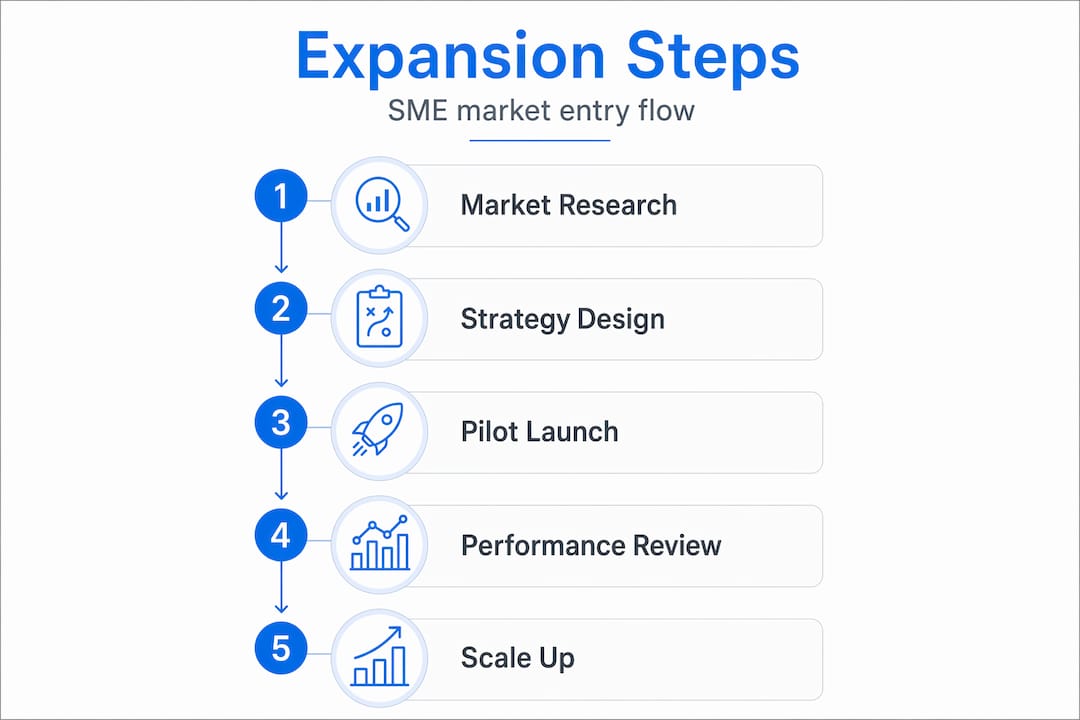
- How to stage your entry into new markets
- Measuring whether expansion is working
- My honest take on what most SMEs get wrong
- How Marvingrowthpartners helps you expand with clarity
- FAQ
Key takeaways
| Point | Details |
|---|---|
| Expansion is more than geography | Market expansion strategy covers new segments, channels, and regions, not just physical locations. |
| Research before you commit | Demand analysis and competitive mapping directly reduce costly entry mistakes. |
| Match strategy to risk tolerance | Ansoff Matrix types carry different risk levels; choose the one your resources can support. |
| Stage your entry | Incremental commitment protects cash flow and lets you learn before scaling. |
| Measure and adjust continuously | KPIs tied to revenue, share, and customer satisfaction keep your expansion on track. |
The real role of market expansion strategy
At its core, market expansion strategy is the structured process of growing revenue through new markets rather than just pushing harder in the ones you already serve. It sits inside the broader discipline of growth strategy, alongside product expansion, operational scaling, and acquisition. The key difference is adjacency: you are leveraging what already works, your product, your brand reputation, your delivery capability, and applying it somewhere new.
This is not the same as product expansion, where you create something new for existing customers. Market expansion keeps your offer largely constant and changes who you are selling it to or where. That distinction shapes everything from your budget to your timeline to your hiring decisions.
The objectives of a well-designed expansion strategy include three things. First, revenue growth through new customer pools. Second, risk diversification by reducing dependence on a single market. Third, long-term competitive positioning in markets where you can build durable advantage before competitors arrive.
For SMEs specifically, this third point is underrated. Large enterprises can afford to enter a market after it heats up and buy their way to relevance. You cannot. Your window to establish yourself in a new market is often the period before it becomes crowded. A clear strategy is what gets you there with intention rather than accident.
Pro Tip: Before writing any expansion plan, articulate your “right to win” in the target market. If you cannot answer why a customer there would choose you over local alternatives, your research phase is not finished yet.
Why market research makes or breaks expansion
The single most common failure mode in market expansion is insufficient research before commitment. Entrepreneurs get excited about an opportunity, move fast, and discover too late that the demand was softer than expected or that a local competitor had structural advantages they never mapped.
Solid expansion research covers several distinct layers. The U.S. Small Business Administration outlines that demand, pricing, and saturation all require evaluation before entry decisions are made. Here is how to think about each layer:
- Market size and demand: Is there enough buying activity in this segment to justify entry costs? Look at total addressable market estimates, growth trends, and whether demand is growing or consolidating.
- Saturation and pricing: A crowded market with compressed margins is a different beast than an underserved one. Know which you are entering before you price your offer.
- Economic indicators: Employment rates, disposable income trends, and sector-specific indicators tell you whether the timing is right.
- Competitive mapping: Who holds market share? What are the barriers to entry? The SBA specifically recommends identifying indirect competitors and barriers, not just direct rivals, because these shape your go-to-market cost and timeline.
For SMEs, good competitive analysis does more than reveal threats. It reveals gaps. A competitor with strong brand recognition but poor customer service creates an opening. A dominant player who serves enterprise clients but ignores the mid-market creates another. These gaps are where smart expansion begins.
Pro Tip: Use your competitive analysis to build a “window of opportunity” document. List every gap you find in competitor offerings, then rank them by how well your current capabilities can fill that gap. The top items become your entry positioning.
Choosing the right type of expansion
Not every expansion move carries the same risk. The Ansoff Matrix, a well-established strategic framework, gives SME leaders a practical lens for understanding this. Ansoff’s four strategies map expansion options by how far they deviate from what you already know.
| Strategy type | What changes | Risk level | Best for |
|---|---|---|---|
| Market penetration | Nothing. Push harder in current markets. | Low | Building share before expanding |
| Market development | New segments or geographies, same product | Moderate | Core expansion play for SMEs |
| Product development | New product, same market | Moderate to high | When market is maxed out |
| Diversification | New product, new market | High | Well-resourced, experienced companies |
For most SMEs exploring growth, market development is the primary play. You take what already works and bring it to a new audience or region. The risk is moderate because you understand the product; the uncertainty is the new market itself. That is manageable with good research.
Diversification sits at the opposite end of the spectrum. You are simultaneously navigating an unfamiliar product and an unfamiliar market. Ruthless prioritization of growth bets is critical here, because spreading resources across multiple unknown variables is how expansion budgets disappear without returns.
Market penetration techniques, like price adjustments, loyalty programs, or increased marketing spend in your current market, are worth considering before any expansion. If your current market is far from saturated, expansion may be premature.
How to stage your entry into new markets
Even when the research is solid and the strategy type is right, execution timing matters. The Uppsala internationalization model, developed by Swedish researchers studying how companies enter foreign markets, offers a useful framework for any expansion context, not just international. It advocates incremental market entry rather than full commitment from day one.
Here is how a staged approach works in practice for an SME:
- Start with low-commitment entry modes. Exporting your product, using agents or distributors, or running a pilot program in the new segment gives you real market data without large capital exposure.
- Build knowledge before scaling. Every interaction in the new market teaches you something about customer behavior, pricing sensitivity, and competitive response. Capture that learning formally, not just informally.
- Progress to higher commitment as confidence grows. Once you have validated demand and refined your offer, move toward more direct presence: a dedicated sales team, a regional partner, or in some cases a local subsidiary.
- Avoid the big-bang temptation. It is tempting to launch with full marketing spend and maximum presence. For most SMEs, staged entry outperforms large upfront bets because it preserves cash and allows course corrections.
- Set clear go and no-go criteria. Before entering, define what results in the first six months would cause you to accelerate versus pause. Having these criteria written down prevents sunk-cost thinking from driving bad decisions later.
The benefits of expansion strategy become real at this stage. A structured plan tells you not just where to go, but at what pace and with what evidence required to justify the next investment.
Pro Tip: Treat your first market expansion like a pilot, not a launch. Set a defined window, track a short list of leading indicators weekly, and build a 90-day decision review into the plan from the start.

Measuring whether expansion is working
Expansion without measurement is just spending. Once you are in a new market, you need a defined set of KPIs connected directly to your original objectives. Generic metrics like website traffic or social media engagement rarely tell you what you need to know at this stage.
Defining measurable goals upfront is what separates expansion programs that self-correct from ones that drift into irrelevance:
- Revenue from new market: This is the primary test. Is actual revenue tracking against your pre-entry projections?
- Customer acquisition cost in the new segment: Compare this to your existing market. If it is dramatically higher, your positioning or channel may need adjustment.
- Market share estimates: Use third-party data, distributor feedback, or sales rep intelligence to track your relative position.
- Customer satisfaction scores: New markets sometimes receive the same product with a different service experience. Track NPS or CSAT separately for new customers versus existing ones.
- Payback period on entry investment: How long until the new market covers its own launch costs? Keep this visible at every executive review.
The goal is not to track everything. It is to track the right things and review them on a cadence that allows adjustments before small problems compound into expensive ones.
My honest take on what most SMEs get wrong
I have worked with enough growing companies to see a pattern. Executives underestimate how much discipline market expansion actually requires. Not just analysis discipline, but execution discipline. The decision to enter a market gets made at the top. The actual work of navigating an unfamiliar customer base, adjusting messaging, building local relationships, and managing cash flow during a slow ramp gets delegated, underfunded, or both.
What I have found is that a clear, written market expansion strategy is not just a planning document. It is a communication tool. It tells your team, your partners, and your investors exactly what you are trying to do, why, and how you will know if it is working. Without it, every setback becomes a debate about whether to continue. With it, setbacks become data.
The other thing I see consistently is companies choosing the wrong expansion type for their actual risk tolerance. They say they want moderate risk, then pursue diversification because the opportunity looks exciting. Matching ambition to capability is not timidity. It is how you expand market reach without putting the core business at risk.
Resilience, long-term profitability, and a business that does not collapse when one market softens. That is what a structured approach to expansion actually builds.
— Eric
How Marvingrowthpartners helps you expand with clarity

Knowing the theory is one thing. Building a market expansion plan that actually fits your business, your team, and your resources is another. Marvingrowthpartners works directly with SME owners and executives to align growth strategy with the realities of execution. The approach at Marvin Growth Partners is not a recycled playbook. Every engagement starts with your actual growth stage, your cash position, and the specific markets you are targeting. From competitive research through staged entry planning and KPI design, the team builds systems that create measurable results without requiring you to add a full internal strategy department. If you are ready to move from thinking about expansion to executing it with precision, that conversation starts here.
FAQ
What is a market expansion strategy?
A market expansion strategy is a structured plan to grow revenue by taking existing products or services into new customer segments, geographies, or distribution channels. It differs from product expansion by keeping the offer stable and changing who receives it.
What are the main benefits of expansion strategy for SMEs?
The core benefits include revenue growth through new customer pools, reduced risk from over-reliance on a single market, and the ability to build competitive position in new segments before they become crowded.
How does the Ansoff Matrix help with expansion planning?
The Ansoff Matrix maps four growth options by risk level, from low-risk market penetration to high-risk diversification. For most SMEs, market development, entering new segments with existing products, offers the best balance of growth potential and manageable risk.
What KPIs should I track during market expansion?
Track revenue from the new market, customer acquisition cost compared to your existing market, estimated market share, customer satisfaction scores, and payback period on your entry investment. Review these on a defined schedule, not just at year-end.
How do I know if I am ready to expand into a new market?
You are ready when you have validated demand through research, mapped the competitive environment, defined your entry mode, set specific KPIs, and established clear go and no-go criteria for the first review period.