

Why SMBs Need Personalized Marketing to Grow
Personalized marketing is defined as the practice of using customer data to deliver tailored messages, offers, and experiences to individuals rather than broad audiences. For small and medium-sized businesses, this is no longer a nice-to-have. It is the single most effective way to compete with larger brands without outspending them. Tools like Klaviyo, HubSpot, and ActiveCampaign have made one-to-one personalization accessible at any budget. AI-driven emails generate 6x more transactions than generic emails. The businesses that understand why SMBs need personalized marketing are the ones pulling ahead right now.
Why SMBs need personalized marketing: the core case
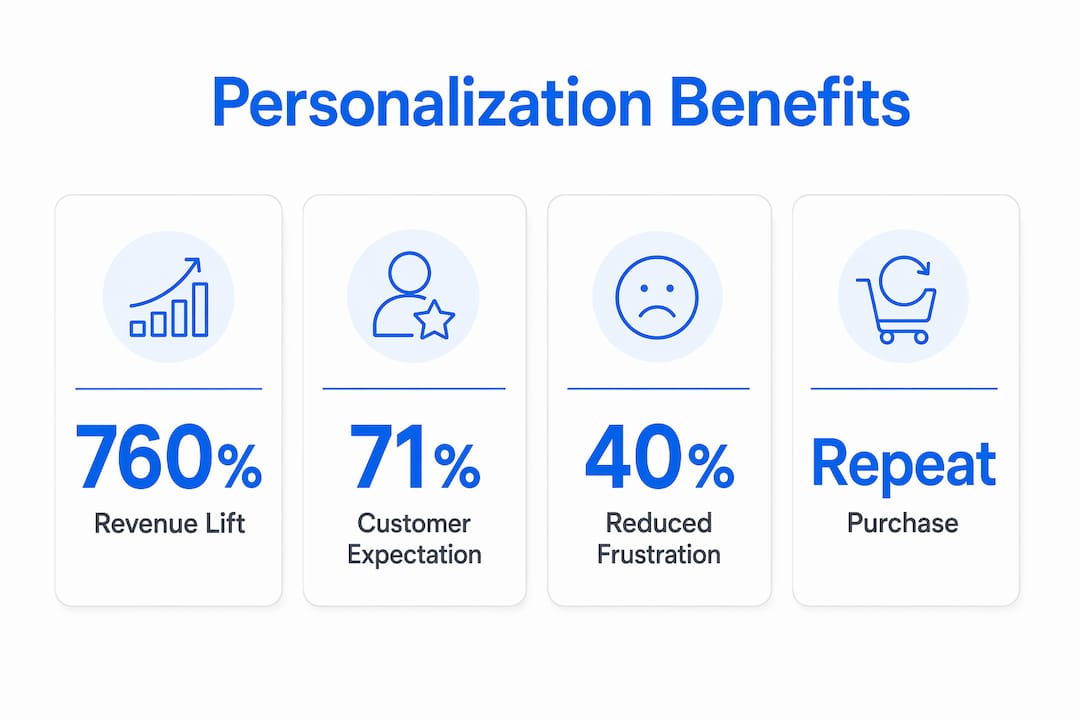
The industry term for what most SMBs are trying to achieve is “one-to-one marketing,” a concept that has existed since the 1990s but only became practically achievable for small businesses with the rise of AI-powered platforms. The business case is not subtle. Companies excelling at personalization generate up to 40% more revenue than their peers. That gap compounds over time, meaning the SMB that starts personalizing today builds a structural advantage that is hard for late movers to close.
Consumer expectations have shifted permanently. 71% of consumers expect personalized interactions, and 76% report frustration when brands fail to deliver them. Those numbers reflect a market where generic communication is not neutral. It actively damages your brand. For SMBs with limited marketing budgets, every message that misses the mark is a direct cost, not just a missed opportunity.

The Amazon and Spotify effect is real. Consumers now experience personalization daily through product recommendations, curated playlists, and dynamic pricing. They carry that expectation into every brand interaction, including yours. SMBs that meet that expectation build the kind of trust that converts first-time buyers into repeat customers.
What measurable benefits does personalized marketing bring to SMBs?
The revenue impact of personalization is documented and specific. Segmented campaigns optimized with AI drive up to 760% more revenue compared to non-personalized campaigns. That figure is not a ceiling. It reflects what happens when the right message reaches the right person at the right moment, which is exactly what personalization is designed to produce.
Beyond revenue, personalization reduces customer acquisition costs. When you focus communication on high-potential leads based on behavioral signals, you stop wasting budget on audiences unlikely to convert. This is especially critical for SMBs where every marketing dollar has to justify itself. AI audience targeting has democratized this precision, giving small businesses the same targeting efficiency that enterprise brands have used for years.
Customer retention is the third major benefit. Relevant communication increases repeat purchase rates because customers feel understood rather than marketed at. Personalization builds trust and shifts customer relationships from one-time transactions to long-term advocacy. For SMBs, a loyal customer base is a more stable growth engine than constant new customer acquisition.
Pro Tip: Start with two high-impact tactics before building anything complex: returning visitor recognition on your website and location-based offers in your email campaigns. Both can be set up in Klaviyo or HubSpot within a day and typically show measurable lift within two to three weeks.
| Point | Details |
|---|---|
| Revenue lift | Segmented AI campaigns drive up to 760% more revenue than generic campaigns. |
| Acquisition efficiency | Behavioral targeting reduces wasted spend by focusing only on high-potential leads. |
| Customer retention | Relevant messaging increases repeat purchases and builds long-term brand loyalty. |
| CTA performance | Personalized CTAs convert significantly better than default versions across all channels. |
How does personalized marketing differ from traditional segmentation?
Segmentation groups customers by shared traits such as age, location, or purchase history, then sends the same message to everyone in that group. It is a static approach. You define the group once, assign content, and repeat. Most SMBs already do some version of this, and it produces better results than no targeting at all. But it is not personalization.
True one-to-one personalization is dynamic. AI-powered platforms analyze individual behavior in real time and generate content specific to that person’s current context, not their demographic category. A returning visitor who browsed a specific product category gets a different homepage experience than a first-time visitor from a paid ad. A customer who abandoned a cart on Tuesday gets a different email sequence than one who completed a purchase. The difference in conversion rates between these two approaches is significant.
84% of brands do not excel at true personalization, and 40% of consumers report feeling misunderstood by the brands they buy from. That gap exists precisely because most businesses are still operating at the segmentation level while consumers expect individual-level relevance. For SMBs, closing that gap is a competitive opportunity, not a technical burden.
| Characteristic | Segmentation | AI-powered personalization |
|---|---|---|
| Data type | Static demographic groups | Real-time behavioral signals |
| Content delivery | Same message per group | Individual-level dynamic content |
| Update frequency | Manual, periodic | Continuous, automated |
| Conversion impact | Moderate improvement | Significantly higher conversion rates |
| Setup complexity | Low | Moderate, but accessible via Klaviyo, HubSpot |
What practical personalization strategies can SMBs implement today?
The most common mistake SMBs make is waiting until they have a “complete” data strategy before starting. Effective personalization starts with simple, rule-based tactics and scales from there. You do not need a data science team. You need a clear starting point.
Here is a practical progression that works for most SMB tech stacks:
- Returning visitor recognition: Show a different homepage banner or CTA to visitors who have been to your site before. Most website platforms including Shopify support this natively or through low-cost apps.
- Traffic source CTAs: A visitor arriving from a Facebook ad should see a different offer than one arriving from a Google search. Personalized CTAs convert 202% better than default versions. This single change can meaningfully lift your paid traffic ROI.
- Behavioral email triggers: Set up sequences in ActiveCampaign or Klaviyo that fire based on specific actions: product views, cart abandonment, post-purchase follow-up. These are not complex to build and run automatically once configured.
- Location-based content: If you serve multiple regions or have physical locations, use IP-based location detection to surface relevant store information, local offers, or regional pricing.
- First-party data collection: Build your own data asset through preference centers, post-purchase surveys, and account profiles. This data is more accurate than third-party data and fully consent-based.
Modern email platforms include AI features requiring no technical setup, which means SMBs can access send-time optimization, product recommendations, and subject line testing without hiring a developer. For Shopify-based businesses, Klaviyo’s native integration makes this setup particularly fast.
Pro Tip: Avoid over-personalization. Referencing a customer’s browsing history too explicitly can feel intrusive rather than helpful. The goal is relevance, not surveillance. Focus on what makes the experience more useful, not what demonstrates how much data you have.
The marketing automation checklist for SMBs from BabyLoveGrowth.ai is a practical resource for mapping out which triggers and sequences to build first, particularly if you are starting from scratch.
How can SMBs measure and optimize personalization success?
Measurement is where most personalization efforts either compound or collapse. Without clear metrics, you cannot distinguish what is working from what is just running. Start with these five core indicators:
- Email open rate: Tracks whether your subject lines and send timing are relevant to individual recipients. A lift here confirms that your segmentation and AI optimization are working.
- Click-through rate: Measures whether the content inside your emails or on your website is matching what recipients actually want. Low CTR with high open rate signals a content relevance problem.
- Conversion rate by segment: Break down conversions by audience segment to identify which groups respond best to personalized offers. This tells you where to invest more.
- Customer retention rate: Tracks whether personalized communication is building loyalty over time. Compare retention rates before and after implementing personalization sequences.
- Revenue lift per campaign: Compare revenue from personalized campaigns against your historical baseline. Website personalization can increase revenue by 5-15%, which gives you a realistic benchmark for early-stage results.
A/B testing is non-negotiable. Every personalization tactic should be tested against a control group before being rolled out broadly. HubSpot and Klaviyo both include built-in A/B testing that requires no additional tools. The role of data in marketing strategy is to give you the feedback loop that turns early experiments into scalable systems.
Three common pitfalls to avoid: fragmented data across disconnected platforms that prevents a unified customer view, ignoring consent and privacy requirements which erodes trust faster than any personalization can build it, and launching personalization without defined goals which makes it impossible to know whether your efforts are paying off.
Key takeaways
Personalized marketing works because it replaces generic broadcast messaging with individual relevance, and SMBs that implement it early build a compounding revenue and retention advantage over competitors who wait.
| Point | Details |
|---|---|
| Revenue impact | AI-optimized segmented campaigns drive up to 760% more revenue than non-personalized campaigns. |
| Consumer expectations | 71% of consumers expect personalization; 76% are frustrated when brands fail to deliver it. |
| Segmentation vs. personalization | True one-to-one personalization uses real-time behavioral data, not static demographic groups. |
| Start simple | Returning visitor recognition and behavioral email triggers deliver fast results with minimal setup. |
| Measure consistently | Track open rates, CTR, conversion rates, and retention to identify what to scale and what to cut. |
Why I think most SMBs are leaving their biggest growth lever untouched
Working with SMB owners across industries, I see the same pattern repeatedly. They run the same email blast to their entire list, wonder why open rates are declining, and conclude that email marketing is dead. It is not dead. It is just being done wrong.
The shift from spray-and-pray to precise, individual-level communication is not a technology problem. It is a mindset problem. Most SMB owners I work with are sitting on enough customer data to build meaningful personalization right now. Purchase history, browsing behavior, geographic data, email engagement signals. The data exists. What is missing is the decision to use it deliberately.
The democratization of AI tools has removed the budget barrier. A Klaviyo account with AI features costs less per month than a single print ad. The role of AI in marketing strategies has fundamentally changed what a two-person marketing team can execute. SMBs that recognize this and act on it now will have a compounding advantage in 12 to 24 months that will be very difficult for slower competitors to close.
My one caution: do not let automation replace judgment. The best personalization I have seen from SMBs combines data-driven triggers with a human voice. Customers can tell when they are talking to a sequence versus a brand that actually knows them. Keep the human element visible, even when the system is running automatically.
Explore the marketing strategy types for SMBs guide from Marvingrowthpartners if you want a broader framework for where personalization fits within your overall growth plan.
— Eric
Ready to build a personalization system that actually scales?
Marvingrowthpartners specializes in helping SMBs move from generic marketing to data-driven, personalized growth systems without the overhead of a full internal team. The approach is built around your specific business stage, not recycled templates.
If you are ready to stop guessing which messages resonate and start building campaigns that convert, Marvingrowthpartners offers hands-on strategy and execution support tailored to where your business is right now. From initial personalization setup to full AI-powered campaign architecture, the team delivers measurable results at every stage of growth.
FAQ
What is personalized marketing for small businesses?
Personalized marketing for small businesses is the practice of using customer data to deliver tailored messages, offers, and content to individuals rather than broad audiences. Tools like Klaviyo, HubSpot, and ActiveCampaign make this accessible without large budgets or technical teams.
How much revenue lift can SMBs expect from personalization?
Segmented campaigns optimized with AI drive up to 760% more revenue compared to non-personalized campaigns, according to research from FutureFactors. Even basic personalization tactics like returning visitor recognition and behavioral email triggers show measurable lift within weeks.
What is the difference between segmentation and true personalization?
Segmentation groups customers by shared traits and sends the same message to each group. True personalization uses real-time behavioral data to generate individual-level content dynamically, which produces significantly higher conversion rates than static segmentation alone.
How do SMBs start personalized marketing without a big budget?
Small businesses can implement personalization quickly with low-cost tools integrated into platforms like Shopify. Start with returning visitor recognition and behavioral email triggers, then scale to AI-powered features as your data and budget grow.
What metrics should SMBs track for personalization success?
Track email open rates, click-through rates, conversion rates by segment, customer retention rates, and revenue lift per campaign. A/B testing every tactic against a control group is the fastest way to identify what to scale and what to cut.