

The Role of Data in Marketing Strategy: 2026 Guide
Data is the operating system of every effective marketing strategy. Without it, you are guessing at which messages resonate, which channels convert, and which customers are worth pursuing. The role of data in marketing strategy is to replace those guesses with decisions grounded in customer behavior, engagement patterns, and measurable business outcomes. Platforms like HubSpot, Customer.io, and Salesforce have made data collection and activation accessible to companies of every size. The marketers who win in 2026 are not the ones with the biggest budgets. They are the ones who know exactly what their data is telling them and act on it faster than their competitors.
What is the role of data in marketing strategy?
Data-driven marketing is defined as using customer behavior and engagement signals to decide when to communicate, what to say, and which channel to use. This is a meaningful departure from calendar-based campaigns where a team decides in January what emails to send in March. Behavioral decisioning means a customer’s own actions trigger the next message, not a scheduled send date.
The operational framework rests on three pillars:
- Reliable first-party data: Behavioral signals you own, such as website visits, purchase history, email opens, and product usage events.
- Real-time activation capability: The ability to act on those signals within minutes or hours, not days.
- Measurement tied to outcomes: Connecting marketing actions to revenue, retention, or acquisition cost reduction, not just impressions or clicks.
The shift from batch campaigns to behavioral triggers is significant. A SaaS company using Customer.io, for example, can fire an onboarding sequence the moment a user completes a specific in-app action. That message arrives when the customer is most engaged, not when the marketing calendar says it should. The result is higher conversion and lower churn.
Pro Tip: Map your top five customer behavioral signals before choosing any activation platform. Knowing what triggers matter most to your business makes platform selection and setup far more precise.

How does data improve marketing effectiveness and ROI?
Marketing analytics connects activities like webinar attendance, email clicks, and paid ad impressions to revenue outcomes. Without that connection, budget decisions are political rather than evidence-based. With it, you can reallocate spend toward what actually drives growth.
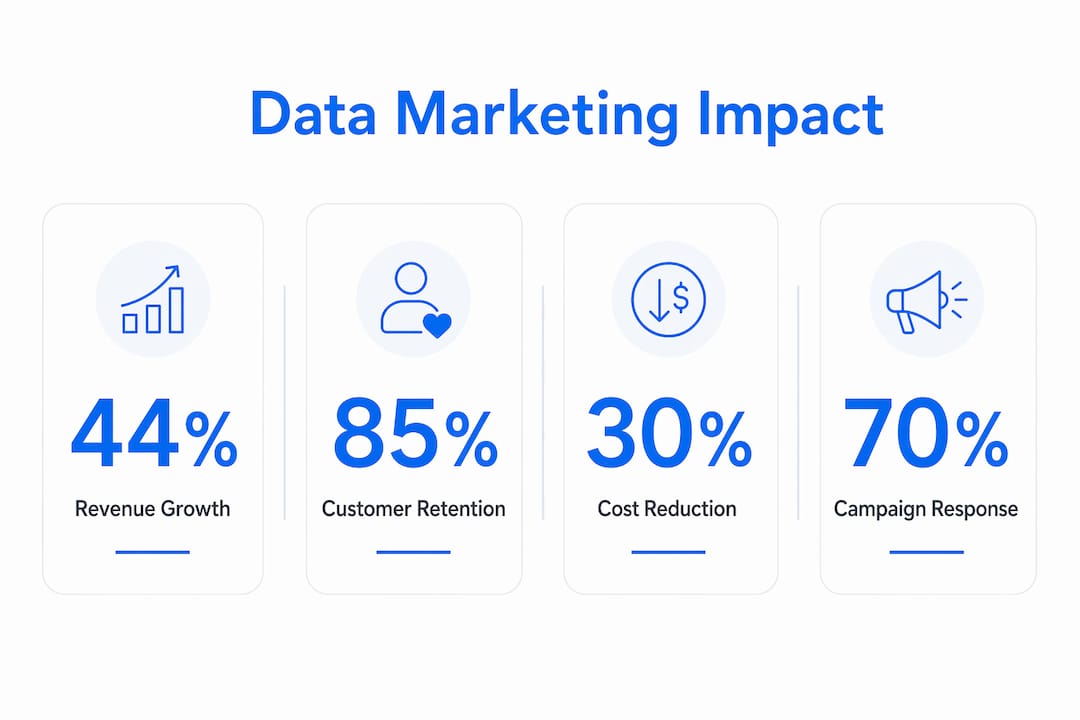
A concrete example comes from NC State’s Poole College of Management, where webinar attendees convert at three times the rate of blog readers. That single insight justified shifting budget from content production to webinar promotion, directly reducing customer acquisition costs. This is the impact of data on marketing in practice: a measurable signal that changes where money goes.
The most effective analytics frameworks separate two distinct questions:
- What happened? Multi-touch attribution (MTA) maps which channels and touchpoints appeared in the path to conversion.
- What caused it? Incrementality testing isolates the causal effect of a specific campaign or channel by comparing exposed and unexposed groups.
Separating diagnostic attribution from incrementality testing is critical to making defensible budget decisions. Many marketing teams rely on MTA alone and end up over-crediting channels that correlate with conversion but do not actually cause it. Incrementality testing removes that bias.
A practical approach to marketing strategy optimization using data looks like this:
- Define the revenue outcome you want to influence (new customers, retention, upsell).
- Identify the behavioral signals that predict that outcome.
- Build attribution models to map current channel contribution.
- Run incrementality tests on your top two or three channels.
- Reallocate budget based on causal impact, not correlation.
This process turns data analytics in marketing from a reporting function into a growth function.
What challenges do marketers face with data-driven strategies?
The biggest barrier to data-driven marketing is not a lack of data. It is fragmentation. Most organizations collect data across CRM systems, ad platforms, email tools, and web analytics, but those sources rarely talk to each other in real time. The result is siloed dashboards that tell different stories and no single version of the truth.
Only 46% of organizations have a fully centralized single source of truth (SSOT) for customer data. Organizations with an SSOT report 44% revenue growth compared to 8% for those without one. That gap is not a coincidence. Centralized data enables faster personalization, more reliable experimentation, and cleaner measurement.
The most common operational obstacles include:
- Data latency: Event data that takes 24 to 48 hours to process cannot support real-time personalization. Only 12% of marketers primarily use real-time signals, which means most campaigns are still optimized on yesterday’s behavior.
- Partial integration: 68% of organizations report partial data integration, which prevents cross-channel activation and leaves loyalty data sitting unused in disconnected systems.
- Poor data hygiene: Duplicate records, inconsistent identifiers, and missing fields degrade the quality of every downstream decision, including AI-generated recommendations.
The solution starts with adopting a Customer Data Platform (CDP). CDPs unify customer data across channels and devices in real time, building continuously updated profiles that feed segmentation, personalization, and AI systems. Salesforce, Segment, and mParticle are among the leading CDP providers. Beyond technology, data centralization requires governance: clear ownership of data quality, defined schemas, and cross-team agreements on how data is collected and used.
Pro Tip: Treat your data centralization project as a governance initiative first and a technology project second. The best CDP in the world will not fix inconsistent data collection practices upstream.
How can AI enhance data analytics in marketing?
AI amplifies the value of good data infrastructure. It does not replace the need for clean, centralized, and timely data. It multiplies it. When the underlying data is fragmented or stale, AI decisioning becomes inconsistent and less reliable, which erodes trust in the outputs across the entire marketing team.
When data foundations are solid, AI delivers measurable gains across three specific use cases:
- Campaign optimization: AI identifies which audience segments, creative variants, and send times produce the best outcomes, then adjusts in real time. 45% of marketing teams now use AI primarily for campaign optimization.
- Performance analysis: AI surfaces patterns in large datasets that human analysts would miss or take weeks to find. 37% of teams apply AI to performance analysis.
- Personalization at scale: AI generates individualized content recommendations, product suggestions, and messaging sequences based on behavioral profiles. 29% of teams use AI for this purpose.
The most advanced teams are moving toward multi-method measurement architectures that combine Marketing Mix Modeling (MMM), multi-touch attribution, and incrementality testing. The AIMx framework proposed in recent research integrates all three approaches with AI to support adaptive budget allocation decisions. This is not a tool most small teams can deploy immediately, but it represents the direction the industry is heading.
“The gap between marketers who treat AI as a reporting shortcut and those who use it as a decisioning engine is widening. The difference is almost always data readiness.”
For most marketing teams, the practical starting point is using AI within existing platforms like HubSpot, Klaviyo, or Iterable to automate segmentation and trigger-based messaging before building custom analytics infrastructure.
Best practices for using data effectively in your strategy
Getting data-driven marketing right requires discipline at every stage, from how you collect data to how you act on it and measure results. These practices apply whether you are running a five-person marketing team or managing a $10 million ad budget.
- Set outcome-based goals first. Define what business result you are trying to move before choosing metrics. Revenue per customer, retention rate, and acquisition cost are outcome metrics. Open rates and impressions are activity metrics. Build your measurement system around outcomes.
- Identify your highest-value behavioral signals. Not all data is equally useful. Purchase intent signals, product usage milestones, and repeat visit patterns are far more predictive than page views. Prioritize collecting and activating these signals.
- Centralize before you personalize. Personalization built on fragmented data produces irrelevant messages. Irrelevant targeting damages inbox engagement and domain reputation. Centralize your customer data first, then build personalization on top of a clean foundation.
- Test causality, not just correlation. Run incrementality tests on your top channels at least quarterly. This protects your budget from being allocated to channels that look effective in attribution reports but do not actually drive incremental revenue.
- Iterate based on data, not intuition. Build a regular cadence of reviewing campaign performance against outcome metrics. Use what you learn to adjust messaging, targeting, and channel mix. The marketing strategy types that compound over time are the ones built on continuous measurement and refinement.
Pro Tip: Start with one behavioral trigger and one outcome metric. Prove the loop works at small scale before expanding. Complexity added too early is the most common reason data-driven programs stall.
Key takeaways
Data-driven marketing requires centralized first-party data, real-time activation, and outcome-based measurement to deliver consistent, compounding ROI.
| Point | Details |
|---|---|
| Centralize data first | Organizations with a single source of truth report 44% revenue growth vs. 8% for those without one. |
| Separate attribution from causality | Multi-touch attribution shows what happened; incrementality testing proves what caused it. Use both. |
| AI needs clean data | AI campaign tools only perform reliably when built on unified, timely, and well-governed data. |
| Real-time activation is rare | Only 12% of marketers use real-time signals, making it a significant competitive advantage for early adopters. |
| Behavioral triggers outperform calendars | Messaging triggered by customer actions converts at higher rates than scheduled batch campaigns. |
What I’ve learned from watching teams get data wrong
Most marketing teams I work with do not have a data shortage. They have a data activation problem. They are sitting on months of behavioral signals, loyalty records, and engagement history that never gets used because it lives in three different systems that were never designed to talk to each other.
The instinct is to buy a new tool. The actual fix is governance. Who owns data quality? Who decides what gets tracked and how? Without answers to those questions, a new CDP or AI platform just adds another silo with a better interface.
The other pattern I see consistently: teams measure activity instead of outcomes. They celebrate a 40% email open rate while the revenue number stays flat. Open rates are not irrelevant, but they are not the goal. The discipline of tying every marketing metric back to a business outcome is harder than it sounds, and most teams abandon it when the pressure to report something positive gets high enough.
What gives me confidence about where this is heading is that the tools have genuinely improved. Platforms like HubSpot and Customer.io have made behavioral activation accessible without a data engineering team. The digital marketing challenges that used to require enterprise budgets are now solvable for growing companies. The constraint is no longer technology. It is the willingness to do the unglamorous work of cleaning data, defining outcomes, and testing assumptions before scaling spend.
— Eric
How Marvingrowthpartners can help you activate your data
Marvingrowthpartners works with marketing teams and business owners who know data matters but are not yet getting measurable results from it. The work starts with diagnosing where your current strategy breaks down, whether that is fragmented data, unclear attribution, or campaigns disconnected from revenue outcomes. From there, Marvingrowthpartners builds the systems and processes that connect your marketing activity to business growth. If you are ready to move from reporting on activity to driving outcomes, explore what Marvin Growth Partners offers and see how a tailored, execution-focused approach can change what your marketing data actually does for your business. You can also review the analytics terminology that underpins every strategy we build.
FAQ
What is the role of data in a marketing strategy?
Data defines which customers to target, what messages to send, and which channels to prioritize based on behavioral evidence rather than assumption. It connects marketing activity directly to revenue outcomes, making budget decisions defensible and repeatable.
How does data-driven marketing differ from traditional marketing?
Traditional marketing relies on scheduled campaigns and broad audience segments. Data-driven marketing uses real-time behavioral signals to trigger personalized messages at the moment a customer is most likely to act.
What is a single source of truth in marketing data?
A single source of truth (SSOT) is a centralized data system where all customer information from every channel is unified and accessible in real time. Research shows organizations with an SSOT report 44% revenue growth compared to 8% for those relying on fragmented data.
Why does data quality matter for AI in marketing?
AI marketing tools generate unreliable outputs when built on fragmented or inconsistent data. Clean, unified, and timely data is the prerequisite for AI-driven personalization and campaign optimization to perform at the level vendors promise.
How can small businesses use data analytics in marketing?
Small businesses can start by centralizing customer data in a CRM like HubSpot, identifying two or three behavioral signals that predict purchase, and building simple trigger-based email sequences. The analytics impact on ROI compounds quickly even from a modest starting point.