

Low-Cost Local Marketing Tactics for SMBs in 2026
Low-cost local marketing tactics are proven methods small businesses use to build visibility and attract customers without large advertising budgets, with approaches like Google Business Profile optimization delivering 300–500% ROI at zero cost. The most effective budget-friendly marketing strategies follow a specific sequence: build your organic foundation first, then layer in physical outreach, community partnerships, and finally paid ads. Skipping that order is the single most expensive mistake local businesses make. Most SMBs compete effectively on $200–$500 per month by combining free digital tools with high-impact offline tactics. This guide covers every tier of that system, from free platforms to affordable local advertising that converts.
1. Low-cost local marketing tactics that every SMB should start with
The foundation of any cost-effective community outreach plan is your Google Business Profile (GBP). It costs nothing to set up, takes two to eight weeks to gain traction, and consistently delivers the highest return of any local marketing channel. GBP profiles with over 100 photos outperform those with fewer than 20 in click-through and call rates by two to three times. That means uploading photos of your team, your work, and your location is not optional. It is one of the highest-leverage hours you will spend this quarter.
Reviews are the second pillar. A simple automated follow-up text or email asking satisfied customers to leave a Google review costs nothing beyond a few minutes of setup. Online reviews drive measurable revenue for SMBs, and businesses with consistent review volume rank higher in local search results. Pair your GBP with a free Nextdoor business page, where verified neighborhood residents engage with local businesses at a trust level no national platform matches.
Organic social media rounds out the foundation. Facebook Groups, Nextdoor, and Instagram are free to use and reward consistent posting with compounding reach. The social media role in brand presence for SMBs is well documented: regular posting builds familiarity, and familiarity drives foot traffic and referrals.
Key foundational tactics to implement before spending a dollar on ads:
- Fully complete and verify your Google Business Profile with categories, hours, and services
- Upload at least 50 photos and add new ones monthly
- Set up an automated review request via SMS or email after every transaction
- Create a free Nextdoor business page and post weekly updates
- Join three to five local Facebook Groups relevant to your service area and participate genuinely
- Post to Instagram or Facebook three times per week using local hashtags and location tags
Pro Tip: Add a weekly Google Business Profile post with a specific offer or update. GBP posts appear directly in search results and cost nothing, yet fewer than 20% of local businesses use them consistently.
2. Effective physical marketing methods for local outreach
Physical marketing is not dead. For local businesses, it is often the fastest path to a new customer because it reaches people where they live, not where they scroll.
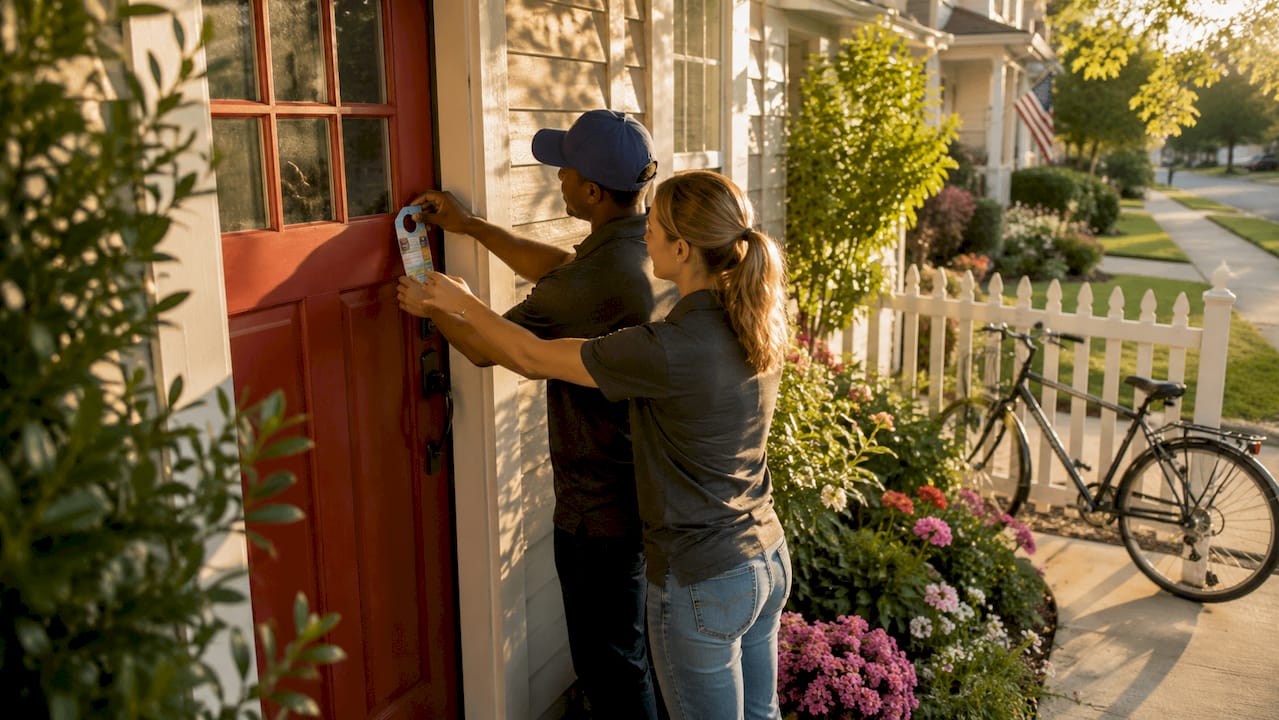
Door hanger campaigns are the most cost-effective physical tactic available. Distribution costs run $0.10–$0.35 per unit, with one person covering 40 to 60 doors per hour. Response rates of 1–5% outperform most direct mail and email campaigns. A plumber targeting 500 homes in a specific zip code can reach every household for under $175 and expect five to 25 calls. The key design principle is specificity: a door hanger that references the street name or neighborhood (“We just finished a job on Maple Street”) converts significantly better than a generic offer because it uses social proof from the immediate community.
Community mailers, where your ad shares space with other local businesses in a single envelope, reach thousands of local households for $250–$350 per campaign. That is up to 80% cheaper than solo direct mail. Services like Valpak and local co-op mailers let you split printing and postage costs across multiple advertisers.
Bandit signs placed at high-traffic intersections are another underused physical tactic. A single well-placed sign in a busy spot can drive 30–40 new customers per season, representing roughly 30% annual growth for a service business with minimal overhead. Physical bulletin boards at libraries, coffee shops, and community centers provide hyper-local visibility at near-zero cost and are consistently overlooked by competitors.
| Tactic | Approx. cost | Reach | Response rate | Best for |
|---|---|---|---|---|
| Door hangers | $0.10–$0.35/unit | 200–1,000 homes | 1–5% | Service businesses, new movers |
| Community mailers | $250–$350/campaign | 5,000–20,000 homes | 0.5–2% | Retail, restaurants, home services |
| Bandit signs | $5–$20/sign | High-traffic intersections | Indirect | Seasonal services, events |
| Bulletin boards | Near zero | Local foot traffic | Indirect | Tutors, cleaners, tradespeople |
Pro Tip: When designing door hangers, use a custom door hanger that includes a QR code linking to a Google review page or a specific landing page. Tracking which neighborhoods generate calls tells you exactly where to focus your next distribution run.
3. Leveraging community partnerships and local collaborations affordably
A referral from a trusted neighbor converts at a rate no paid ad can match. Building a network of local business partners is one of the most cost-effective community outreach strategies available, and it requires zero ad spend.
Start with complementary businesses that serve your exact customer. A landscaper partners with a fence installer. A pediatric dentist partners with a daycare. A bookkeeper partners with a business attorney. Each business sends referrals to the other, and both grow without paying for leads. Formalize the arrangement with a simple referral card or a shared discount offer so customers have a tangible reason to act.
Community event sponsorships are another high-return tactic. Sponsoring a local Little League team, a school fundraiser, or a neighborhood cleanup costs $100–$500 and puts your name in front of hundreds of engaged, local residents. The community marketing role for local business is not just about visibility. It builds the kind of trust that makes people choose you over a competitor they found on Google.
Partnership and collaboration ideas that cost little or nothing:
- Create a “local business bundle” with two or three complementary businesses and promote it across all your channels
- Offer to speak at a local Chamber of Commerce meeting or neighborhood association event
- Co-host a free workshop with a partner business (a realtor and a home stager, for example)
- Cross-promote on each other’s email lists with a simple introduction post
- Participate actively in neighborhood Facebook Groups and Nextdoor without selling directly
- Donate a service or product to a local charity auction in exchange for logo placement
4. Strategic use of paid advertising on a tight budget
Paid advertising works best as the final layer of your local marketing system, not the first. Running paid ads without an organic foundation raises your cost per acquisition by two to three times because there are no reviews, no GBP signals, and no trust indicators to convert the traffic you pay for. Build the foundation first. Then add paid ads to accelerate what is already working.
When you are ready to spend, follow this sequence:
- Google Local Services Ads (LSAs): These appear above standard search results and charge only per verified lead, not per click. For service businesses like plumbers, electricians, and cleaners, LSAs are the most cost-efficient paid channel available in 2026.
- Google Search Ads on service plus city keywords: Target phrases like “roof repair Austin” or “dog grooming Brooklyn.” These are high-intent searches from people ready to buy. Keep daily budgets at $10–$20 to start and track every conversion.
- Meta retargeting ads: Retargeting ads convert three to five times better than cold ads while costing 70% less. Run a small Facebook or Instagram retargeting campaign to people who visited your website but did not call or book.
- Test one offer at a time: Run a single ad with a single offer for two weeks before changing anything. Most SMBs waste budget by changing too many variables at once and never learning what actually worked.
- Pre-optimize your landing page: Every paid ad needs a dedicated landing page with a clear headline, one call to action, and a phone number visible above the fold. Sending paid traffic to your homepage is one of the most common and costly mistakes in local advertising.
The SBA recommends 7–8% of gross revenue on marketing, but most local SMBs do not need to spend that much if their organic foundation is strong. Email marketing alone delivers a 36:1 return on ad spend, making a simple monthly newsletter one of the highest-ROI paid tools available at minimal cost.
Key takeaways
The most effective low-cost local marketing system builds organic trust through Google Business Profile and reviews before adding paid ads, cutting acquisition costs by two to three times.
| Point | Details |
|---|---|
| Start with GBP optimization | A fully optimized Google Business Profile delivers 300–500% ROI at zero cost. |
| Physical tactics still convert | Door hangers at $0.10–$0.35 per unit achieve 1–5% response rates, beating most digital direct mail. |
| Partnerships multiply reach | Referral networks with complementary local businesses generate pre-qualified leads at no ad spend. |
| Sequence matters for paid ads | Launching paid ads without organic signals raises cost per acquisition by two to three times. |
| Retargeting beats cold ads | Retargeting campaigns convert three to five times better while costing 70% less than cold traffic ads. |
What I have learned after years of watching SMBs market locally
The most common pattern I see at Marvingrowthpartners is a business owner who spent $1,500 on Google Ads in their first month, got almost nothing back, and concluded that digital marketing does not work for them. It did not fail because the platform is bad. It failed because the foundation was missing. No reviews, an incomplete GBP, and a homepage that loaded slowly on mobile. The paid traffic had nowhere to land.
The businesses that grow consistently on tight budgets share one habit: they treat their Google Business Profile like a storefront window and update it every single week. They ask every happy customer for a review. They show up in two or three local Facebook Groups not to sell, but to be genuinely useful. That behavior compounds over six to twelve months in a way that no ad budget can replicate quickly.
I am also watching AI search change local discovery faster than most business owners realize. When someone asks ChatGPT or Perplexity for a recommendation for a local service, the answer pulls from review signals, GBP data, and structured web content. The businesses investing in their organic presence now are building an asset that will pay off in AI-driven search results over the next two to three years. That is not a trend to wait on.
Start with what costs nothing. Measure what works. Add paid spend only to amplify proven winners. That sequence is not glamorous, but it is the one that actually builds a local business.
— Eric
How Marvingrowthpartners helps SMBs grow locally without wasting budget
Marvingrowthpartners works directly with small and medium-sized businesses to build local marketing systems that produce measurable results without the overhead of a full internal team. The approach starts with a clear audit of where your current marketing is losing money or missing opportunities, then builds a prioritized plan based on your specific growth stage and budget. Every strategy is tailored to your market, not copied from a generic playbook. If you are ready to stop guessing and start building a local presence that compounds over time, visit Marvingrowthpartners to learn how the team can help you grow efficiently and affordably.
FAQ
What is the cheapest way to market a local business?
Optimizing your Google Business Profile is the lowest-cost tactic available, delivering 300–500% ROI at zero cost. Pairing it with a consistent review generation strategy and organic Nextdoor posts creates a strong local presence without any ad spend.
How much should a small business spend on local marketing?
Most small businesses compete effectively on $200–$500 per month by combining free digital tools with targeted physical tactics. The SBA recommends 7–8% of gross revenue, but a strong organic foundation reduces that requirement significantly.
Do door hanger campaigns actually work?
Door hangers achieve response rates of 1–5%, which outperforms most direct mail and email campaigns. At $0.10–$0.35 per unit, they are one of the most cost-efficient physical marketing tools for local service businesses.
When should a local business start running paid ads?
Paid ads should only be added after your Google Business Profile is optimized, you have consistent reviews, and your website converts visitors. Running ads before that foundation is in place raises cost per acquisition by two to three times.
What are the best free local marketing platforms in 2026?
Google Business Profile, Nextdoor, and Facebook Groups are the three highest-impact free platforms for local businesses. Each reaches verified local audiences and rewards consistent, genuine engagement with compounding organic visibility.
Recommended
- Marketing Strategy Types for SMBs: 2026 Growth Guide – Marvin Growth Partners
- The Role of Social Media in Brand Presence for SMBs – Marvin Growth Partners
- Why Video Marketing Works for Local Business – Marvin Growth Partners
- The Role of Community Marketing for Local Business – Marvin Growth Partners