

Grow Local Business Organic Traffic in 2026
Growing local business organic traffic means optimizing for both traditional search engines and AI-powered answer engines using proven local SEO and Generative Engine Optimization (GEO) techniques. AI-assisted searches now account for about 30% of total search volume in 2026. That shift means your Google Business Profile, NAP consistency, on-page content, and structured schema markup must all work together. Miss one layer, and you hand visibility to a competitor who got the full picture.
How to grow local business organic traffic with Google Business Profile
Your Google Business Profile (GBP) is the single most important asset for local search visibility. A fully completed GBP with profile completeness above 95% generates significantly more clicks and calls than a sparse listing. Think of it as a living asset, not a one-time setup.
Follow these steps to get the most from your profile:
- Complete every field. Add your business name, address, phone number, website, hours, service categories, and a detailed business description. Leave nothing blank.
- Upload high-quality photos. Add exterior shots, interior shots, product photos, and team images. Profiles with photos receive far more direction requests than those without.
- Post weekly updates. Share offers, events, or news at least once a week. Active profile management links directly to stronger local search performance.
- Respond to every review within 24 hours. Fast, professional responses signal engagement to Google’s algorithm and build trust with potential customers.
- Use the Q&A section. Seed it with questions your customers actually ask, then answer them yourself. This content feeds both Google’s local results and AI answer engines.
Pro Tip: Set a recurring calendar reminder every Monday to post a GBP update and check for new reviews. Consistency over weeks compounds into measurable ranking gains.
Common mistakes include choosing the wrong primary category, letting photos go stale, and ignoring the services section. Each of those gaps costs you prominence. For a deeper breakdown of GBP best practices, Marvingrowthpartners has a dedicated resource worth bookmarking.

Why NAP consistency and local citations build search engine trust
NAP stands for Name, Address, and Phone number. Consistent NAP data across every directory tells search engines your business information is accurate and trustworthy. Inconsistent data, even a suite number formatted differently, creates conflicting signals that suppress your rankings.
Key citation sources every local business should cover:
- Google Business Profile (your anchor citation)
- Yelp and Apple Maps (high-traffic consumer directories)
- Better Business Bureau (BBB) (trust and authority signal)
- Bing Places (captures non-Google search traffic)
- Industry-specific directories relevant to your service category
- Local chamber of commerce listings
Building citations across 30–50 local directories creates a broad footprint of trust signals. Each accurate citation acts as a vote of confidence in your business’s legitimacy.
| Citation tier | Examples | Primary benefit |
|---|---|---|
| Core directories | Google, Yelp, BBB, Apple Maps | High traffic and trust authority |
| Secondary directories | Bing Places, Yellow Pages, Foursquare | Broader NAP footprint |
| Niche directories | Industry associations, local chambers | Targeted relevance signals |
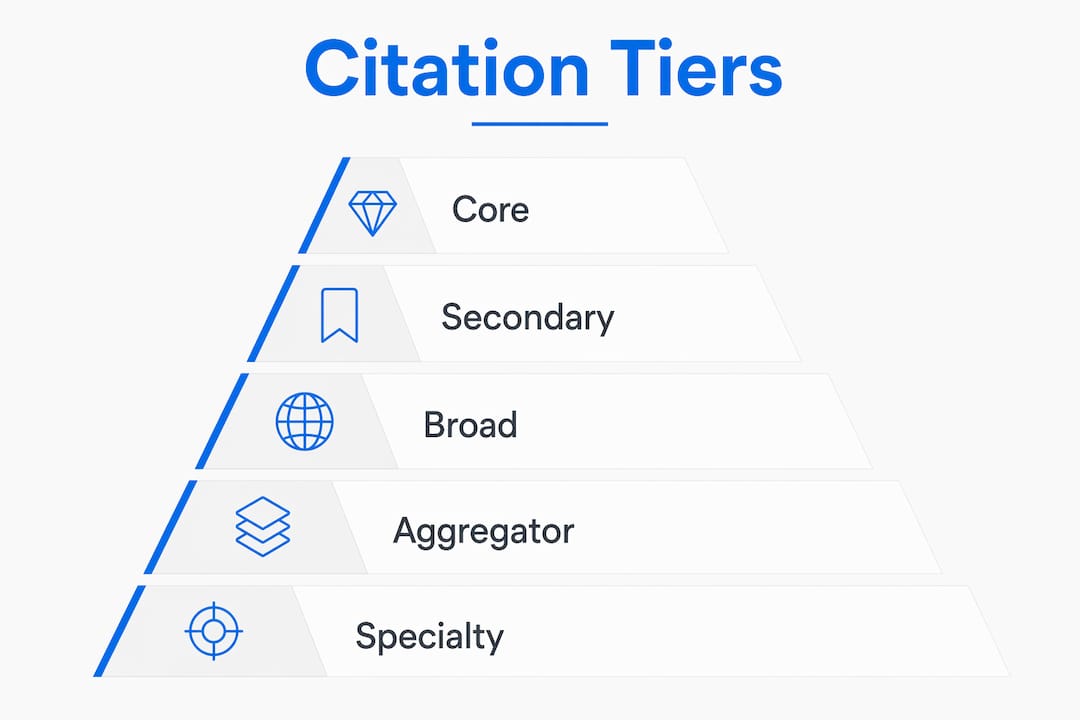
AI answer engines also rely on trusted aggregators when surfacing local business recommendations. A dual strategy focused on both your own website and aggregator presence is the most reliable path to maximize local online presence across both traditional and AI-driven results.
How does location-specific content improve organic search rankings?
Location-specific content is the mechanism that extends your organic footprint beyond the map pack into standard search results and AI-generated answers. Dedicated neighborhood pages with unique content drive higher rankings for service-area businesses. Generic city pages with swapped names do not work and can trigger duplicate content penalties.
Each location page should include:
- A unique description of the services you offer in that specific area
- Local landmarks, neighborhoods, or community references that prove genuine local relevance
- Customer testimonials or case studies from that location
- An embedded Google Map with your verified pin
Pro Tip: Add a short FAQ section to every location page. Write questions the way a local customer would actually type them. Direct-answer content is what AI engines pull when generating local recommendations.
| Content type | Duplicate risk | AI citation potential |
|---|---|---|
| Generic city page (name-swapped) | High | Low |
| Unique location page with local detail | Low | High |
| FAQ-enriched service page | Low | Very high |
Integrating LocalBusiness schema markup on every location page gives search engines and AI engines a structured data layer to read. Schema markup is the primary mechanism AI engines like ChatGPT use to understand your location, hours, pricing, and services. Without it, you are invisible to a growing share of search traffic. You can explore local search strategy tips from Marvingrowthpartners for more on building content that ranks.
How do reviews affect local search and AI rankings?
Reviews are a direct ranking signal in local search, and their influence on AI recommendations is growing fast. Review volume, recency, and descriptive keywords in customer feedback significantly influence both local search ranking and AI-generated recommendations. A review that mentions your specific service and neighborhood carries more weight than a generic five-star rating.
Use these steps to build a review strategy that compounds over time:
- Ask at the right moment. Request a review immediately after a positive interaction, when the experience is fresh.
- Make it easy. Send a direct link to your Google review page via text or email. Remove every possible friction point.
- Coach for specificity. Ask customers to mention the service they received and the neighborhood or city. Do not dictate the words, but give them a prompt.
- Respond to every review. Acknowledge positive reviews with a thank-you that includes your business name and service. Address negative reviews calmly and with a resolution offer.
“Reviews mentioning specific services and neighborhoods carry more algorithmic weight than generic praise. A customer who writes ‘best HVAC repair in Midtown Atlanta’ gives you a geo-keyword signal that a simple five-star rating never provides.”
AI answer engines treat review content as evidence of your authority in a specific service category and location. The more your reviews contain location and service keywords, the stronger your entity authority becomes in AI-driven results.
What technical factors support local SEO and GEO success?
Technical website health is the foundation that all other strategies rest on. Without a solid technical SEO foundation, GEO and AI visibility strategies will not succeed. You can have perfect content and a complete GBP, but a slow or broken website will cancel those gains.
Critical technical factors for local businesses in 2026:
- Mobile-first design. Google indexes the mobile version of your site first. A site that breaks on a phone loses rankings.
- Page speed under 3 seconds. Fast-loading, mobile-friendly websites perform markedly better in both traditional SEO and GEO rankings.
- AI crawler access. Allow GPTBot and other AI crawlers in your robots.txt file. Blocking them means AI engines cannot read your content and will not cite you.
- LocalBusiness JSON-LD schema. Implement structured data with accurate NAP, service details, hours, and geo-coordinates on every key page.
- GPS pin precision. Verify your map pin coordinates to within five decimal places. Imprecise pins cause GPS drift, which misplaces your business on maps and reduces search prominence.
Stat: Page speed and mobile usability are critical ranking factors for local search. A site loading in under 3 seconds outperforms slower competitors in both standard and AI-driven results.
Run a technical audit at least once per quarter. Tools like Google Search Console and PageSpeed Insights surface the most common issues for free. Fix crawl errors, broken links, and missing schema before spending time on content. For a look at how common local search mistakes compound over time, Marvingrowthpartners has a practical breakdown worth reading.
Key Takeaways
Growing local business organic traffic requires a combined approach of traditional local SEO fundamentals and AI-focused GEO strategies, with Google Business Profile optimization, NAP consistency, and schema markup as the non-negotiable core.
| Point | Details |
|---|---|
| GBP is your foundation | A profile above 95% completeness with weekly posts drives more clicks, calls, and AI citations. |
| NAP consistency builds trust | Accurate citations across 30–50 directories signal legitimacy to both search engines and AI answer engines. |
| Location content expands reach | Unique, FAQ-enriched location pages rank in standard search and get cited by AI engines. |
| Reviews carry keyword signals | Reviews mentioning specific services and neighborhoods boost both algorithmic and AI ranking strength. |
| Technical health enables everything | Mobile speed under 3 seconds, JSON-LD schema, and precise GPS coordinates are non-negotiable baselines. |
What I’ve learned about local SEO that most guides skip
The biggest mistake I see local business owners make is treating local SEO as a setup task rather than an ongoing practice. They claim their GBP, fill in the basics, and then walk away. Six months later, they wonder why a competitor with a less polished website is ranking above them. The answer is almost always activity. The competitor posts weekly, responds to reviews the same day, and updates their hours when they change.
The second thing I have noticed is that most businesses are not ready for GEO because they skipped the fundamentals. AI engines like ChatGPT and Perplexity pull from structured, authoritative sources. If your schema is missing, your NAP is inconsistent, and your content is thin, no amount of AI-specific optimization will help. Traditional SEO is the essential baseline that GEO builds on, not a separate track.
The third insight is about patience. Real gains in local organic traffic take three to six months of consistent effort. Businesses that commit to the full system, GBP management, citation building, content creation, and technical hygiene, see compounding returns. Those that chase shortcuts see short-term spikes and long-term stagnation.
— Eric
How Marvingrowthpartners helps local businesses get found
Local organic traffic growth requires consistent execution across multiple channels at once. Most business owners do not have the bandwidth to manage GBP updates, citation audits, content production, and technical fixes simultaneously.
Marvingrowthpartners builds growth systems that align executive-level strategy with hands-on execution, so nothing falls through the cracks. The team handles Google Business Profile optimization, citation management, location-specific content development, and technical audits tailored to your specific growth stage. There is no recycled playbook. Every strategy reflects the real challenges your business faces, from cash flow constraints to competitive local markets. If you want to see how the approach applies to your situation, the business growth strategy page is the right starting point.
FAQ
What is Generative Engine Optimization (GEO)?
GEO is the practice of structuring your website content, schema markup, and entity signals so AI-powered search engines like ChatGPT and Perplexity cite your business in their answers. It builds on traditional SEO rather than replacing it.
How many citations does a local business need?
Citations across 30–50 local directories provide a strong trust signal for local search rankings. Accuracy matters more than volume, so audit existing listings before adding new ones.
How often should I post on my Google Business Profile?
Post at least once per week. Weekly updates and same-day review responses are directly linked to stronger local search prominence and higher engagement rates.
Does page speed really affect local search rankings?
Yes. Mobile-friendly websites loading in under 3 seconds perform measurably better in both traditional local SEO and AI-driven search results. Use Google PageSpeed Insights to identify and fix the biggest speed issues first.
What schema markup does a local business need?
Implement LocalBusiness JSON-LD schema on every key page. Include your NAP, service details, hours, and geo-coordinates. JSON-LD schema is the primary mechanism AI engines use to understand and accurately cite your business in local results.
Recommended
- Understanding Organic Traffic: SEO and Local Search Optimization Explained – Marvin Growth Partners
- Navigating Local Rankings with Effective Google Business Profile Strategies – Marvin Growth Partners
- Low-Cost Local Marketing Tactics for SMBs in 2026 – Marvin Growth Partners
- Grow Your Business with Expert Local SEO in Flint MI – Marvin Growth Partners