

Growth Marketing Explained for Business Owners in 2026
Growth marketing is defined as a data-driven, experiment-heavy discipline that optimizes the full customer lifecycle from acquisition through referral to drive measurable, compounding business growth. Unlike traditional marketing, which typically focuses on brand awareness and top-of-funnel lead generation, growth marketing treats every stage of the customer journey as a lever worth testing and improving. The term “growth hacking” popularized this mindset in Silicon Valley, but the more mature industry term is growth marketing, which reflects a structured, repeatable system rather than a bag of viral tricks. Frameworks like AARRR and tools like Google Analytics, Mixpanel, and HubSpot are the operational backbone of any serious growth marketing strategy.
What is growth marketing, and how is it defined?
Growth marketing is a data-driven approach that optimizes every stage of the customer lifecycle: acquisition, activation, retention, revenue, and referral. The core idea is that sustainable business growth does not come from a single campaign or channel. It comes from running dozens of small, measurable experiments across the entire funnel, learning fast, and doubling down on what works.
The growth marketing definition separates itself from conventional marketing in one critical way: it measures success by business outcomes like revenue, retention rate, and lifetime value, not vanity metrics like impressions or follower counts. A traditional marketing team might celebrate 100,000 ad views. A growth marketing team asks how many of those viewers became paying customers who came back a second time.

Understanding growth marketing also means recognizing its cross-functional nature. Growth marketing’s scope extends beyond the marketing department to include product, engineering, and data teams working together to improve customer experience at every touchpoint. This is not a solo sport. It requires organizational alignment that most traditional marketing setups simply do not have.
How does growth marketing differ from traditional marketing?
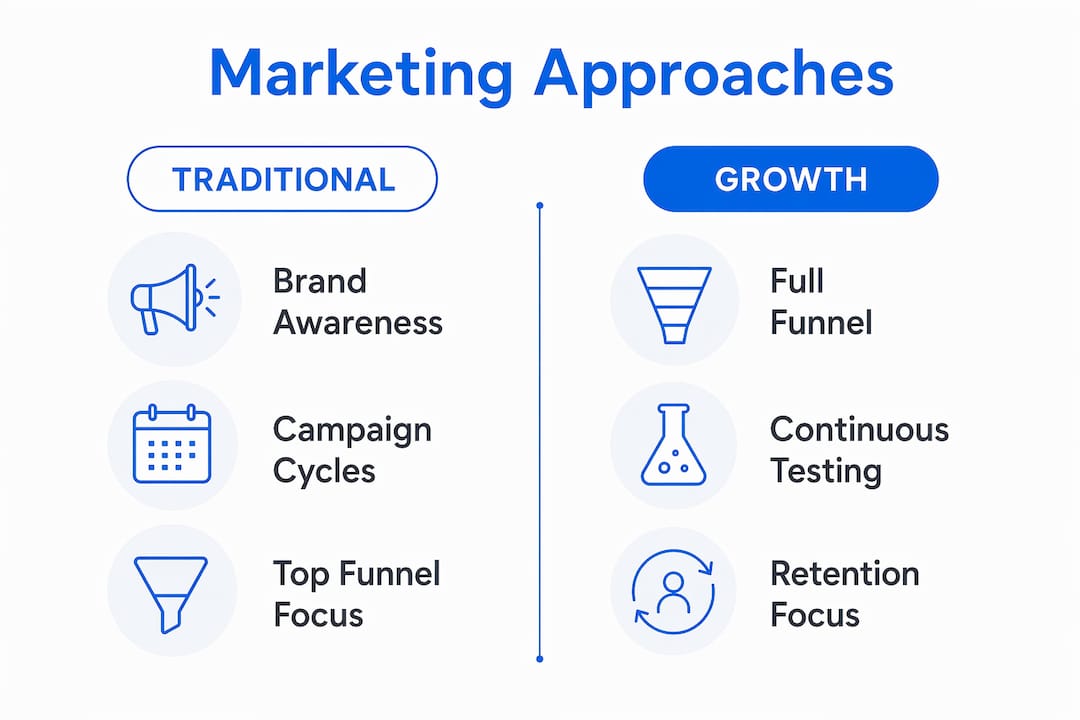
Traditional marketing and growth marketing share the same goal: grow the business. Their methods, however, are fundamentally different in scope, speed, and measurement.
Traditional marketing typically operates in campaign cycles. A team plans a campaign, executes it over weeks or months, measures reach and engagement, and reports back. Growth marketing runs 4+ experiments per week, uses data to identify winners quickly, and kills losing tests before they drain budget. The learning velocity is the competitive advantage.
The table below captures the most important distinctions:
| Dimension | Traditional Marketing | Growth Marketing |
|---|---|---|
| Focus | Brand awareness, lead generation | Full funnel: acquisition to referral |
| Success metrics | Impressions, clicks, reach | Revenue, retention, lifetime value |
| Team structure | Siloed marketing department | Cross-functional: marketing, product, engineering, data |
| Experimentation speed | Quarterly or monthly campaigns | Dozens of tests per month |
| Decision basis | Creative intuition, past playbooks | Data, explicit evidence thresholds |
| Time horizon | Short-term campaign performance | Compounding, long-term growth systems |
The practical implication for business owners is significant. If your marketing team is only optimizing the top of the funnel, you are leaving retention, referral, and expansion revenue entirely unmanaged. Growth marketing optimizes every stage from first discovery to referral, which means every dollar spent on acquisition works harder because more customers stay and refer others.
What is the AARRR framework and why does it matter?
The AARRR framework, developed by venture capitalist Dave McClure, is the operating model most growth teams use to diagnose funnel problems and prioritize experiments. Each letter represents a stage in the customer lifecycle, and each stage has specific metrics that tell you whether that stage is healthy or leaking.
The five stages break down as follows:
- Acquisition: How do users find you? Metrics include cost per acquisition, organic traffic, and paid channel conversion rates.
- Activation: Do users experience your product’s core value quickly? Metrics include onboarding completion rate, time to first key action, and trial-to-paid conversion.
- Retention: Do users come back? Metrics include day-7 and day-30 retention rates, churn rate, and engagement frequency.
- Revenue: Are users paying, and are they paying more over time? Metrics include average revenue per user, expansion revenue, and net revenue retention.
- Referral: Are users bringing others? Metrics include Net Promoter Score, referral program conversion rate, and viral coefficient.
The AARRR framework guides growth teams to prioritize experiments by identifying which stage of the funnel is leaking the most value. If your activation rate is 15% but your acquisition cost is rising, fixing activation will deliver more return than spending more on ads. This diagnostic logic is what separates structured growth marketing from random tactic execution.
Pro Tip: Before running any experiment, map your current AARRR metrics in a single dashboard. The stage with the biggest gap between current performance and industry benchmarks is where your first experiment should live. Prioritizing by impact, not by ease, is what separates high-growth teams from busy ones.
Retention and referral deserve special attention within AARRR. Most businesses over-invest in acquisition and under-invest in the stages that create compounding returns. A customer who stays for three years and refers two friends is worth exponentially more than three one-time buyers. The framework forces you to see that math clearly.
What strategies and tactics are used in growth marketing?
Growth marketing strategy is built on one operating principle: ship fast, measure fast, iterate fast. A mediocre experiment today consistently beats the perfect campaign launched six months from now. This is not an excuse for sloppy work. It is a recognition that real-world data is always more valuable than pre-launch assumptions.
The most effective growth marketing tactics fall into several categories:
- Lifecycle email marketing: Automated sequences triggered by user behavior, such as onboarding emails, win-back campaigns, and upgrade prompts. Tools like Klaviyo, ActiveCampaign, and Customer.io make this executable for teams of any size.
- Personalized in-product messaging: Using behavioral data to show the right message at the right moment inside your product. Intercom and Appcues are purpose-built for this.
- Pricing experiments: Testing annual versus monthly billing, tiered pricing structures, or free trial lengths to find the combination that maximizes conversion and lifetime value.
- Referral programs: Structuring incentives so existing customers actively recruit new ones. Dropbox’s storage-for-referrals program is the canonical example, growing the user base by 3,900% in 15 months.
- SEO and content loops: Creating content that attracts organic traffic, converts visitors into users, and generates backlinks that compound over time.
- Paid acquisition testing: Running small-budget tests across Google Ads, Meta, and LinkedIn to identify the highest-converting audience and message combinations before scaling spend.
Pro Tip: Framing growth marketing as a list of tactics is the fastest way to fail at it. Sustainable growth comes from documented growth models with explicit evidence thresholds, not from copying what worked for another company. Build your own model, run your own experiments, and document every result.
Tools like MediaFast enable growth teams to test messaging in real time across platforms, which accelerates the experimentation cycle significantly. Automation is not optional in growth marketing. Without it, the volume of experiments required to find scalable tactics becomes operationally impossible for small teams.
How does retention drive sustainable growth?
Retention is the single most underrated lever in growth marketing. Most business owners fixate on acquiring new customers because growth feels visible and immediate. Retention is quieter, but its compounding effect on revenue and referral is far more powerful.
“Retention is the foundation of all growth. Without it, you’re filling a leaky bucket. With it, every acquisition dollar compounds.” — Brian Balfour, former VP of Growth at HubSpot
Retention beats acquisition because longer customer lifetimes generate more growth loops and revenue opportunities. A retained customer creates three distinct value streams: they continue paying (expansion revenue), they refer others (viral loops), and they provide product feedback that improves activation for future customers. None of these streams exist if the customer churns after the first month.
Brian Balfour’s Use Case Map methodology addresses one of the most common retention mistakes: measuring retention with the wrong metric. Retention metrics must align with the natural use frequency of your product. A daily task management app should measure day-7 retention. A tax filing tool should measure year-over-year return rate. Applying the wrong metric leads to strategies that look good on paper but do not reflect actual customer behavior.
The three levers Balfour identifies for improving retention are activation (getting users to the core value faster), depth of engagement (increasing how much of the product users rely on), and resurrection (winning back churned users before they are permanently lost). Companies like Airbnb have built entire growth teams around each of these levers, treating retention as a product problem as much as a marketing one. You can explore proven retention strategies that apply directly to this framework.
Key takeaways
Growth marketing succeeds when it combines structured experimentation, full-funnel measurement, and retention-first thinking into a repeatable system rather than a collection of disconnected tactics.
| Point | Details |
|---|---|
| Full-funnel focus | Growth marketing optimizes acquisition, activation, retention, revenue, and referral simultaneously. |
| AARRR as a diagnostic tool | Use the AARRR framework to identify which funnel stage is leaking value before running experiments. |
| Retention over acquisition | Retained customers generate expansion revenue, referrals, and product feedback that compound over time. |
| Experimentation velocity | Running dozens of small tests per month outperforms waiting for the perfect campaign. |
| Cross-functional teams | Growth marketing requires alignment between marketing, product, engineering, and data to work at full capacity. |
Why most businesses get growth marketing wrong
I have worked with enough business owners to know that the most common mistake is treating growth marketing as a job title or a list of tactics to copy. Someone reads a case study about Dropbox’s referral program or Airbnb’s Craigslist integration, and suddenly the entire growth strategy becomes “let’s build a referral program.” That is not growth marketing. That is cargo-cult thinking.
Real growth marketing starts with a documented model of how your specific business grows. What does your acquisition loop look like? Where does activation break down? What behavior predicts a customer will stay for two years versus churn in 30 days? Until you can answer those questions with data, you are not doing growth marketing. You are doing marketing with a growth marketing label on it.
The second mistake I see constantly is running experiments without explicit evidence thresholds. A team launches a test, gets ambiguous results, and declares it a win because the numbers moved slightly in the right direction. A structured growth model with decision logs and pre-defined success criteria is what separates teams that learn from teams that just stay busy.
The mindset shift that actually works is this: treat your business as a system, not a series of campaigns. Every experiment is a question. Every result is an answer. The goal is to accumulate answers fast enough that your growth model becomes genuinely predictive. That takes discipline, cross-functional buy-in, and a willingness to kill ideas you were excited about. It is not glamorous. It is also the only approach I have seen produce durable results.
— Eric
How Marvingrowthpartners puts growth marketing into practice
Marvingrowthpartners was built specifically for business owners who understand that growth marketing is the right approach but do not have the internal team to execute it at the required depth and speed.

Marvingrowthpartners aligns executive-level strategy with hands-on execution across the full customer funnel. That means building your AARRR diagnostic, designing your first experiment roadmap, and running tests across acquisition, activation, and retention without the overhead of a full-time internal growth team. Every engagement is built around your specific business model, not a recycled playbook. If you are ready to move from marketing activity to measurable growth, explore the growth strategy approach Marvingrowthpartners uses with growing companies across industries.
FAQ
What is the growth marketing definition in simple terms?
Growth marketing is a data-driven approach that runs continuous experiments across the entire customer lifecycle, from acquisition to referral, to find and scale what drives measurable business growth. It differs from traditional marketing by measuring success through revenue, retention, and lifetime value rather than reach or impressions.
How does growth marketing differ from growth hacking?
Growth hacking focuses on quick, often viral wins to spike user numbers fast, while growth marketing builds repeatable, compounding systems with documented models and evidence-based decision making. Growth marketing is the mature, sustainable evolution of the growth hacking mindset.
What is the AARRR framework in growth marketing?
AARRR stands for Acquisition, Activation, Retention, Revenue, and Referral. It is a diagnostic framework that helps growth teams identify which stage of the customer funnel is underperforming and prioritize experiments accordingly.
How do I start implementing a growth marketing strategy?
Start by mapping your current AARRR metrics to identify your biggest funnel leak, then design one focused experiment to address it with a pre-defined success threshold. Marvingrowthpartners recommends beginning with marketing ROI metrics to establish your baseline before running any tests.
Why is retention so important in growth marketing?
Retention creates three compounding value streams: expansion revenue from existing customers, referrals that reduce acquisition cost, and product feedback that improves activation for new users. Without strong retention, every dollar spent on acquisition is partially wasted filling a leaky funnel.