

How to Develop an Executive Marketing Roadmap
An executive marketing roadmap is defined as a concise, visual communication tool that links marketing initiatives directly to business objectives and presents them in a format built for leadership decision-making. Most executives confuse it with a marketing plan. A marketing roadmap focuses on the “why” behind initiatives and their sequence, not the granular daily tasks that belong in a plan. Getting this distinction right from the start determines whether your roadmap gets approved or shelved. Marvingrowthpartners builds these documents for SMBs every quarter, and the difference between a roadmap that secures budget and one that does not comes down to structure, credibility, and executive-level clarity.
How to develop an executive marketing roadmap: prerequisites first
Before you write a single slide, you need the right inputs. A roadmap built on incomplete data signals guesswork to any executive in the room.
Gather your baseline data. Pull past campaign performance, current market analysis, and documented buyer personas. Without these, your situation analysis, which is the foundation of the entire document, will read as speculation rather than evidence.
Choose a planning framework. The SOSTAC framework (Situation, Objectives, Strategy, Tactics, Action, Control) is the most widely cited structure for gaining executive budget approval. It forces you to address context before making claims, which is exactly what skeptical executives need to see. Skipping any one of its six components weakens the whole document.
Align with cross-functional stakeholders early. Sales, finance, product, and operations each hold data and priorities that shape your roadmap. Engaging key stakeholders early reduces surprises and speeds up approvals. A roadmap built in a marketing silo almost always requires last-minute rewrites.
Define your KPIs using the SMART framework. Each goal must be Specific, Measurable, Achievable, Relevant, and Time-bound. Vague goals like “grow brand awareness” give executives nothing to approve or hold accountable.
Pro Tip: Before your first stakeholder meeting, build a one-page data brief covering your top three performance gaps, your primary growth opportunity, and your proposed measurement approach. It signals preparation and earns credibility before the roadmap conversation even starts.
Step-by-step process to create your executive marketing plan
A well-built executive marketing plan follows a clear sequence. Skipping steps does not save time. It creates rework.
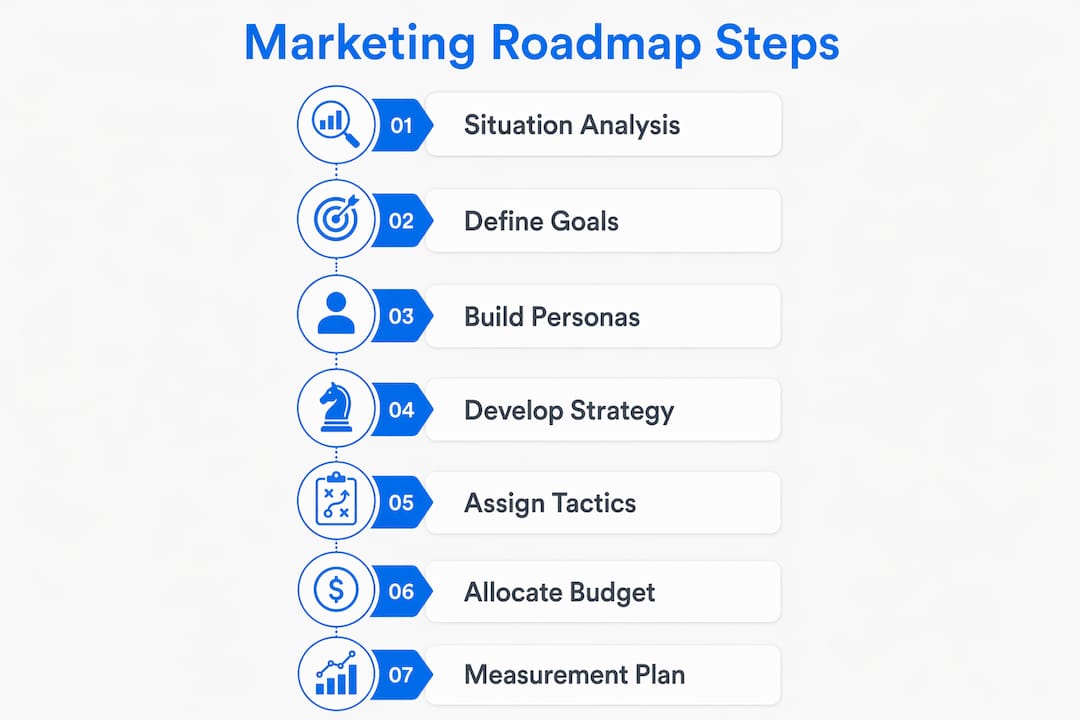
Step 1: Conduct a situation analysis
Start with context. Document your current market position, competitive environment, customer insights, and internal capabilities. Skipping the situation analysis is the number one cause of marketing plan rejection because it removes credibility. Executives need to see that your recommendations are grounded in evidence, not optimism.
Step 2: Define goals and objectives
Translate business goals into specific marketing objectives. If the company needs to grow revenue by 20% this year, your marketing objectives must show a clear line from their activities to that number. Use SMART criteria for every objective you include.

Step 3: Build audience personas
Identify your two or three most valuable customer segments. Document their pain points, buying triggers, and preferred channels. Personas keep the roadmap grounded in real buyer behavior rather than internal assumptions.
Step 4: Develop your strategy
This is where you make your “strategic bets.” Choose the two or three approaches that will drive the most growth given your resources. Align marketing strategy tightly with the corporate vision so executives see direct continuity between their priorities and your plan.
Step 5: Outline channel tactics and assign ownership
Map each strategy to specific channels: paid search, content, email, events, or partnerships. Assign a named owner to each tactic. Ownership without a name attached is not ownership at all.
Step 6: Allocate budget with a leader pattern
Budget allocation signals your maturity as a marketing leader. A leader budget pattern distributes spend as approximately 48% promotion, 14% relationships, 13% branding, and 16% infrastructure. Laggard patterns over-invest in promotion above 60% and under-invest in infrastructure, which reduces approval likelihood. Executives who review many plans recognize this pattern immediately.
| Budget Category | Leader Pattern | Laggard Pattern |
|---|---|---|
| Promotion | ~48% | >60% |
| Relationships | ~14% | <8% |
| Branding | ~13% | <10% |
| Infrastructure | ~16% | <8% |
Step 7: Build your measurement plan
A measurement plan with named owners and decision triggers turns your roadmap from a wish list into a commitment. Assign a metric owner to every KPI. Define decision triggers: the specific threshold at which you will change course. Distinguish leading indicators like click-through rate and engagement from lagging indicators like revenue. Leading indicators let you course-correct before outcomes are final.
Write the executive summary last
Most practitioners write the executive summary last despite it being read first. This matters because a summary written before the full plan is complete tends to overstate conclusions. Write it after every other section is done, and keep it to one to three pages depending on complexity.
Pro Tip: Format your roadmap as a one-page visual overview for the board presentation, supported by a five to ten page detailed document for department heads. Never hand a 30-page plan to a CEO and expect it to be read.
What common mistakes should you avoid in your marketing roadmap?
Most roadmaps fail before they reach a vote. The reasons are predictable and preventable.
- Confusing the roadmap with the plan. A roadmap communicates sequence, dependencies, and alignment. A plan details daily tasks. Mixing the two creates a document that is too tactical for executives and too vague for teams.
- Skipping the situation analysis. Plans without evidence-based context appear speculative. Executives reject them because they cannot assess risk without baseline data.
- Leaving metrics without owners. A KPI without a named owner is a suggestion, not a commitment. Every metric in your measurement plan needs a person accountable for it.
- Ignoring budget balance. Over-investing in promotion signals short-term thinking. Balanced budget allocations signal mature marketing leadership and correlate with better financial outcomes.
- Presenting a plan that is too long. Executive attention is finite. A 40-page roadmap document communicates poor judgment about your audience.
- Excluding stakeholders until the final draft. Late-stage feedback from sales or finance forces rewrites and delays approvals.
- Relying only on lagging indicators. If you only track revenue and pipeline at the end of each quarter, you have no early warning system.
“A robust measurement plan with named owners and decision triggers turns the plan from a wish list into a commitment, increasing approval probabilities.” — Prooflytics, 2026
Pro Tip: Run a “red team” review before your executive presentation. Ask one person outside marketing to read your roadmap and identify every claim that lacks supporting data. Fix those gaps before the room does it for you.
How do you maintain and adapt your roadmap for sustained growth?
A roadmap is not a static document. Markets shift, budgets change, and priorities evolve. The executives who trust your roadmap today will lose confidence in it if you never update it.
Set up quarterly reviews. Quarterly milestone reviews allow dynamic adjustments without requiring full plan rewrites. This maintains executive trust while keeping the plan current. Bring cross-functional stakeholders into each review, not just the marketing team.
Use dashboards to track leading and lagging indicators. A live dashboard showing weekly leading indicators gives you and your executives an early warning system. Waiting for monthly reports means you are always reacting, never anticipating.
Pre-commit to decision triggers. When you define in advance what action you will take if a metric falls below a threshold, you remove the politics from mid-year adjustments. Executives respect pre-committed logic over reactive pivots.
Adjust tactics, not the entire strategy. Changing your core strategy every quarter signals instability. Adjust channel mix, messaging, or pacing instead. Reserve full strategy rewrites for major market shifts or significant new data.
Communicate updates clearly. Send a brief monthly update to executive stakeholders: three metrics, one win, one risk, and one decision needed. This keeps leadership informed without scheduling another full presentation.
Roadmaps typically cover a 6–12 month horizon. Startups and high-growth SMBs often prefer quarterly horizons for faster iteration. Choose the horizon that matches your company’s planning cycle, not the one that feels most ambitious.
Key Takeaways
An executive marketing roadmap succeeds when it combines evidence-based context, clear ownership, and a measurement plan that turns commitments into verifiable outcomes.
| Point | Details |
|---|---|
| Roadmap vs. plan | A roadmap shows sequence and alignment; a plan details daily execution tasks. |
| SOSTAC framework | Use Situation, Objectives, Strategy, Tactics, Action, and Control to structure every roadmap. |
| Budget leader pattern | Allocate roughly 48% to promotion, 16% to infrastructure, and 14% to relationships for executive credibility. |
| Measurement ownership | Assign a named owner and decision trigger to every KPI to convert goals into commitments. |
| Quarterly reviews | Review and adjust the roadmap every quarter without rewriting the full strategy. |
What I’ve learned building roadmaps that actually get approved
Most executives I work with have seen dozens of marketing plans. What they remember is not the one with the best creative ideas. They remember the one that made them feel confident about where their money was going.
The single biggest shift I made in my own practice was treating the situation analysis as the most important section, not the strategy. When you walk into a room with clear data on where you are, why you are there, and what the market looks like, you earn the right to make recommendations. Without that foundation, even a brilliant strategy sounds like a guess.
I have also seen firsthand how budget allocation signals leadership maturity. When a roadmap shows heavy promotion spend with almost nothing in infrastructure or relationships, experienced executives read it as short-term thinking. Rebalancing that allocation, even slightly, changes the entire tone of the conversation.
The other thing I will say plainly: collaboration is not optional. The roadmaps that move fastest through approval are the ones where sales, finance, and product had input before the first draft was finished. You are not asking for permission. You are building shared ownership. That distinction matters when the budget vote happens.
Finally, invest time in the visual format. A one-page roadmap overview that a CEO can absorb in 90 seconds is worth more than a 30-page document that never gets read. Clarity is a form of respect for your audience’s time.
— Eric
How Marvingrowthpartners can accelerate your roadmap development
Building a credible executive marketing roadmap takes time, cross-functional input, and a clear framework. For SMB executives who need results without the overhead of a full internal team, Marvingrowthpartners provides the structure and expertise to get there faster.

Marvingrowthpartners specializes in aligning executive-level strategy with hands-on execution. Whether you need a custom growth strategy built from your specific business data or ongoing fractional marketing leadership to keep your roadmap on track, the team brings proven frameworks and real-world experience to every engagement. The result is a roadmap your executives will approve and your team can actually execute.
FAQ
What is an executive marketing roadmap?
An executive marketing roadmap is a concise, visual document that connects marketing initiatives to business objectives and is formatted for leadership decision-making. It focuses on sequence, priorities, and alignment rather than granular daily tasks.
How is a marketing roadmap different from a marketing plan?
A roadmap communicates the “why” and timing of initiatives at a high level, while a marketing plan details the specific tasks and activities needed to execute those initiatives.
How long should an executive marketing roadmap be?
The executive summary should be one to three pages, with a supporting detailed document of five to ten pages for department heads. A one-page visual overview works best for board-level presentations.
What framework works best for building a marketing roadmap?
The SOSTAC framework (Situation, Objectives, Strategy, Tactics, Action, Control) is the most widely cited structure for roadmaps that win executive budget approval, because it grounds recommendations in evidence before making claims.
How often should you update your executive marketing roadmap?
Quarterly reviews are the standard cadence for most companies. Startups and fast-growing SMBs often review monthly, adjusting tactics and pacing without rewriting the full strategy each time.
Recommended
- How to Develop a Marketing Plan That Boosts Sales Growth and Business Growth – Marvin Growth Partners
- Build a Custom Marketing Strategy for Your Detroit Business – Marvin Growth Partners
- Why Your Startup Needs an Outsourced Marketing Executive for Strategic Growth – Marvin Growth Partners
- Our Approach | Growth Strategy, Visibility & Execution – Marvin Growth Partners