

Align Marketing with Business Goals: SMB Growth Guide
Aligning marketing with business goals is defined as building every marketing initiative directly from your company’s commercial objectives, not from trends, gut instinct, or last year’s tactics. Professionals who formally document their strategy are 313% more likely to report success. That single fact explains why so many small and medium-sized businesses spend money on marketing that never moves the needle. The fix is not a bigger budget. It is a tighter connection between what your business needs to achieve and what your marketing team is actually doing. Frameworks like SMART goals, tools like HubSpot, and cross-functional leadership involvement make that connection real and measurable.
What does it mean to align marketing with business goals?
Marketing strategy alignment is defined as building your marketing plan from the same financial targets and growth priorities that live in your business plan. Business strategy sets the direction. Marketing strategy handles execution. When those two operate separately, you get wasted spend and scattered effort. When they operate as one system, revenue can grow by 24% and profits by 27%.
A documented marketing strategy connects business goals to audience targeting, brand positioning, and channel selection. Without it, marketing becomes a series of disconnected activities that burn budget without producing commercial results. Think of it as the difference between a construction crew with blueprints and one that just shows up with tools.
Misalignment shows up in predictable ways:
- Marketing promotes brand awareness while the business desperately needs new customer acquisition this quarter.
- The sales team chases a new vertical while marketing still runs campaigns for the old one.
- Budget gets spent on social media because a competitor is active there, not because the audience is.
- Campaigns launch without defined success metrics tied to revenue or retention.
Each of these is a symptom of the same root problem. Marketing goals were set independently of business goals, and no one built a system to keep them connected.
How do you define business objectives that guide marketing?
Clear business objectives are the foundation of effective marketing alignment. Vague goals like “grow the business” or “get more customers” cannot drive a marketing plan. Specific, time-bound targets can.
The SMART framework is the standard tool for this. SMART goals are specific, measurable, achievable, relevant, and time-bound. They give marketing a precise target to work toward instead of a general direction to drift in.
Here is how to set business objectives that actually guide marketing:
- Start with your biggest challenge or opportunity. HubSpot’s goal-setting process begins with business challenges, then derives marketing objectives from those challenges. If your biggest challenge is customer churn, your business objective becomes a retention target, not a growth target.
- Attach a number and a deadline. “Increase recurring revenue by 20% by december 31” is a business objective. “Grow revenue” is not. The number gives marketing a finish line.
- Categorize by type. Business objectives typically fall into revenue growth, market expansion, or retention improvement. Each category demands a different marketing response.
- Get executive sign-off. Objectives that live only in the marketing department get ignored by sales, product, and finance. Leadership alignment at the objective-setting stage prevents conflict later.
Pro Tip: Write your top three business objectives on a single page and share it with every department head before any marketing planning begins. If leadership cannot agree on three priorities, your marketing will never be focused enough to drive results.
Involving executive leadership at this stage is not optional. Marketing leaders who have not read the company’s P&L and growth targets operate in a silo. That silo is where marketing budgets go to disappear.
How do you build marketing goals from business objectives?
The correct sequence is business goals first, then marketing objectives, then tactics. Starting with tactics before confirming business goals is the most common planning mistake SMBs make. It produces activity without direction.

Reverse-engineering works like this: if the business goal is to increase new customer revenue by 30% in 12 months, the marketing goal becomes a specific acquisition target. That target then determines which channels, messages, and budgets make sense.
The table below shows how business objectives translate into marketing goals:
| Business objective | Derived marketing goal | Key metric |
|---|---|---|
| Grow revenue by 30% in 12 months | Generate 500 qualified leads per quarter | Cost per lead, lead-to-close rate |
| Expand into a new market segment | Build 40% brand awareness in target segment by Q3 | Aided awareness, share of voice |
| Reduce customer churn by 15% | Increase email engagement among existing customers by 25% | Open rate, click rate, retention rate |
| Launch a new product line | Drive 1,000 trial sign-ups in 90 days | Trial conversion rate, CAC |
Once you have this mapping, document it. Documented marketing strategies produce results 82% of the time when followed consistently. Documentation creates accountability. It also gives you something concrete to review when results fall short.
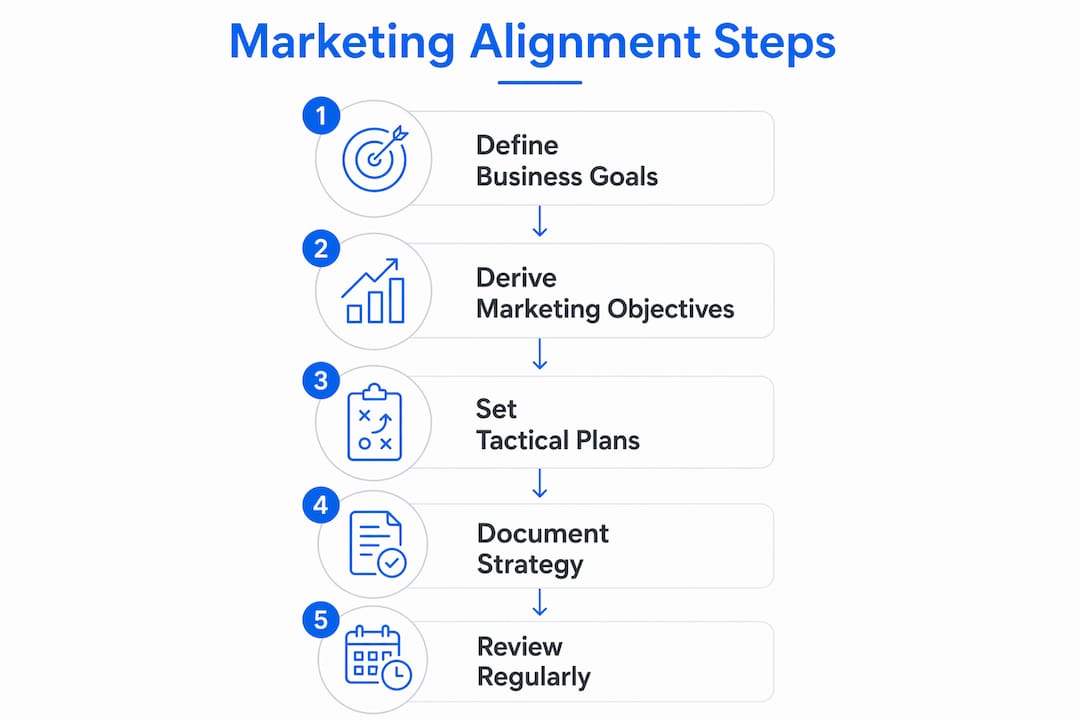
Cross-functional collaboration is what keeps this mapping honest. Marketing goals set in a shared planning room with sales, product, and finance leadership create shared accountability for commercial outcomes. When sales is in the room, marketing cannot set lead quality targets that sales will later reject. When finance is in the room, budget requests get grounded in projected returns. You can build a custom marketing strategy that reflects this kind of cross-team input from the start.
Key behaviors to build into your goal-setting process:
- Write marketing goals in the same financial language as the business plan.
- Assign a named owner to each marketing goal, not a department.
- Set a review date at the time of goal creation, not after results disappoint.
- Link every marketing channel and campaign to at least one business objective before spending begins.
What tools and practices keep alignment on track?
Alignment is not a one-time event. It breaks down the moment priorities shift and no one updates the marketing plan. The practices below keep business objectives marketing in sync over time.
Shared planning sessions. Collaborative planning involving sales, product, finance, and marketing creates shared accountability and more effective execution. Schedule a quarterly planning session where all four functions review business performance and adjust marketing priorities together.
Regular reporting tied to commercial outcomes. Quarterly reporting is more effective than annual reviews for maintaining alignment. Monthly dashboards that show marketing metrics alongside revenue and retention data keep leadership informed and prevent misunderstandings from compounding.
The comparison below shows the difference between misaligned and aligned reporting:
| Misaligned reporting | Aligned reporting |
|---|---|
| Reports impressions and follower growth | Reports leads generated and pipeline influenced |
| Measures campaign clicks | Measures revenue attributed to campaigns |
| Reviewed annually or after a crisis | Reviewed quarterly with executive leadership |
| Marketing owns the data alone | Sales, finance, and marketing review together |
Pro Tip: Build a one-page marketing scorecard that shows three marketing metrics next to three business metrics. Share it in every leadership meeting. When executives see marketing data next to revenue data, the conversation shifts from “what did marketing do?” to “how did marketing contribute?”
Avoiding the tactic-first trap is the most underrated discipline in marketing performance and business outcomes. Before approving any new campaign, channel, or tool, ask one question: which business objective does this directly support? If the answer is vague, the tactic is premature. Understanding the role of data in this process helps you build reporting that actually answers that question.
Key Takeaways
Effective marketing alignment requires documented goals, cross-functional collaboration, and regular reporting that connects marketing activity directly to business outcomes.
| Point | Details |
|---|---|
| Document your strategy | Documented strategies produce results 82% of the time when followed consistently. |
| Reverse-engineer marketing goals | Start with business objectives, then derive marketing goals and tactics from them. |
| Involve cross-functional leadership | Include sales, product, and finance in goal-setting to create shared accountability. |
| Report on commercial outcomes | Link marketing metrics to revenue and retention data in quarterly leadership reviews. |
| Use SMART goals | Specific, measurable, time-bound objectives give marketing a precise target to hit. |
Marketing alignment is not a marketing problem
Here is what I have learned working with SMB owners who are frustrated with their marketing results. The problem is almost never the marketing itself. It is the absence of a clear business objective that marketing was supposed to serve.
Most business owners treat marketing as a cost center. They fund it, hand it off, and wait for results. When results disappoint, they blame the channel or the agency. The real issue is that no one defined what “results” meant in business terms before the campaign launched.
The shift I recommend is treating marketing as a revenue function with the same accountability you apply to sales. That means marketing leaders read the P&L. It means the marketing plan references the same revenue targets as the business plan. It means the CMO or marketing lead sits in the same planning meetings as the CFO and VP of Sales.
I have also seen SMBs waste significant budget by choosing tactics before goals. A business owner sees a competitor running LinkedIn ads and decides to do the same. There is no business objective behind the decision, no defined audience, and no metric for success. Six months later, the campaign is canceled and the budget is gone. The sequence matters more than the tactic.
My practical recommendation for any SMB owner reading this: write down your top three business priorities for the next 12 months. Then ask your marketing lead to show you, in writing, how each current marketing activity connects to one of those three priorities. If they cannot, you have found your alignment gap.
— Eric
How Marvingrowthpartners approaches marketing and business alignment
Marvingrowthpartners works directly with SMB owners to connect executive-level business priorities to hands-on marketing execution. The process starts with your business plan, not a marketing template.

Every engagement begins by mapping your revenue targets, growth stage, and cash flow realities to a documented marketing plan built specifically for your situation. Marvingrowthpartners does not use recycled playbooks. The team brings sales, finance, and marketing into a shared planning process that produces clear goals, named owners, and measurable outcomes. If you want marketing that actually moves your business forward, explore the growth strategy approach Marvingrowthpartners uses with growing companies. For businesses ready to act, the fractional marketing leadership service gives you executive-level alignment without the overhead of a full-time hire.
FAQ
What does it mean to align marketing with business goals?
Aligning marketing with business goals means building every marketing objective and campaign directly from your company’s defined commercial priorities, such as revenue growth, market expansion, or customer retention. Marketing plans that mirror the business plan produce measurably better results than those developed independently.
Why do SMBs struggle with marketing strategy alignment?
Most SMBs choose marketing tactics before confirming business goals, which produces activity without commercial direction. The fix is reversing the sequence: define business objectives first, then derive marketing goals, then select tactics.
How does the SMART framework help with marketing goals and objectives?
SMART goals are specific, measurable, achievable, relevant, and time-bound. They give marketing a precise, accountable target tied to a business outcome rather than a vague aspiration like “increase awareness.”
How often should marketing and business goals be reviewed together?
Quarterly reviews are more effective than annual reviews for maintaining alignment. Linking marketing metrics to revenue and retention data in each review prevents misalignment from compounding over time.
What is the biggest sign that marketing and business goals are misaligned?
The clearest sign is when marketing reports metrics like impressions or followers while the business is missing revenue targets. Aligned marketing reports leads, pipeline, and revenue contribution alongside business performance data.
Recommended
- Build a Custom Marketing Strategy for Your SMB in 2026 – Marvin Growth Partners
- Marketing Strategy Types for SMBs: 2026 Growth Guide – Marvin Growth Partners
- Why Content Marketing Drives SMB Growth in 2026 – Marvin Growth Partners
- Why SMBs Need Personalized Marketing to Grow – Marvin Growth Partners