

Build a Custom Marketing Strategy for Your SMB in 2026
A custom marketing strategy for an SMB is a documented, goal-aligned plan that connects your specific business objectives, customer insights, chosen channels, and measurable KPIs into one executable system. Most small business owners skip the documentation step and wonder why their marketing feels scattered. To build a custom marketing strategy for your SMB that actually drives growth, you need four things working together: research grounded in your real market position, goals tied to revenue outcomes, channel choices based on where your customers actually spend time, and a review cadence that keeps the plan alive. Tools like HubSpot, monday.com, and frameworks like SMART goals give you the structure to make this repeatable.
How to build a custom marketing strategy for your SMB
Every effective custom marketing plan for an SMB starts with a clear picture of where you stand today. A documented plan integrates business objectives with audience insights, goals, channels, tactics, and budget into a single measurable system. Without that documentation, you are making decisions from memory instead of data.
Conducting research and competitive analysis
Start with a SWOT analysis. Map your strengths, weaknesses, opportunities, and threats against at least two or three direct competitors. Customer and competitive research should document your customers’ demographics, pain points, and purchasing behavior before you write a single tactic. This step separates businesses that grow from businesses that guess.
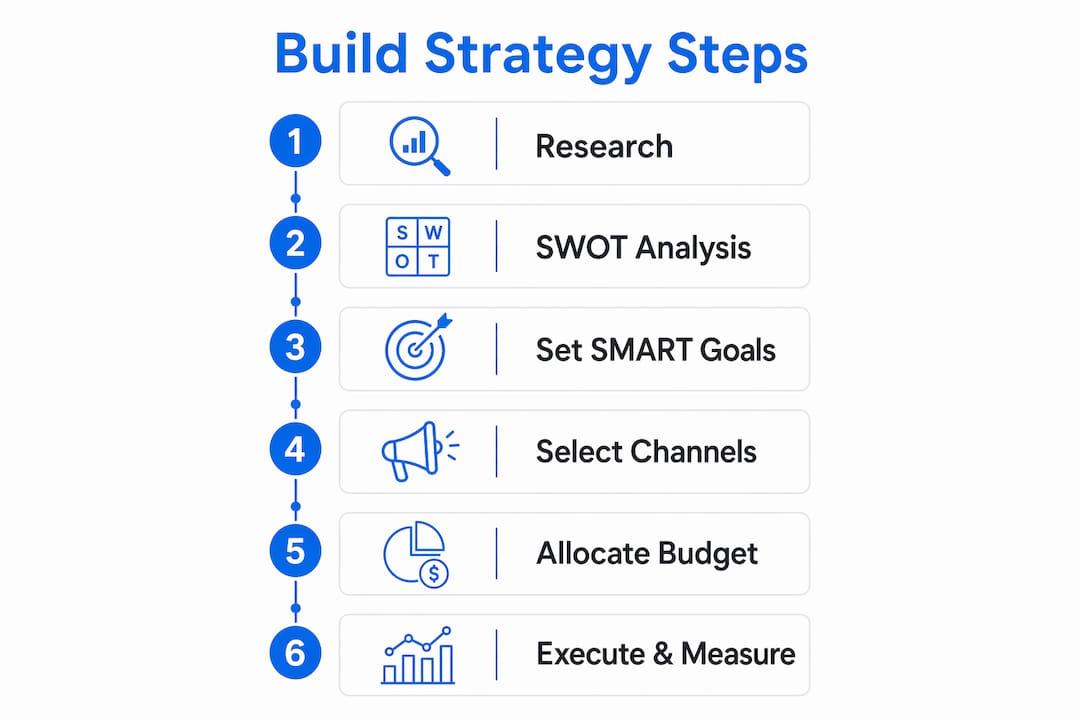
Customer profiling goes deeper than age and location. You want to understand what triggers a purchase decision, what objections stall it, and which channels your buyers use to research solutions. Surveys through Typeform, social listening via Sprout Social, and traffic analysis in Google Analytics 4 each reveal a different layer of that picture. Document every insight in a shared file your whole team can reference.
Market and industry trends matter too. If your competitors are shifting budget toward short-form video and your audience skews under 40, that is a signal worth acting on. The goal of this research phase is to surface the two or three biggest opportunities your business is positioned to capture in the next 12 months.
- Run a SWOT analysis against two to three named competitors
- Build customer profiles covering demographics, pain points, and buying triggers
- Use Google Analytics 4, Typeform, and Sprout Social to gather behavioral data
- Document all findings in a centralized, team-accessible format
- Identify two to three market opportunities your business can realistically pursue
Pro Tip: Interview five to ten recent customers directly. Ask them what almost stopped them from buying. Their answers will rewrite your messaging faster than any analytics report.
How to set SMART goals and KPIs that drive real results
SMART goals are Specific, Measurable, Achievable, Relevant, and Time-bound. For SMBs, they translate vague ambitions like “grow the business” into targets like “generate 50 qualified leads per month by Q3 through organic search and email.” Backlinko recommends prioritizing one primary goal over a six to twelve month horizon and defining KPIs in measurable terms from day one.
The most common mistake SMBs make is setting too many goals at once. When everything is a priority, nothing gets the budget or attention it needs. Pick one primary goal, such as lead generation or customer retention, and add one or two secondary goals that support it. A lean team executing one goal well outperforms a stretched team chasing five.
Vanity metrics like pageviews and follower counts feel good but rarely connect to revenue. HubSpot warns that KPIs must tie to outcomes like demos booked, signups, and influenced deals. If your dashboard does not show a path to closed revenue, rebuild it.
Examples of SMART goals for common SMB priorities:
- Lead generation: Increase marketing-qualified leads from 30 to 60 per month within 90 days using SEO and paid search
- Brand awareness: Grow organic social reach by 40% in six months through a consistent content publishing schedule
- Customer retention: Reduce churn by 15% in Q2 by launching a monthly email nurture sequence for existing customers
- Sales growth: Generate $50,000 in new revenue from referral partnerships by the end of Q3
Align every goal with your actual budget and team capacity. A goal that requires a $10,000 monthly ad spend when your total budget is $3,000 is not achievable. That mismatch kills execution before it starts.
Which marketing channels work best for SMBs?
Effective channel selection for a tailored marketing strategy comes down to three criteria: where your audience already spends time, which channels support your primary goal, and which ones your team can execute consistently. Focusing on three to five channels maximizes ROI and prevents the dilution that kills most SMB marketing programs.

The table below compares the most effective channels for SMBs in 2026 based on cost, effort, and typical use case.
| Channel | Cost level | Effort level | Best for |
|---|---|---|---|
| SEO and content marketing | Low to medium | High | Long-term lead generation and brand authority |
| Email marketing | Low | Medium | Retention, nurture, and repeat purchase |
| Paid social (Meta, LinkedIn) | Medium to high | Medium | Audience targeting and fast awareness |
| Referral programs | Low | Low | High-trust acquisition at low cost |
| Organic social media | Low | Medium | Community building and brand presence |
For most SMBs, SEO and email marketing form the core because they compound over time without requiring constant ad spend. Paid channels like Meta or LinkedIn Ads work well for testing messaging quickly or filling pipeline gaps. Brand strategy for small businesses that works integrates channel choices with a consistent brand voice so every touchpoint reinforces the same message.
Pro Tip: Before adding a new channel, ask whether you can publish or respond there at least three times per week for the next 90 days. If the answer is no, do not start. Inconsistency does more damage than absence.
Content strategy ties all channels together. Your blog post feeds your email newsletter, which drives traffic back to a landing page, which converts visitors into leads. That loop only works if your messaging stays consistent across every format and platform.
How to allocate your SMB marketing budget
SMBs under $5 million in gross revenue typically allocate 7 to 8% of revenue to marketing, with Gartner and Deloitte surveys showing average spends ranging from 7.7% to 9.4%. That benchmark gives you a realistic starting point, not a ceiling.
The table below shows a practical budget split for a $200,000 annual marketing budget.
| Category | Allocation | Example spend |
|---|---|---|
| Customer acquisition (paid ads, SEO tools) | 40 to 50% | $80,000 to $100,000 |
| Customer retention (email, loyalty programs) | 20 to 30% | $40,000 to $60,000 |
| Creative production (design, video, copy) | 15 to 20% | $30,000 to $40,000 |
| Tools and platforms (CRM, analytics, automation) | 10 to 15% | $20,000 to $30,000 |
| Experimentation reserve | 5 to 10% | $10,000 to $20,000 |
The experimentation reserve is the line most SMBs cut first. That is a mistake. Keeping 5 to 10% for testing new channels or formats gives you the data to make smarter decisions in the next planning cycle. Budget allocation should also inform your goal setting. If your acquisition budget cannot support a paid search campaign, your lead generation goal needs to rely on organic channels instead. Understanding social media’s role in your channel mix helps you decide where that acquisition spend delivers the most return.
How to execute your plan and measure what matters
Execution without structure produces inconsistent results. Building marketing workflows and assigning clear responsibilities through a RACI matrix (Responsible, Accountable, Consulted, Informed) prevents tasks from falling through the gaps. Every tactic in your plan needs an owner, a deadline, and a defined output.
Start with a 90-day marketing calendar. Map every piece of content, every campaign launch, and every review meeting onto a shared calendar in monday.com or Asana. A 90-day window is short enough to stay focused and long enough to see whether your tactics are working.
- Build a 90-day editorial calendar covering all channels and campaigns
- Assign a RACI owner to every tactic before the quarter starts
- Run weekly execution check-ins to catch blockers early
- Conduct monthly KPI reviews comparing actual results to targets
- Hold quarterly strategy sessions to adjust channel mix, budget, and goals based on data
Standardizing UTM parameters and using multi-touch attribution models in HubSpot or Google Analytics 4 lets you connect specific campaigns to revenue. Without that tracking infrastructure, your monthly KPI review is just a conversation about feelings. Define your conversion events clearly in your analytics stack so every dashboard reflects real business outcomes, not just traffic numbers.
A living plan requires a regular review cadence. Weekly check-ins keep execution on track. Monthly reviews tell you whether your KPIs are moving. Quarterly sessions are where you make the bigger calls: shift budget, drop a channel, or double down on what is working. Treating your customer journey as a living system means updating your messaging and tactics after meaningful changes in your market or customer behavior, not waiting for the annual planning cycle.
Pro Tip: Set a 15-minute weekly “red flag” meeting with whoever owns execution. The only agenda item: what is at risk of missing this week? That single habit prevents most campaign failures.
Key takeaways
A custom marketing strategy for an SMB requires documented research, one primary goal, focused channel selection, and a consistent review cadence to produce measurable growth.
| Point | Details |
|---|---|
| Start with documented research | Run a SWOT analysis and customer profiling before choosing any channel or tactic. |
| Set one primary goal | Focus on a single revenue-tied goal for six to twelve months to prevent execution sprawl. |
| Limit channels to three to five | Consistent execution on fewer channels outperforms scattered presence across many. |
| Allocate 7 to 8% of revenue | Use budget benchmarks to set realistic goals and prioritize acquisition and retention spend. |
| Build a review cadence | Weekly, monthly, and quarterly reviews keep the plan responsive and spending efficient. |
What most SMB marketing plans get wrong
Most SMB owners I work with arrive with the same problem: they have tactics but no strategy. They are posting on Instagram, running occasional Google Ads, and sending emails when they remember to. Each tactic works in isolation sometimes, but nothing compounds because there is no documented plan connecting them.
The instinct to do everything at once is understandable. You see a competitor running LinkedIn Ads and feel like you are missing out. You read about TikTok and wonder if you should be there. That fear of missing out is the single biggest budget killer in small business marketing. The businesses I have seen grow fastest are the ones that picked two or three channels, got genuinely good at them, and ignored everything else for at least six months.
The other pattern I see constantly is treating the annual plan as a fixed document. You write it in January, file it, and revisit it in December to see how wrong you were. A real strategy is reviewed monthly and adjusted quarterly. Data-driven marketing is not about having more dashboards. It is about having a standing meeting where someone is accountable for the numbers and empowered to change course.
Technology helps, but only after the fundamentals are in place. Automating a broken email sequence just sends bad emails faster. Get your messaging right, confirm your goals are tied to revenue, and then use tools like HubSpot or ActiveCampaign to scale what is already working.
— Eric
How Marvingrowthpartners helps SMBs build strategies that scale
Building a custom marketing plan takes time, expertise, and honest assessment of where your business actually stands today. Most SMB owners do not have a spare 40 hours to run competitive research, map customer journeys, set attribution models, and build a 90-day calendar from scratch.
Marvingrowthpartners specializes in exactly this work. The team aligns executive-level strategy with hands-on execution to build growth systems tailored to your specific stage, cash flow reality, and market position. No recycled playbooks. No generic channel recommendations. If you are ready to stop guessing and start executing a plan built around your actual business, explore what Marvingrowthpartners offers and see how the approach translates to measurable results for growing companies.
FAQ
What is a custom marketing strategy for an SMB?
A custom marketing strategy for an SMB is a documented plan that aligns your specific business goals, customer insights, channel choices, and KPIs into one executable system. It differs from a generic plan because every element is built around your actual market position and resources.
How much should an SMB spend on marketing?
SMBs under $5 million in gross revenue typically allocate 7 to 8% of revenue to marketing, with Gartner and Deloitte surveys showing averages between 7.7% and 9.4%. Budget splits generally favor 40 to 50% toward acquisition and 20 to 30% toward retention.
How many marketing channels should a small business use?
Most SMBs perform best when they focus on three to five channels consistently rather than spreading effort across many. Consistent execution on fewer channels produces better ROI than inconsistent presence across a dozen platforms.
How do you measure whether a marketing strategy is working?
Tie every KPI to a revenue-driving outcome such as demos booked, signups, or closed deals. Use UTM parameters and multi-touch attribution in tools like HubSpot or Google Analytics 4 to connect specific campaigns to actual revenue, not just traffic or engagement.
How often should an SMB review its marketing strategy?
Run weekly execution check-ins to catch blockers, monthly KPI reviews to assess performance against targets, and quarterly strategy sessions to adjust channel mix, budget, and goals based on real data. Annual planning alone is not sufficient for a responsive marketing program.