

Why Content Marketing Drives SMB Growth in 2026
Content marketing is the strategic creation and distribution of valuable content to attract, convert, and retain ideal customers. For small and medium-sized businesses, it answers a critical question: how do you compete with larger players without a larger budget? The answer is consistent, targeted content. Why content marketing drives SMB growth comes down to three compounding forces: organic visibility, earned trust, and long-term customer loyalty. Channels like blogs, email newsletters, LinkedIn, and Google Business Profile give SMBs direct access to buyers without paying for every impression. Small businesses that blog consistently see 55% more website visitors than non-bloggers. That gap compounds every month you publish and every month your competitors don’t.
Why content marketing drives SMB growth more than paid ads
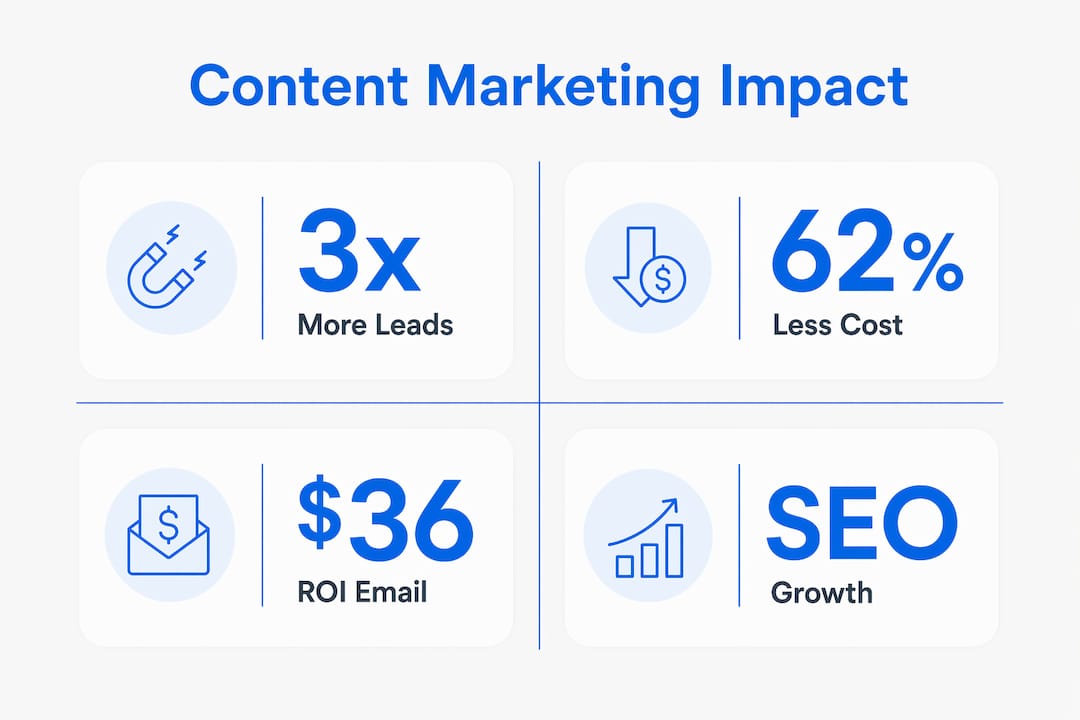
Content marketing generates three times more leads than paid advertising while targeting intent rather than demographics. That distinction matters enormously for SMBs. Paid ads reach people who fit a profile. Content reaches people actively searching for answers you provide. The difference in conversion quality is significant.
The cost advantage is equally striking. Content marketing costs 62% less than outbound marketing while producing the same lead volume multiplied by three. For an SMB spending $2,000 per month on Google Ads, shifting even half that budget toward content creation and distribution produces a measurably better return within two quarters.

Strategic content marketing improves lead generation, SEO rankings, brand authority, and customer retention simultaneously from a single investment. Traditional advertising buys one outcome per campaign. A well-written blog post on a topic your customers search for every week keeps generating traffic, leads, and trust for years without additional spend.
Content marketing vs. traditional advertising: what SMBs actually get
| Dimension | Content marketing | Traditional advertising |
|---|---|---|
| Cost per lead | Up to 62% lower | Higher, paid per impression |
| Lead quality | Intent-based, higher conversion | Demographic-based, lower conversion |
| Longevity | Evergreen content works for years | Stops when budget stops |
| Trust building | High, through expertise demonstration | Low, perceived as promotional |
| SEO impact | Direct, compounds over time | None |
Pro Tip: Repurpose one strong blog post into three LinkedIn posts, one email newsletter, and a short FAQ page. You multiply distribution without multiplying production time.
How SMB constraints actually shape a better content strategy
The instinct for most SMB owners is to spread content across every platform available. That instinct produces mediocre results everywhere and burnout within 90 days. The smarter approach is narrower than most people expect.
Successful SMB content marketing targets a niche audience of 100 to 500 ideal prospects rather than chasing mass reach. If you run a B2B accounting firm serving manufacturers in the Midwest, you do not need 10,000 blog readers. You need 200 of the right decision-makers reading your content every month. That precision changes everything about what you write, where you publish, and how you measure success.
Channel discipline is equally important. Limiting content to 1-2 primary platforms prevents founder burnout and produces more consistent execution than spreading thin across five channels. For most SMBs, the winning combination is Google Business Profile paired with email newsletters, or LinkedIn long-form posts paired with a company blog. Pick the two channels where your buyers already spend time, then commit fully.
Personal branding is an underused SMB advantage. A solo founder or small team can write with a voice that a 500-person company cannot replicate. Authenticity builds trust faster than polished corporate content, and trust converts. The importance of content strategy for brand building is not about volume. It is about showing up consistently with a recognizable, credible voice.
- Focus your content on solving one specific problem your best customers face repeatedly
- Post on a weekly cadence rather than daily bursts followed by long silences
- Write from personal experience and specific client scenarios, not generic industry advice
- Distribute content manually to your existing network before relying on algorithms
- Measure engagement from known prospects, not total follower counts
Pro Tip: Personal distribution to your existing network can outperform algorithmic reach by 10 to 100 times for small businesses. Send your best content directly to 20 key contacts before you post it publicly.
What content types and distribution channels work best for SMBs
Blog posts remain the foundation of SMB content marketing because they produce compounding SEO value. A post ranking on page one of Google for a relevant search term generates leads every week without additional effort. The key is writing posts that answer specific questions your buyers type into search engines, not broad industry overviews that compete with major publications.
Email newsletters deliver the highest direct ROI of any content channel. Email marketing returns $36 for every $1 spent, making it the most capital-efficient distribution method available to SMBs. A list of 500 engaged subscribers who know your business is worth more than 5,000 social media followers who have never bought from you.
LinkedIn long-form posts work particularly well for B2B SMBs because the platform’s algorithm still rewards original, text-based content from individual accounts. A founder sharing a detailed breakdown of a client problem solved, with specific numbers and outcomes, routinely outperforms polished brand content. For B2C SMBs, a local blog combined with Google Business Profile posts drives foot traffic and local search visibility more reliably than most paid options. Exploring top digital marketing channels helps clarify which platforms align with your specific buyer behavior.
| Content type | Approximate monthly cost | Primary benefit | Best distribution platform |
|---|---|---|---|
| Blog posts | $200-$800 | Long-term SEO and organic traffic | Website, Google Search |
| Email newsletter | $50-$200 | Direct lead nurturing, highest ROI | Email list (Mailchimp, ConvertKit) |
| LinkedIn long-form | $0-$300 | B2B authority and network reach | |
| Google Business posts | $0-$100 | Local visibility and trust | Google Search, Maps |
| Short-form video | $100-$500 | Engagement and brand awareness | YouTube, Instagram Reels |
How can SMBs measure content marketing success without drowning in data?
Most SMBs track the wrong metrics. Follower counts, total page views, and social media impressions feel like progress but rarely correlate with revenue. The metrics that actually matter are lead conversations started, email subscribers added, and customer conversions attributed to content.
Start with three numbers: how many qualified leads contacted you after reading a specific piece of content, how many email subscribers joined your list this month, and how many closed deals mentioned your content during the sales process. Those three data points tell you more than any dashboard full of vanity metrics. For a deeper look at connecting these numbers to business outcomes, the marketing ROI framework for SMBs provides a practical measurement structure.
Most SMBs see meaningful organic traffic growth within 3 to 6 months of consistent publishing. That timeline requires patience, but the trajectory is predictable. The ROI of content marketing compounds as your content library grows, meaning month 18 produces better returns than month 6 from the same initial investment. Plan for 6 to 12 months before expecting meaningful business results, and track leading indicators monthly to confirm you are on the right path.
- Track lead conversations, not just traffic volume
- Monitor email list growth as a direct measure of audience trust
- Review which specific posts generate the most qualified inquiries
- Adjust posting themes quarterly based on what drives actual engagement
- Connect content performance data to your CRM to attribute revenue accurately
Integrating content analytics with your referral program and outreach efforts gives you a complete picture of how content supports the full customer acquisition cycle. A 2026 digital marketing guide for SMBs covers how to connect these channels into a single measurement system.
Key takeaways
Content marketing drives SMB growth by generating intent-based leads at lower cost, building compounding organic visibility, and creating the kind of trust that paid advertising cannot buy.
| Point | Details |
|---|---|
| Cost and lead advantage | Content marketing produces 3x more leads at 62% less cost than outbound methods. |
| Channel discipline | Limit to 1-2 platforms in year one to maintain consistency and avoid burnout. |
| Email ROI | Email newsletters return $36 per $1 spent, making them the highest-ROI content channel. |
| Patience required | Plan for 6-12 months before meaningful business results appear from content investment. |
| Measure what matters | Track lead conversations and customer conversions, not follower counts or raw traffic. |
What I’ve learned about content marketing after working with dozens of SMBs
The most common mistake I see SMB owners make is treating content marketing like a campaign. They publish 10 posts in January, see modest results by March, and conclude it doesn’t work. Content marketing is not a campaign. It is infrastructure. The businesses I’ve watched grow fastest through content were the ones that committed to one channel, posted every week without exception, and measured results over quarters rather than weeks.
The second lesson is harder to hear: most SMB content is too safe. Owners write what they think sounds professional instead of writing what they actually know. A plumber who writes a post titled “The Three Mistakes Homeowners Make Before Calling a Plumber” will outrank any generic “plumbing tips” article because it is specific, credible, and written from real experience. That specificity is your competitive advantage over larger competitors with bigger budgets and blander content.
I also caution against chasing every new platform. When a new social channel gains traction, the pressure to be there immediately is real. Resist it. The marketing strategy types that work for SMBs in 2026 are the ones built on channels where your buyers already exist, not the ones generating the most media coverage. Consistency on two channels beats sporadic presence on six every time. View every piece of content you publish as a long-term asset, not a short-term post. That shift in perspective changes how you write, what you write about, and how long you stick with it.
— Eric
How Marvingrowthpartners helps SMBs turn content into consistent growth
Marvingrowthpartners works with SMB owners who know content marketing matters but struggle to build a system that produces results without consuming every available hour. The team aligns executive-level strategy with hands-on execution, so you get a content plan built around your specific growth stage, cash flow constraints, and customer acquisition goals. No recycled playbooks. No generic editorial calendars. Every strategy is built from your real business challenges and measured against revenue outcomes.
If you are ready to build a content system that compounds over time, explore Marvingrowthpartners’ services and see how a tailored approach changes what content marketing can do for your business.
FAQ
What is content marketing for small businesses?
Content marketing for small businesses is the practice of creating and distributing valuable, relevant content to attract and retain a defined audience of ideal customers. It includes blog posts, email newsletters, LinkedIn posts, and Google Business Profile updates designed to build trust and generate leads organically.
How long does content marketing take to show results for SMBs?
Most SMBs see meaningful organic traffic growth within 3 to 6 months of consistent publishing, with real business results typically appearing between 6 and 12 months. The ROI compounds as the content library grows, so early investment pays off at an accelerating rate over time.
How much does content marketing cost compared to paid advertising?
Content marketing costs 62% less than outbound marketing methods while generating three times more leads. For SMBs with limited budgets, this cost-to-lead ratio makes content the most capital-efficient growth channel available.
Which content channels work best for SMBs?
Email newsletters and blog posts deliver the strongest ROI for most SMBs. Email returns $36 for every $1 spent, and blog content produces compounding SEO value for years. B2B SMBs benefit significantly from LinkedIn long-form posts, while local businesses gain from Google Business Profile content.
How do SMBs measure content marketing success?
Track lead conversations started, email subscribers added, and customer conversions attributed to specific content pieces. Avoid measuring follower counts or raw traffic without connecting those numbers to actual business outcomes.