

The Role of Content Strategy in Brand Building
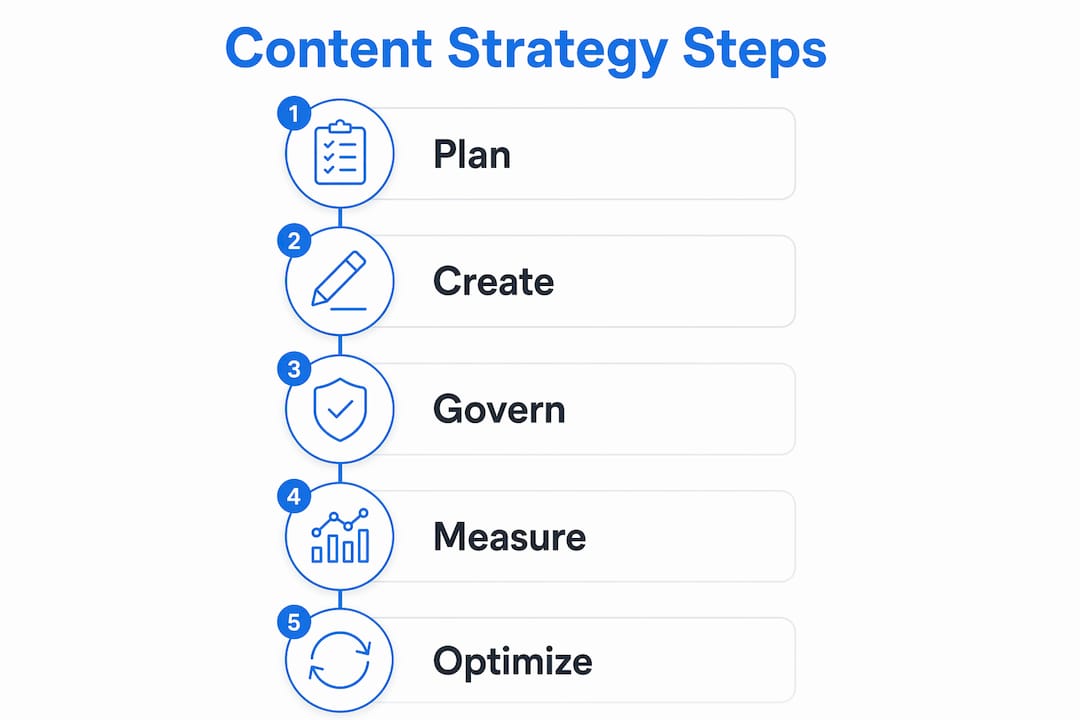
Content strategy is the deliberate framework of planning, creating, governing, and measuring brand-aligned content to build trust, visibility, and lasting brand equity. For small and medium-sized businesses, this discipline separates brands that grow with intention from those that drift with the news cycle. The content strategy framework covers the entire content lifecycle, from conception to maintenance, optimizing user experience while aligning every asset with business goals. When you treat content as a system rather than a series of one-off posts, your brand becomes recognizable, credible, and worth remembering.
What is the role of content strategy in brand building?
Content strategy, as a recognized discipline, is often described through Kristina Halvorson’s content strategy quad: substance, structure, workflow, and governance. Each quadrant directly shapes how your brand is perceived. Substance defines what you say and why it matters to your audience. Structure determines how content is organized and formatted for clarity and discoverability. Workflow maps who creates, reviews, and publishes content. Governance sets the rules that keep all of it consistent over time.
The content strategy quad is used as a planning backbone in brand-related content work precisely because it forces you to think beyond the next blog post. Most SMBs skip directly to production and wonder why their brand feels scattered six months later. The quad gives you a map before you start driving.

Content strategy also differs from content marketing, though the two are often confused. Content marketing is the execution: the blog posts, videos, and social updates. Content strategy is the architecture that makes those executions coherent and cumulative. Without the strategy layer, content marketing produces noise. With it, every piece of content compounds toward a recognizable brand identity.
What are the key components that drive brand consistency?
Brand consistency does not happen by accident. It is an operational discipline built through deliberate governance and repeatable workflows. Here are the four components that matter most:
- Substance: Your core messages, value propositions, and the topics your brand owns. These should be documented and referenced before any content is created.
- Structure: The formats, templates, and information architecture that make your content scannable and trustworthy. A brand that uses consistent heading styles, image ratios, and content lengths trains readers to recognize it instantly.
- Workflow: The editorial process covering who writes, who edits, who approves, and at what cadence. Without a defined workflow, content quality fluctuates and deadlines slip.
- Governance: The policies that define brand voice, tone, approval rights, and quality standards. Governance policies prevent fragmentation in distributed or growing teams by making brand decisions explicit rather than assumed.
Style guides and brand voice documents are the practical tools that make governance real. A style guide specifies word choices, punctuation preferences, and formatting rules. A brand voice document describes the personality behind the words: whether your brand is direct and technical, warm and conversational, or authoritative and data-driven. Together, they give every contributor a shared reference point.
Pro Tip: Build your governance documents before you scale your content team. Adding writers or agencies without a style guide in place is the fastest way to dilute your brand voice. Even a two-page document covering tone, banned phrases, and formatting rules will prevent months of cleanup later.
The deeper risk of skipping governance is brand drift. When multiple writers, agencies, or departments produce content independently, each makes small stylistic decisions that accumulate into a fragmented identity. Readers notice the inconsistency even when they cannot name it. Trust erodes quietly.
How does content strategy enhance brand visibility and trust?
Voice and tone consistency across brand touchpoints forges trust and deeper connections, strengthening brand identity over time. This is not a soft claim. When your audience reads a blog post, watches a video, and visits your homepage and all three feel like they came from the same mind, they form a stronger mental association with your brand. That association is what drives recall and preference.
Original, human-led storytelling is the differentiator that most brands underinvest in. A 2026 Sprout Social report found that only 56% of users think brands do well with originality on social media. That gap is an opportunity. Brands that commit to genuine perspectives, real stories, and specific expertise stand out precisely because most content is generic. The power of storytelling in brand engagement is not about production value. It is about specificity and honesty.
Awareness-stage content formats are particularly effective for building brand visibility:
- Glossaries and definitions answer the questions buyers ask at the start of their research journey, positioning your brand as the authoritative source before competitors enter the conversation.
- FAQs and how-to guides capture search traffic from people who do not yet know your product exists but are actively looking for solutions you provide.
- Video content builds emotional connection faster than text. Video marketing works for local and small businesses because it communicates personality in a way that written content alone cannot replicate.
AI search engines now cite specific content assets rather than general pages. Top-of-funnel educational content aligned to buyer journey stages boosts brand presence in AI answer engines by increasing citation and visibility. This means your glossary entry or definition page can appear in a ChatGPT or Perplexity response, putting your brand in front of a buyer who never ran a traditional search.
What modern metrics measure content strategy’s brand impact?
Traditional brand measurement relies on unaided awareness surveys and last-click attribution. Both are inadequate for understanding how content strategy builds brand equity over time. Unaided awareness is slow to move and expensive to measure. Last-click attribution credits the final touchpoint and ignores the six blog posts that built the trust that made the click possible.
BCG’s First-Fast Response metric, known as FFR, addresses this gap directly. FFR is 2.6 times more responsive and four times more predictive of future sales than unaided awareness. FFR measures how quickly and confidently a consumer associates a brand with a specific need or category. That speed of association is exactly what consistent, well-governed content builds over time.
“Measuring shifts in early cognitive brand associations through advanced metrics like FFR allows better management of brand investments.” — BCG
HubSpot’s 2026 case study on answer engine optimization demonstrates what this looks like in practice. By building a library of AI-optimized glossary and definition content, HubSpot raised citation share by 60% and improved brand visibility for awareness-stage prompts by 35 points. That is a measurable, attributable outcome from a content strategy decision, not a campaign.
| Metric | What it measures | Best for |
|---|---|---|
| First-Fast Response (FFR) | Speed of brand-category association | Long-term brand equity tracking |
| AI citation share | Brand mentions in AI-generated answers | Awareness-stage content performance |
| Organic search visibility | Ranking and traffic for target queries | SEO-driven content programs |
| Content engagement rate | Time on page, scroll depth, shares | Content quality and relevance |
For SMBs, the practical takeaway is to triangulate. No single metric tells the full story. Combine search visibility data from Google Search Console, engagement metrics from your CMS, and periodic brand association surveys to build a picture of how your content is shifting brand perception over time.
How to build and govern a content strategy for brand growth
Building a content strategy that actually strengthens your brand requires a sequenced approach. Skipping steps, particularly the audit and governance phases, is why most content programs stall after six months.
- Conduct an audience research sprint. Interview five to ten current customers about the questions they had before buying, the content they consumed, and the language they use to describe their problems. This gives you the raw material for messaging that resonates.
- Run a content audit. Catalog every existing piece of content by format, topic, performance, and alignment with your current brand positioning. Most SMBs discover they have significant gaps at the awareness stage and redundant content at the consideration stage.
- Map topics to the buyer journey. Assign content topics to awareness, consideration, and decision stages. Prioritize awareness-stage content first because it builds the brand associations that make everything downstream more effective.
- Build an editorial calendar. Commit to a publishing cadence you can sustain. Consistency matters more than volume. Two well-crafted pieces per month outperform eight rushed ones every time.
- Set up governance before you scale. Document your brand voice, tone guidelines, approval workflow, and quality standards. Use a RACI matrix to define who is Responsible, Accountable, Consulted, and Informed for each content type.
- Measure and adjust quarterly. Review your marketing strategy metrics against brand visibility and engagement benchmarks. Adjust topic priorities and formats based on what is building the associations you want.
Pro Tip: Your brand voice document should include three to five example sentences that sound like your brand and three to five that do not. The negative examples are often more useful than the positive ones because they make the boundaries concrete for writers and agencies.
The comparison that clarifies governance for most teams is the difference between a franchise and an independent restaurant. Both serve food, but the franchise has documented standards that produce a consistent experience regardless of location or staff. Your content governance is the franchise operations manual for your brand.
Key takeaways
Content strategy builds brand equity by making every content decision deliberate, consistent, and measurable rather than reactive and fragmented.
| Point | Details |
|---|---|
| Governance prevents brand drift | Document brand voice, tone, and approval workflows before scaling your content team. |
| Awareness-stage content builds brand equity | Glossaries, FAQs, and definitions create brand associations before buyers reach the decision stage. |
| FFR outperforms traditional metrics | BCG’s First-Fast Response metric is four times more predictive of future sales than unaided awareness. |
| AI citation share is a new brand metric | HubSpot’s AEO strategy raised citation share by 60%, proving content strategy drives AI-era visibility. |
| Originality differentiates brands | Only 56% of users think brands succeed at originality, making genuine storytelling a competitive advantage. |
Why governance is the part most brands get wrong
I have worked with enough growing companies to say this plainly: the content strategy conversation almost always starts with “we need more content” and almost never starts with “we need better governance.” That framing is backwards, and it costs brands real money.
The brands I have seen build durable equity through content share one trait. They treated their brand voice as infrastructure, not inspiration. They wrote it down, trained people on it, and enforced it in review cycles. When a new writer joined or an agency came on board, the standards were already documented. The brand did not have to start over.
The rise of AI-driven content discovery makes this even more urgent. When ChatGPT or Perplexity cites your brand, it is citing a specific asset, a definition, a guide, a structured answer. That asset either reflects your brand clearly or it does not. There is no algorithm that will fix a vague, off-brand glossary entry after the fact. You have to build it right the first time.
My honest advice for SMBs is to resist the pressure to publish constantly. One well-governed, deeply useful piece of content that owns a specific buyer question will do more for your brand than thirty generic posts. Build your brand online with assets that answer real questions at the moment buyers are asking them. That is where brand trust actually forms.
Measurement rigor should start on day one, not after six months of publishing. Even simple tracking of which content pieces generate the most qualified traffic or the most time on page will tell you what your audience values. Those signals are the feedback loop that keeps your content strategy aligned with your brand goals as both evolve.
— Eric
How Marvingrowthpartners can help you build a stronger brand
Marvingrowthpartners works with SMBs and marketing teams that are ready to treat content as a growth system, not a content calendar. The team aligns executive-level brand strategy with hands-on content execution, building governance frameworks, editorial workflows, and measurement systems tailored to where your business actually is, not where a generic playbook assumes you should be. If your content feels scattered or your brand voice varies by channel, that is a solvable problem. Explore Marvingrowthpartners’ services to see how a structured content strategy can turn your publishing efforts into measurable brand equity.
FAQ
What is content strategy in brand building?
Content strategy is the framework of planning, producing, governing, and measuring content to consistently communicate a brand’s identity and values. It differs from content marketing by providing the structure and rules that make individual content efforts coherent and cumulative.
How does content governance prevent brand inconsistency?
Governance defines approval processes, brand voice standards, and quality bars that every piece of content must meet. Without it, distributed teams make independent stylistic decisions that fragment brand identity over time.
What metrics best measure content strategy’s brand impact?
BCG’s First-Fast Response metric is four times more predictive of future sales than unaided awareness, making it a strong indicator of brand equity built through content. Combining FFR with AI citation share and organic search visibility gives the most complete picture.
How does awareness-stage content build brand recognition?
Glossaries, FAQs, and definition pages answer buyer questions at the earliest stage of research, creating brand associations before competitors enter the conversation. HubSpot’s AEO strategy demonstrated this by raising brand visibility for awareness prompts by 35 points through structured educational content.
How often should SMBs publish content to build their brand?
Consistency matters more than volume. A sustainable cadence of two to four well-governed pieces per month builds stronger brand associations than high-volume publishing that sacrifices quality or voice consistency.