

Why Growth Stages Require Different Business Strategies
Each growth stage in a business demands a fundamentally different strategy because the constraints, leadership capacity, and market conditions at each phase are structurally incompatible with a single approach. Founders who apply the same playbook from startup through scale-up consistently hit walls that feel like market problems but are actually internal mismatches. The research is clear: strategy ambition must align with operational capacity, or failure follows. Understanding why growth stages require different strategies is not a philosophical exercise. It is the difference between scaling efficiently and burning resources on solutions that do not fit your current reality.
Why growth stages require different strategies: the core case
Every business moves through predictable phases, and each phase has a defining constraint that limits total output. The mistake most leaders make is treating growth as a linear acceleration problem when it is actually a sequence of distinct operating modes. General Motors learned this the hard way when its AI-generated seat bracket design was 40% lighter and 20% stronger than conventional designs, yet the innovation stalled because manufacturing systems could not support it without years of retooling. The vision was right. The operational stage was wrong.
This is the central truth behind growth stage strategy differentiation, the recognized framework in organizational development for matching tactics to phase-specific realities. The constraint driving your business is not always visible from the outside. Capacity, market, system, and policy constraints each require a different intervention. Applying a system-building solution to a capacity constraint wastes months. Applying a marketing fix to an internal coordination problem wastes money and morale.

The importance of growth stages becomes undeniable when you see how many companies plateau not because the market dried up but because internal coordination broke down. When growth stalls, the instinct is to spend more on marketing. The actual fix is usually an internal diagnostic.
What unique challenges define each growth stage?
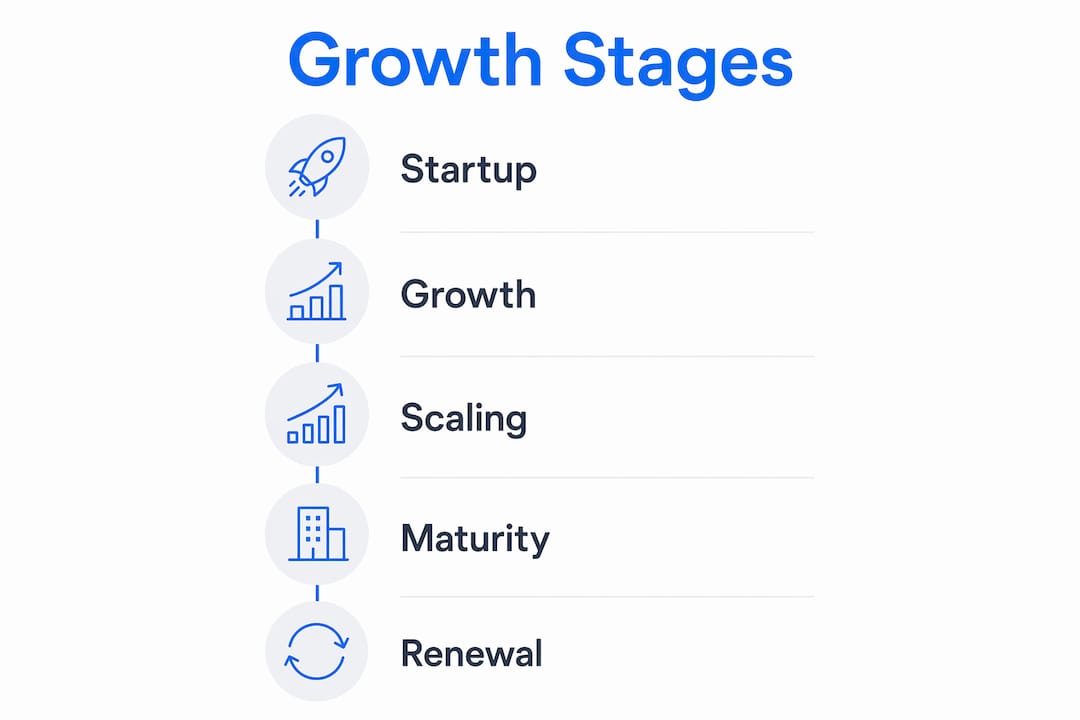
Growth stages are not arbitrary labels. They correspond to real operational thresholds where the current approach stops working. Larry Greiner’s research identifies leadership crises at predictable employee counts of 15 to 20, 45 to 55, and 90 to 100 people. Each threshold represents a span of control violation, where one manager exceeds 7 to 10 direct reports and decision bottlenecks multiply. These are not soft management challenges. They are structural failures that require a different organizational design.
Here is how the challenges stack up across the three primary stages most growing businesses move through:
-
Early stage (1 to 20 people). The constraint is almost always capacity. You are doing everything yourself or with a tiny team. Speed and improvisation are assets. The founder is the system. Customer discovery, rapid iteration, and direct selling define the work. The risk is not moving fast enough to find what works.
-
Repeatable results stage (20 to 50 people). The constraint shifts to systems. What worked through founder heroism now creates decision latency and bottlenecks as complexity increases. Processes that lived in one person’s head need to be documented and delegated. The founder must shift from doing to designing operating systems. This is where most scaling failures begin.
-
Scaling stage (50 to 100-plus people). The constraint becomes policy and coordination. You need dashboards, ERPs, structured communication, and defined accountability. Leadership must shift again from system design to system governance. The scrappiness that built the company now actively undermines it.
Pro Tip: If your best people are constantly waiting on you for decisions, you are in a founder bottleneck regardless of your headcount. That is a stage-two problem requiring a systems solution, not a hiring solution.
The shift from stage one to stage two is the most dangerous transition because it requires founders to give up the behaviors that made them successful. Speed and improvisation become liabilities when the team is large enough that inconsistency creates chaos.
How do strategies compare across growth stages?
Strategic priorities do not just shift at each stage. They invert. What is correct at stage one is actively harmful at stage three. The table below captures the core strategic differences that define each phase.
| Growth stage | Strategic focus | Marketing priority | Leadership mode | Key risk |
|---|---|---|---|---|
| Early stage | Customer discovery and validation | Learning what channels work | Founder executes directly | Moving too slow to find traction |
| Repeatable results | Building consistent delivery systems | Proving unit economics | Founder designs processes | Over-systematizing before product fits |
| Scaling | Operational discipline and measurement | Scalable acquisition channels | Leaders govern systems | Premature hiring and analysis paralysis |
The marketing dimension alone illustrates why growth strategy variations matter so much. Paid ads before understanding customer needs waste money at the early stage. The same paid ads become a core growth lever once repeatability and unit economics are proven. The channel did not change. The stage did.
The most common strategic missteps by stage include:
- Early stage: Hiring specialists before the generalist work is done. Building technology before validating the process manually.
- Repeatable results stage: Documenting processes so rigidly that the team cannot adapt. 80% of founders resist documenting processes at all, but over-documentation at this stage is also a trap.
- Scaling stage: Chasing growth channels that assume later-stage operational maturity. Stage mismatch leads to chasing elusive channels that do not fit current traction.
The practical implication for strategic planning for growth is that you need a stage diagnosis before you build a strategy. Without it, you are solving the wrong problem with the right tools.
How to diagnose your current stage and align your strategy
Diagnosing your growth stage is not about counting employees. It is about identifying your binding constraint, the single factor most limiting your output right now. Stage-based approaches work best when bottlenecks are correctly identified and matched with tailored interventions. Otherwise, scaling efforts fragment and underperform.
Use this four-step diagnostic to locate your current stage and align your strategy accordingly:
-
Map your decision flow. Track how long decisions take from identification to execution. If most decisions require founder input, you have a founder bottleneck. This is a stage-two problem requiring delegation frameworks and documented decision rights.
-
Identify your constraint type. Ask whether your output is limited by capacity (not enough people or time), market (not enough demand or clarity on who buys), system (inconsistent delivery or coordination failures), or policy (rules and structures that slow execution). Each type requires a different fix.
-
Assess your operational metrics. If you cannot answer basic questions about customer acquisition cost, delivery time, or team utilization without asking someone, your measurement infrastructure is behind your growth stage. Building ERPs, dashboards, and structured communication before reaching 50 employees is not optional. It is the foundation for stage-three execution.
-
Audit your leadership span. Count direct reports per manager. If any manager has more than 10 direct reports, you have a span of control violation that will create a leadership crisis at the next growth threshold.
Pro Tip: The fastest way to identify your stage is to ask your team what slows them down most. Founders are often the last to see their own bottleneck because the team routes around them rather than naming the problem directly.
Adapting strategies for growth requires this kind of honest internal assessment. The earlier leadership strengths become growth barriers without deliberate skill evolution. Leaders who built companies through hands-on execution must transition to system architecture roles. That transition does not happen automatically.
Practical applications: tailoring strategy by stage
Once you know your stage, the strategic levers become specific. Here is how the three core business functions shift across phases:
Marketing strategy. Early-stage marketing is an experiment budget, not a growth budget. You are buying information about what works, not scaling what you know. The stage-based growth guide for SMEs from Marvingrowthpartners outlines how to sequence marketing investment as traction develops. At the scaling stage, marketing shifts to channel optimization, retention economics, and referral architecture.
Operational systems. Do not implement an ERP at 15 people. Do implement one before you hit 50. The timing matters because systems introduced too early create bureaucracy that kills speed, while systems introduced too late create chaos that kills quality. The role of design in marketing also shifts at this point, from informal brand expression to consistent visual systems that support scalable acquisition.
Leadership development. The skills that make a great early-stage founder, speed, improvisation, direct selling, become liabilities at scale without deliberate evolution. Stage-two leaders need to build process documentation skills. Stage-three leaders need to build governance and accountability skills. Treating leadership development as a single track across all stages produces leaders who are perpetually behind their company’s needs.
The marketing strategy types guide from Marvingrowthpartners breaks down how channel selection, budget allocation, and messaging strategy each shift as businesses move through growth phases.
Key takeaways
Growth stage strategy differentiation is the practice of matching your operational approach, leadership model, and market tactics to the specific constraints and capacities of your current phase, and it is the primary determinant of whether scaling efforts succeed or stall.
| Point | Details |
|---|---|
| Stage defines constraint | Capacity, market, system, and policy constraints each require a different strategic response. |
| Founder bottleneck is a stage signal | Decision latency caused by founder dependence signals a transition from stage one to stage two. |
| Premature systematizing kills speed | Introducing ERPs and formal processes before the team or process is ready creates bureaucracy that slows growth. |
| Marketing tactics are stage-specific | Paid acquisition only works efficiently once unit economics and repeatability are proven. |
| Leadership must evolve with the company | Skills that build early-stage companies become bottlenecks without deliberate transition to system design and delegation. |
What I have learned watching founders fight their own growth
I have worked with enough founders to recognize a pattern that almost no one talks about openly. The leaders who struggle most at scale are not the ones who lack vision or drive. They are the ones who were too good at the early stage. Their speed, their instinct, their ability to hold everything in their heads, those traits made the company. And then those same traits became the ceiling.
The hardest conversation I have with any founder is not about strategy. It is about identity. When I tell someone that their hands-on style is now the primary constraint on their company’s growth, the instinct is to defend it. “That’s why we move fast.” “That’s our culture.” What they are really saying is: “I am not ready to become a different kind of leader.”
The companies that scale well are not the ones with the best strategies on paper. They are the ones where the leader was willing to be ruthlessly honest about what stage they were actually in, not the stage they wanted to be in. I have seen founders spend 18 months applying scaling-stage tactics to an early-stage problem and wonder why nothing worked. The strategy was not wrong in the abstract. It was wrong for where they were.
My advice is simple: before you build your next growth plan, spend one week doing nothing but diagnosing your current constraints. Talk to your team. Map your decisions. Count your bottlenecks. The strategy you need will become obvious. The strategy you want will become irrelevant.
— Eric
How Marvingrowthpartners aligns your strategy to your growth stage
Marvingrowthpartners specializes in exactly the kind of stage-based strategy alignment this article describes. The firm works directly with business leaders to diagnose operational constraints, identify founder bottlenecks, and build the systems and leadership structures that match where your company actually is, not where you hope it will be. Unlike agencies that hand you a recycled playbook, Marvingrowthpartners provides fractional COO support and growth consulting tailored to your current phase. If you are ready to stop applying the wrong strategy to the right ambition, the Marvingrowthpartners team is the practical next step.
FAQ
Why do growth stages require different strategies?
Each growth stage presents a different binding constraint, whether capacity, market, system, or policy, and applying the wrong solution to the wrong constraint wastes resources without improving output. Strategy must match the operational reality of the current phase.
What is the most common strategic mistake at the early stage?
Founders most often apply scaling-stage tactics before validating their core product and customer, spending on paid acquisition or specialist hires before unit economics are proven. This produces frustration and wasted budget without meaningful traction.
When should a business start building formal operational systems?
Gartner research identifies four foundational operational systems that should be in place before a company reaches 50 employees. Waiting until after that threshold creates coordination failures that are far more expensive to fix than to prevent.
How do I know if I have a founder bottleneck?
If decisions consistently wait on one person, if your team routes requests through you rather than resolving them independently, and if your calendar is full of operational decisions rather than strategic ones, you have a founder bottleneck that requires a systems and delegation response.
How does marketing strategy change across growth stages?
Early-stage marketing prioritizes learning over scaling, testing channels to understand what works before committing budget. Later stages shift to scalable acquisition channels and retention economics once repeatability and unit economics are confirmed.