

Why Local SEO Matters for Entrepreneurs in 2026
Local SEO is the process of optimizing your business’s online presence to appear in location-based search results, and it is the single most cost-effective growth channel available to entrepreneurs today. 46% of all Google searches carry local intent, and 28% of those searches result in a purchase. Google controls 92% of the U.S. search engine market, which means your local visibility on that one platform directly determines whether nearby customers find you or your competitor. For any entrepreneur building a customer base from scratch, understanding why local SEO matters is not optional. It is the foundation of a sustainable growth plan.
Why local SEO matters for entrepreneurs more than broad marketing
Local SEO outperforms broad digital marketing on every metric that matters to a cash-conscious entrepreneur: cost per lead, lead quality, and long-term return. The average cost per lead through local SEO runs approximately $32, compared to $75–$150 for Google Ads in competitive U.S. markets. That gap compounds over time. Paid ads stop the moment your budget runs out. Local SEO keeps working.
The quality difference is just as significant. Local SEO filters unqualified traffic by focusing on searchers within your specific service area. A plumber in Austin does not need clicks from Seattle. Local search delivers people who are nearby, ready to act, and already searching for exactly what you offer. That is a fundamentally different lead than someone who clicked a broad display ad.

Local SEO generates three times more foot traffic than paid ads for brick-and-mortar businesses. For service-area businesses, it drives calls, bookings, and form submissions at a fraction of the cost. The compounding effect is the real advantage. Consistent optimization begins to impact leads within 4–12 weeks and continues to grow even when you pause your marketing budget.
| Method | Avg. Cost Per Lead | Traffic Duration | Lead Quality |
|---|---|---|---|
| Local SEO | ~$32 | Ongoing, compounding | High (geo-targeted) |
| Google Ads | $75–$150 | Stops with budget | Mixed |
| Broad/national SEO | Variable | Long-term | Low (unfiltered) |
| Social media ads | Variable | Stops with budget | Mixed |
Pro Tip: Track your cost per lead from local SEO separately from paid channels. Most entrepreneurs are shocked to see the gap after 90 days of consistent local optimization.
What are the key pillars of local SEO for entrepreneurs?
Local SEO success rests on a small number of high-impact fundamentals. Entrepreneurs who master these outrank businesses spending ten times more on ads.
Google Business Profile (GBP) optimization is the single most important starting point. Your GBP listing controls what appears in the Local Pack, the three-result box that captures 44% of all local search clicks. A complete, accurate, and regularly updated profile signals relevance and prominence to Google directly.
NAP consistency means your business Name, Address, and Phone number appear identically across every directory, website, and citation. A single inconsistency across Yelp, your website, and your GBP listing confuses Google’s algorithm and suppresses your ranking. Audit your citations quarterly.
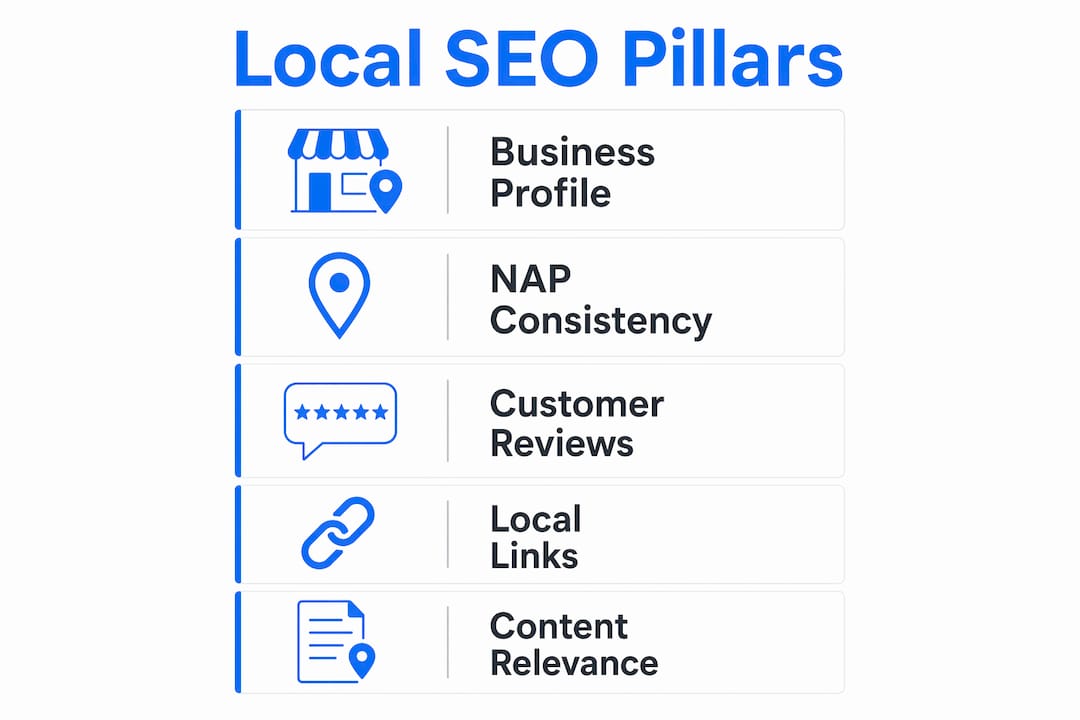
Reviews and owner responses are a direct ranking signal. High-frequency, high-quality, and recent reviews correlate with Local Pack rankings. Responding to every review, positive or negative, signals active engagement and builds trust with both Google and potential customers.
The remaining pillars that round out a complete local SEO foundation include:
- Local backlinks: Links from neighborhood blogs, local chambers of commerce, community event pages, and regional news sites carry more local ranking weight than generic directory links.
- Hyper-local content: Write service pages and blog posts that mention specific neighborhoods, landmarks, and community events. Generic content does not rank locally.
- On-page local signals: Include your city and service area in title tags, meta descriptions, H1 headings, and schema markup. Schema markup tells Google exactly what your business does and where.
- Google Business Profile optimization: Add photos weekly, post updates, and use the Q&A feature to answer common customer questions.
Pro Tip: Ask satisfied customers for reviews immediately after a positive interaction. A simple text message with a direct link to your GBP review page removes all friction and doubles your response rate.
How does hyper-local SEO help entrepreneurs beat larger competitors?
The most counterintuitive insight in local marketing is this: smaller geographic focus produces bigger results. Shifting from broad national keywords to granular, block-by-block targeting is the playbook that lets a startup outrank a national chain in its own backyard.
A national competitor optimizes for “HVAC services.” You optimize for “HVAC repair in Midtown Atlanta near Ponce City Market.” The national brand cannot match that specificity. Google rewards the most relevant answer, and hyper-local content makes you the most relevant answer in your neighborhood.
Here is how to build a hyper-local SEO strategy that compounds over time:
- Map your micro-markets. Identify the three to five neighborhoods or zip codes where your best customers already live. These become your primary content targets.
- Create location-specific service pages. Write a unique page for each neighborhood. Include local landmarks, community references, and specific service details. Avoid templated pages. Duplicate location content triggers algorithmic penalties and kills rankings.
- Build local trust signals. Sponsor a neighborhood event. Partner with a complementary local business. Get mentioned in a community newsletter. These local engagement signals carry real ranking weight.
- Replicate what works. Once you dominate one neighborhood, apply the same content and citation strategy to the next adjacent area. This is how a single-location business scales its local footprint without increasing ad spend.
- Target underserved search queries. Use Google Search Console to find searches where you appear on page two or three. These are your fastest wins. A focused content update often moves them to page one within weeks.
Broad national keyword targeting burns startup budgets without delivering the cash flow that keeps a young business alive. Hyper-local SEO builds that cash flow by connecting you to buyers who are already nearby and already searching.
What practical steps can entrepreneurs take to start and measure local SEO?
Getting started with local SEO does not require a large budget. It requires consistency and the right sequence of actions.
Start with an audit. Search your business category plus your city name in an incognito browser. Note who ranks in the Local Pack and what their profiles look like. This tells you the baseline you need to beat. Check your own NAP consistency across Google, Yelp, Facebook, and Apple Maps.
Set up and fully complete your Google Business Profile. Choose the most accurate primary category. Add every relevant secondary category. Upload at least ten photos. Write a keyword-rich business description that mentions your city and core services. Set your service area if you do not have a physical storefront.
The following steps build on that foundation:
- Build citations on authoritative directories. Start with Google, Bing Places, Apple Maps, Yelp, and your local Chamber of Commerce. Consistency across these five alone produces measurable ranking improvements.
- Publish local content monthly. One blog post per month targeting a neighborhood-specific keyword outperforms a dozen generic posts. Write about local events, community partnerships, or customer success stories tied to specific locations.
- Track the right metrics. Monitor GBP insights for search views, direction requests, and phone calls. Use Google Search Console to track local keyword rankings. These numbers tell you what is working before you see revenue changes.
- Handle multiple locations with unique pages. If you expand, each location needs its own page with unique content, a unique phone number, and a separate GBP listing. Shared pages split ranking signals and hurt both locations.
- Avoid common pitfalls. Do not use a P.O. box as your business address. Do not keyword-stuff your GBP business name. Do not ignore negative reviews. Each of these mistakes actively suppresses your ranking.
Integrating local SEO with your broader local marketing strategies multiplies the impact. Social media posts that link back to your local service pages build both traffic and domain authority. Local partnerships that earn backlinks from community websites accelerate your ranking timeline significantly.
Google ranks local results on three factors: relevance, distance, and prominence. Distance is fixed. Relevance and prominence are fully within your control, and consistent execution of the steps above moves both in your favor.
Key Takeaways
Local SEO is the highest-ROI growth channel for entrepreneurs because it delivers geo-targeted leads at roughly one-third the cost of paid advertising, with compounding results that persist long after initial optimization.
| Point | Details |
|---|---|
| Cost advantage is significant | Local SEO costs roughly $32 per lead versus $75–$150 for paid ads in competitive markets. |
| Google Business Profile is the priority | A complete, active GBP listing controls your Local Pack placement and captures 44% of local clicks. |
| Hyper-local beats broad targeting | Neighborhood-specific content and citations outrank national competitors in their own service areas. |
| Reviews drive rankings and trust | High-frequency, recent reviews with owner responses directly improve Local Pack position. |
| Consistency compounds over time | Local SEO leads emerge within 4–12 weeks and continue growing even when ad budgets pause. |
What I’ve learned working with entrepreneurs on local SEO
Most entrepreneurs I work with make the same mistake early on. They chase the biggest possible keyword, spend months trying to rank for “best [service] in [city],” and wonder why nothing moves. The answer is almost always that they are competing against businesses with five years of domain authority and thousands of backlinks. That fight is not winnable in the short term.
The entrepreneurs who grow fastest do the opposite. They pick a specific neighborhood, write one genuinely useful page about their service in that neighborhood, get five real reviews from customers in that area, and build two or three local backlinks from community sources. Within 60 days, they are ranking. Within 90 days, they are getting calls. That is not theory. That is a pattern I have watched repeat across industries.
The other thing I tell every founder is this: stop treating local SEO as a one-time setup task. Your GBP profile needs fresh photos. Your review count needs to grow every month. Your content needs to reflect what is actually happening in your community. Google rewards businesses that look alive and engaged. A profile that has not been updated in six months looks abandoned to the algorithm, even if your business is thriving.
The entrepreneurs who treat local SEO as an ongoing practice, not a one-time project, are the ones who build a customer pipeline that does not depend on ad spend. That kind of independence is worth every hour of effort.
— Eric
How Marvingrowthpartners helps entrepreneurs build local visibility
Entrepreneurs who want to move faster on local SEO do not have to figure it out alone. Marvingrowthpartners works directly with small business owners to build visibility systems that generate real leads, not just rankings.

The approach at Marvingrowthpartners combines executive-level strategy with hands-on execution. That means your Google Business Profile gets optimized, your local content gets built, and your growth plan gets tied to measurable outcomes from day one. There is no recycled playbook. Every strategy is built around your specific market, your service area, and your growth stage. If you are ready to see what a focused local growth strategy can do for your business, Marvingrowthpartners is the place to start.
FAQ
What is local SEO and why does it matter for small businesses?
Local SEO is the practice of optimizing your online presence to appear in location-based search results. It matters because 46% of all Google searches have local intent, and 28% of those searches result in a purchase.
How long does local SEO take to show results?
Local SEO typically begins to generate leads within 4–12 weeks of consistent optimization. Unlike paid ads, those results compound and continue even when you reduce your marketing spend.
Is local SEO better than Google Ads for entrepreneurs?
For most entrepreneurs, local SEO delivers a significantly lower cost per lead, approximately $32 versus $75–$150 for Google Ads, and produces traffic that does not stop when your budget runs out.
What is the most important factor in local SEO rankings?
Google ranks local results based on relevance, distance, and prominence. Entrepreneurs control relevance and prominence through Google Business Profile optimization, consistent citations, and active review management.
How do I start local SEO with a limited budget?
Start by fully completing your Google Business Profile, auditing your NAP consistency across major directories, and publishing one neighborhood-specific content page per month. These three steps alone produce measurable ranking improvements without paid tools or agency fees.
Recommended
- Best Social Media Platforms for Local Entrepreneurs – Marvin Growth Partners
- Low-Cost Local Marketing Tactics for SMBs in 2026 – Marvin Growth Partners
- Local SEO & Google Business Profile Optimization | Improve Local Rankings – Marvin Growth Partners
- Communities We Serve | Business Growth, SEO & AI Visibility Consulting – Marvin Growth Partners