

Why Local Partnerships Amplify Marketing for SMBs
Local partnerships are defined as formal or informal agreements between two or more businesses that share audiences, resources, or community presence to grow together. Why local partnerships amplify marketing comes down to one core mechanic: you borrow trust you did not earn alone. A bakery that bundles its products with a florist’s arrangement does not just sell more pastries. It inherits the florist’s customer relationships, and vice versa. For small to medium-sized businesses and local entrepreneurs, that borrowed credibility is often worth more than any paid ad campaign.
What are the key benefits of local partnerships in marketing?
Local partnerships cut customer acquisition costs faster than almost any other tactic available to small businesses. One documented example shows a bakery reducing its cost per acquisition from $25 to $3.33 through a bundled offer with a florist. That is roughly an 87% drop in acquisition cost. No Google Ads campaign delivers that kind of efficiency at the local level.
The benefits of local partnerships go beyond cost savings. When your business appears alongside a trusted neighbor, you gain what marketers call credibility transfer. Customers who already trust the florist extend that trust to the bakery without needing a separate introduction. This is why audience affiliation matters more than audience overlap. Your partner’s customers do not need to be identical to yours. They just need to share values, habits, or geography.

Community engagement deepens through repeated, affiliated brand appearances. Local partnership marketing produces higher loyalty than one-off paid campaigns because customers see your brand reinforced through multiple trusted sources. That repetition builds familiarity without requiring you to spend more.
Key benefits at a glance:
- Reduced acquisition costs: Shared promotions split the cost of reaching new customers.
- Credibility amplification: Your partner’s trust network becomes part of your brand perception.
- Reach multiplication: Two audiences, even if different, both hear about you.
- Community loyalty: Repeated local exposure builds long-term brand recognition.
- Faster relationship building: Local partners know their customers personally and can make warm introductions.
Pro Tip: Start with a partner whose customers already buy something before or after they buy from you. A gym and a massage therapist share a customer at different points in the same wellness routine. That sequence makes the referral feel natural, not forced.
How do local partnerships compare to other marketing strategies?
Local partnerships offer advantages that paid advertising and national campaigns simply cannot match at the small business level. The comparison below shows where each approach wins and where it falls short.
| Strategy | Cost | Speed to results | Trust factor | Audience targeting |
|---|---|---|---|---|
| Local partnerships | Low to zero | Fast (weeks) | High (borrowed trust) | Affiliation-based |
| Paid social ads | Medium to high | Immediate | Low (cold audience) | Demographic-based |
| National campaigns | High | Slow | Low to medium | Broad |
| Content marketing | Low | Slow (months) | Medium | Intent-based |
| Local partnerships | Low to zero | Fast (weeks) | High (borrowed trust) | Affiliation-based |
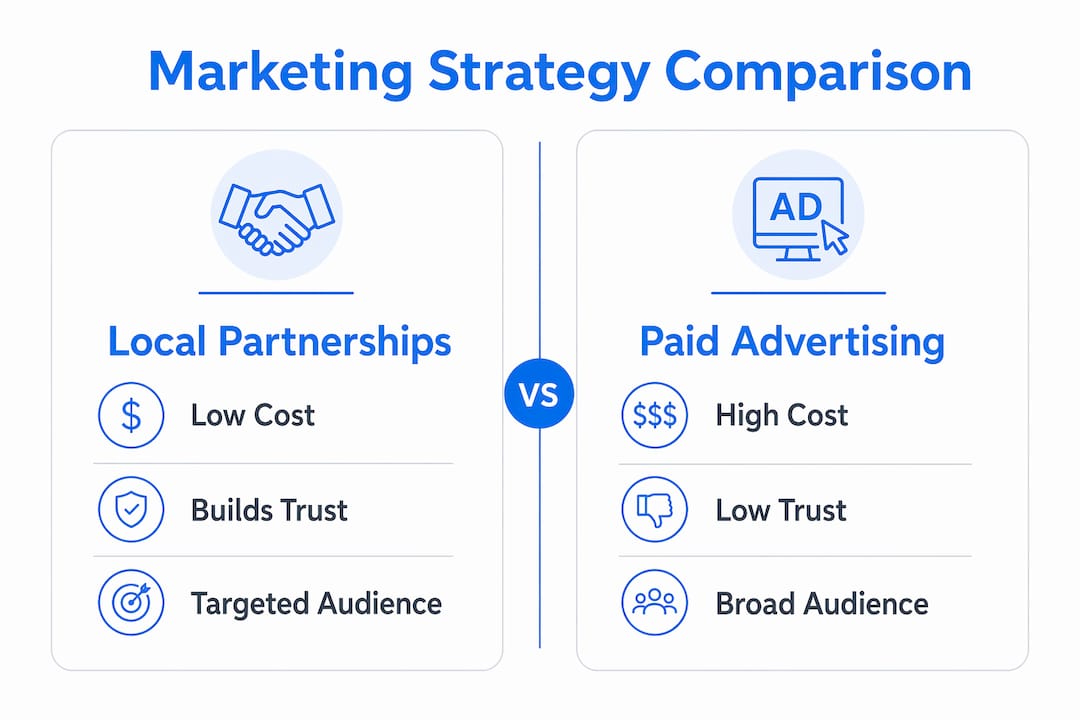
Local partnerships are less bureaucratic than national alliances, which means you reach decision-makers faster and execute ideas in days rather than quarters. A national co-marketing deal requires legal review, brand guidelines approval, and multiple stakeholder sign-offs. A local partnership often starts with a handshake at a community event.
Local partnerships also allow businesses to experiment and iterate rapidly because there is less hierarchy involved. If a bundled offer does not convert, you adjust it next week. If a co-hosted event draws a crowd, you schedule another one next month. That speed of learning is a real competitive advantage for small businesses with limited budgets.
Paid ads deliver immediate visibility but zero trust. Local partnerships deliver slower initial reach but compounding trust. For businesses that depend on repeat customers and word-of-mouth, the compounding effect wins over time. You can find more context on how this fits into a broader plan in this 2026 marketing strategy guide for SMBs.
What types of local partnerships work best, and how do you build them?
Six partnership models consistently produce results for small and medium-sized businesses.
- Referral programs: You send customers to a partner, they send customers back. Track referrals with a simple code or form. A gym and a nutritionist work well here.
- Bundled offers: Two businesses package their products or services together at a combined price. The bakery-florist example is the textbook case.
- Co-hosted events: A bakery and a wedding planner co-hosting a bridal tasting event, or a gym bundling services with a massage therapist for a wellness day, creates shared visibility and shared cost.
- Content swaps: Each business features the other in an email newsletter, social post, or blog. No cash changes hands. Both audiences grow.
- Community sponsorships: Two or more local businesses co-sponsor a neighborhood event, a school fundraiser, or a local sports team. The community sees both names together.
- Shared landing pages or flyers: A single printed or digital asset promotes both businesses. Split the design cost and double the distribution.
The biggest mistake businesses make is starting with a cold email. Partnerships rarely flourish in isolation. Shared experiences lower friction and build the trust that makes collaboration feel safe. Attend a local chamber of commerce meeting, a neighborhood business association event, or a community market. Meet potential partners in person before you pitch anything.
Once you have built rapport, the first collaboration should be low-stakes. A social media shoutout costs nothing and tests whether both audiences respond. If it works, propose something bigger. If it does not, you have lost nothing and learned something.
Pro Tip: Look for partners at community events where your customers already spend time. A yoga studio owner who attends the same farmers market as a local juice bar has a natural opening. The shared setting does the introduction work for you.
Maintenance matters as much as the launch. Schedule a brief check-in every quarter to review what is working. Bring data. Ask your partner what they need. Partnerships that survive the first year almost always have one thing in common: both sides feel the value is mutual.
How do you track and sustain value in local marketing partnerships?
Measurement is what separates a productive partnership from a friendly arrangement that fades. The U.S. Chamber of Commerce recommends quarterly metric reviews to maintain mutual value and identify problems before they damage the relationship.
The table below outlines the core KPIs to track and the tools that support each one.
| KPI | What it measures | Recommended tool |
|---|---|---|
| Referral count | Direct customers sent by partner | CRM or referral tracking form |
| Joint website traffic | Visitors from partner’s links | Google Analytics with UTM links |
| Social media growth | Follower gain during joint campaigns | Native platform analytics |
| Event attendance | Community engagement from co-hosted events | Sign-in sheet or Eventbrite |
| Revenue from referrals | Direct sales attributed to partner | POS system or tagged discount codes |
Google Analytics combined with UTM links gives you a clear picture of how much traffic your partner actually drives. Create a unique UTM parameter for each partner so you can compare performance across your entire partnership network. Surveys sent to new customers asking “how did you hear about us?” add qualitative context that numbers alone miss.
Measurement should combine business metrics with community impact indicators to get the full picture. A co-sponsored neighborhood event may not generate immediate sales but builds the kind of brand recognition that pays off over six to twelve months. Track both.
Transparency keeps partnerships alive. Share your numbers with your partner at every quarterly review. When both sides see the data, trust grows and the collaboration stays honest. If one partner is consistently outperforming the other in referrals, that conversation needs to happen before resentment does. For additional tactics on tracking local marketing performance, the local SEO and visibility tools at Marvingrowthpartners offer practical frameworks for SMBs.
Key Takeaways
Local partnerships amplify marketing by combining borrowed trust, shared audiences, and low-cost execution to deliver results that paid advertising cannot replicate at the small business level.
| Point | Details |
|---|---|
| Cost reduction is dramatic | Bundled offers can cut customer acquisition costs by approximately 87% compared to solo campaigns. |
| Trust transfers between partners | Audience affiliation, not identical customers, is what makes partnerships work. |
| Local beats national for speed | Local partnerships skip bureaucracy and reach decision-makers in days, not quarters. |
| Measurement sustains value | Quarterly reviews using Google Analytics and UTM links keep partnerships honest and productive. |
| Start in person, not in email | Community events build the rapport that cold outreach never can. |
What I have learned about building partnerships that actually last
Most businesses approach local partnerships the same way they approach advertising: they look for the biggest audience they can access. That instinct is wrong. The best partner I have seen small businesses work with is rarely the most prominent business in town. It is the one whose customers already trust them deeply and whose values align closely enough that a referral feels natural.
The social shortcut concept is real. I have watched business owners spend months trying to negotiate partnerships over email, only to close the same deal in twenty minutes at a local chamber event. Shared context collapses the trust gap faster than any pitch deck. If you are serious about community marketing, you have to show up in the community first.
Patience is the other underrated factor. The first collaboration will be imperfect. The second will be better. By the third, you will have a system. Businesses that quit after one underwhelming content swap never discover what a well-run referral program can do for their monthly revenue. Consistency compounds. The partnerships that generate the most value are the ones that have survived a few awkward conversations and kept going anyway.
— Eric
How Marvingrowthpartners helps you build local partnerships that grow revenue

Marvingrowthpartners works with small and medium-sized businesses that want real growth systems, not recycled advice. The team aligns executive-level thinking with hands-on execution, which means your partnership strategy gets built around your actual cash flow, customer base, and growth stage. Not a generic template. If you are ready to turn local community connections into a measurable marketing channel, the growth strategy approach at Marvingrowthpartners gives you a clear path from first partnership conversation to tracked revenue results.
FAQ
Why do local partnerships reduce marketing costs so much?
Local partnerships share the cost of reaching new customers across two businesses. A bundled offer between a bakery and a florist, for example, dropped the bakery’s cost per acquisition from $25 to $3.33, roughly an 87% reduction.
Do my partner’s customers need to be the same as mine?
No. Audience affiliation matters more than identical customer bases. Partners whose customers share values, habits, or geography create effective referral pathways even without perfect overlap.
How do I start a local partnership without cold outreach?
Attend community events, local chamber meetings, or neighborhood markets where potential partners already spend time. Shared experiences build trust faster than any email introduction.
What KPIs should I track in a local partnership?
Track referral counts, joint website traffic via Google Analytics with UTM links, social media growth during campaigns, and revenue attributed to partner referrals. Review these metrics quarterly.
How often should I check in with my local partners?
The U.S. Chamber of Commerce recommends quarterly reviews. Bring data to each meeting, discuss what is working, and adjust the collaboration based on results from both sides.
Recommended
- Low-Cost Local Marketing Tactics for SMBs in 2026 – Marvin Growth Partners
- Build a Custom Marketing Strategy for Your SMB in 2026 – Marvin Growth Partners
- Why Content Marketing Drives SMB Growth in 2026 – Marvin Growth Partners
- Why Bootstrapped Marketing Strategies Work for SMBs – Marvin Growth Partners