

How to Identify Best Growth Channels for Business
Growth channel identification is the process of systematically evaluating and ranking marketing and sales pathways to find which ones deliver the highest return for your specific business. For SMB owners and marketers, this is not a creative exercise. It is a structured decision that determines where your limited time and budget go. Frameworks like the ICE score and the Channel Decision Matrix give you a repeatable way to identify the best growth channels for your business, cut through the noise, and stop wasting spend on channels that look good on paper but stall in practice. Tools like Google Analytics, HubSpot, and Salesforce make the measurement side of this work far more precise than it was even five years ago.
What are the top growth channels businesses should consider?
Growth channels fall into two broad categories: owned and paid. Owned channels build long-term compounding value. Paid channels generate faster but more expensive results. The best marketing strategies for SMBs typically combine both, but the right mix depends entirely on your sales cycle, margin, and team capacity.
Here are the channels most relevant to SMBs today:
- SEO and content marketing: Organic search drives consistent, low-cost traffic over time. A well-optimized blog post or landing page can generate leads for years without additional spend. SEO rewards patience and consistency, making it a strong long-term channel for businesses with a 6-plus month horizon.
- Email marketing: Email consistently delivers one of the highest returns of any digital channel. It works best when your list is segmented and your sequences are tied to specific buyer behaviors, not just broadcast newsletters.
- Social media marketing: Platforms like LinkedIn, Instagram, and Facebook serve different audiences and goals. LinkedIn is the dominant B2B channel for SMBs targeting professionals. Instagram and Facebook work better for consumer-facing brands with strong visual content.
- Pay-per-click advertising (PPC): Google Ads and Meta Ads deliver fast, measurable traffic. The tradeoff is cost. PPC requires ongoing budget and skilled management to stay profitable, making it better suited for businesses with proven conversion rates.
- Referral and affiliate programs: Word-of-mouth referrals convert at higher rates than almost any other channel because trust is built in before the first contact. Structured referral programs formalize this into a repeatable system.
- Influencer marketing: For consumer brands and some B2B niches, partnering with credible voices in your space accelerates awareness faster than organic content alone.
Each channel contributes differently to your growth goals. SEO and content build brand awareness and organic authority. PPC and social ads generate immediate leads. Email and referral programs drive conversion and retention. Understanding these distinctions is the first step before you score or prioritize anything. For a deeper look at how these channels map to SMB growth stages, the 2026 SMB marketing guide from Marvingrowthpartners covers the full breakdown.
How do you evaluate and prioritize growth channels?

Two frameworks stand out for structured channel evaluation: the ICE framework and the Channel Decision Matrix. Both give you a scoring system that replaces gut instinct with repeatable logic.
The ICE framework explained
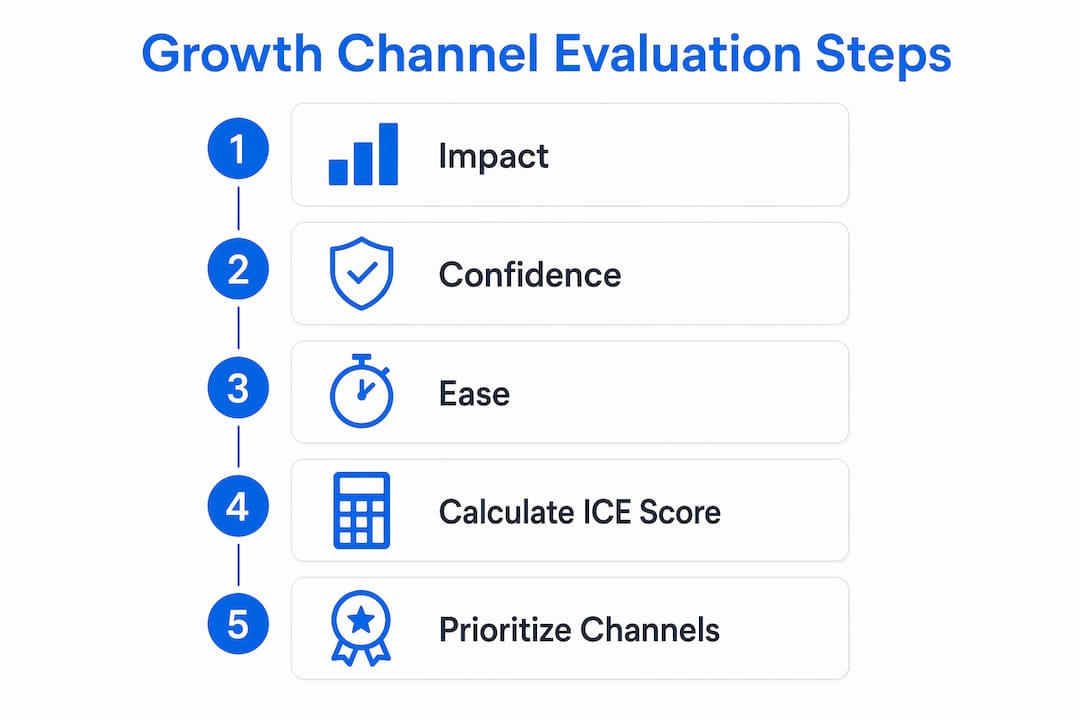
The ICE framework scores each channel on three dimensions: Impact, Confidence, and Ease. Impact measures how much the channel could move your core metric. Confidence measures how certain you are that it will work based on past data or industry evidence. Ease measures how much effort, time, and budget the channel requires to execute. You score each dimension from 1–10, then average the three scores to get a single priority number. Most companies complete their first ICE prioritization cycle within 30 days. That speed matters because it gets your team aligned and moving without months of analysis.
The channel decision matrix explained
The Channel Decision Matrix scores channels on six criteria: audience fit, competition level, time to results, cost efficiency, compounding potential, and your team’s execution capability. Each criterion gets a score, and the totals rank your options. This matrix adds more nuance than ICE alone because it forces you to think about factors like whether your team can actually execute the channel well, not just whether the channel looks attractive in theory.
Here is a sample scoring table to illustrate how both frameworks work together:
| Channel | Impact (1–10) | Confidence (1–10) | Ease (1–10) | ICE Average | Matrix Score |
|---|---|---|---|---|---|
| SEO / Content | 8 | 7 | 6 | 7.0 | High |
| Email Marketing | 7 | 9 | 8 | 8.0 | High |
| PPC (Google Ads) | 8 | 6 | 5 | 6.3 | Medium |
| LinkedIn Organic | 6 | 7 | 7 | 6.7 | Medium |
| Influencer Marketing | 5 | 5 | 4 | 4.7 | Low |
One critical nuance: contextual factors override scoring frameworks. If your top-scoring channel requires a full-time SEO specialist you do not have, move to the next best option your team can execute confidently. A channel you can run well beats a theoretically superior channel you cannot staff.
Pro Tip: Reassess your ICE and Matrix scores every 90 days. Markets shift, competitors enter channels, and your team’s capabilities grow. A channel that scored low six months ago may now be your best opportunity.
How should you allocate resources to top channels?
Identifying your top channels is only half the work. The other half is committing to them with enough focus to actually see results. The most common failure mode in SMB growth is spreading resources too thin across too many channels at once.
The 80/15/5 allocation rule solves this directly. Here is how it works:
- Allocate 80% of your marketing budget and time to your top one or two channels. These are the channels with the highest combined ICE and Matrix scores that your team can execute well. Full commitment here drives mastery and compounding returns.
- Allocate 15% to secondary channels. These are proven channels that support your primary ones. For example, if SEO is your primary channel, email nurture sequences that convert organic traffic into leads would be a strong secondary channel.
- Allocate 5% to experimental channels. This is your testing budget. Use it to run small, time-boxed experiments on emerging channels like short-form video, AI-driven search optimization, or new social platforms. Keep experiments small enough that a failed test does not damage your core growth engine.
Focusing 80% of effort on top performers prevents dilution and enables mastery. This is the single most important principle in effective business growth tactics for resource-constrained SMBs. Companies that try to run six channels simultaneously with equal effort rarely master any of them. Companies that go deep on two channels and build repeatable systems there scale far more predictably.
Pro Tip: Before adding a new channel, ask whether you have fully extracted the potential from your current top channel. Most SMBs have untapped upside in the channels they already use before they need to expand.
How do you measure true growth channel performance?
Vanity metrics like raw impressions, follower counts, and total lead volume are the most misleading numbers in marketing. Integrating marketing data with CRM and sales records is critical for identifying which channels actually drive revenue, not just traffic.
The metrics that matter most for growth channel analysis:
- Customer acquisition cost (CAC) by channel: How much does it cost to acquire one paying customer through each channel? A channel with high lead volume but high CAC may be less valuable than a lower-volume channel with a fraction of the cost.
- Revenue attribution by channel: Which channels are directly tied to closed deals? Multi-touch attribution models capture the full customer journey rather than crediting only the last click.
- Customer lifetime value (LTV) by channel: Customers acquired through referral programs often have higher LTV than those acquired through paid ads. Knowing this changes how much you should invest in each channel.
- Conversion rate by stage: Track how leads from each channel move through your pipeline. A channel that generates 500 leads but converts at 0.5% is less valuable than one generating 100 leads at a 5% conversion rate.
Setting clear goals and defining primary metrics like cost per acquisition (CPA), return on ad spend (ROAS), or lifetime value before you launch any channel is non-negotiable. Without a defined success metric, you cannot make a sound decision about whether to scale, pause, or cut a channel. Build a simple channel scorecard in a tool like Google Sheets, Notion, or HubSpot that tracks these numbers monthly.
What are the common pitfalls when identifying growth channels?
Even with solid frameworks in place, SMBs run into predictable problems during channel identification and prioritization. Knowing these in advance saves months of wasted effort.
- Chasing trendy channels: TikTok, AI-generated content, and whatever platform is generating buzz this quarter all attract attention. The question is never whether a channel is popular. The question is whether your audience is there and whether your team can execute it well.
- Misreading early data: A channel that performs well in week one may be benefiting from novelty or a small, unrepresentative sample. Give new channels at least 60–90 days of consistent execution before drawing conclusions.
- Ignoring internal capability gaps: A channel that requires video production, paid media expertise, or technical SEO skills you do not have will underperform regardless of its theoretical score. Disciplined growth management means matching channel selection to real execution capacity.
- Paralysis by analysis: Scoring frameworks are tools, not answers. Run your first prioritization cycle fast, commit to a decision, and build in a review date. Waiting for perfect data before choosing a channel is how SMBs lose six months.
“Growth is not accidental but achieved through disciplined, programmatic management with rigorous evaluation and execution.” — BCG, The CEO’s Guide to Growth in 2026
When a high-scoring channel underperforms after a fair test period, do not immediately abandon it. First, audit your execution. Poor results often trace back to weak creative, misaligned targeting, or insufficient budget rather than the channel itself. If execution is solid and results are still poor, then pivot. For SMBs working with tight budgets, the bootstrapped marketing approach covered by Marvingrowthpartners offers a practical framework for making these calls without burning cash.
Key takeaways
Identifying and committing to your top growth channels requires structured scoring, disciplined resource allocation, and revenue-focused measurement rather than vanity metrics.
| Point | Details |
|---|---|
| Use structured frameworks | Apply the ICE score and Channel Decision Matrix to rank channels by impact, confidence, ease, and execution fit. |
| Follow the 80/15/5 rule | Put 80% of budget and time into your top one or two channels to build mastery before expanding. |
| Measure revenue, not vanity | Track CAC, LTV, and conversion rates by channel using CRM-integrated attribution, not just lead volume. |
| Context overrides scores | If your top-scoring channel requires resources you lack, prioritize the next best channel your team can execute. |
| Reassess every 90 days | Markets and team capabilities change; regular scoring cycles keep your channel mix current and competitive. |
Why most smbs pick the wrong channels and how to stop
I have worked through channel prioritization exercises with dozens of SMB owners, and the pattern is almost always the same. The business is running four or five channels simultaneously, none of them particularly well, and the owner cannot tell you which one is actually driving revenue. When I ask why they added each channel, the answer is usually some version of “we heard it was working for other companies.”
That is the core problem. Channel selection driven by what worked for someone else, without accounting for your audience, your team, and your current growth stage, is how you end up busy but not growing. The ICE framework and Channel Decision Matrix are not magic. They are forcing functions that make you answer specific questions about your own business before committing budget. That discipline is what separates companies that scale from those that stay stuck.
The other mistake I see constantly is treating measurement as an afterthought. Teams launch channels, track impressions and clicks, and declare success or failure based on numbers that have no direct connection to revenue. Aligning measurement to business model nuances changes everything. When you know your CAC and LTV by channel, the decision to scale or cut becomes obvious. Without those numbers, you are guessing.
Internal culture also matters more than most owners admit. A team that is disengaged or undertrained will underperform on any channel. The best channel strategy in the world fails if the people executing it are not bought in or capable. Growth depends on how a business creates and captures value at every level, not just in marketing.
My advice: pick two channels, score them honestly, commit to them for 90 days, and measure only what connects to revenue. Then reassess. That cycle, repeated consistently, is how real scaling happens.
— Eric
Ready to find your best growth channels?
Identifying which channels deserve your time and budget is one of the highest-leverage decisions you can make as an SMB owner. Marvingrowthpartners specializes in exactly this work, aligning executive-level strategy with hands-on execution so you get a channel plan built around your actual business, not a recycled playbook.

Whether you need a full growth strategy consultation or a focused channel prioritization session, the team at Marvingrowthpartners brings the frameworks, data analysis, and real-world execution experience to get you moving fast. If you are ready to stop guessing and start scaling, explore our growth approach to see how we build channel systems that deliver measurable results.
FAQ
What is the ICE framework for growth channels?
The ICE framework scores marketing channels on Impact, Confidence, and Ease, each rated 1–10, to produce a priority ranking. Most businesses complete their first ICE prioritization cycle within 30 days.
How many growth channels should an SMB focus on?
SMBs should focus the majority of their resources on one or two top-scoring channels. The 80/15/5 rule allocates 80% of budget to primary channels, 15% to secondary channels, and 5% to experiments.
What metrics actually measure channel performance?
Customer acquisition cost, revenue attribution, and customer lifetime value by channel are the metrics that matter. Tracking revenue impact rather than vanity metrics like impressions or raw lead volume gives you accurate channel performance data.
What is the channel decision matrix?
The Channel Decision Matrix scores channels across six criteria including audience fit, competition, time to results, and cost efficiency to guide investment focus. It adds execution-fit analysis that the ICE framework alone does not capture.
How often should you reassess your growth channel strategy?
Reassess your channel scores and allocation every 90 days. Markets shift, competitors enter channels, and your team’s capabilities evolve, making regular review cycles a core part of any top growth strategy.
Recommended
- Business Growth Strategy Consultant | Growth Planning & Execution – Marvin Growth Partners
- Growth Strategy Frameworks for Small Business Success – Marvin Growth Partners
- Build a Custom Marketing Strategy for Your SMB in 2026 – Marvin Growth Partners
- Our Approach | Growth Strategy, Visibility & Execution – Marvin Growth Partners