

Scalable Marketing Stack Tools Comparison: Growth Guide
For most growth teams, the right answer is a hybrid stack: buy your core systems of record, then build or configure the narrow data and workflow layers that remove real bottlenecks. That single decision saves more money and time than any individual tool choice.
The short list, by role:
- CRM/CDP: HubSpot (SMB to mid-market) or Salesforce + Twilio Segment (Series A and beyond)
- Marketing automation: ActiveCampaign (SMB), Marketo/Adobe (enterprise), HubSpot (all-in-one play)
- Analytics: Google Analytics (GA4) as the baseline; add Hotjar or FullStory for behavioral depth
- Organic search: SEMrush or Ahrefs for keyword intelligence and technical audits
- Adtech: Google Ads and Meta Ads Manager as the paid foundation
- Integration/orchestration: Zapier for low-code automation; Twilio Segment when data unification becomes the constraint
- CRO/experimentation: Unbounce for landing pages; add a dedicated A/B testing layer as traffic scales
- Social management: Sprout Social or Hootsuite for scheduling, listening, and reporting
Before you buy anything new, run an audit. Capability utilization across martech stacks has dropped significantly over recent years, falling from approximately 58% in 2020 to 33% in 2023. This means the average team activates about one-third of what they pay for. The fastest ROI move in most stacks is not adding a tool. It is retiring the ones collecting dust.
Table of Contents
- How does your current stack compare? A tool-by-tool matrix
- What a martech stack actually is (and why structure matters)
- What each core category needs to do at scale
- How do you choose tools that will actually scale with you?
- What does a starter stack look like at each growth stage?
- Build vs. buy: which architecture pattern fits your team?
- How to run an 8-week martech stack audit
- What does implementation actually cost, and how long does it take?
- Key Takeaways
- When hiring an external partner is the fastest path forward
- Marvingrowthpartners designs scalable stacks for teams that need results, not more tools
- Useful sources and further reading
How does your current stack compare? A tool-by-tool matrix
The table below maps the major platform categories against the dimensions that matter most when you are evaluating tools for a scalable stack. Use it as a filter, not a verdict. Your GTM motion, team size, and existing data infrastructure will shift which row matters most.
| Category | Best for / company size | Primary function | Key integrations | Scalability notes | Pricing model & cost band | Implementation complexity | Data ownership & export | AI / automation |
|---|---|---|---|---|---|---|---|---|
| CRM (HubSpot) | SMB to mid-market | Contact management, pipeline, lifecycle | Native email, ads, CMS, Zapier, Segment | Scales to ~10K contacts free; paid tiers handle millions | Freemium; paid from entry-level tier | Low-medium; 2–6 weeks to value | Full export; HubSpot owns schema | AI content assist, predictive lead scoring |
| CRM/CDP (Salesforce + Segment) | Series A to enterprise | Revenue CRM + identity resolution | Marketo, GA4, Snowflake, many connectors | Near-unlimited with proper data modeling | Salesforce price varies; Segment pricing varies | High; 6–16 weeks | Full export; warehouse-native | Einstein AI, journey orchestration |
| Marketing automation (ActiveCampaign) | SMB, e-commerce, agencies | Email, SMS, CRM-lite, automations | Shopify, WooCommerce, Zapier, Segment | Up to millions of contacts; API rate limits apply | From ~$15/mo (Starter); scales with contacts | Low; 1–3 weeks | Full CSV/API export | Predictive sending, AI content generation |
| Marketing automation (Marketo/Adobe) | Mid-market to enterprise | Demand gen, ABM, lead nurturing | Salesforce, Adobe Experience Cloud, Segment | Built for large-scale multi-brand programs | Custom pricing; typically $1,000–$3,500+/mo | High; 8–20 weeks | Full export; Adobe ecosystem | AI-driven segmentation, engagement scoring |
| Email (Mailchimp) | Early-stage, SMB | Email campaigns, basic automations | Shopify, WooCommerce, Zapier, GA4 | Handles millions of subscribers; limited CRM depth | Freemium; paid from entry-level tier | Very low; days to value | Full export | AI subject lines, send-time optimization |
| Analytics (GA4) | All sizes | Web/app analytics, attribution | Google Ads, Search Console, BigQuery, Segment | Handles high traffic volumes; BigQuery export for scale | Free (standard); GA4 360 from ~$50K/yr | Low; 1–2 weeks | BigQuery export (paid); limited raw data on free | AI anomaly detection, predictive audiences |
| Behavioral analytics (Hotjar / FullStory) | SMB to enterprise | Heatmaps, session replay, funnels | GA4, Segment, HubSpot, Salesforce | FullStory scales to enterprise data volumes | Hotjar free tier; paid from ~$39/mo; FullStory custom | Low; days to value | Session data export; API available | AI session summaries, friction detection |
| Organic search (SEMrush / Ahrefs) | All sizes | SEO, content research, backlink analysis | GA4, Search Console, Zapier | Cloud-based; no meaningful scale ceiling | SEMrush from ~$140/mo; Ahrefs from ~$129/mo | Very low; immediate | Data export via CSV/API | AI writing assist, keyword clustering |
| Adtech (Google Ads) | All sizes | Search, display, YouTube, Performance Max | GA4, Merchant Center, Salesforce, HubSpot | Handles any spend level; API for programmatic control | Performance-based; no minimum spend | Low-medium; 1–3 weeks | Campaign data export; limited raw click data | Smart Bidding, Performance Max AI |
| Adtech (Meta Ads Manager) | SMB to enterprise | Social paid, retargeting, lookalikes | GA4, Pixel, CRM via CAPI, Segment | Scales with budget; CAPI improves signal quality | Performance-based; no minimum spend | Low; 1–2 weeks | Ads Reporting export; CAPI for server-side data | Advantage+ AI campaigns, creative optimization |
| Social management (Sprout Social / Hootsuite) | SMB to enterprise | Scheduling, listening, analytics, engagement | GA4, Salesforce, HubSpot, Slack | Sprout scales to enterprise; Hootsuite handles large teams | Sprout from ~$249/mo; Hootsuite from ~$99/mo | Low; 1–2 weeks | Full export; API available | AI caption writing, optimal send-time |
| CRO / landing pages (Unbounce) | SMB to mid-market | Landing page builder, A/B testing | HubSpot, Salesforce, Mailchimp, GA4, Zapier | Handles high traffic; limited native CDP integration | From entry-level tier pricing | Very low; days to value | Full export | AI copy generation, Smart Traffic |
| Integration / orchestration (Zapier) | SMB to mid-market | Workflow automation, point-to-point integration | 6,000+ apps; native to most tools above | Handles moderate task volumes; Zap limits apply at scale | Free tier; paid from ~$20/mo | Very low; hours to value | Workflow logs; limited raw data ownership | AI Zap builder, multi-step automation |
| CDP / data unification (Twilio Segment) | Series A to enterprise | Identity resolution, audience activation | Many sources and destinations; warehouse-native | Built for high-volume event streams | Team plans and custom pricing available | Medium-high; several weeks to months | Full data ownership; warehouse export | AI audience builder, predictive traits |
How to read this table: Start with your GTM motion and team size. If you are pre-Series A, prioritize the low-complexity, freemium-friendly rows. If you are scaling past a few hundred thousand contacts or events, the scalability and data ownership columns become your primary filter. Integration openness, particularly two-way sync to your CRM or CDP, is one of the strongest predictors of whether a tool will still fit your stack two years from now.
What a martech stack actually is (and why structure matters)
A martech stack is the connected set of software systems a marketing team uses to attract, engage, convert, and retain customers across the full lifecycle. The word “connected” is doing the heavy lifting there. A list of tools is not a stack. A stack is a set of tools that share data, trigger each other, and produce a coherent view of performance.
For scale, the structure matters more than the individual tools. Systems of truth, meaning your CRM and CDP, should sit at the core with every other layer reading from and writing back to them. When that architecture is missing, you end up with siloed data, broken attribution, and the kind of tool sprawl that drives utilization rates into the floor.
The core categories a scalable stack typically contains:
- Audience and data layer: CRM, CDP, or data warehouse (the source of truth for customer identity and behavior)
- Campaign execution and automation: Email platforms, marketing automation, SMS, and lifecycle orchestration
- CMS and website: Content management, landing pages, and conversion infrastructure
- Adtech: Paid search, paid social, programmatic display, and retargeting
- Organic search tools: SEO platforms, content research, and technical audit tools
- Analytics and experimentation: Web analytics, behavioral analytics, A/B testing, and attribution
- Integration and orchestration: iPaaS tools, native connectors, and workflow automation
- Social management: Scheduling, listening, and community engagement
Stack shape varies significantly by channel mix, GTM motion, and growth stage. A product-led SaaS company running in-app onboarding sequences needs a very different configuration than a B2C e-commerce brand running dynamic retargeting at scale.
What each core category needs to do at scale
CRM and CDP: your data foundation
The CRM is where customer identity lives. The CDP is where behavioral data gets unified across channels. At early stages, these can be the same system. At scale, they usually need to be separate layers connected by a data pipeline.

HubSpot handles both reasonably well for SMB and mid-market teams. Its native integrations with Google Ads, Meta, and most email tools mean you can get a working data foundation without engineering support. The tradeoff is schema rigidity: HubSpot’s data model is opinionated, and teams with complex product data or multi-brand structures often hit its ceiling.
Salesforce paired with Twilio Segment is the enterprise answer. Segment handles identity resolution and event streaming across sources, then routes clean data to Salesforce and any downstream activation tool. The setup cost is real (expect 6–16 weeks for a production-grade implementation), but the data ownership and API flexibility are unmatched. AI-powered tools now require CDP or data warehouse integration as the baseline evaluation criterion for any serious stack.
Marketing automation and email
ActiveCampaign is the most capable tool in its price range for SMB teams. Its automation builder handles multi-step behavioral sequences, and its CRM-lite layer is good enough to delay a full CRM investment for early-stage companies. It connects cleanly to Shopify, Zapier, and Segment.
Marketo (Adobe) is built for demand generation at scale: multi-touch attribution, ABM programs, and complex lead scoring across large contact databases. It earns its price tag for enterprise teams running coordinated sales and marketing motions, but the implementation timeline and admin overhead are not trivial.
Mailchimp remains the fastest path to a working email program for early-stage teams. Its AI subject-line suggestions and send-time optimization are genuinely useful at low volume. The limitation is depth: once you need behavioral triggers tied to product events or CRM data, Mailchimp’s automation logic starts to feel thin.
Analytics and measurement
Google Analytics (GA4) is the non-negotiable baseline for any stack. Its BigQuery export (available on the free tier with some limits, fully open on GA4 360) is what makes it a real data asset rather than just a reporting dashboard. The event-based data model takes adjustment if your team is coming from Universal Analytics, but the flexibility it unlocks for custom funnel analysis is worth the learning curve.
Hotjar and FullStory answer the questions GA4 cannot: why users drop off, where they hesitate, and what friction looks like in a real session. Hotjar is the right call for most SMB and mid-market teams. FullStory scales to enterprise data volumes and adds DX Data, which connects session behavior to revenue outcomes. Both integrate with GA4 and Segment.
Organic search
SEMrush and Ahrefs are functionally similar at the feature level. SEMrush has a broader surface area (PPC research, content marketing tools, local SEO), while Ahrefs has a stronger backlink index and a cleaner interface for technical SEO work. Most teams pick one and stay with it. The switching cost is low, but the institutional knowledge built around a single platform’s reporting is real.
Adtech
Google Ads and Meta Ads Manager are the paid foundation for virtually every growth stack. Google’s Smart Bidding and Performance Max campaigns use first-party data signals from GA4 and your CRM to optimize across channels automatically. Meta’s Advantage+ campaigns do the same on the social side, and its Conversions API (CAPI) integration with your CRM or CDP is now table stakes for maintaining signal quality in a post-cookie environment.
Both platforms reward data quality. The teams getting the best results from Google Ads and Meta are the ones feeding clean, matched first-party audiences from their CRM or CDP into both platforms.
Social management
Sprout Social is the stronger platform for teams that need deep listening, sentiment analysis, and CRM integration alongside scheduling. Hootsuite is the more budget-friendly option for teams whose primary need is multi-channel scheduling and basic analytics. Both connect to GA4, HubSpot, and Salesforce.
CRO and experimentation
Unbounce handles landing page creation and A/B testing for teams that need to move fast without engineering support. Its Smart Traffic feature uses AI to route visitors to the highest-converting variant automatically. For teams running higher-volume experiments across the full site, a dedicated experimentation platform layered on top of GA4 is the next step.
Integration and orchestration
Zapier is the right starting point for most SMB and mid-market teams. Six thousand-plus app connections, a no-code builder, and a free tier that handles light automation workloads make it the lowest-friction way to connect tools that do not have native integrations. Its limits show at scale: high task volumes get expensive, and complex multi-step workflows with conditional logic are better handled by a proper iPaaS or a warehouse-native orchestration layer.
Twilio Segment is the upgrade path when data unification becomes the constraint. Rather than connecting tools point-to-point, Segment creates a single event stream that routes to every destination simultaneously. That architecture eliminates the data inconsistency that plagues point-to-point stacks as they grow.
Pro Tip: Vendor ecosystem matters as much as features. Before committing to any platform, check whether it has a native two-way sync with your CRM and CDP. A tool that only pushes data out, but cannot receive enriched contact data back, will create a data silo within six months.
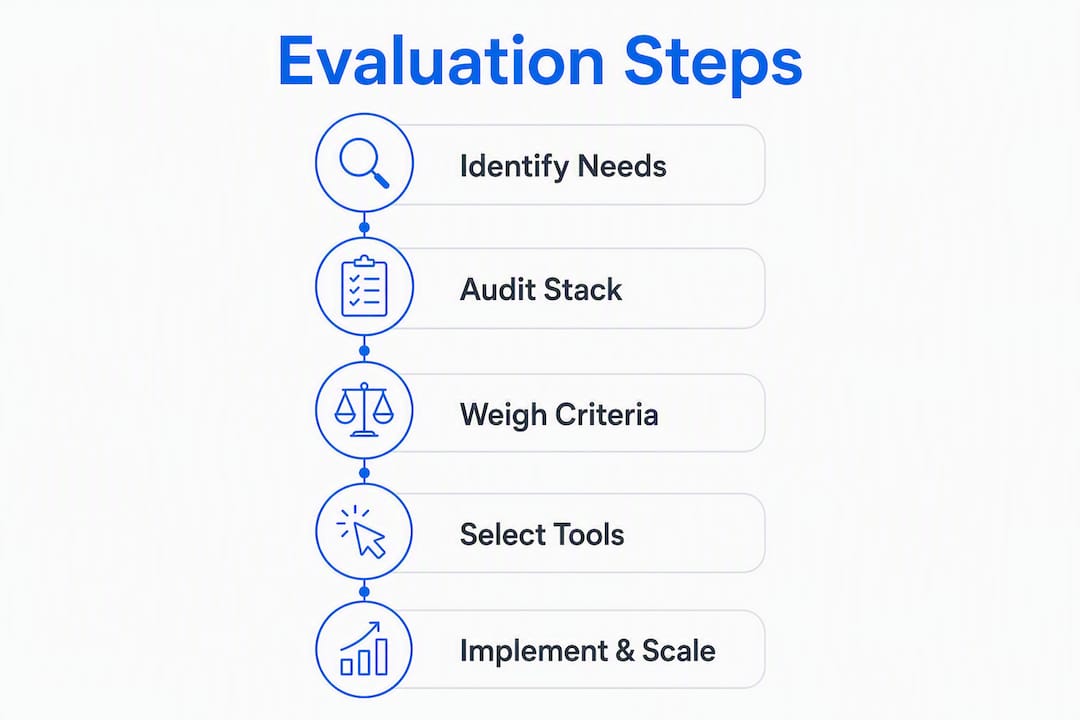
How do you choose tools that will actually scale with you?
The most common mistake in martech selection is optimizing for features at the expense of integration posture. A tool with 200 features and a weak API will cost you more in engineering time and data debt than a simpler tool that connects cleanly to your stack.
Prioritized selection criteria
- Integration and data ownership: Does the tool offer a documented, reliable API? Can you export all your data in a portable format? Who owns the schema?
- Scalability limits: What are the API rate limits? What happens to performance at 10x your current data volume?
- Total cost of ownership: License cost is usually the smallest number. Add implementation services, internal engineering time, training, and ongoing maintenance.
- SLA and support: What uptime does the vendor guarantee? What is the support model at your tier?
- Security and compliance: Is the tool SOC 2 Type II certified? Does it support GDPR and CCPA data subject requests? Where is data stored?
- Migration path: How hard is it to leave? Can you export everything, or are you locked into a proprietary schema?
- AI and automation capabilities: Does the AI layer connect to your first-party data, or is it running on generic models?
- Community and ecosystem: Is there an active user community, a marketplace of integrations, and a partner network for implementation support?
Questions to ask vendors during evaluation
- What is your data retention policy, and can we export full historical data at any time?
- What are your API rate limits at our expected event volume, and what happens when we exceed them?
- Which third-party integrations are native versus webhook-based, and what is the maintenance burden for each?
- Do you support multi-workspace or multi-brand configurations under a single contract?
- What does the upgrade path look like if we outgrow our current tier, and is there a migration fee?
- How do you handle data subject requests under GDPR and CCPA?
- What is your SLA for uptime, and what is the remediation process when it is breached?
Scoring rubric for vendor evaluation
Weight these criteria based on your growth stage. A Series A team should weight integration and data ownership heavily. An early-stage team can weight time-to-value and cost more aggressively.
| Criterion | Weight (early) | Weight (Series A+) |
|---|---|---|
| Integration and data ownership | 15% | Varies by business |
| Scalability limits | 10% | 20% |
| Time to value | Varies by business | 10% |
| Total cost of ownership | 20% | 15% |
| Security and compliance | 10% | 15% |
| AI and automation capabilities | 10% | 10% |
| Vendor support and community | 10% | 5% |
Typical cost and timeline estimates: A proof-of-concept for a single tool runs 2–4 weeks and costs primarily internal time. A pilot across two or three integrated tools runs 4–8 weeks with $5,000–$20,000 in implementation services for most SMB teams. A full production deployment of a mid-market stack (CRM + automation + analytics + CDP) typically runs 3–6 months and $30,000–$150,000 in total first-year cost including licenses, implementation, and training. Hidden costs to budget for: data migration (often 20–40% of implementation cost), integration maintenance (plan for 5–10 hours per month per complex integration), and retraining when tools are replaced.
What does a starter stack look like at each growth stage?
Early stage (pre-revenue to $1M ARR)
Core systems: HubSpot Free CRM, Mailchimp (email), GA4 (analytics), Google Search Console (organic), Google Ads and Meta Ads Manager (paid)
Integration approach: Point-to-point via native connectors and Zapier. No CDP needed yet.
Buy vs. build: Buy everything. No engineering investment in data infrastructure at this stage.
Cost band: $0–$500/month in tool licenses. Time to value: 2–4 weeks.
Migration note: When contact volume exceeds 10,000 or automation complexity grows, move to ActiveCampaign or HubSpot Starter. For SMB-specific strategy guidance, the tool choice should follow the GTM motion, not the other way around.
SMB (1M–$10M ARR)
Core systems: HubSpot Marketing Hub Pro (CRM + automation), GA4 + Hotjar (analytics + behavioral), SEMrush or Ahrefs (organic), Google Ads + Meta Ads Manager (paid), Sprout Social or Hootsuite (social), Unbounce (CRO), Zapier (orchestration)
Integration approach: HubSpot as the hub; Zapier for gaps. GA4 BigQuery export for reporting.
Buy vs. build: Buy all core systems. Build only custom reporting queries in BigQuery.
Cost band: $2,000–$6,000/month. Time to value: 4–8 weeks for full stack.
Series A ($10M–$50M ARR)
Core systems: HubSpot or Salesforce (CRM), ActiveCampaign or Marketo (automation), Twilio Segment (CDP), GA4 + FullStory (analytics), SEMrush (organic), Google Ads + Meta Ads Manager (paid), Sprout Social (social), Unbounce (CRO)

Integration approach: Segment as the data backbone, routing events to CRM, automation, and analytics simultaneously. A hybrid model, buying core systems and building the data layer, usually offers the best balance of speed and long-term control at this stage.
Buy vs. build: Buy all execution tools. Build the Segment event schema and any custom attribution models.
Cost band: $8,000–$20,000/month. Time to value: 8–16 weeks for full production.
Migration note: This is the stage where point-to-point integrations start breaking under data volume. Segment pays for itself by eliminating the engineering time spent fixing broken Zapier workflows.
Mid-market ($50M–$200M ARR)
Core systems: Salesforce (CRM), Marketo/Adobe (automation + ABM), Twilio Segment or a warehouse-native CDP (data layer), GA4 360 (analytics), FullStory (behavioral), SEMrush or Ahrefs (organic), Google Ads + Meta Ads Manager (paid), Sprout Social (social)
Integration approach: Warehouse-led. Snowflake or BigQuery as the central data store; Segment or a reverse ETL tool (like Hightouch) for activation.
Buy vs. build: Buy all execution tools. Build the warehouse data models, activation pipelines, and custom attribution logic.
Cost band: $20,000–$80,000/month. Time to value: 3–6 months for full production.
Enterprise ($200M+ ARR)
At enterprise scale, the stack is typically a combination of Adobe Experience Cloud (Marketo, Analytics, Target, AEM), Salesforce (CRM, Marketing Cloud), a warehouse-native data layer, and a full programmatic adtech stack. The B2B software model emphasizes CRM, marketing automation, and ABM; B2C e-commerce shifts toward personalization engines, DSPs, and dynamic creative tools. Custom builds are common for data pipelines and attribution.
Build vs. buy: which architecture pattern fits your team?
Three patterns dominate martech architecture decisions.
Buy-first (vendor-led): You purchase best-of-breed tools and connect them via native integrations and iPaaS. Fast to deploy, low initial engineering cost, and lower implementation risk. The tradeoff is data fragmentation: each tool holds a partial view of the customer, and reconciling those views requires ongoing effort. Buy-first stacks are best when teams need speed, standard lifecycle automation, and low implementation risk.
Build-first (engineering-led): Your data team builds a warehouse-native stack where all customer data flows into a central store (Snowflake, BigQuery, Redshift) and activation tools read from it. High data control, flexible attribution, and no vendor lock-in on the data layer. The cost is real: engineering maintenance, longer time-to-market, and the risk that the data team becomes a bottleneck for marketing execution. This pattern makes sense only when engineering capacity and unique GTM complexity both exist.
Hybrid (recommended for most teams): Buy your core systems of record (CRM, marketing automation, analytics) and build or configure the data and workflow layers that remove specific bottlenecks. Most teams should start here. Buy core systems of record and build only the narrow pieces needed to remove data friction or unique routing needs.
CDP vs. point-to-point integrations
Point-to-point integrations (Tool A sends data to Tool B via webhook or Zapier) work fine up to about 5–7 tools. Beyond that, the maintenance burden grows faster than the team’s capacity to manage it, and data inconsistency compounds.
A CDP like Twilio Segment solves this by creating a single event stream that routes to every destination simultaneously. Every tool sees the same customer data, in the same format, at the same time. The tradeoff is implementation complexity and cost.
The decision rule is straightforward: choose a CDP when you need deterministic identity resolution and marketing activation; choose a warehouse-first approach when reporting and analytics flexibility are paramount and engineering can support activation. If neither condition applies yet, point-to-point with Zapier is the right call.
- Point-to-point fits: fewer than 7 tools, low event volume, limited engineering capacity
- CDP fits: 7+ tools, high event volume, need for real-time audience activation, identity resolution across devices
- Warehouse-first fits: strong engineering team, complex custom attribution, reporting flexibility is the primary need
How to run an 8-week martech stack audit
Most teams do not need a new tool. They need to understand what their current tools are actually doing. Audit deliverables should include utilization scores, integration health scoring, ROI clarity per tool, modeled consolidation scenarios, and governance rules to prevent re-sprawl.
Capability utilization across martech stacks has dropped significantly over recent years, falling from approximately 58% in 2020 to 33% in 2023. This means the average team activates about one-third of what they pay for. The fastest ROI move is almost always consolidation, not addition.
Week-by-week timeline
Weeks 1–2: Discovery
- Inventory every tool: name, owner, monthly cost, contract end date, and primary use case
- Pull license counts and active user counts for each tool
- Map integrations: which tools send data to which, and via what mechanism (native, Zapier, webhook, manual)
- Deliverable: full tool inventory spreadsheet with contract and cost data
Weeks 3–4: Diagnostic analysis
- Calculate utilization scores: (active users ÷ licensed seats) × (estimated features used ÷ total features). Low utilization alone should not force retirement; pair the score with ROI data and qualitative feedback from the team
- Score integration health: is data flowing correctly? Are there broken syncs, duplicate records, or attribution gaps?
- Map ROI clarity: for each tool, can you draw a line from its output to a revenue or pipeline metric?
- Deliverable: utilization and integration health scorecard
Weeks 5–6: Architecture design and consolidation modeling
- Identify overlapping tools (two email platforms, two social schedulers, three analytics tools)
- Model consolidation scenarios: what happens to capability and cost if you merge overlapping tools? Run the numbers on at least two scenarios
- Design the target architecture: which tools stay, which get retired, which get replaced, and how does data flow between them?
- Deliverable: consolidation scenario models and target architecture diagram
Weeks 7–8: Pilot and governance setup
- Run a small pilot before any large migration. Measure real migration cost and time-to-value against the model
- Set governance rules: who owns each tool, what is the business-case requirement for adding a new tool, and how often does the stack get reviewed?
- Set up a monitoring dashboard: track utilization, integration health, and attribution coverage on a quarterly basis
- Deliverable: pilot results, governance charter, and monitoring dashboard
Pro Tip: Treat experimental tools and operational tools differently. Pilots get lighter evaluation criteria and a 90-day sunset clause if they do not hit a defined metric. Operational tools get strict ROI and integration standards before they are added to the stack.
Governance to prevent re-sprawl
Governance is the part most teams skip, and it is why stacks sprawl back to their pre-audit state within 18 months. The minimum viable governance model:
- A named owner for every tool in the stack
- A written business case required before any new tool is added (minimum: use case, integration plan, success metric, and review date)
- A quarterly stack review against the utilization and integration health scorecard
- A monitoring dashboard that surfaces underutilized tools before they become sunk costs
What does implementation actually cost, and how long does it take?
| Project size | Pilot phase | Production phase | Total timeline | License cost (annual) | Implementation services | Hidden costs to budget |
|---|---|---|---|---|---|---|
| Small (1–3 tools, SMB) | 2–4 weeks | 4–8 weeks | 6–16 weeks | $5,000–$30,000 | $5,000+ range | Data migration, basic training |
| Mid (4–7 tools, mid-market) | 4–6 weeks | 8–16 weeks | 3–5 months | $30,000+ range | $20,000+ range | Integration maintenance, retraining, data cleanup |
| Large (8+ tools, enterprise) | 6–10 weeks | Several months | Several months | $100,000+ range | $75,000+ range | Custom development, change management, ongoing engineering |
Hidden costs that routinely blow budgets:
- Data migration: Moving historical contact, event, and campaign data to a new platform typically runs 20–40% of implementation cost and takes longer than vendors quote
- Integration maintenance: Plan for 5–10 hours per month per complex integration (non-native, webhook-based, or custom-built)
- Training and adoption: A tool nobody uses is a tool you are paying for twice. Budget for structured onboarding, not just a vendor webinar
- AI tooling: Allocate roughly 15–30% of total martech spend to AI tooling and related implementation, up from the historical 5–10% range
- Vendor professional services: Most enterprise platforms have a professional services team that is faster than a third-party implementer but priced accordingly. Get a fixed-scope quote before signing
When to contract professional services or an external partner: if your implementation involves more than three integrated platforms, a data migration of more than 500,000 records, or a custom attribution model, the internal time cost of DIY implementation almost always exceeds the cost of a scoped engagement with a specialist.
Key Takeaways
The most durable stacks are built on a hybrid architecture: buy core systems of record, build only the data and workflow layers that remove real bottlenecks, and audit utilization before adding anything new.
| Point | Details |
|---|---|
| Audit before you buy | Capability utilization has dropped from about 58% in 2020 to 33% in 2023; consolidation beats addition for most teams. |
| Hybrid architecture wins | Buy CRM, automation, and analytics; build only the data layer that removes specific friction at your stage. |
| Integration posture is the filter | Two-way sync to your CRM or CDP is the single strongest predictor of long-term tool fit. |
| Match stack to growth stage | Early teams need speed and low cost; Series A teams need a CDP backbone; enterprise teams need warehouse-native data models. |
| Marvingrowthpartners for implementation | Marvingrowthpartners designs and implements scalable stacks for SMB and mid-market teams, from audit through governance setup. |
When hiring an external partner is the fastest path forward
The teams that benefit most from an external partner are not the ones with the smallest budgets. They are the ones where the internal bottleneck is not knowledge, it is bandwidth and cross-functional alignment.
Three scenarios where bringing in a partner accelerates the outcome:
Limited internal engineering capacity. If your marketing team is running point-to-point integrations through Zapier and the data is already breaking, you need someone who can design and implement a proper data layer without pulling your engineering team off product work. An external partner scopes the architecture, manages the implementation, and hands off a documented, maintainable system.
Cross-functional data challenges. When marketing, sales, and product are each running their own analytics and the numbers never agree, the problem is not the tools. It is the data model. An external partner can audit the full data flow, identify where definitions diverge, and build a unified reporting layer that all three functions trust.
Governance and executive alignment. New tools get approved without a business case. The stack grows by 30% every year. Nobody owns the integration between the CRM and the automation platform. These are organizational problems, not technical ones, and they require someone with the authority and the framework to set governance rules that stick.
A well-scoped external engagement for a mid-market team typically delivers: a full stack audit report with utilization scores and consolidation recommendations, a target architecture diagram with integration specifications, a phased migration plan with cost and timeline estimates, implementation oversight through the pilot phase, and a governance charter with quarterly review cadence. The outcome is a stack that costs less, performs better, and does not sprawl back to its pre-audit state within a year.
Marvingrowthpartners designs scalable stacks for teams that need results, not more tools
Most growth teams do not have a tool problem. They have a strategy and execution gap: the right platforms exist, but nobody has connected them into a system that produces measurable outcomes. That is exactly what Marvingrowthpartners is built to fix.
Marvingrowthpartners works with SMB and mid-market companies to design, implement, and govern scalable martech stacks, from the initial audit through production deployment and quarterly reviews. The engagement model covers stack audits with utilization and ROI scoring, target architecture design, implementation oversight, governance setup, and fractional CMO leadership for teams that need executive-level direction without a full-time hire. Unlike a traditional agency running a recycled playbook, every engagement starts with your actual data, your actual bottlenecks, and a plan built around your growth stage.
If you are paying for tools you are not using, running integrations that break, or trying to make attribution work across five disconnected platforms, the fastest path forward is a scoped discovery conversation. See how Marvingrowthpartners approaches growth strategy and execution and book a discovery call to get a clear picture of what your stack should look like at your next stage.
Useful sources and further reading
- MarTech Stack Audit: 8-Week Optimization Methodology — House of Martech’s detailed audit framework covering utilization scoring, integration health, consolidation modeling, and governance setup.
- What is a martech stack? How to build one (the right way) — StackAdapt’s breakdown of the six core martech components and how stack composition varies by business model.
- Gartner: Improve Your Martech Stack Effectiveness — Gartner’s research on martech stack effectiveness and the factors that drive utilization and ROI.
- Marvingrowthpartners: Growth Strategy and Execution — Marvingrowthpartners’s approach to scalable stack design, audit methodology, and fractional CMO leadership for SMB and mid-market teams.
- Marketing strategy types for SMBs: 2026 growth guide — Guidance on aligning tool selection with growth-stage strategy for small and mid-sized businesses.