

Transition From Startup to Scalable Brand: A Practical Guide
Most startups that fail at scaling don’t run out of ideas. They run out of structure. The transition from startup to scalable brand is less about adding more and more, about replacing informal habits with systems that hold up under pressure. Done right, it means your company can grow revenue, headcount, and market reach without the founder becoming the bottleneck for every decision.
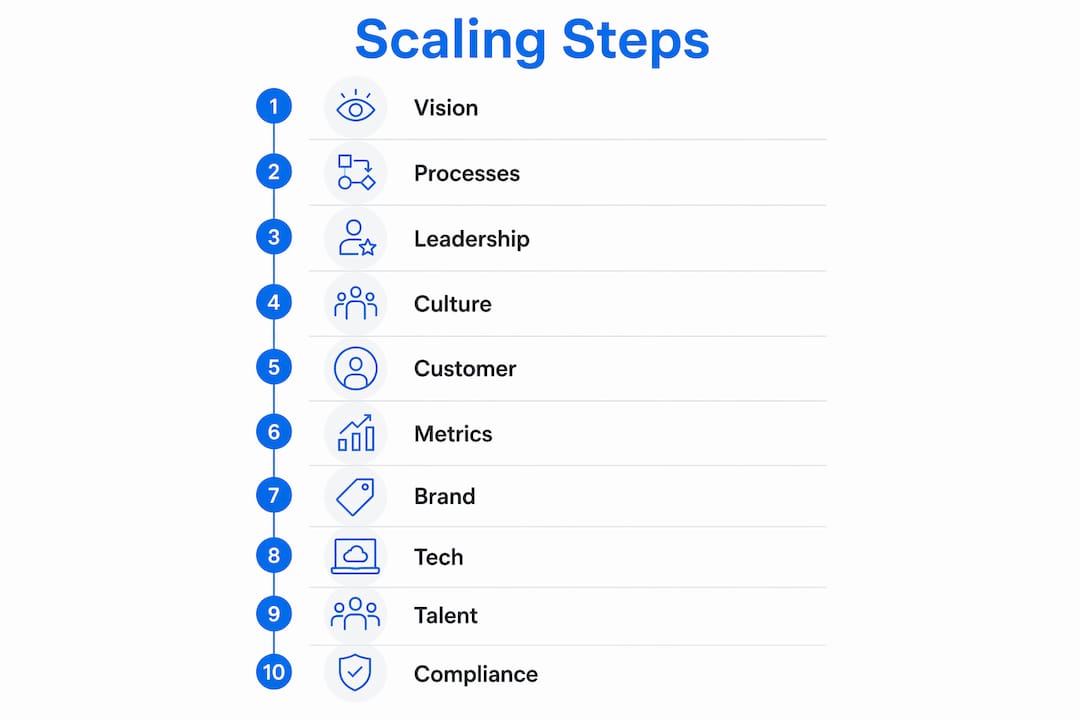
Here is what that transition actually requires:
- Redefine your vision and values so they guide decisions at every level, not just yours.
- Build a leadership team before you desperately need one.
- Standardize the processes that repeat, and leave room for the ones that shouldn’t.
- Protect your culture deliberately, especially during fast hiring phases.
- Create customer experience systems that don’t depend on heroic individual effort.
- Track the metrics that signal health, not just growth.
- Know the difference between a strategy worth persevering with and one worth abandoning.
- Build a brand identity around messaging and purpose, not just a logo.
- Make your website and SEO work for you before you need them to.
- Shift your mindset from founder-operator to CEO-architect.
Pro Tip: Write your vision statement as if you’re explaining your company’s purpose to a new hire on their first day. If it takes more than two sentences, it’s too complicated to guide daily decisions at scale.
How the transition from startup to scalable brand actually starts
The clearest signal that you’re ready to scale isn’t a revenue number. According to the OECD, the scaleup phase begins when a company sustains roughly 20% annual growth in both employees and turnover for several consecutive years. That definition matters because it separates genuine scaling from a lucky quarter.
Before you can scale, you need a vision that functions as a decision filter, not a wall poster. A compelling vision tells your team what to prioritize when two good options compete for the same resources. It also tells investors, partners, and customers what you stand for. As you grow, that clarity becomes the difference between a team that moves in one direction and a team that fragments.
Redefining values during growth isn’t a sign of weakness. It’s a sign that you’re paying attention. The values that worked for a five-person team may need sharper language at fifty people. The goal is alignment, not nostalgia.
- Articulate your vision in plain language your newest hire can act on.
- Review core values annually and test whether they still describe how decisions actually get made.
- Communicate vision in team meetings, hiring conversations, and product decisions, not just in decks.
- Use your vision as a filter when evaluating new markets, partnerships, or product lines.
Why your processes need to grow up before your team does
Founders often mistake adding people for adding capacity. The real capacity multiplier is a repeatable process. When you document how sales calls get logged, how customer complaints get resolved, or how new features get prioritized, you free your team to execute without asking you first.

The trap is over-engineering. A 40-step onboarding checklist for a ten-person team creates bureaucracy, not clarity. The goal is to standardize what repeats and leave flexibility where judgment matters. Think of it as building rails, not walls.
Technology helps, but only after the process is clear — consider using growth marketing software tools relevant for scalable startups. Automating a broken workflow just produces broken results faster. Map the process first, then find the tool that fits it.
Pro Tip: Before automating any process, run it manually three times and document every decision point. You’ll catch the exceptions that automation will otherwise break.
- Identify the five processes that happen most often and write them down.
- Assign ownership for each process so someone is accountable for its performance.
- Use tools like project management software or CRM platforms to support, not replace, human judgment.
- Review processes quarterly as the team grows, cutting steps that no longer add value.
Building a leadership team before you actually need one
The founder who insists on approving every hire, every contract, and every campaign is the single most common reason a startup stalls at scale. Leadership development and top team capacity are a critical success factor for companies that successfully move past the initial growth phase.
Hiring specialized leaders in sales, marketing, operations, and finance before those functions are overwhelmed gives them time to learn the business before the pressure peaks. Waiting until a function is on fire means your new VP of Sales spends their first three months firefighting instead of building.
McKinsey research found that headcounts for both junior staff and senior leaders typically doubled for startups that successfully expanded into new markets. That kind of growth demands leaders who can manage complexity, not just execute tasks.
- Hire or develop functional leaders in sales, marketing, finance, and operations early.
- Define each leader’s decision-making authority clearly so they don’t defer everything upward.
- Align your leadership team around the company vision through regular strategic reviews.
- Invest in leadership coaching and development, not just technical training.
How to protect your culture when growth gets fast
Culture doesn’t dilute because you hired the wrong people. It dilutes because you stopped talking about it. The companies that maintain strong cultures through rapid growth are the ones where leaders model the values visibly and consistently, not just in all-hands meetings but in how they handle a missed deadline or a difficult customer.
Rapid hiring is the highest-risk moment for culture. When you add twenty people in three months, the informal norms that held your original team together don’t transfer automatically. New employees absorb the culture they observe, not the one written in the employee handbook.
Geographic expansion adds another layer. A team in Austin and a team in New York will develop local habits. Without deliberate cultural reinforcement, those habits diverge.
- Run structured onboarding that explicitly covers cultural values with real examples.
- Create rituals, whether weekly standups, peer recognition programs, or retrospectives, that reinforce what you care about.
- Involve employees in defining how values show up in day-to-day decisions.
- Address cultural drift early; waiting until it’s visible in turnover data means you’re already behind.
Scaling your customer experience without losing what made you good
Early-stage startups win on personal attention. The founder knows every customer’s name. That doesn’t scale. What does scale is a system that delivers consistent, high-quality experiences without requiring heroic effort from your team every time.

The shift is from personalized to standardized quality. That means documenting your best customer interactions and building processes that replicate them. It means using data to understand where customers get stuck, frustrated, or delighted, and then designing around those moments.
Feedback loops are the engine here. Companies that build structured ways to collect, analyze, and act on customer feedback improve faster than those relying on gut instinct. A quarterly NPS survey is a start. A weekly review of support tickets is better.
- Map the customer journey and identify the three moments that most affect satisfaction.
- Build feedback collection into the product or service experience, not as an afterthought.
- Use CRM tools to track customer history and personalize at scale.
- Train support teams on brand voice and resolution standards so quality stays consistent.
Knowing when to pivot and when to stay the course
Pivoting too early wastes the momentum you’ve built. Pivoting too late means you’ve been scaling a model that doesn’t work. The discipline is in reading the signals correctly.
Scaling too fast without operational redundancy or localized market insight often leads to rapid failure. The companies that burn out aren’t usually the ones that moved too slowly. They’re the ones that mistook speed for strategy.
Product-market fit isn’t a one-time achievement. Markets shift, competitors emerge, and customer needs evolve. A plateau in your conversion rate or a rising churn rate are signals worth investigating before you assume the answer is more marketing spend.
Pro Tip: Set a 90-day review cadence for your core growth assumptions. If three consecutive reviews show the same negative trend, that’s a signal worth acting on, not explaining away.
- Track customer acquisition cost and lifetime value together; a widening gap is a warning sign.
- Distinguish between execution problems and model problems before deciding to pivot.
- Test pivots on a small segment before committing resources across the business.
- Consult your leadership team and key investors before making major strategic shifts.
Which metrics actually tell you if your scaling is working
Tracking revenue alone is like driving by looking in the rearview mirror. The metrics that matter for building a scalable business are the ones that predict future performance, not just describe the past.
Customer acquisition cost (CAC), churn rate, revenue per customer, and gross margin tell you whether your growth is profitable or just busy. Employee growth rate and operational capacity tell you whether your team can sustain the pace. Together, they give you a picture of health, not just size.
Dashboards matter because they make these numbers visible to the people who can act on them. A metric that lives in a spreadsheet the CEO checks monthly isn’t driving decisions. A metric on a shared dashboard that every team lead reviews weekly is.
| Metric | What it tells you | Review frequency |
|---|---|---|
| Customer acquisition cost (CAC) | Cost efficiency of your growth engine | Monthly |
| Customer churn rate | Retention health and product-market fit | Monthly |
| Revenue per customer | Monetization depth and upsell potential | Quarterly |
| Gross margin | Profitability of your core model | Monthly |
| Employee growth rate | Organizational capacity vs. revenue growth | Quarterly |
| Net Promoter Score (NPS) | Customer loyalty and advocacy strength | Quarterly |
What a real brand identity looks like beyond the logo
A logo is the last thing a brand needs and the first thing most founders buy. The brand identity that actually drives growth are built on a clear mission, a defined voice, and messaging that speaks directly to the problems your customers are trying to solve.
Brand purpose answers the question your customers are really asking: why should I trust you with this? It’s not a tagline. It’s the reason your company exists beyond making money, and it has to be specific enough to guide real decisions. “We help small manufacturers reduce waste” is a purpose. “We create value for our customers” is not.
Storytelling is the delivery mechanism. Authentic communication about how your product was built, who it was built for, and what problems it has actually solved builds emotional connection faster than any campaign.
- Write a brand purpose statement that names a specific problem and a specific audience.
- Develop a messaging framework with three to five core messages tied to customer pain points.
- Create visual guidelines covering color, typography, and imagery so your brand looks consistent across channels.
- Train your team on brand voice so every customer touchpoint sounds like the same company.
Building a website that grows with your business
Most startup websites are built to launch, not to grow. They’re designed to explain what the company does, not to convert visitors, capture leads, or rank in search. That’s fine at day one. By year two, it’s a liability.
Investing in scalable websites and SEO foundations early ensures your digital presence supports growth momentum rather than fighting it. That means structuring your site around the questions your customers are actually searching, not just the features you want to highlight.
Technical SEO, page speed, mobile optimization, and clear conversion paths aren’t optional extras. They’re the foundation that determines whether your content marketing, paid campaigns, and brand awareness efforts actually convert.
Pro Tip: Install Google Analytics 4 and Google Search Console on day one, even before you have traffic. The historical data becomes invaluable when you start making optimization decisions six months later.
- Design your site architecture around customer intent, not your internal org chart.
- Implement on-page SEO from the start: title tags, meta descriptions, header structure, and internal linking.
- Integrate a CRM or email capture to turn anonymous visitors into identifiable leads.
- Audit technical performance quarterly: page speed, broken links, and crawlability.
Why your message matters more than your design
A beautifully designed website with unclear messaging loses to a plain site that speaks directly to the customer’s problem. Design creates first impressions. Messaging creates decisions.
The most common mistake growing startups make is spreading their marketing across every available channel before they’ve proven their message works on any of them. Pick two channels where your audience actually spends time, get the message right there, and then expand.
For managing marketing during rapid growth, the discipline is in saying no to channels that feel exciting but don’t match your audience’s behavior. A B2B software company doesn’t need TikTok. A consumer brand targeting Gen Z probably does.
- Write your core value proposition in one sentence before designing anything.
- Test two or three message variations on a small audience before committing to a campaign.
- Choose channels based on where your specific customer segment actually makes decisions.
- Measure cost per lead and conversion rate by channel, then cut the ones that underperform.
Why professional content builds authority faster than advertising
Paid advertising stops working the moment you stop paying. Content compounds. A well-researched blog post, a detailed case study, or a practical white paper keeps generating traffic, building credibility, and answering customer questions long after it’s published.
Thought leadership content works because it demonstrates expertise before the sale. When a potential customer reads your guide on a problem they’re actively trying to solve, they arrive at the sales conversation already trusting your judgment. That shortens sales cycles.
The quality bar matters more than the volume. Two authoritative, well-researched pieces per month outperform ten thin posts that say nothing new. Consistency in tone and quality is what builds a recognizable brand voice over time.
- Develop a content calendar tied to the questions your sales team hears most often.
- Publish case studies that show specific outcomes, not vague success stories.
- Use white papers and guides to capture leads from prospects in the research phase.
- Maintain a consistent brand voice across all content so every piece sounds like the same company.
What experts say about the mindset shift scaling actually demands
The hardest part of scaling isn’t operational. It’s psychological. Founders who built their companies on speed and instinct often resist the shift to structured governance, not because they don’t understand it intellectually, but because it feels like losing control.
Leaders who resist shifting from informal startup speed to structured governance become bottlenecks that impede growth. That’s not a management theory. It’s a pattern that plays out in companies at every stage. The founder who insists on approving every hire at 200 employees is the same person who approved every hire at 20. The difference is that at 200, it’s breaking the company.
Scaling is not just about speed but shifting mindset from chaotic innovation to steady, structured governance critical for resilience.
The transition from generalist teams to specialist teams is part of this shift. Early startups run on people who do everything. Scaled companies run on people who do one thing exceptionally well. That requires founders to hire people who are better than them in specific domains, which is uncomfortable for many.
- Recognize when your personal bandwidth is the constraint and hire to remove it.
- Build governance structures: regular leadership reviews, clear decision rights, and documented strategy.
- Invest in your own development as a CEO, not just in your product or team.
- Treat organizational readiness as a growth lever, not an administrative burden.
How to fund your growth without losing control of it
Growth costs money before it makes money. The funding strategy you choose shapes not just your runway but your governance, your growth pace, and your exit options.
Careful planning and resource allocation reduce risk and build the kind of trust with investors and partners that sustains long-term scaling. That means knowing your burn rate, your payback period on customer acquisition, and the point at which each funding round needs to be deployed before you raise it.
The main options for US-based growth-stage companies include venture capital for high-growth, equity-diluting capital; revenue-based financing for companies with predictable recurring revenue; Small Business Administration (SBA) loans for asset-backed or working capital needs; and strategic partnerships that provide capital alongside distribution or market access. Each has different implications for control, dilution, and growth pace.
- Build a 24-month financial model before approaching any investor or lender.
- Understand your unit economics: CAC, lifetime value, and gross margin must support the growth rate you’re pitching.
- Match funding type to growth stage; venture capital suits high-growth models, while SBA loans suit capital-efficient ones.
- Maintain a cash reserve that covers at least three months of operating expenses regardless of growth pace.
When your technology infrastructure needs to catch up with your growth
Most startups accumulate technical debt the way most people accumulate clutter: gradually, then suddenly. The tools that worked at ten employees start breaking at fifty. The spreadsheet that tracked inventory becomes the reason orders get lost.
Reducing technical debt progressively and upgrading operational systems is one of the six core scaling challenges Harvard Business School identifies. The key word is progressively. You don’t need to rebuild everything at once. You need to identify which systems are actively limiting growth and fix those first.
Cloud-based platforms for CRM, project management, finance, and HR give you the flexibility to scale without rebuilding from scratch. Tools like Salesforce, HubSpot, NetSuite, and Workday are designed to grow with you. The investment in proper infrastructure pays back in reduced manual work, fewer errors, and faster decision-making.
- Audit your current tech stack annually and identify the three systems causing the most friction.
- Prioritize integrations that eliminate manual data transfer between platforms.
- Build data security and compliance into your infrastructure before you need it, not after a breach.
- Involve your operations and finance teams in technology decisions, not just your engineering team.
Hiring and keeping the people who can actually scale with you
Talent strategy at scale is different from talent strategy at launch. Early hires need to be generalists who thrive in ambiguity. Scaling hires need to be specialists who can build and run a function. Confusing the two is expensive.
Retention at scale requires more than competitive salaries. Employees who can grow their careers, see a clear path to advancement, and feel connected to the company’s mission stay longer. Those who feel like cogs in a machine that no longer recognizes them leave, often taking institutional knowledge with you.
Employer brand matters here. The way your company is perceived as a place to work affects who applies, who accepts, and who stays. Glassdoor reviews, LinkedIn presence, and the stories your current employees tell their networks all feed into that perception.
- Define career paths for key roles before you need to fill them.
- Build structured onboarding that connects new hires to the company’s mission and culture from day one.
- Conduct stay interviews, not just exit interviews, to understand what’s keeping your best people engaged.
- Offer equity, flexibility, or development opportunities that competitors can’t easily replicate.
Legal and compliance foundations you can’t afford to skip
Scaling creates legal exposure that didn’t exist at launch. New states mean new tax registrations. New employees mean new labor law obligations. New contracts mean new liability. Founders who treat legal as an afterthought discover the cost of that decision at the worst possible moment.
For US-based companies expanding across state lines, nexus rules for sales tax, state income tax registration, and employment law variations by state are the most common traps. California, New York, and Texas each have distinct requirements that can create significant liability if ignored.
Intellectual property protection becomes more valuable as your brand grows. Trademark registration with the USPTO protects your brand name and logo. Patent protection matters if your product has defensible technical innovation. Both are significantly cheaper to secure before a dispute than after.
- Engage a business attorney before entering new states or markets, not after.
- Register your trademarks with the USPTO early; the process takes 12–18 months and protection is retroactive to the filing date.
- Review your contracts, terms of service, and privacy policy annually as your business model evolves.
- Build compliance into your HR and finance processes so it’s not a last-minute scramble during audits.
Marvingrowthpartners gives you executive-level strategy without the full-time overhead
Scaling a startup into a brand requires the kind of strategic clarity that most founders don’t have time to develop while also running the business. Marvingrowthpartners is built for exactly that gap.
Where traditional agencies hand you a playbook and walk away, Marvingrowthpartners aligns executive-level strategy with hands-on execution. That means your growth strategy is built around your actual cash flow, your current growth stage, and the specific constraints your business faces, not a template designed for a different company’s problems. The result is a growth system that produces measurable ROI without the overhead of a full-time internal marketing team.
If you’re at the stage where you know what needs to happen but don’t have the leadership bandwidth to make it happen consistently, a fractional marketing leadership engagement gives you senior-level execution at a fraction of the cost. Start with a visibility assessment to identify exactly where your growth is leaking and what to fix first.
Key Takeaways
Scaling a startup into a brand requires structured vision, specialized leadership, and systems that hold up under growth pressure before you need them.
| Point | Details |
|---|---|
| Scale readiness threshold | The OECD defines the scaleup phase by sustained 20% annual growth in employees and turnover over several consecutive years. |
| Leadership is the bottleneck | Leaders who resist shifting to structured governance actively impede growth at scale. |
| Headcount doubles in expansion | Research indicates that startups expanding into new markets typically experience significant increases in both junior and senior headcount to manage complexity. |
| Message before design | A clear value proposition drives conversion; design supports it but cannot replace it. |
| Marvingrowthpartners | Provides executive-level growth strategy and execution without the cost of a full-time internal team. |